Advertisement
Chicken feet, necks and wings simmered for 24 to 48 hours with vegetables, herbs and apple cider vinegar: how to make it on the stovetop, in a slow cooker or in a pressure cooker, what it does for your gut lining and joints, and how much to drink.
By Dr. Josh Axe, DC, DNM, CNS ·
Jump to recipe ↓
Why it works: Chicken feet, necks and wings, or the carcass of a roast chicken, simmered for a day or two with vegetables, herbs and a splash of apple cider vinegar until the broth turns golden and rich with gelatin. Dr. Axe recommends it as an everyday food for your gut lining and joints, and it's the base of the chicken soup he eats when he's sick.
If long-simmered broth doesn't agree with you, make a short batch instead: an hour or two in a pressure cooker, with the vinegar left out (see the pressure cooker section).
Feet, necks and wings are rich in collagen, and the carcass of a roast chicken works well too.
When your chilled broth sets like jelly, that's the gelatin. Lift off the hardened layer of fat on top if you like.
Bring stored broth to a rolling boil when you reheat it.
How much to drink Aim for a cup most days, and while you're healing your gut, Dr. Axe's Healing Leaky Gut Protocol calls for 8 to 16 ounces a day, ideally 16.
Chicken bone broth is a slow-simmered broth of chicken feet, necks and wings, or a leftover carcass, cooked for 24 to 48 hours with vegetables, herbs and apple cider vinegar until it turns golden and rich with gelatin.1 I recommend it as an everyday food for your gut lining, your joints and your skin, because the long simmer draws collagen and its amino acids out of the bones and cartilage and into your mug.23
I recommend chicken bone broth, the golden, gelatin-rich broth you get from simmering chicken feet, necks and wings or a leftover carcass for a day or two, as an everyday food for your gut lining and your joints.64 When I do get sick, I eat chicken broth or chicken vegetable soup for every meal.8
People have relied on bone broth for thousands of years for their health, their immunity and their longevity,3 and the reason it works is simple. As the pot simmers, the collagen in a chicken's feet, joints and cartilage breaks down into gelatin, and the amino acids that come with it, glycine, proline and hydroxyproline among them, are the same materials your gut lining is made of.19 So when your gut is irritated or your joints are stiff, the place to start is food that gives your body the raw materials to rebuild, because your body was designed to heal when it has what it needs. That's why bone broth leads the foods that heal in my Healing Leaky Gut Protocol,4 and back around 2016, I started using it with patients to help them heal from chronic digestive issues.10
30-day protocol
Rebuild the gut lining and microbiome: the remove–replace–repair sequence, foods, supplements and the labs that confirm progress.
Free with your Dr. Axe account
View the protocol →
What's your biggest goal right now?
A pot takes about 10 minutes to put together, and the stove or slow cooker does the rest. Make a batch on a weekend through the colder months and you'll have broth in the freezer for cold and flu season, ready to sip or to turn into soup whenever someone in your house needs it.
Chicken broth in particular might be the most beneficial because not only does it have collagen, it also has glucosamine, chondroitin, and hyaluronic acid.Dr. Josh Axe, DC, DNM, CNSFrom 11 Supplements Every 40+ Adult Should Consider, The Dr. Josh Axe Show (2026)
My free 30-day Healing Leaky Gut Protocol puts bone broth first among the foods that heal. Inside:
Free with your Dr. Axe account (email or Google). You'll also get the protocol's short email series and the Dr. Axe newsletter; unsubscribe anytime.
Open the free protocol →Chicken bone broth is a broth made by simmering chicken bones and collagen-rich parts like feet, necks and wings in water for 24 to 48 hours, long enough to draw their collagen out as gelatin.1 It's the same idea as a chicken stock, cooked much longer, and a well-made batch sets like soft jelly when it's chilled.
A chicken's feet, necks and wing joints don't carry much meat, but they're full of the skin, cartilage and connective tissue a long simmer is made for, and that's where a broth gets its body. When food scientists in China stewed traditional chickens for one, two and three hours, the protein in the broth rose the longer it cooked, and its larger proteins were mainly gelatin, along with actin from the meat.1 Bone broth keeps that gentle simmer going for a day or two, and that long cook is what sets it apart from an ordinary stock.
Bone broth, chicken and beef alike, is one of the most nutritious foods you can eat. It's rich in collagen and gelatin, kind to your joints and friendly on your gut, and it's integral to traditional diets around the world.11 Chicken and chicken wings are also on my list of top collagen-building foods, right beside bone broth itself,12 so this pot puts two of them to work at once.
The difference comes down to what goes in the pot and how long it cooks. A broth is usually made from meat, vegetables and herbs and simmers for 45 minutes to 2 hours. A stock adds bones, often with some meat still on them, and cooks for 4 to 6 hours. Bone broth starts like a stock but keeps going for 24 hours or more, which gives the collagen in the bones, joints and cartilage time to break down into gelatin. That's why a good chicken bone broth sets like jelly in the refrigerator and melts back into a rich, silky liquid as soon as you warm it.
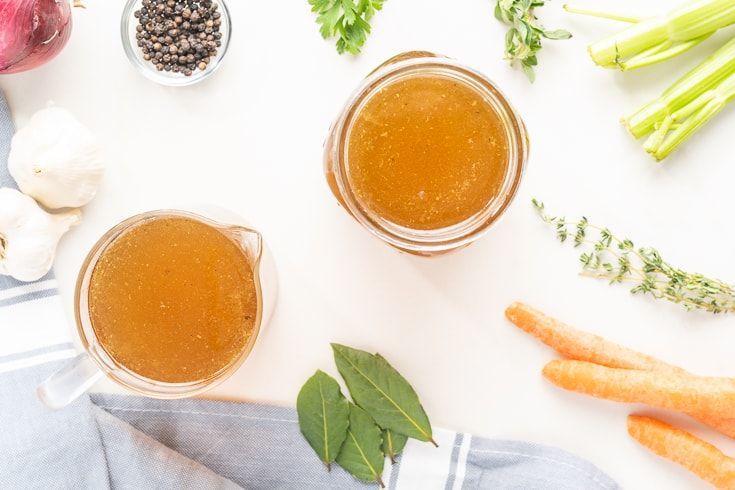
Both are good for you, and I recommend both.13 Each brings collagen with naturally occurring glucosamine and chondroitin,11 while chicken broth also carries hyaluronic acid and leans toward type 2 collagen, the kind your cartilage is built from,312 and it has a lighter flavor than beef.
When I talk about supporting an underactive thyroid, bone broth is the first food I name, both chicken and beef, because it's very nourishing to the adrenals and the kidneys.14 Beyond that, the choice often comes down to taste. Chicken bone broth is lighter and more delicate, while broth made from beef is deeper and richer, and plenty of people keep both in the freezer. When you want that deeper flavor for a stew or a bowl of pho, our beef bone broth recipe roasts the bones first and simmers them for 24 to 36 hours.
Where chicken broth stands out is in its cartilage. Bone broth carries types 1, 2 and 3 collagen, and while broth from beef is typically types 1 and 3, chicken broth is predominantly type 2,12 the type that makes up the cartilage cushioning your joints. Every type breaks down into gelatin as it simmers, and a chicken broth brings the cartilage compounds along with it.
Those cartilage compounds really do end up in the broth. In a lab analysis of a company-made chicken-vegetable bone broth from Japan, the team recovered 17.8 milligrams of hyaluronic acid and 10.7 milligrams of chondroitin sulfate from 50 milliliters, a little over 3 tablespoons, along with a much larger amount of collagen and its breakdown products.15 The maker didn't publish its recipe or simmer time, so your own mug will hold different amounts, but the analysis shows a chicken bone broth carrying the compounds of cartilage right alongside its collagen.
Hyaluronic acid and chondroitin measured in a chicken bone broth
Chicken bone broth is good for your gut lining, your joints and your skin, and ancient physicians recommended it for sick days.316 It brings gelatin and amino acids like glycine and proline, the materials those tissues are built from, in a warm food that's easy to digest.95
One food can help your gut, your joints and your skin because all three are built in part from collagen and the amino acids that come out of it as a broth simmers, and the cartilage compounds in chicken broth are key components of all three as well.43
When you're repairing your gut, I want you focused on foods that are easy to digest, and for most people the number one food is bone broth.5 Each mug delivers glycine, glutamine and collagen, which my Healing Leaky Gut Protocol calls the building blocks of new gut lining,4 and it fits a principle from Chinese medicine that the protocol follows too: a healing gut prefers warm, cooked, soft foods over raw, cold or fibrous ones, and broth is all three.4 Chicken broth is also on my list of foods for a younger immune system, because amino acids like glycine and proline help heal the gut lining and support immune balance.17
Broth's amino acids also help strengthen the barrier that lines your gut. A 2025 review by Mayo Clinic gastroenterologists pulled together the animal and human research on what bone broth contains and found that its glutamine, glycine, proline, histidine and arginine, along with its minerals, support the gut barrier, ease inflammation in the intestinal lining and improve how the barrier works, especially in inflammatory bowel disease.18 That barrier is what weakens in leaky gut, so a daily mug of broth is one of the simplest ways to feed it. If you'd like a quick read on how your own gut is doing, try the Gut Health Quiz.
As the broth simmers, the cartilage and connective tissue in the feet, necks and wings give up their collagen and its amino acids, which help preserve youthful skin and joints.2
Bone broth is nature's collagen supplement. When you simmer the bones and ligaments and tendons, collagen comes out into the liquid.Dr. Josh Axe, DC, DNM, CNSFrom The 1 Vitamin That Raised Skin Cell Collagen 3 to 4 Times (Lab Study), The Dr. Josh Axe Show (2026)
Collagen can ease achy joints and help them move better. A 2024 review of 35 randomized trials in people with osteoarthritis pooled 25 of them, with 2,856 people, for its main analysis and found that collagen products relieved pain and helped joints work better than in the control groups, with no rise in side effects, and the authors graded the evidence for better function as high certainty.19 Those trials used collagen products, while in this pot the collagen comes from feet, necks and wing joints and reaches you as gelatin.
Chicken broth's cartilage compounds may help your bones as well. The Japanese team behind that broth analysis also gave the broth by mouth for 10 weeks to 9 rats whose ovaries had been removed, a model of bone loss after menopause, and those rats ended up with higher bone mineral density and more bone in the shin than 6 rats given only water.15
Collagen in the feet, necks and wing joints breaks down into gelatin, the protein that gives the broth its body, and in a lab test, the broth held more protein the longer it stewed, over one to three hours.1
Researchers recovered hyaluronic acid and chondroitin sulfate from a chicken-vegetable bone broth.15
My Healing Leaky Gut Protocol counts glycine, glutamine and collagen as the building blocks of new gut lining, and a Mayo Clinic review links broth's amino acids to a stronger gut barrier.418
In randomized trials of people with osteoarthritis, collagen products relieved pain and helped joints work better.19
Chicken bone broth has been consumed for thousands of years, and ancient physicians recommended it to help nourish the immune system.16 When I was sick as a kid, my mom gave me chicken noodle soup, and the older version of that remedy is even simpler: in Chinese medicine, a sick child gets ginger tea and chicken bone broth soup, mostly broth with a little vegetable and a little chicken.16 Chinese medicine also teaches that when you've got a virus or any immune issue, you eat a lot of light yellow foods, like garlic, onion, chicken broth and miso,20 which are the same foods that go into the soup I make when I'm sick (you'll find it in the recipe list below).
Science has started to explain why that bowl feels so good. In a lab study, a traditional homemade chicken soup slowed the movement of neutrophils, white blood cells that rush to an infection and help drive inflammation, and the more soup the researchers added, the stronger the effect. The chicken and every vegetable in the soup showed some of that activity on its own, and the researchers suggested that a mild calming of inflammation could be one way chicken soup eases a cold.21
In a small study of 15 healthy adults who each tried hot chicken soup, hot water and cold water, sipping hot chicken soup sped up the flow of mucus through the nose from 6.9 to 9.2 millimeters a minute, measured 5 minutes after drinking it. The soup still raised it when sipped through a straw, which hot water didn't, so the researchers suggested the soup carries something beyond its steam.22 A warm mug of this broth belongs right beside your other natural cold remedies.
Our full guide to bone broth benefits covers the rest of the research, from sleep to skin.
Put 4 pounds of chicken necks, feet and wings (or a carcass) in a large stockpot or slow cooker with the vegetables, garlic, herbs, salt, peppercorns and apple cider vinegar, cover everything with cold filtered water, and simmer gently for 24 to 48 hours before you strain and chill it. It makes about 20 cups.
This is one of the simplest recipes you can make at home, because everything goes into one pot and the long, gentle simmer does the work.
Necks, feet and wings are the heart of this recipe. They're mostly bone, skin and connective tissue, and they're rich in collagen. In a lab study from Brazil, food scientists extracted the collagen from chicken feet left over from poultry processing and made a gelatin that more than 80 percent of tasters said they would eat,23 and in your pot, that same collagen gives you a broth that gels. You can also use the carcass and bones from a whole chicken. Roast a chicken for dinner, as my gut protocol's meal plan does, pull off the meat to eat, and the bones, skin and joints that are left are a ready-made start to your next pot.4
Whether you're buying parts or a whole bird, organic or pasture-raised chicken is the way to go, and I put pasture-raised first, ahead of organic and well ahead of conventional factory-farmed chicken.11 Our guide to free-range chicken compares free-range, organic and conventional birds if you're weighing the labels at the store.
The apple cider vinegar in the pot helps the long simmer pull calcium out of the bones. When researchers cooked a beef bone in water for 24 hours, the soup's calcium rose when the water was acidic but not when it was neutral,24 which is why the vinegar goes into the pot at the start, along with the cold water.
Both work well. A slow cooker is the easiest, because it can run on low while you sleep or work, and if yours shuts off after 8, 12 or 24 hours, restart it as soon as the cycle ends so the broth stays hot, at 140 °F or warmer, until you reach 24 to 48 hours.25 On the stovetop, bring the pot to a boil over high heat, then turn it down to a gentle simmer. If you won't be tending the stove overnight, take the pot off the heat in the evening, chill it quickly and get it into the refrigerator within 2 hours, then bring it back to a boil in the morning and lower it to a simmer again.25
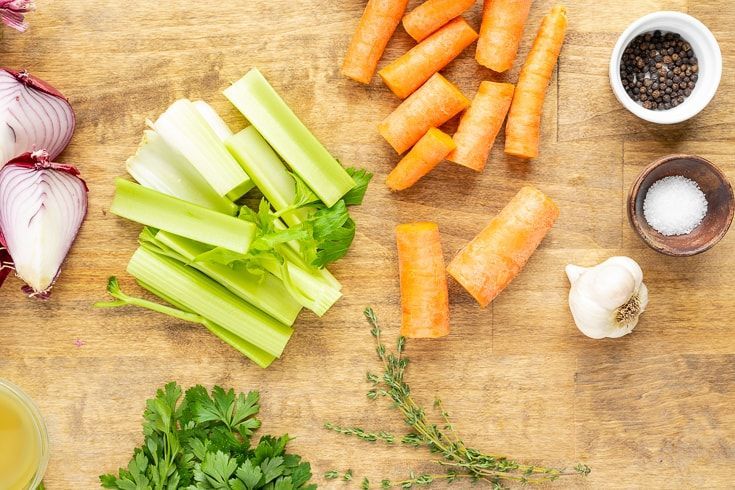
Start by gathering and preparing your ingredients. Chop the carrots and celery, cut the onions in half lengthwise and quarter them with their peels on, and smash the garlic cloves, leaving the peel on those too.
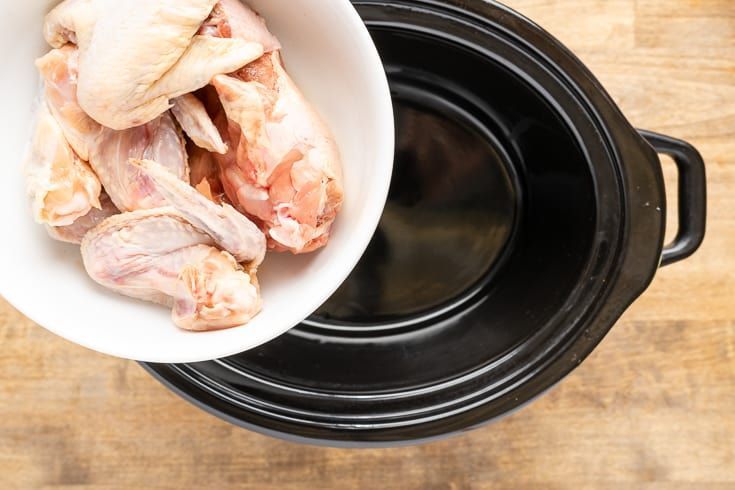
Put the chicken parts in a 10-quart slow cooker or a large stockpot, add the vegetables, garlic, herbs, salt, peppercorns and vinegar, and pour in cold filtered water to cover. Set the slow cooker on low, or bring the stockpot to a boil and turn it down to a gentle simmer. Let it cook for 24 to 48 hours, skimming off the fat that rises now and then and adding water when you need to so the bones and vegetables stay under the surface.
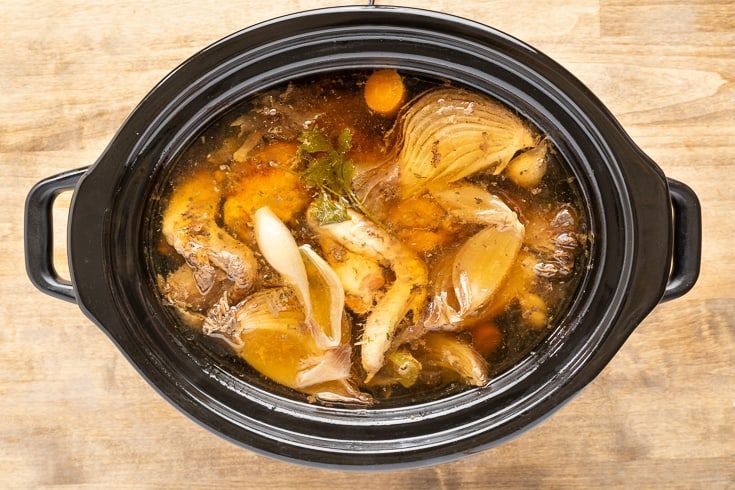
When it's done, take the pot off the heat and let it cool slightly, then lift out the bones, vegetables and herbs and discard them.
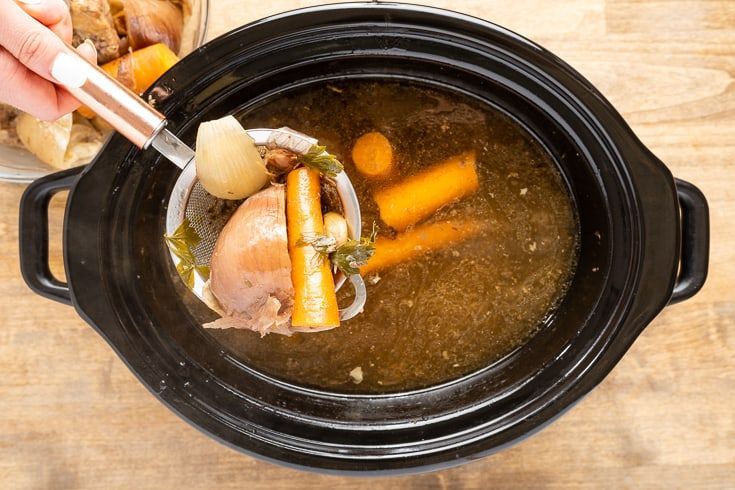
Strain the broth through a colander into a large bowl, and discard any small bits left behind.
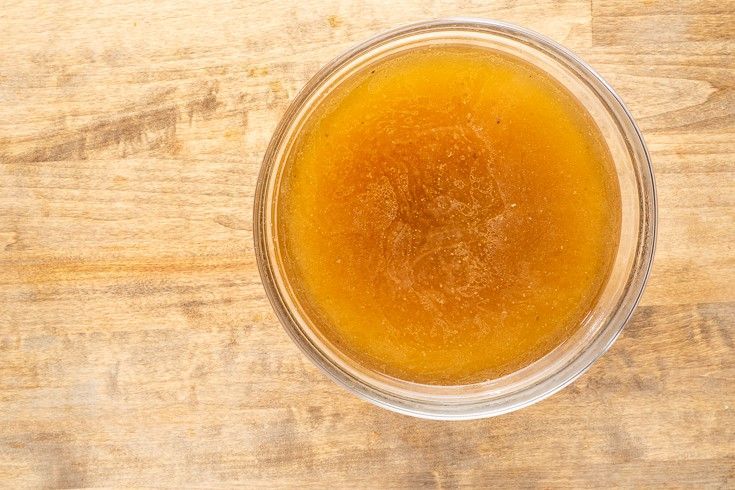
Cool the strained broth quickly, as the recipe card describes, and refrigerate it within 2 hours.25 After a few hours, the fat hardens into a layer on top that you can lift off with a spoon, and underneath, a well-made chicken bone broth will have set into a soft, wobbly jelly that turns back into liquid as soon as it's warm.
When you need broth today rather than in two days, reach for a pressure cooker. The short version I recommend takes just an hour or two under pressure with no vinegar, and I suggest it for anyone whose body doesn't do well with long-simmered broth, as the safety section explains.5 Use the same chicken parts, vegetables and herbs as the main recipe, scaled down to fit your cooker if you need to, follow its directions for filling and releasing it, then strain and chill the broth the same way.
The collagen in your broth comes from the parts you choose and how you cook them. Load the pot with feet, necks and wings, add just enough cold water to cover them so the gelatin isn't spread too thin, and keep the pot at a gentle simmer for the full 24 to 48 hours. Temperature matters too: in a lab comparison of chicken stocks, cooking just under a boil, at 99 °C (210 °F), gave more protein and a thicker body than cooking at 85 °C (185 °F), and tasters liked it more.26 You'll know you got it right when the chilled broth sets like jelly.
For everyday health, a cup (8 ounces) most days is enough, and while you're healing your gut, my Healing Leaky Gut Protocol raises that to 8 to 16 ounces a day, ideally 16.674 A 1.5-cup serving of this recipe holds 12 ounces.
Bone broth does the most for you when it's part of your day rather than an occasional treat. My Anti-Inflammatory Reset calls for a cup a day for the gut lining and joints, and the Mitochondrial Longevity Protocol for 8 ounces most days.67 My gut protocol asks for more while you heal, with 8 to 16 ounces every day in the first step and ideally 16 once you move on to repair, which works out to one or two mugs.4
You can drink it whenever it suits you, and evenings are a good time for it. Glycine, one of the amino acids bone broth is high in, is great for calming the body, so one option I suggest is a mug of bone broth in the evening to help you improve your sleep, and chicken or beef broth both work.139
Bone broth is also the heart of a bone broth fast. When I started writing about bone broth, I had patients start doing one, drinking just bone broth and herbal tea,10 and our guide explains how to do one well.
Chicken bone broth is good straight from the mug and even better as the start of a meal. While you're repairing your gut, soups should be the basis of your diet,5 and my gut protocol's meal plan builds several meals around broth.4 A batch goes a long way, and these are good places to start, beginning with my own soups:
For more ideas, our roundup of bone broth recipes has 101 of them.
No two pots of bone broth come out exactly alike, since the parts you choose, the simmer time, the fat you skim and the salt you add all change the numbers. The table uses USDA's record for home-prepared chicken stock, the closest match to a long-simmered bone broth, for one 1.5-cup serving (360 grams):28
| Nutrient | Per 1.5 cups (360 g) |
|---|---|
| Calories | 130 |
| Protein | 9.1 g |
| Fat | 4.3 g |
| Carbohydrates | 12.7 g |
| Total sugars | 5.7 g |
| Fiber | 0 g |
| Sodium | 515 mg (22% DV) |
| Potassium | 378 mg (8% DV) |
| Magnesium | 14.4 mg (3% DV) |
| Calcium | 10.8 mg (1% DV) |
| Iron | 0.76 mg (4% DV) |
It's a light food, with about 130 calories and 9 grams of protein in a 12-ounce serving, and much of that protein is gelatin, which is why a richer broth sets more firmly in the refrigerator.1 USDA calculates the carbohydrate in this record by difference rather than measuring it directly, and it comes to 12.7 grams a serving, or about 8.5 grams a cup, so a mug fits a keto or low-carb day as long as you count it,28 and our list of keto drinks has more ideas.
For most people, chicken bone broth is simply food. If you react to histamine or free glutamate, a shorter-cooked or homemade broth suits you better, and a big pot needs to be cooled and stored with care.
Histamine. A long simmer and a generous splash of vinegar raise the histamine in bone broth, so people with histamine intolerance often don't do well with it.5 If that sounds like you, switch to the pressure-cooker batch, an hour or two with no vinegar, and leave out the onions if you have SIBO or they don't agree with you; most everyone tolerates that kind of broth, even people with histamine problems or SIBO, and a chicken stock or a bone broth protein are other options.5
Glutamate. Like any protein-rich food, broth contains glutamate, the amino acid behind the savory taste of MSG, and in its free form it bothers some people. When 61 adults who considered themselves sensitive to MSG were tested in a placebo-controlled trial, run so that neither the people nor the researchers knew who got what, the share who reacted wasn't clearly higher with MSG than with the placebo, but their symptoms after 5 grams of MSG were more severe, and in a second round at smaller doses, reactions started at about 2.5 grams.29 Powdered stock is where free glutamate adds up: in a survey of foods in Malaysia, a chicken stock powder had about 171 milligrams of free glutamic acid per gram, the most of any condiment tested.30 Making your own broth sidesteps those powders, and on store-bought broth, read the label for flavor enhancers like yeast extract and hydrolyzed protein.11
Sodium. USDA's sample of home-prepared chicken stock carries 515 milligrams of sodium per 1.5 cups, and the teaspoon of Himalayan salt in this recipe works out to about 175 milligrams a serving on its own.2831 If you like it saltier, season each mug to taste, and if you're watching your sodium, check the label on store-bought broth.
Lead. If you've wondered about lead, a small test of three kinds of organic chicken broth found several times the lead of the tap water they were made with: 7.01 micrograms per liter in a chicken-bone broth and 9.5 in a broth made from skin and cartilage, against 0.89 in the same tap water cooked the same way.32 That lead came mostly from the chicken parts rather than the water, so enjoy your broth as one part of a varied diet.
Cooling and storage. Because a full pot holds its heat for hours, cool it fast in a sink of ice water or split it into shallow containers, and have it in the refrigerator within 2 hours.25 It keeps 3 to 4 days in the refrigerator and up to 3 months in the freezer, and stored broth should come to a rolling boil when you reheat it.2533
Yes. Chicken bone broth is one of the most nourishing things you can cook, and I recommend it as a daily food for your gut lining and your joints. A long, gentle simmer turns feet, necks and wings into a golden broth full of gelatin, with the hyaluronic acid and chondroitin of cartilage alongside, and the collagen research on joints points the same way.
Put everything in one pot, simmer it for 24 to 48 hours, then strain, chill and skim. Make it part of your week, and whatever you don't drink can wait in the freezer for soups and sick days. Your body was designed to heal, and a mug of broth a day is one of the simplest ways to give it what it needs.
Bone broth leads the foods that heal in this free 30-day protocol, alongside the 6R roadmap and a 7-day meal plan of soups, roast chicken and warm, cooked meals.
Free with your Dr. Axe account (email or Google). You'll also get the protocol's short email series and the Dr. Axe newsletter; unsubscribe anytime.
Open the free protocol →A 1.5-cup serving has about 130 calories, with 9.1 grams of protein, 4.3 grams of fat and 12.7 grams of carbohydrate, based on USDA's record for home-prepared chicken stock, so a 1-cup mug has about 86.28 Your own pot will vary with the parts, the simmer time and how much fat you skim.
About 9 grams in a 1.5-cup serving, or about 6 grams a cup, based on USDA's record for home-prepared chicken stock.28 Much of it is gelatin from the collagen in the bones and joints, which a lab study of stewed chicken broth found to be the broth's main large protein,1 so a broth that sets firmly when it's cold holds more, and on weeks you can't cook, a collagen or bone broth supplement can fill in.3
Simmer it for 24 to 48 hours, on low in a slow cooker or at a gentle simmer on the stovetop, so the feet, necks and wings have time to give up their collagen. In a lab study of a traditional Chinese chicken broth, the protein in the broth rose the longer it stewed, over one, two and three hours,1 and in a pressure cooker, an hour or two is enough for the short version I recommend.5
Yes. Cook the chicken parts and vegetables under pressure for an hour or two and leave out the vinegar; a short cook like that tends not to build up histamine, and it's a broth most everyone tolerates, even people with histamine problems or SIBO.5
Yes, and they're one of the best parts to use, because they're rich in collagen. In a lab study from Brazil, food scientists turned the collagen from chicken feet left over from poultry processing into a gelatin that more than 80 percent of tasters said they would eat.23 Use them on their own or with necks and wings, and expect a broth that sets firmly when it's chilled.
Use plenty of collagen-rich parts like necks, wings and feet, which food scientists have even turned into gelatin in a lab study,23 cover them with just enough water, and keep the pot at a gentle simmer for 24 to 48 hours. In a lab comparison of chicken stocks, cooking just under a boil, at 99 °C (210 °F), gave more protein and a thicker body than cooking at 85 °C (185 °F).26 If the chilled broth sets like jelly, you've drawn out plenty of gelatin.
Cooking time is the main difference. Stock is made with bones, vegetables and herbs and usually simmers for 4 to 6 hours, while bone broth uses the same ingredients and simmers for 24 hours or more, long enough to draw more of the collagen out as gelatin.
Yes, in sensible amounts. A 1.5-cup serving has about 12.7 grams of carbohydrate and 4.3 grams of fat in USDA's record for home-prepared chicken stock, or about 8.5 grams of carbohydrate in a 1-cup mug, so a mug fits a keto or low-carb day as long as you count it.28
Yes. Bone broth tops the list of foods that heal in my Healing Leaky Gut Protocol, because its glycine, glutamine and collagen are the building blocks of new gut lining, and it's easy to digest.45 A 2025 Mayo Clinic review of animal and human research on bone broth's nutrients found that its amino acids and minerals support the gut barrier, especially in inflammatory bowel disease.18
Yes. Chicken bone broth has been used for thousands of years to nourish the immune system when people are sick,16 and in a small study of 15 healthy adults who each tried hot chicken soup, hot water and cold water, sipping hot chicken soup sped up the flow of nasal mucus from 6.9 to 9.2 millimeters a minute, measured 5 minutes after drinking it.22 In a lab study, a homemade chicken soup also slowed the movement of white blood cells that help drive inflammation.21
No, not this recipe, because it contains onion and garlic. The ASPCA warns that onions, garlic and chives can irritate the gut and damage red blood cells in pets, and cats are more susceptible than dogs.34
A 1.5-cup serving has about 130 calories, with 9.1 grams of protein, 4.3 grams of fat and 12.7 grams of carbohydrate, based on USDA's record for home-prepared chicken stock, so a 1-cup mug has about 86.28 Your own pot will vary with the parts, the simmer time and how much fat you skim.
About 9 grams in a 1.5-cup serving, or about 6 grams a cup, based on USDA's record for home-prepared chicken stock.28 Much of it is gelatin from the collagen in the bones and joints, which a lab study of stewed chicken broth found to be the broth's main large protein,1 so a broth that sets firmly when it's cold holds more, and on weeks you can't cook, a collagen or bone broth supplement can fill in.3
Simmer it for 24 to 48 hours, on low in a slow cooker or at a gentle simmer on the stovetop, so the feet, necks and wings have time to give up their collagen. In a lab study of a traditional Chinese chicken broth, the protein in the broth rose the longer it stewed, over one, two and three hours,1 and in a pressure cooker, an hour or two is enough for the short version I recommend.5
Yes. Cook the chicken parts and vegetables under pressure for an hour or two and leave out the vinegar; a short cook like that tends not to build up histamine, and it's a broth most everyone tolerates, even people with histamine problems or SIBO.5
Yes, and they're one of the best parts to use, because they're rich in collagen. In a lab study from Brazil, food scientists turned the collagen from chicken feet left over from poultry processing into a gelatin that more than 80 percent of tasters said they would eat.23 Use them on their own or with necks and wings, and expect a broth that sets firmly when it's chilled.
Use plenty of collagen-rich parts like necks, wings and feet, which food scientists have even turned into gelatin in a lab study,23 cover them with just enough water, and keep the pot at a gentle simmer for 24 to 48 hours. In a lab comparison of chicken stocks, cooking just under a boil, at 99 °C (210 °F), gave more protein and a thicker body than cooking at 85 °C (185 °F).26 If the chilled broth sets like jelly, you've drawn out plenty of gelatin.
Cooking time is the main difference. Stock is made with bones, vegetables and herbs and usually simmers for 4 to 6 hours, while bone broth uses the same ingredients and simmers for 24 hours or more, long enough to draw more of the collagen out as gelatin.
Yes, in sensible amounts. A 1.5-cup serving has about 12.7 grams of carbohydrate and 4.3 grams of fat in USDA's record for home-prepared chicken stock, or about 8.5 grams of carbohydrate in a 1-cup mug, so a mug fits a keto or low-carb day as long as you count it.28
Yes. Bone broth tops the list of foods that heal in my Healing Leaky Gut Protocol, because its glycine, glutamine and collagen are the building blocks of new gut lining, and it's easy to digest.45 A 2025 Mayo Clinic review of animal and human research on bone broth's nutrients found that its amino acids and minerals support the gut barrier, especially in inflammatory bowel disease.18
Yes. Chicken bone broth has been used for thousands of years to nourish the immune system when people are sick,16 and in a small study of 15 healthy adults who each tried hot chicken soup, hot water and cold water, sipping hot chicken soup sped up the flow of nasal mucus from 6.9 to 9.2 millimeters a minute, measured 5 minutes after drinking it.22 In a lab study, a homemade chicken soup also slowed the movement of white blood cells that help drive inflammation.21
No, not this recipe, because it contains onion and garlic. The ASPCA warns that onions, garlic and chives can irritate the gut and damage red blood cells in pets, and cats are more susceptible than dogs.34

This article is for educational purposes. See our medical disclaimer.