





Advertisement
Essential Oils · Roots & Spices
What turmeric oil is, what the human studies show for itchy skin, joint pain and support during cancer treatment, how to dilute it or take it by the drop, and who should be careful.

Interaction check: Moderate when you take turmeric oil by mouth or use curcumin capsules made with it; Low when diffused or diluted on the skin. Taken by mouth, it may add to the effect of blood thinners; the table below shows what to do. Interactions are rated separately and don't change the score.
30-day protocol
The complete root-cause framework for cooling chronic inflammation — and easing the aches, stiffness, puffiness, fatigue and brain fog that sit upstream of nearly every chronic disease.
Free with your Dr. Axe account
View the protocol →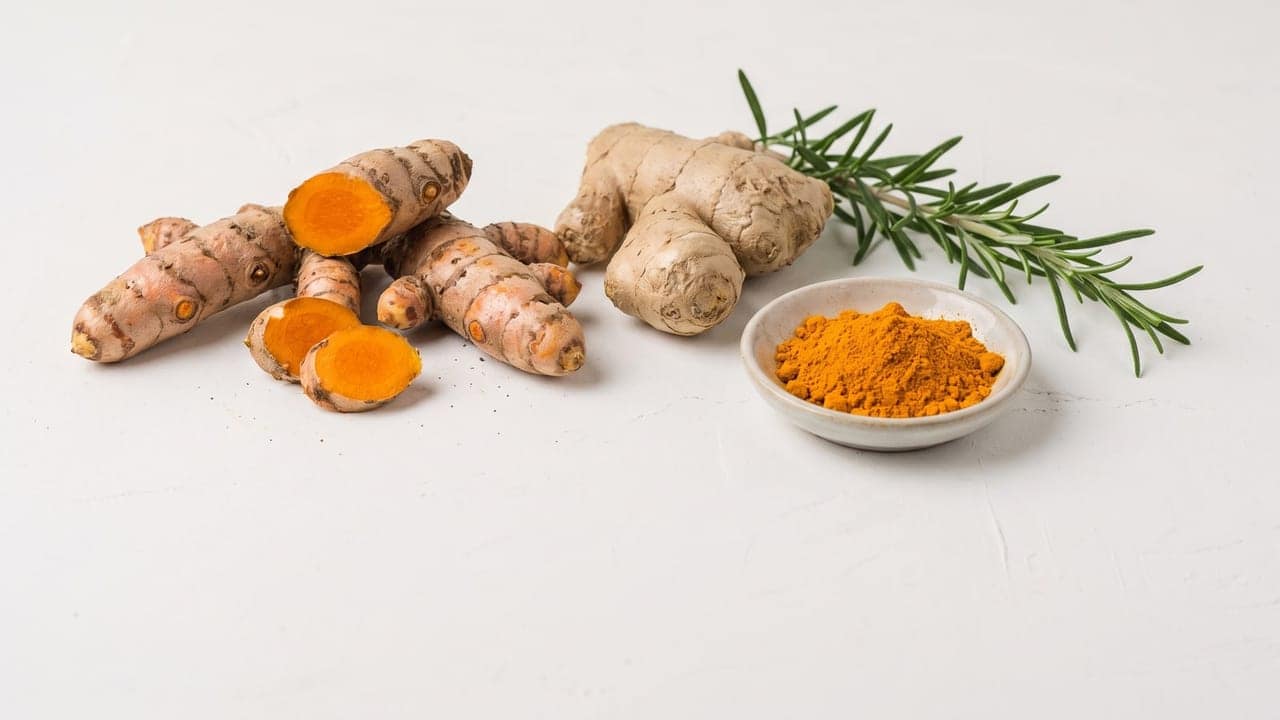
What's your biggest goal right now?
Turmeric oil is the fragrant essential oil of the turmeric root, steam-distilled or CO2-extracted, and it carries the root's aromatic compounds, the turmerones, rather than its yellow curcumin.12 Rubbed on the skin twice a day, it eased itching in people on dialysis more than coconut oil did, and blended back with curcumin, it's part of a capsule formula that eased knee pain much like diclofenac, with fewer side effects.34
Slice a fresh turmeric root and two things greet you: bright orange flesh that stains your fingers, and a sharp, spicy aroma. The color is curcumin, turmeric's yellow pigment,5 and the aroma is the root's essential oil, the oil you're buying in a bottle of turmeric oil.1
The oil is rich in turmerones, a family of aromatic compounds, and it has a research record of its own, from itchy skin to a 3-month human safety study, plus knee-pain trials of capsules that blend it with curcumin.364 The root behind it has a long healing history, and Ayurvedic medicine still knows it as haridra.7
Turmeric and ginger are probably the top two oils for reducing inflammation,8 and when I use turmeric oil, I prefer a CO2-extracted one.910
Turmeric is a fast-growing star in the essential oil category.Dr. Josh Axe, DC, DNM, CNSFrom 11 Breast Cancer-Fighting Tips, The Dr. Axe Show (2017), at 4:25
Curcumin, from turmeric, is number two on this free 30-day protocol's ranked list of anti-inflammatory herbs and nutrients. It lays out:
Free with your Dr. Axe account (email or Google). You'll also get the protocol's short email series and the Dr. Axe newsletter; unsubscribe anytime.
Open the free protocol →Did you know?
Oil distilled from fresh turmeric root differs from dried-root oil: alpha-turmerone is a major compound in fresh-root oil and only a minor one in dried-root oil.2
In lab tests against skin fungi taken from patients, turmeric oil stopped growth at 1.56 to 6.25 µg/mL and its main compound, ar-turmerone, at 3.90 to 7.81 µg/mL, both lower than the 6.25 to 25 µg/mL the antifungal drug ketoconazole needed.11
In lab cages, steam-distilled turmeric oil, especially with 5% vanillin added, repelled three species of disease-carrying mosquitoes for up to 8 hours.12
Turmeric oil is the essential oil of the turmeric root, Curcuma longa, made by steam distillation or CO2 extraction.113 Its main compounds are the turmerones, led by ar-turmerone, and it contains none of the curcuminoids that give turmeric powder its yellow color.12
No two bottles are exactly alike, because the blend shifts with the root and the way it's processed. In one analysis of oil from fresh rhizomes, ar-turmerone made up 24.4%, alpha-turmerone 20.5% and beta-turmerone 11.1%, while in an oil tested for its anti-inflammatory effects, ar-turmerone made up 61.79%.214 Steam-distilled oil was the form in the mosquito studies,1215 and a standardized CO2 extract of turmeric oil, made with pressurized carbon dioxide, was the form given to women with cervical precancer.137
Because the oil and the powder carry different compounds, their research lives in different places. Curcumin's large trial record, from knee pain to C-reactive protein (CRP), is covered in turmeric benefits; this page follows the oil and the capsules made with it.10
Traditional healers in Chinese, Ayurvedic, Islamic and Thai medicine have used turmeric for indigestion, colds, skin infections, arthritis and liver problems.16 Thai traditional medicine still uses it for rashes, itching, tinea and ringworm.11 The bottled oil is a newer way to carry that root. For years, the oil left over from making curcumin extracts was usually discarded, or used on the skin by some, until researchers in India began studying it in its own right, for safety and for cancer prevention.7
I describe turmeric in the language of Chinese medicine: it works to fight inflammation by both nourishing and moving the blood, which in plain English means feeding your tissues and improving circulation so they heal faster.17 Today's researchers have tested the oil on a similar list: skin, itching, fungal infections and inflammation.31114
Turmeric oil's strongest human evidence covers itchy skin, where rubbing it on eased itching in people on dialysis, and joint pain, where capsules of curcumin blended with the oil gave relief similar to diclofenac and as good as acetaminophen.3418 Human studies also point to support during cancer treatment and protection from mosquito bites,191315 and lab and animal studies add inflammation, brain and skin-tone findings.142021
Five human studies on this page tested turmeric oil itself, and six randomized-trial reports cover curcumin blended with the oil.6132231541823242519 Every row below names the exact product tested and the type of study behind it.
| Use | Evidence | What was studied | What the research shows |
|---|---|---|---|
Joint pain | Moderate | Curcumin blended with turmeric oil, 1,000 to 1,500 mg a day | Pain relief similar to diclofenac and as good as acetaminophen, with fewer side effects418 |
Itchy skin | Emerging | Turmeric oil on the skin, twice a day | Itch score fell from 15.44 to 13.53, against 14.94 to 14.75 with coconut oil3 |
Mouth sores during chemoradiation | Emerging | Curcumin blended with turmeric oil, 1 or 1.5 g a day | Severe mouth sores in 25% and 20% of patients, against 65% on placebo19 |
Cervical precancer | Emerging | CO2 turmeric-oil extract, 0.2 g twice a day | Lesions regressed in 16 of 19 women; none progressed13 |
Mosquito bites | Emerging | Turmeric-oil repellent | Full protection from landing and biting for 9 hours15 |
Inflammation and pain | Preclinical | Turmeric oil | Less paw swelling; 76% less in rats, against 62% for aspirin1426 |
Brain stem cells | Preclinical | Ar-turmerone | More neural stem cells in lab dishes and in rat brains20 |
Skin tone and fungal skin infections | Preclinical | Ar-turmerone; turmeric-oil creams |
The best-mapped route runs through your gut: turmeric oil's turmerones help curcumin get into your body, and they're absorbed themselves.
Turmeric oil is the root's aromatic fraction: mostly turmerones, led by ar-turmerone, with no curcuminoids.12
In lab-grown human intestinal cells, alpha- and ar-turmerone increased the amount of curcumin that moved into the cells within 2 hours.27
In rats, the oil's turmerones were absorbed and cleared with half-lives of 5.5 to 7.2 hours,28 and in 5 volunteers who took a turmeric extract standardized for ar-turmerone, the compound showed up in the blood and peaked at 2 hours.29
In a study in which 11 volunteers each tried both forms, curcumin blended with turmeric's own oil produced about 6.93 times the blood curcumin of plain curcumin.30
Turmerones have work of their own, too:
They turn down inflammatory enzymes (proposed in people). In lab studies, ar-turmerone turned down COX-2 and iNOS, two enzymes that drive inflammation.5
They raise the body's own antioxidant defenses (shown in mice). A month of turmeric oil by mouth raised the antioxidant enzyme superoxide dismutase in the blood and liver of mice, and glutathione in their blood.14
Ranked by evidence, turmeric oil does the most for joint pain, as curcumin's partner, and for itchy skin, with encouraging results for support during cancer treatment and for keeping mosquitoes away.
Capsules of curcumin blended with turmeric's own essential oil gave knee pain relief similar to diclofenac, with far fewer side effects, and worked as well as acetaminophen in a separate trial.418 The trial details are in the joint section below.
Study takeaway: the blend matched two common pain relievers for knee pain and caused fewer side effects.
In people on dialysis with stubborn itch, rubbing on turmeric oil twice a day for 2 weeks lowered itch scores more than coconut oil, the hospital's standard care.3 The numbers and a chart are in the skin section below.
Study takeaway: itch eased within 2 weeks of twice-daily use.
Severe mouth sores during chemoradiation struck 20% to 25% of patients on curcumin blended with turmeric oil, against 65% on placebo,19 and a CO2 turmeric-oil extract was followed by regression of cervical precancer in 16 of 19 women.13 Both studies are covered in the cancer section below.
Study takeaway: fewer severe mouth sores during chemoradiation, and precancer that regressed.
Steam-distilled turmeric-rhizome oil, formulated as a repellent, kept mosquitoes from landing and biting for the full 9 hours of a field test on volunteers in Thailand, as long as deet did, and it held off black flies and land leeches too.15
Study takeaway: a turmeric-oil repellent protected volunteers for 9 hours.
In mice, turmeric oil reduced paw swelling in three models of inflammation and eased pain responses.14 In rats, it cut paw swelling by 76%, compared with 62% for the same dose of aspirin.26
Study takeaway: the oil calmed swelling in rodents, in one study more than aspirin.
Ar-turmerone increased the growth of neural stem cells, the cells that can become new brain cells, in lab dishes, and a single injection into rats' brains mobilized stem cells in two brain regions.20 Dr. Will Cole and I point to that turmerone research in Heal Your Cells as one reason turmeric supports the brain,31 and it's a promising lead for human studies.
Study takeaway: ar-turmerone multiplied brain stem cells in lab dishes and mobilized them in rats.
In lab studies, ar-turmerone lowered melanin production in pigment cells, and turmeric-oil creams killed the fungi behind ringworm and other tinea infections.2111 The details are in the skin section below.
Study takeaway: lab work supports turmeric oil's traditional use on the skin.
Yes, for itch: in a controlled study of 72 people on dialysis, turmeric oil applied twice a day for 2 weeks lowered itch scores more than coconut oil, the hospital's standard care.3 Use it diluted, with the skin blend and patch test below, since turmeric can cause allergic rashes.32
If you or someone you love is on dialysis, you may know uremic itch, the stubborn itch that kidney disease can bring on. In this study, 36 patients rubbed turmeric essential oil onto their skin twice a day, after a patch test to rule out allergy, and 36 used virgin coconut oil, the hospital's standard care. On an itch scale that runs from 5 to 25, scores fell from 15.44 to 13.53 with turmeric oil and barely moved with coconut oil, from 14.94 to 14.75, and by the end, the turmeric-oil group's itch was significantly lower than the coconut-oil group's. Itch eased in 28 of 36 people on turmeric oil and 23 of 36 on coconut oil. The researchers chose the groups rather than assigning them at random.3
Itch scores with turmeric oil vs. coconut oil
Turmeric oil is also popular for dark spots and uneven skin tone. In pigment-producing cells, ar-turmerone lowered melanin production and the activity of tyrosinase, the enzyme that starts it, and it did so more strongly than curcumin.21 Those were cell studies, and they make a diluted blend worth trying on a dark spot, with the dilution and patch test below.21
For fungal skin infections, the lab work fits the tradition. Thai traditional medicine uses turmeric for rashes, itching, tinea and ringworm, and creams made with 6% or 10% turmeric oil killed the dermatophyte fungi behind those infections, including the kind that causes athlete's foot.11 People also reach for turmeric oil for acne, in part because ar-turmerone calmed inflammatory enzymes in cell studies, though acne itself hasn't been studied yet.5
To use it on your skin, mix 2 to 3 drops into a teaspoon of carrier oil, such as coconut or jojoba, about a 2% to 3% blend, the same dilution used for hyssop oil.33 Test it on a small patch of skin for a day, then apply it to itchy or rough spots up to twice a day, the schedule in the dialysis study.3 Stop at any redness, itching or rash, and see who should be careful about allergic reactions. For more options, see essential oils for skin and this turmeric face mask made with the powder.
Yes, as part of curcumin capsules: curcumin blended with turmeric's own essential oil gave knee pain relief similar to diclofenac, with fewer side effects, and worked as well as acetaminophen.418 On its own, turmeric oil reduced swelling and pain in mice and rats.1426
Some curcumin capsules blend curcumin back with turmeric's own essential oil to help it absorb, and that blend is the version tested in the trials below, so their results belong to the blend.304
In a randomized trial of 139 adults with knee osteoarthritis, 500 mg of the blend three times a day for 28 days eased pain and improved knee function about as much as diclofenac, 50 mg twice a day, with no significant difference between them. Side effects were far less common on the blend, 13% against 38%, and no one taking it needed stomach-acid medicine, against 28% of those on diclofenac. People on the blend also had fewer bouts of gas and lost a little weight.4
Side effects: 13% on curcumin with turmeric oil, 38% on diclofenac
People often ask how natural options stack up against pain relievers. Here are the head-to-head trials of this blend.
| Comparison | Who, and for how long | Daily doses | Result | Side effects |
|---|---|---|---|---|
vs. diclofenac (randomized; patients knew their treatment) | 139 adults with knee osteoarthritis, 28 days | 500 mg three times a day vs. diclofenac 50 mg twice a day | Similar pain relief and knee function4 | 13% vs. 38%; 0% vs. 28% needed stomach-acid medicine4 |
vs. acetaminophen (randomized, designed to test whether it worked as well) | 193 adults with knee osteoarthritis randomized, 144 finished, 6 weeks | 500 mg twice a day vs. acetaminophen 650 mg three times a day | As good for pain, stiffness and function; 18% vs. 0% at least halved their combined pain, stiffness and function score18 | Mild; 5.48% vs. 12.68%18 |
vs. diclofenac in rheumatoid arthritis (randomized pilot) | 45 adults with active rheumatoid arthritis, 8 weeks | 500 mg twice a day vs. diclofenac 50 mg twice a day | Better disease-activity scores than diclofenac23 | None linked to curcumin23 |
Added to diclofenac (randomized) | 140 adults with knee osteoarthritis, 28 days | 500 mg plus diclofenac 50 mg, twice a day, vs. diclofenac alone | Better pain and quality-of-life scores; 3% vs. 17% needed extra pain relievers24 | 13% vs. 38%; 6% vs. 28% needed stomach-acid medicine24 |
In the acetaminophen trial, run at a New Delhi medical college with no outside funding, the blend worked as well as the drug for pain, stiffness and function over 6 weeks. The inflammatory marker TNF-alpha fell 74.81% on the blend, significantly more than on acetaminophen, and CRP fell 37.21%, a difference from acetaminophen that wasn't statistically significant.18 In the rheumatoid arthritis pilot, the curcumin group improved most on disease-activity scores and on the American College of Rheumatology (ACR) response scores, significantly more than the diclofenac group.23 Across these trials, including three knee trials in which patients knew which treatment they were taking and the capsule maker supplied the capsules, the drug never relieved pain better than the blend.4182324
If you take a prescription pain reliever, don't stop it on your own; make any change with the doctor who prescribed it.
The blend has a placebo-controlled trial as well. In 201 adults with osteoarthritis, one 500 mg capsule three times a day for 12 weeks improved physical performance tests compared with placebo, and a version that added boswellia, the resin extract behind frankincense, improved both the performance tests and the pain index.25
Can you rub turmeric oil on a sore joint instead? The oil calmed swelling in the rodent studies ranked above, though rubbing it on a joint hasn't been tested in people yet.1426 If you want to try it, massage the skin blend above into the joint; essential oils for arthritis covers other oils for the same job.
Still, oils and capsules work best inside a bigger plan. Unless you remove the root of inflammation, you'll stay chronically inflamed,34 and as I put it on my show, "You cannot supplement your way out of an inflammatory diet, but you can eat your way out of one."35 Build your meals around anti-inflammatory foods, including turmeric itself in a turmeric tea or a turmeric latte, and let the oil support that work.
A blood test can show how much inflammation you're carrying and some of what drives it. It can't locate the inflammation, but rechecking hs-CRP shows whether your overall inflammation is coming down. Talk through your results and these targets with a practitioner.
See the cellular bloodwork panel
Have results? Analyze them free →When someone is facing cancer, the approaches I'm most confident in come first: diet, exercise, prayer, high-dose vitamin C, hyperthermia and nutrients such as vitamin D. Turmeric oil, and the curcumin capsules made with it, can play a supporting role in that plan.
The strongest human result comes from support during treatment. In a randomized, placebo-controlled trial of 60 adults receiving chemoradiation after surgery for oral cancer, in which neither the patients nor the researchers knew who got what, curcumin blended with turmeric oil, 1 or 1.5 g a day for 6 weeks, cut severe mouth sores to 25% and 20% of patients, against 65% on placebo. Severe mouth pain (35% and 30%, against 70%) and severe trouble swallowing (25% and 20%, against 60%) fell too, severe radiation skin reactions dropped to 5% on the higher dose against 30% on placebo, and patients on the blend lost less weight and stayed on their treatment schedule more reliably.19
Severe mouth sores during chemoradiation: 65% on placebo, 20% to 25% with curcumin and turmeric oil
Turmeric oil on its own has been studied in cervical precancer. In 21 women whose low-grade cervical lesions persisted after antimicrobial treatment, capsules of a standardized CO2 turmeric-oil extract, 0.2 g twice a day for 12 weeks, were followed by regression in 16 of the 19 women who took them; 3 stayed the same, and none progressed. Serum IL-6, an inflammatory marker, fell from an average of 248 to 27.7 pg/mL.13 Over 36 months of follow-up in a non-randomized comparison, none of 18 women treated this way progressed to a higher-grade lesion or cancer, while low-grade lesions persisted in 5 of 10 women who had antimicrobials alone.22 Keep up regular Pap smears alongside it.
Lab and animal research points the same way. Turmeric oil applied to the skin of mice delayed and prevented chemically triggered skin tumors,36 and turmerones combined with curcumin prevented tumors from forming in a mouse model of colitis-linked colon cancer.5 In human cancer cells, ar-turmerone triggered cell death in two leukemia cell lines, though not in a stomach cancer line,37 and it slowed the invasion and spread of breast cancer cells.38 Back in 2017, I noted that turmeric's curcumin and turmerone both show anticancer benefits in lab studies,39 and the findings above bear that out.
If you're in chemotherapy or radiation, clear turmeric oil and curcumin capsules with your oncology team before you start; the reason, and what to watch for, is in who should be careful. My Cancer Support Protocol takes the same approach: food comes first, liposomal turmeric/curcumin sits at the top of its supplement list at 1,000 to 2,000 mg a day with food, one of the core herbs my mom took every day during a recovery that came through nutrition and lifestyle alongside her medical care, and your oncology team clears each item first.40
Blend 2 to 3 drops into a teaspoon of carrier oil for your skin, put 3 to 5 drops in a diffuser, or take 1 to 2 drops by mouth.3317 Take the drops in a spoonful of raw honey or a teaspoon of carrier oil, and try the skin blend on a small patch before the first full use.
Keep it away from your eyes and nostrils, and rinse your hands once you've applied it. For storage tips and dilutions for other oils, see essential oil safety.
Yes, in small amounts, if you're a healthy adult. I've written that oils from commonly consumed herbs, spices, roots and berries, including turmeric oil, can be taken by mouth at 1 or 2 drops, while tree oils such as tea tree, eucalyptus and wintergreen are dangerous to swallow.17 I've also said on my show that turmeric CO2 extract, like ginger, peppermint and lemon oil, can be taken in small doses on a regular basis.9
Pick an oil with one ingredient, Curcuma longa, ideally CO2-extracted, and stir the 1 to 2 drops into a spoonful of raw honey or a teaspoon of carrier oil. Oil and water don't mix, so drops added to a glass of water float as concentrated oil that can sting your mouth and throat. Keep it to adults, and stop if your mouth or stomach feels irritated or you get dizzy or nauseated.17 Pregnant and nursing women should leave internal use out. Supervised studies of far larger amounts have a reassuring safety record, covered in who should be careful, though drops in honey haven't been tested directly.
Ask Dr. Axe AI. Answers are grounded in this library, with sources shown.
Quality comes first with any essential oil. As I wrote in Ancient Remedies, "Synthetic oils are worthless at best and unhealthy at worst."17 Look for these on the label and from the seller:
Curcuma longa on the label, the turmeric species in the studies on this page1
CO2-extracted or steam-distilled, the two methods used in the research1312
One ingredient, 100% pure, and certified organic if it's available
Lab results for your batch, ideally a GC-MS report listing the turmerones, since the blend varies from root to root214
Amber or cobalt glass, stored somewhere cool with the cap on tight
Turmeric oil, turmeric powder and curcumin capsules come from the same root and do different jobs.
| Form | What it carries | How you use it | What it's studied for |
|---|---|---|---|
Turmeric oil | Turmerones, with no curcuminoids1 | Diluted on skin, diffused, or 1 to 2 drops by mouth | |
Turmeric powder | 0.58% to 3.14% curcumin by weight across the store-bought powders tested41 | Cooking, tea and golden milk | Food; see turmeric benefits |
Curcumin with turmeric oil | Curcuminoids blended with turmeric's essential oil | Capsules, 1,000 to 1,500 mg a day in the trials |
Cook with the powder for everyday use. For curcumin capsules, choose a supplement that includes black pepper or another enhanced-absorption form,10 and the Anti-Inflammatory Reset lists 500 to 1,000 mg a day of a bioavailable form.42 Curcumin blended with turmeric oil is one enhanced-absorption option, and it's the one tested in the joint and mouth-sore trials on this page. For more on choosing capsules, see turmeric pills and turmeric dosage for inflammation.
Turmeric oil is well tolerated in people and animals, and its main side effect is an allergic skin rash in some people.64344 The groups who need extra care: pregnant or nursing women, people on blood thinners or scheduled for surgery who take it by mouth, and anyone who has reacted to turmeric before.
The safety record is reassuring in both people and animals. In a 3-month safety study, 9 healthy adults took turmeric oil by mouth under daily supervision: 0.6 mL three times a day for a month, then 1 mL a day in divided doses for 2 months, far more than the 1 to 2 drops on this page. The 7 who finished showed no changes in blood counts, liver or kidney function, bleeding or clotting time, blood pressure or weight; one volunteer stopped on day 3 because of an allergic skin rash, which cleared within 2 weeks, and another left with an unrelated fever.6 Rats given single doses up to 5 grams per kilogram of body weight, or daily doses for 13 weeks, showed no deaths or changes in liver enzymes, kidney markers or tissues, and the oil didn't damage DNA in standard tests.43 The curcumin and turmeric oil blend also showed no toxicity in rats and mice given a single high dose, or in rats given it daily for 90 days.45
The side effect to watch for shows up on your skin. Turmeric can cause allergic contact dermatitis, an itchy rash where it touches the skin.32 In one documented case, turmeric essential oil caused a rash resembling erythema multiforme, with target-shaped spots,44 and in another, a massage oil containing turmeric caused contact dermatitis.46 In the cervical precancer study, 1 of 21 women stopped early because of itching.13
The interaction rating is Moderate because of lab and animal findings. In lab tests, ar-turmerone slowed platelet clumping, and when collagen triggered the clumping, it was more potent than aspirin;47 in rats, turmeric oil reduced platelet clumping and clot formation, with a mild effect on bleeding time and no change in standard clotting tests.28 My Anti-Inflammatory Reset carries the same caution for curcumin: it can add to the effect of blood thinners.42
If you take turmeric oil by mouth, or curcumin capsules made with it, alongside a medicine, here's what to do:
| If you take | What to do |
|---|---|
Warfarin | Ask for an INR check after you start it or change how much you take |
A different anticoagulant or an antiplatelet medicine | Let your prescriber know, notice whether you bruise more easily, and mention it to your surgeon before any procedure |
A drug with a narrow safe range, or chemotherapy | Review it with your pharmacist or oncology team first: in lab tests the oil blocked several CYP enzymes, which the body uses to process many medicines36 |
See natural blood thinners for other foods and herbs with this effect.
Curcumin capsules carry one more caution. Liver injury has been reported in some people taking curcumin formulas made for better absorption,16 and a U.S. liver-injury registry has recorded 10 cases linked to turmeric supplements.48 Curcumin blended with turmeric oil is made for better absorption, so the same caution applies: if you take it and notice unusual fatigue, nausea, poor appetite, dark urine or yellowing of your skin or eyes, stop it and see your doctor. Turmeric side effects covers the powder and capsules in more depth.
Pregnancy or nursing: skip internal use of the oil and curcumin capsules. Turmeric supplements may be unsafe in pregnancy, and little is known about more-than-food amounts while breastfeeding.16
Skin: dilute every time, patch-test before wider use, and wash it off at the first itching, redness or rash.32
Curcumin capsules: skip them if you have gallstones, kidney stones or liver disease.10
Children: don't give it by mouth, and keep the bottle where children can't reach it.
Yes. Turmeric oil carries the aromatic heart of a root long used in Chinese, Ayurvedic, Islamic and Thai medicine, and I give that record real weight, because a remedy that four healing traditions have kept using is worth taking seriously. Rubbed on the skin, the oil eased stubborn itch; blended with curcumin, it's part of capsules that eased knee pain much like two common pain relievers, with fewer side effects; and it has a clean safety record in people and animals. The itch and joint findings are the best studied, and the cancer-support, mosquito and brain findings are promising.
Dilute 2 to 3 drops in a teaspoon of carrier oil for your skin, diffuse 3 to 5 drops, or take 1 to 2 drops in raw honey or carrier oil if you're a healthy adult. Leave internal use out during pregnancy and nursing, get your INR checked if you're on warfarin, and wash it off at any rash. Keep the root on your plate, too. Your body was designed to heal, and turmeric, from the kitchen spice to the bottled oil, gives it simple, time-tested support.
A 30-day plan in four phases, with the anti-inflammatory herbs and nutrients ranked (curcumin is number two), a 7-day meal plan and the tests that show inflammation. Free with your Dr. Axe account (email or Google). You'll also get the protocol's short email series and the Dr. Axe newsletter; unsubscribe anytime. Have recent bloodwork? Analyze it free.
Open the free protocol →Yes, for healthy adults in small amounts: 1 to 2 drops of a pure Curcuma longa oil,17 ideally CO2-extracted,9 stirred into a spoonful of raw honey or a teaspoon of carrier oil. Pregnant or nursing women and children shouldn't take it by mouth, and anyone whose mouth or stomach gets irritated, or who feels dizzy or queasy, should stop.
It can be, diluted: turmeric oil eased itching in a controlled study of 72 people on dialysis,3 and in lab studies its main compound, ar-turmerone, lowered melanin production in pigment cells.21 Mix 2 to 3 drops into a teaspoon of carrier oil and try it on one small spot for a day first, since turmeric can cause allergic rashes.3332
It may. In lab studies, ar-turmerone turned down inflammatory enzymes and turmeric-oil creams killed skin fungi, though acne itself hasn't been studied yet.511 If you try it, use the skin blend; essential oils for acne covers more natural approaches.
It can play a supporting role: the approaches Dr. Axe is most confident in come first, including diet, exercise, prayer, high-dose vitamin C, hyperthermia and vitamin D. In a placebo-controlled trial of 60 adults in chemoradiation for oral cancer, severe mouth sores struck 20% to 25% of those taking curcumin blended with turmeric oil, against 65% on placebo,19 and a CO2 turmeric-oil extract was followed by regression of cervical precancer in 16 of 19 women.13 Its direct effects on cancer cells come from lab and animal studies so far, so clear it with your oncology team before you start.3637
Turmeric powder is the dried, ground root, and the store-bought turmeric powders in one analysis ranged from 0.58% to 3.14% curcumin by weight,41 while turmeric oil is the root's distilled or CO2-extracted aromatic fraction, rich in turmerones and free of curcuminoids.1 Cook with the powder, and use the oil by the drop, on your skin or in a diffuser.
Mix 2 to 3 drops into a teaspoon of carrier oil, such as coconut or jojoba, for about a 2% to 3% blend,33 and test it on a small patch of skin for a day before wider use.
The main one is an allergic skin rash: one of 9 volunteers in a 3-month safety study stopped because of a rash, and allergic reactions to turmeric oil on the skin have been reported.644 Taken by mouth, it can add to the effect of blood thinners, so anyone on warfarin should get an INR check after starting it.2842
Hair growth hasn't been tested yet, so use it as a scalp-care oil: mix 2 to 3 drops into a teaspoon of coconut or jojoba oil, patch-test it, and massage it into your scalp.33 For more options, see essential oils for hair.
Yes: formulated as a repellent, steam-distilled turmeric-rhizome oil kept mosquitoes from landing and biting volunteers for the full 9 hours of a field test in Thailand, as long as deet did, and it also held off black flies and land leeches.15 For bites you already have, see home remedies for mosquito bites.
Absorbing turmeric oil through the navel hasn't been studied, but you can apply it there like any other skin use, with the skin blend.
October 15, 2026 — Updated the optimal lab ranges to DrAxe.com's current standard.
October 9, 2026 — Trimmed repeated book references.
October 1, 2026 (second update) — Kept the cancer-support paragraph to Dr. Axe's approved wording about his mom's recovery; tied the 2% to 3% dilution to the hyssop oil guidance; restated the mouth-sore result as a comparison with placebo; described the acetaminophen trial as designed to test whether the blend worked as well; added that ar-turmerone did not trigger cell death in a stomach cancer line; turned the turmerone mechanisms into labeled cards; added the doses taken in the 3-month safety study; put the medicine guidance in a table; and added an FAQ on turmeric oil and cancer. Restored the line on Dr. Axe's mom taking turmeric/curcumin every day during her recovery (confirmed by Dr. Axe, Oct 1, 2026).
October 1, 2026 — Rewrote the page in full and moved the byline to Dr. Josh Axe. The previous version listed 12 benefits drawn mostly from curcumin and turmeric-extract trials, said the oil contains curcumin, suggested an equal-parts massage blend, said the oil can make skin more sensitive to sunlight, and advised against taking it internally without a practitioner. This version explains what the oil contains and what it doesn't; ranks its benefits by human studies of the oil itself and of capsules that blend it with curcumin; adds an editorial score (6.8) with an interaction check, a controlled itch study, the knee-pain trials against diclofenac and acetaminophen, and support during cancer treatment with each study labeled by type; replaces the massage blend with a 2% to 3% dilution; adds guidelines for taking 1 to 2 drops by mouth; removes the sunlight claim, which traced to curcumin rather than the oil; and adds cautions for allergy, blood thinners, surgery, pregnancy and curcumin capsules, with 48 references.
February 17, 2026 — Previous version published.

This article is for educational purposes. See our medical disclaimer.