





Advertisement
Food & Ingredients · Fruit
A physician's evidence-based guide to the pomegranate (Punica granatum), one of the most antioxidant-rich foods on earth, covering what it does in the body, how much to eat, and who should be careful.
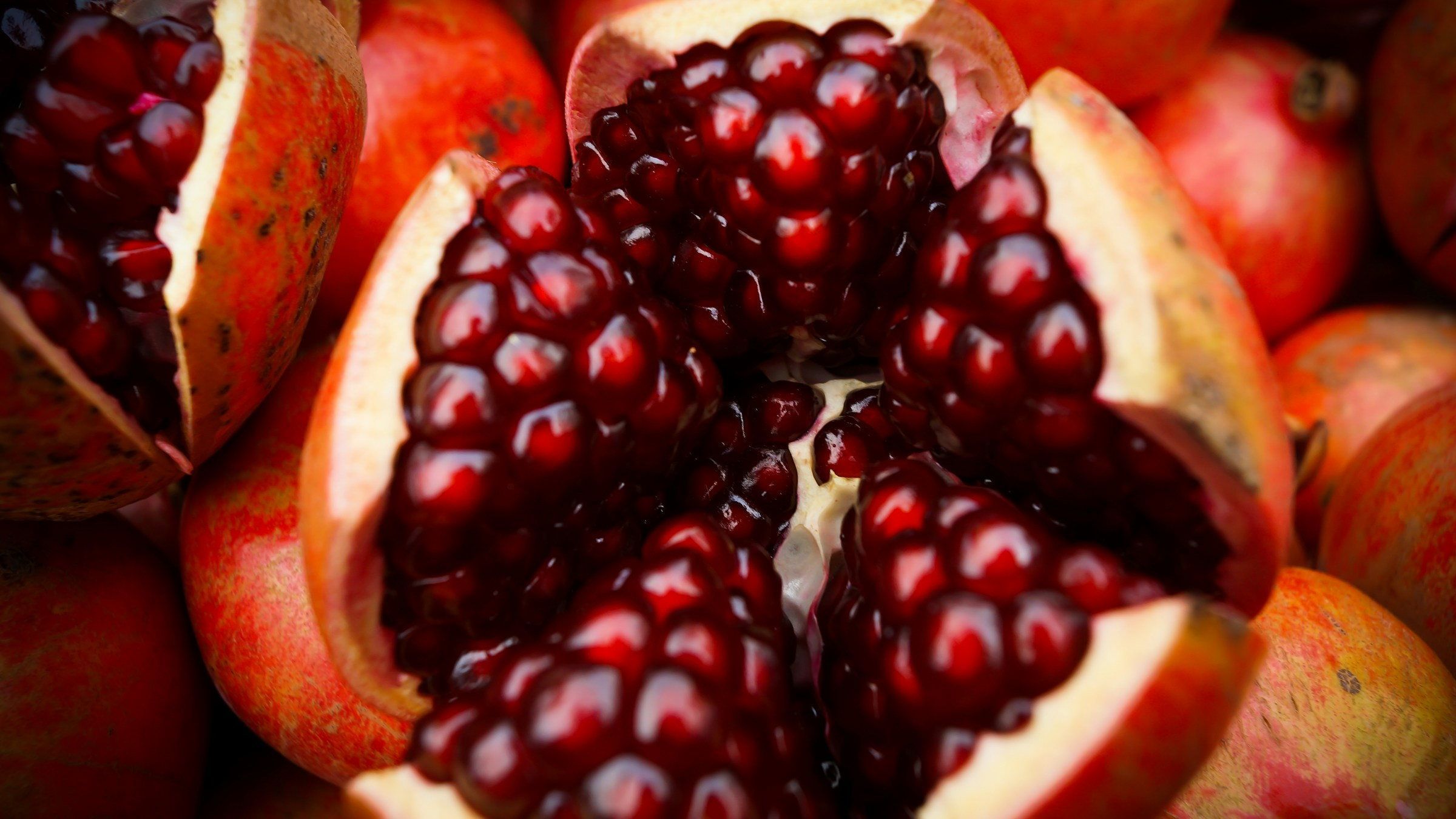
The pomegranate is one of the most antioxidant-rich foods you can eat, and its polyphenols (especially punicalagins) give it roughly three times the antioxidant capacity of red wine or green tea.
Pomegranate is scored against other fruits and berries, never against unlike foods or compounds. This score covers fresh arils (Punica granatum), eaten whole with the seed, and the verdict is: Recommended. Weighting: Composition & Nutrients 30% · Sugar Load & Glycemic Context 25% · Processing & Sourcing 25% · Evidence & Track Record 20%. Pomegranate is one of the few fruits where the human trial record actually matches the reputation. Two separate meta-analyses of randomized trials show it lowers systolic blood pressure, and its ellagitannins feed urolithin A, which is the most interesting cellular longevity pathway I know of in a common food. What keeps it out of the top of this category is straightforward: on nutrition per calorie it sits at 72 on my nutrient density chart, below blueberries and avocado, and most of the strong trials poured juice rather than spooning arils.

The strongest human evidence is for lowering blood pressure and protecting the heart, and its ellagitannins feed the gut compound urolithin A.
Pomegranate looks like an ordinary fruit, but biologically it behaves more like a polyphenol delivery system for your blood vessels, gut, and mitochondria.
Most people think of pomegranate as a sweet, ruby-red snack. From a functional-medicine perspective, its real value is what it does to the terrain of the body. It lowers oxidative stress, supports blood-vessel function, slows the oxidation of LDL cholesterol, calms inflammatory signaling, and feeds the gut-to-mitochondria pathway through a compound called urolithin A. Few fruits influence that many systems at once.
If blueberries are the everyday antioxidant fruit, pomegranate is the cardiovascular and cellular-longevity fruit. In my practice, I recommend it most often for patients working on blood pressure, artery and heart health, and healthy aging, because it covers four bases at once: powerful polyphenols, fiber, vascular support, and cellular signaling. In direct laboratory comparisons, pomegranate juice out-scored red wine, green tea, blueberry, and acai for antioxidant capacity. 2
It is also one of the oldest cultivated fruits on earth, and few foods carry as much history. By a King James concordance count, pomegranates are referenced 33 times across the Old Testament, with 10 in the singular and 23 in the plural, from their first mention in Exodus 28 to their last in Haggai 2:19. 10 They were embroidered onto the robes of the high priest, carved by the hundreds into the pillars of Solomon's Temple, and named among the seven blessed species of the Promised Land (Deuteronomy 8:8). The Romans prized the fruit too, calling it Punicum malum, the "Carthaginian apple", which is why botanists still call it Punica granatum. Across Hebrew, Greek, Roman, and Persian cultures it stood for fertility, abundance, and life, and that ancient reverence is holding up remarkably well under modern science.
Eating actual pomegranates or having pomegranate juice around your workouts is tremendous for your overall health, especially for reversing the age of your heart and cardiovascular system.Dr. Josh Axe, DC, DNM, CNSFrom 10 Biblical Superfoods That Can Add Years to Your Life, The Dr. Josh Axe Show (2026), at 13:08
A pomegranate is the fruit of the Punica granatum tree. Inside its leathery red rind are hundreds of arils, the jewel-like, ruby-red sacs of juice, each surrounding a crunchy edible seed. The arils are what you eat, and they're the source of pomegranate's fiber, vitamins, and signature polyphenols.
Native to the region from Iran to northern India, the pomegranate has been cultivated for more than 4,000 years and appears in Egyptian, Greek, Hebrew, and Persian texts as a symbol of health, fertility, and abundance. A single fruit holds anywhere from 200 to 1,400 arils. You eat the arils whole, juice sac and seed together, and the seed adds a pleasant crunch and a dose of fiber.
One distinction matters throughout this article, because it changes both the nutrition and the research: arils vs. juice vs. extract. Whole arils give you fiber and polyphenols with the fruit's natural structure intact. Juice concentrates the polyphenols (commercial juice is pressed with the rind, which is especially tannin-rich) but strips the fiber and concentrates the sugar. Standardized extracts isolate the polyphenols, mainly punicalagins, into a supplement. Most clinical trials use juice or extract, so I'll note which form a finding comes from.
Pomegranates are best supported for delivering antioxidants, lowering blood pressure, and protecting the heart by reducing the oxidation of LDL cholesterol. Emerging research points to anti-inflammatory effects, cellular/mitochondrial health (via urolithin A), and exercise recovery. Despite early hype, pomegranate is not a proven cancer treatment.
The evidence-graded overview below is updated as new trials publish.
Pomegranate benefits, graded by evidence strength (Updated June 2026)
| Benefit | Evidence | Form studied | What the research shows | Main caution |
|---|---|---|---|---|
Antioxidant capacity | Strong Strong | Juice / arils | ~3× the antioxidant activity of red wine or green tea | Lab capacity ≠ body effect |
Blood pressure | Strong Strong | Juice | Systolic down ~5–8 mmHg across meta-analyses | BP medication |
Heart / LDL oxidation | Emerging Emerging | Juice | Less LDL oxidation; small carotid-thickness study | Small early trials |
Inflammation | Emerging Emerging | Juice / extract | Lower IL-6 and adhesion molecules in some trials | Mixed results |
Cellular / mitochondrial (urolithin A) | Emerging Emerging | Ellagitannins | Precursor to urolithin A, a mitophagy activator | Only ~30–40% convert it well |
Exercise & recovery | Emerging Emerging | Juice / extract | Some trials show less soreness, better recovery | Inconsistent |
Blood sugar / metabolic | Emerging Emerging | Juice / extract | Small improvements in some markers | Juice sugar load |
Prostate health | Mixed Mixed | Juice / extract | Early promise; controlled trials inconclusive | Not a treatment |
Pomegranates work through three main routes: they flood the body with polyphenol antioxidants that lower oxidative stress, they protect blood vessels by reducing LDL oxidation and supporting nitric oxide, and they feed the gut ellagitannins that bacteria can convert into urolithin A, a compound tied to cellular renewal.
Almost every benefit below traces back to these three mechanisms. Understand them, and the rest of the article falls into place.
They flood the body with antioxidants. Pomegranate is dense in polyphenols like punicalagins, ellagitannins, ellagic acid, and anthocyanins. Punicalagin alone accounts for more than half of the juice's antioxidant activity. 1 These compounds neutralize free radicals, and in people, pomegranate juice has measurably raised total antioxidant status and lowered markers of oxidative stress. 4
They protect your blood vessels. A key early step in heart disease is the oxidation of LDL cholesterol, which makes it stick to artery walls. Oxidation is the same browning you see when a cut apple is left out, and it is oxidized LDL, rather than LDL on its own, that drives plaque. Pomegranate polyphenols slow that oxidation, help protect nitric oxide (which keeps vessels relaxed), and modestly lower blood pressure, a combination that targets several cardiovascular risk factors at once. 4
They feed your gut, which can make urolithin A. Pomegranate is one of the richest sources of ellagitannins. Your gut bacteria can convert these into urolithin A, a compound that triggers mitophagy, the cellular "clean-up" that recycles worn-out mitochondria. 5 It's an exciting longevity mechanism with one catch worth flagging, which is that only some people host the bacteria to make it.
Notice the theme: pomegranate is, above all, an antioxidant and vascular food. Its strongest, most consistent effects cluster around oxidative stress and the cardiovascular system, which is exactly where the human evidence is best.
Ranked by the strength of the research, pomegranate's best-supported benefits are its antioxidant power, blood-pressure lowering, heart protection, anti-inflammatory effects, cellular-health (urolithin A) potential, exercise recovery, and metabolic support, in that order.
This is pomegranate's signature strength. In a landmark analysis, commercial pomegranate juice showed antioxidant activity about three times higher than red wine or green tea, 1 and a later head-to-head ranked it the most potent of the popular polyphenol drinks, ahead of red wine, Concord grape, blueberry, and acai. 2 The driver is punicalagin, responsible for more than half that activity. This isn't only a test-tube finding. In patients, a year of pomegranate juice raised total antioxidant status by 130%. 4
Study takeaway: Pomegranate juice carries ~3× the antioxidant capacity of red wine or green tea, and measurably raises antioxidant status in people.
This is pomegranate's best-documented benefit, and the evidence has only grown. A meta-analysis of randomized trials found pomegranate juice lowered systolic blood pressure by about 4.96 mmHg and diastolic by about 2.01 mmHg, 3 and a larger 2024 systematic review of 22 trials found an even greater systolic reduction of about 7.9 mmHg. 8 The effect holds across doses and durations. The likely mechanism is punicalagin's action on the same angiotensin pathway that blood-pressure drugs target, plus protection of vessel-relaxing nitric oxide.
Study takeaway: Across multiple meta-analyses, pomegranate lowers systolic BP by roughly 5–8 mmHg, a meaningful effect for cardiovascular risk.
Because oxidized LDL is what drives artery plaque, pomegranate's antioxidant action has a clear cardiovascular rationale. In a small but striking early study of patients with carotid artery narrowing, a year of pomegranate juice reduced LDL oxidation susceptibility by 59% and was associated with up to a 30% reduction in carotid artery wall thickness, versus a 9% increase in the no-juice group. 4 This was only about ten patients, so I treat it as promising rather than proven, but it fits everything else we know.
Study takeaway: A small early trial showed less LDL oxidation and reduced carotid wall thickness with daily pomegranate juice; larger trials are needed.
Chronic, low-grade inflammation underlies much of modern disease, and pomegranate's polyphenols are anti-inflammatory in the lab. In human trials this shows up as reductions in inflammatory signals such as interleukin-6 (IL-6) and the adhesion molecule ICAM-1, alongside the blood-pressure effects. 3 Results vary between studies, so I'd call this real but modest, a helpful contribution to an anti-inflammatory diet rather than a stand-alone fix.
Study takeaway: Some trials show pomegranate lowers IL-6 and adhesion molecules; the anti-inflammatory effect is genuine but modest and inconsistent.
This is the benefit I'm most excited about long-term. Pomegranate's ellagitannins are the dietary precursor to urolithin A, a gut-derived compound shown to activate mitophagy, clearing damaged mitochondria so cells can build fresh ones. 5 In research, urolithin A improved markers of mitochondrial and muscle health in older adults. The catch is that only about 30–40% of people carry the gut bacteria needed to convert ellagitannins into meaningful urolithin A, 5 and the strongest muscle data come from the isolated compound rather than the fruit. Still, eating pomegranate is one of the best ways to supply the raw material.
Study takeaway: Pomegranate supplies the precursor to urolithin A, a mitophagy activator, but benefits depend on having the right gut bacteria.
Several small trials suggest pomegranate's polyphenols can ease muscle soreness and support recovery and blood flow around exercise, plausibly through the same antioxidant and nitric-oxide pathways behind its vascular benefits. The cellular angle reinforces it: urolithin A specifically improves muscle and mitochondrial function. 5 Results are inconsistent across studies, so I frame this as a reasonable, low-risk addition for active people rather than a guaranteed ergogenic aid.
Study takeaway: Small trials hint at reduced soreness and better recovery; mechanistically supported, but not yet consistent.
Despite its natural sugar, pomegranate's polyphenols may modestly support metabolic health. Some studies report small improvements in blood sugar and lipid markers, and pomegranate's polyphenols don't spike blood sugar the way refined sugar does. I'd weight this lightly and emphasize the whole arils (with their fiber) over juice for anyone managing blood sugar.
Study takeaway: Early signals suggest modest metabolic benefit from pomegranate polyphenols; choose whole arils over juice for blood-sugar control.
Pomegranate is also studied for skin and UV protection, memory, oral health, and joint comfort, with early but encouraging evidence. Its most famous research area, prostate health, shows early promise, though larger controlled trials have so far been inconclusive.
Skin & UV protection. Pomegranate polyphenols defend against oxidative and UV-related skin damage in early research, where it supports sun protection rather than replacing it.
Memory & brain. Small studies suggest pomegranate polyphenols may support memory and are neuroprotective in the lab; the human evidence is preliminary.
Oral health. Pomegranate extract has antimicrobial activity and has been studied as a mouth rinse for gum health.
Prostate health, promising but still unconfirmed. This is pomegranate's most studied and most debated area. An early study reported that pomegranate juice lengthened PSA doubling time from 15 to 54 months in men treated for prostate cancer, and laboratory work shows pomegranate compounds can slow prostate-cancer cell growth. 6 A later placebo-controlled trial didn't show a clear advantage over placebo, though both groups improved, so the picture is mixed and larger trials are warranted. Pomegranate is a supportive food rather than a cancer treatment, so enjoy it alongside medical care, never instead of it.
One cup of pomegranate arils (about 174 g) has roughly 144 calories, 7 grams of fiber, and 24 grams of natural sugar, plus meaningful vitamin C, vitamin K, folate, potassium, and copper. Most of pomegranate's value, though, is in its polyphenols, which don't show up on a standard nutrition label. 7
Pomegranate arils, raw, per 1 cup (174 g). Source: USDA FoodData Central (FDC ID 169134)
| Nutrient | Amount | % Daily Value |
|---|---|---|
Calories | 144 | 7% |
Carbohydrates | 33 g | 12% |
Fiber | 7 g | 25% |
Sugars | 24 g | N/A |
Protein | 3 g | 6% |
Vitamin C | 18 mg | 20% |
Vitamin K | 29 mcg | 24% |
Folate | 66 mcg | 16% |
Potassium | 411 mg | 9% |
Copper | 0.3 mg | 33% |
A practical note: that 24 grams of sugar comes packaged with 7 grams of fiber and a wealth of polyphenols, which is why whole arils behave very differently from a glass of juice. If you're watching blood sugar, the fruit is the smarter choice.
Pomegranate's effects come from its polyphenols: punicalagins (the dominant antioxidant), ellagitannins and ellagic acid (the precursors to urolithin A), and anthocyanins (the red pigments). Punicalagins drive more than half of the antioxidant activity.
Here's the chain that makes pomegranate interesting for cellular health, and it explains why your gut matters as much as the fruit: the large ellagitannins are broken down to ellagic acid, which gut bacteria then convert into urolithin A.
Pomegranate's ellagitannins become urolithin A only with the right gut bacteria, which roughly 30–40% of people have.
The dominant antioxidant, behind more than half of pomegranate's antioxidant activity.
The precursor your gut bacteria convert into urolithin A.
The polyphenols that give arils their ruby color; antioxidant.
Pomegranate's ellagitannins are the dietary raw material for urolithin A, a compound your gut bacteria produce that switches on mitophagy, the cellular clean-up that clears worn-out mitochondria so your cells can build fresh ones. The catch: only about a third of people make it well on their own, but research suggests you can improve your conversion.
This is the part of the pomegranate story I find most compelling, because it connects an ancient fruit to the frontier of longevity science. Your mitochondria are the engines inside every cell, and as they accumulate damage with age, energy production falls and inflammation rises. Mitophagy is the body's recycling program for those worn-out engines, and urolithin A is one of the most promising natural activators of it. 5
The chain works like this: pomegranate is one of the richest sources of ellagitannins, which are broken down to ellagic acid and then converted by gut bacteria into urolithin A. In studies, urolithin A improved markers of mitochondrial and muscle health in older adults. 5 This is the kind of cell-level support I care about most, the type that helps the body renew itself from the inside out rather than just masking symptoms.
Only about 30–40% of people naturally convert ellagitannins into meaningful urolithin A, and it depends on your gut bacteria. The encouraging news is that research suggests eating ellagitannin-rich foods regularly and improving gut health can increase your conversion over time.
If your microbiome doesn't yet make much urolithin A, you're not stuck there. In research, individuals who weren't producers shifted toward producing after consistent intake of ellagitannin-rich foods, and pomegranate's own polyphenols act like a prebiotic, feeding the beneficial bacteria (such as Bifidobacterium) involved in the conversion. 9 A few practical ways to build that capacity:
Eat ellagitannin foods consistently. Pomegranate, walnuts, and berries (strawberries, raspberries) supply the raw material your bacteria adapt to, and regularity matters more than any single large dose.
Feed your microbiome. Fiber, fermented foods, and a diverse, plant-rich diet support the bacteria that perform the conversion.
Protect gut health. Poor metabolic health and gut dysbiosis are linked to weaker conversion, so the same habits that heal your gut help your mitochondria.
Consider a direct source if needed. For a guaranteed dose regardless of your microbiome, urolithin A is available as a standardized supplement, but whole pomegranate is the best food-first starting point.
Choose whole arils for everyday eating (fiber + polyphenols, less sugar impact), 100% juice for a concentrated polyphenol dose (watch the sugar and portion), and a standardized extract only for a targeted, sugar-free polyphenol dose.
Pomegranate forms compared
| Whole arils | 100% juice | Extract / supplement | |
|---|---|---|---|
Fiber | ~7 g per cup | None | None |
Sugar | Moderate (~24 g/cup) | High (concentrated) | None |
Polyphenols | High | Very high (rind tannins) | Standardized punicalagins |
Blood-sugar impact | Lowest (fiber buffers) | Higher | Negligible |
Best for | Everyday eating | Concentrated dose | Targeted, sugar-free |
Dr. Axe pick | First choice | In moderation | If avoiding sugar |
The verdict: eat the whole arils whenever you can. You get the polyphenols and the fiber, the sugar is buffered, and the fruit is more satisfying. Save juice for a small, intentional serving, and reserve extracts for when you specifically want polyphenols without sugar.
Whole arils (fresh). The default choice, with full fiber, all polyphenols, and naturally portion-controlled servings.
Frozen arils. Nearly identical nutritionally to fresh, and the easiest way to build a daily habit.
100% unsweetened juice (small servings). Concentrated polyphenol dose, so treat 4–8 oz as a functional serving.
Pomegranate supplement or freeze-dried powder. A standardized, sugar-free way to get a concentrated polyphenol dose, and a powder can be stirred into unsweetened pomegranate juice to combine a whole-food base with a measured punicalagin dose. You lose the fiber, but the polyphenol density is high.
Pomegranate molasses. Bright flavor for dressings and marinades, a great culinary use, but concentrated in sugar.
Sweetened pomegranate cocktails or drinks. Skip these, since the added sugar undermines the benefits you came for.
Antioxidant capacity is strong across this whole group. On the laboratory ORAC scale, cranberries and blueberries score as high as or higher than pomegranate. The test-tube number isn't what sets pomegranate apart. Its headline benefits, blood pressure and cellular longevity, are backed by meta-analyses of human trials, which isn't yet true for the others. (Pomegranate juice, pressed with the antioxidant-rich rind, also still tops head-to-head beverage rankings. 2)
Pomegranate vs. other antioxidant fruits (per 1-cup serving)
| Pomegranate | Blueberries | Cranberries | Tart cherries | Beets | |
|---|---|---|---|---|---|
| Signature polyphenol | Punicalagins | Anthocyanins | Proanthocyanidins | Anthocyanins | Nitrates & betalains |
| ORAC (µmol TE/100g) | ~4,479 | ~4,669 | ~9,090 | ~3,365 | ~1,776 |
| Sugar | 24 g | 15 g | 4 g | 13 g | 9 g |
| Fiber | 7 g | 3.6 g | 3.6 g | 2.5 g | 3.8 g |
| Strongest evidence | Blood pressure & longevity | Memory & cognition | Recurrent UTIs | Sleep & recovery | Blood flow (nitrates) |
ORAC (Oxygen Radical Absorbance Capacity, µmol TE/100g) values are approximate, from the USDA's 2010 database, which the USDA withdrew in 2012 because the lab scores don't reliably predict antioxidant effects in the body. Sugar and fiber are per 1-cup serving (USDA FoodData Central). Acai is left out here because its freeze-dried ORAC (~100,000+) is an extreme outlier that distorts any comparison.
My take: you don't have to choose. Rotating these fruits gives you a broader range of polyphenols. But if I had to pick one specifically for vascular aging and cellular longevity, pomegranate is my answer, because it's the one whose human-trial evidence matches its antioxidant reputation.
The simplest approach is to keep arils on hand and scatter them onto things you already eat. To de-seed quickly, halve the fruit and tap the back with a spoon over a bowl of water, so the arils sink and the white pith floats.
Spoon arils over yogurt, oatmeal, or chia pudding
Scatter over salads & roasted vegetables
Blend into smoothies
Eat them straight, by the handful
Add to sparkling water for a polyphenol "soda"
Stir into grain bowls, salsa, or dressings
Choose pomegranates that feel heavy for their size with firm, taut skin. To de-seed without the mess, halve the fruit and tap the back of each half with a wooden spoon over a bowl of water, so the arils sink and the white pith floats. Whole fruit keeps about two months in the fridge; arils keep about five days, or freeze them.
Pick: heavy for its size, with firm, taut, slightly angular skin (weight signals juicy arils). Peak season runs from about October into January, when the fruit is at its best.
De-seed (water method): halve the fruit, submerge in a bowl of water, and tap the rind with a spoon; arils sink, the bitter white pith floats off.
Store whole: up to two months refrigerated, or several weeks on the counter.
Store arils: about five days in the fridge, or freeze them in a single layer for up to a year.
Best pairings: pomegranate shines next to walnuts (more ellagitannins for that urolithin A pathway), Greek yogurt or kefir (protein plus gut-friendly probiotics), bitter greens and beets (vascular support), and a little olive oil, citrus, or cinnamon. It's a natural fit for a Mediterranean-style, heart-protective plate.
90-day protocol
The complete root-cause protocol for relaxing your arteries, refilling the minerals that lower pressure, and calming the nervous system — the real fix behind the number your doctor wants to medicate for life.
Free with your Dr. Axe account
View the protocol →The fastest way to make pomegranate a habit is to pair it with foods you already eat, like yogurt, salads, smoothies, and grain bowls. Aim for about ½ cup of arils a day across seven simple uses, and you'll cover roughly a full week of antioxidant, fiber, and polyphenol intake.
A simple 7-day pomegranate plan (~½ cup arils per day)
| Day | Meal / use | Why it works |
|---|---|---|
| Monday | Arils over Greek yogurt with walnuts and cinnamon | Protein, probiotics, ellagitannins, blood-sugar support |
| Tuesday | Pomegranate-walnut salad with arugula and olive oil | Mediterranean pattern; ellagitannin stacking |
| Wednesday | Smoothie: arils + frozen berries + spinach + kefir | Polyphenol-rich, gut-supportive breakfast |
| Thursday | Roasted beet bowl with arils, feta, and balsamic | Two BP-supporting foods on one plate |
| Friday | 4 oz unsweetened juice over sparkling water (mocktail) | Concentrated polyphenol dose, no added sugar |
| Saturday | Grain bowl: quinoa + greens + chicken + arils + tahini | Anti-inflammatory dinner with vascular support |
| Sunday | Arils on a square of dark chocolate (70%+) | Polyphenol-on-polyphenol dessert, small portion |
The goal is simply to make pomegranate something your body sees on a regular basis, without stressing about being perfect. Steady exposure is also what helps shift your gut microbiome toward producing more urolithin A over time. 9
Two low-effort ways to eat pomegranate most days: a pomegranate-walnut arugula salad (which stacks pomegranate's ellagitannins with more from walnuts) and an overnight pomegranate chia pudding for fiber and gut support.
Prep 10 min · No cook · Serves 4 · Mediterranean
A bright, antioxidant-rich salad that pairs pomegranate arils with walnuts, both sources of the ellagitannins your gut converts into urolithin A.
5 oz fresh arugula
½ cup pomegranate arils
½ cup walnuts, toasted
¼ cup feta or goat cheese, crumbled
3 tbsp extra-virgin olive oil
1 tbsp fresh lemon juice
1 tsp honey
Salt & black pepper, to taste
Whisk the olive oil, lemon juice, honey, salt, and pepper into a dressing.
Toss the arugula with just enough dressing to lightly coat.
Top with pomegranate arils, toasted walnuts, and crumbled cheese.
Finish with the remaining dressing and serve right away.
Prep 5 min · Chill 4 hr+ · Serves 2 · Breakfast / snack
A fiber-rich, gut-friendly make-ahead breakfast. The chia and yogurt add protein and prebiotic fiber; the arils bring the polyphenols.
3 tbsp chia seeds
1 cup unsweetened almond milk (or dairy milk)
¼ cup plain Greek yogurt
1 tsp vanilla extract
1–2 tsp honey or maple syrup
½ cup pomegranate arils
Whisk the chia seeds, milk, yogurt, vanilla, and sweetener together in a jar.
Refrigerate at least 4 hours or overnight, stirring once after 10 minutes so it sets evenly.
Top with pomegranate arils just before serving.
Aim for about ½ to 1 cup of arils per day, or 4–8 oz of 100% unsweetened juice (the range used in many studies). With juice, mind the concentrated sugar, especially if you manage blood sugar or weight.
There's no need to overthink it, since pomegranate is a food rather than a medication. A daily half-cup of arils is a realistic, satisfying habit that supplies polyphenols, fiber, and a hit of vitamin C and potassium. If you prefer juice, treat 4–8 oz like a functional serving rather than a thirst-quencher, and choose 100% juice with no added sugar. As with most foods, consistency over weeks and months is what matters.
Pomegranate is very safe as a food. The main things to watch are possible interactions with certain medications (similar to grapefruit), the concentrated sugar in juice, and rare allergy. Whole arils are the safest, simplest way to enjoy it.
Possibly. Like grapefruit, pomegranate juice may influence the CYP3A4 and CYP2C9 enzymes that metabolize certain drugs, including some statins, the blood thinner warfarin, and some blood-pressure medications. The evidence is weaker and less consistent than for grapefruit, but if you take these medications, mention pomegranate juice to your doctor or pharmacist. Pomegranate's own blood-pressure-lowering effect can also add to antihypertensive drugs.
Who should be careful with pomegranate
| If you are… | Recommendation |
|---|---|
| On blood-pressure medication | Use caution with juice and monitor your blood pressure |
| On warfarin or statins | Ask your physician or pharmacist before regular juice |
| Managing blood sugar or weight | Choose whole arils over juice for the fiber |
| Living with kidney disease / potassium limits | Check with your clinician first |
| Prone to fruit allergies | Start with a small amount |
If you take statins, warfarin, or blood-pressure medication, check with your doctor before drinking pomegranate juice regularly
Choose whole arils or 100% juice, and skip sweetened "pomegranate" cocktails and drinks with added sugar
If you manage blood sugar or weight, favor arils over juice for the fiber and lower sugar load
Pomegranate allergy is rare but possible, especially in those with other fruit allergies
Don't rely on pomegranate to treat any disease; think of it as a supportive food rather than a medicine
Pomegranate juice is just as healthy as the whole fruit.
Juice keeps the polyphenols but loses the fiber and concentrates the sugar, so whole arils are the better everyday choice.
You can't eat the seeds inside the arils.
The seeds are completely edible and add fiber, so you eat the whole aril, crunch and all.
Pomegranate's high antioxidant score proves it prevents disease.
Lab antioxidant capacity doesn't automatically translate to clinical benefit; the strongest human proof is for blood pressure.
Yes. It's one of the easiest "yes" foods I recommend. Pomegranate pairs an extraordinary antioxidant load with genuine, controlled-trial evidence for lower blood pressure and a healthier cardiovascular profile, plus a compelling cellular-health story through urolithin A. It's a food where the ancient reverence and the modern data line up.
Eat the whole arils when you can, about half a cup a day is a great habit, and treat juice as a small, intentional serving. The caveats are minor. Skip the sugary cocktails, mind the juice if you watch blood sugar, and check with your doctor if you take statins, warfarin, or blood-pressure medication. Beyond that, enjoy one of the most remarkable foods nature offers.
Pomegranates are one of the most antioxidant-rich foods, and the strongest human evidence is for lowering blood pressure. They also support heart health by reducing LDL oxidation, help fight inflammation, and supply ellagitannins your gut can convert into the cellular-health compound urolithin A.
Yes. Pomegranate arils are high in fiber, vitamin C, vitamin K, and potassium, and they carry one of the highest antioxidant capacities of any common fruit, driven by polyphenols called punicalagins. Whole arils are the best way to eat them.
Modestly, yes. A meta-analysis of randomized trials found pomegranate juice lowered systolic blood pressure by about 5 mmHg and diastolic by about 2 mmHg.
Both deliver polyphenols, but whole arils also give you fiber and less concentrated sugar, while juice removes the fiber and concentrates the natural sugar. Choose whole arils first; if you drink juice, keep it to a small unsweetened serving.
About half a cup to one cup of arils daily is a sensible amount. If you prefer juice, 4–8 oz of 100% unsweetened pomegranate juice is the range used in many studies, mindful of the sugar.
Yes. The crunchy seeds inside the juicy arils are completely edible and add fiber. You eat the whole aril, seed and all.
Urolithin A is a compound linked to mitochondrial and muscle health. Pomegranate is one of the richest sources of the ellagitannins your gut bacteria convert into it, but only about 30–40% of people have the right microbiome to make meaningful amounts.
Only about 30–40% of people naturally convert pomegranate's ellagitannins into meaningful urolithin A. Research suggests you can improve this over time by eating ellagitannin-rich foods (pomegranate, walnuts, berries) consistently and supporting gut health with fiber and fermented foods. A standardized urolithin A supplement is an option if you want a guaranteed dose.
Possibly. Like grapefruit, pomegranate juice may affect enzymes (CYP3A4, CYP2C9) that metabolize some statins, blood thinners such as warfarin, and blood-pressure drugs. If you take these, check with your doctor.
Its polyphenols are antioxidants that help defend against oxidative and UV-related damage, and early research on pomegranate and skin is promising. It supports sun protection rather than replacing it.
Whole arils contain about 24 grams of natural sugar per cup, balanced by 7 grams of fiber. Juice is more concentrated and lacks fiber, so portion size matters more for juice, especially if you manage blood sugar.
Early single-arm studies looked promising, but a randomized placebo-controlled trial did not find pomegranate significantly slowed rising PSA versus placebo. Pomegranate is not a cancer treatment and should not replace medical care.
It supports heart health by lowering blood pressure and reducing the oxidation of LDL cholesterol, an early step in artery plaque. A small early study even reported reduced carotid artery wall thickness, though larger trials are needed.
In laboratory comparisons, pomegranate juice ranked higher in antioxidant potency than blueberry, Concord grape, acai, and green tea. Lab antioxidant scores don't fully predict benefits in the body, but pomegranate consistently ranks at the top.
Any time works; there's no special timing. Many people enjoy arils with breakfast or as a snack. Consistent, regular intake matters more than timing.
Pomegranate is very safe as a food. The main considerations are possible interactions with certain medications, the sugar content of juice, and rare allergy. Stick to whole arils or unsweetened juice.
Published June 2026. — Adds a 2024 meta-analysis on blood pressure (systolic −7.9 mmHg across 22 trials), expands the urolithin A cellular-longevity section with guidance on improving conversion, and adds a superfruit comparison. Includes exact study statistics (antioxidant capacity ~3× red wine/green tea; systolic BP −4.96 to −7.9 mmHg; LDL oxidation −59% and carotid thickness −30% in an early trial; ~30–40% of people convert ellagitannins to urolithin A). Uses the Dr. Axe Score™ methodology v6.0, with four weighted factors scored against other fruits and berries: Composition & Nutrients, Sugar Load & Glycemic Context, Processing & Sourcing, and Evidence & Track Record.

Medically reviewed by the DrAxe.com Medical Advisory Board on Jun 1, 2026.
This content is for educational purposes only and is not medical advice. It is not intended to diagnose, treat, cure, or prevent any disease. Always consult a qualified healthcare provider before making significant dietary changes, especially if you take medication or manage a health condition.