The Best Over-the-Counter Continuous Glucose Monitors of 2026, Ranked by Accuracy, FDA Clearance and What You Actually See
We scored the two over-the-counter glucose sensors you can buy and five programs that ship them on independent accuracy data, FDA records, what the app actually shows you, privacy terms and how honestly they're sold.
Effectively a tie: all 7 score within 0.30 points. Treat them as equal on quality and choose by sensor, price and features.
Top score:Oura + Stelo (8.4/10), if you already wear an Oura Ring. Everyone else:Dexcom Stelo (8.2, $84/month): 15-day wear, 30-minute warm-up, Apple Watch.
Best accuracy evidence:Abbott Lingo (8.1), the only over-the-counter sensor independently tested in people without diabetes[1]. Dietitian coaching:Nutrisense (8.2).
Know this: none sends low or high glucose alarms[3][8], and a CGM can't diagnose prediabetes; lab tests do[64].
Skip: watches and rings that claim to read glucose without a sensor[19].
Top score8.4/10
Oura Ring + Stelo
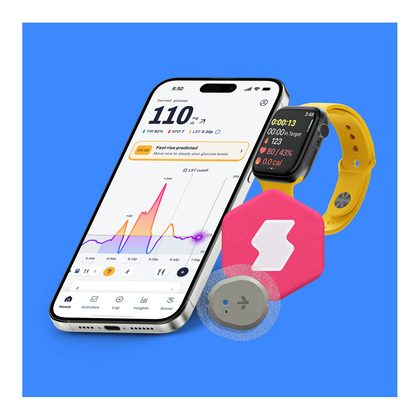
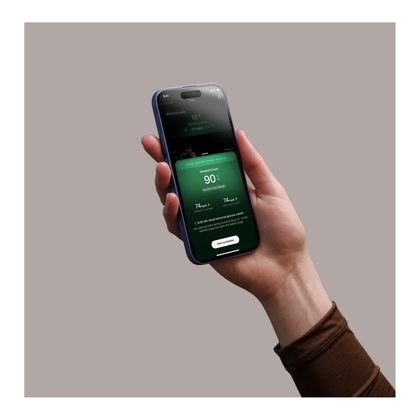
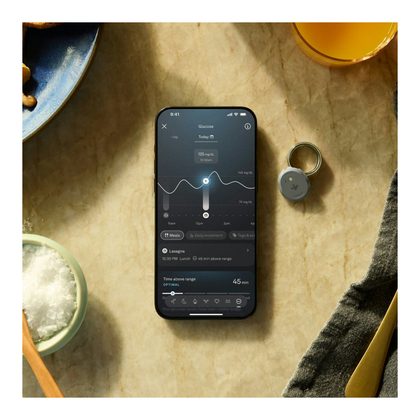
Dexcom's FDA-cleared Stelo sensor, shown in the Oura App next to sleep and activity[36][3].
Same sensor, same scores as Stelo; it leads because Oura sells it with the fewest marketing claims. You need a Gen3 or newer ring (not in our cost) and a $5.99 membership[37].
How we score:Accuracy evidence 30%FDA status & safety record 20%What you see 20%Data privacy & control 15%Claims honesty 15%Full methodology ↓
The Clean Glucose Score is our editorial judgment, not a medical grade. Brands can't pay for placement.
Know your glucose
What a glucose monitor can (and can't) tell you
A CGM shows how your meals, walks and sleep move your glucose in real time. Healthy people spike less than you'd think, respond differently to the same food, and shouldn't read too much into one number.
What “normal” looks likeMostly 70–140 mg/dL, with short rises after meals[54]. Stelo presets 70–140 for people without diabetes[23].
What a CGM can’t doDiagnose. Fasting 100–125 mg/dL on a lab test is the prediabetes range[64].
when they saw a high reading (56 users). Stelo’s new labeling says it’s not for anyone with an eating-disorder history.
Obes Res Clin Pract, 2025; FDA
Check your monitor
Only Dexcom, Abbott and Signos hold over-the-counter CGM clearances in FDA's database[2]. Look up any device yourself, and see what lab numbers mean before you worry about a reading[64].
One Lingo or Stelo sensor lasts 14 to 15 days. Here's how to spend them.
1Days 1–3
Wear it, eat normally, ignore day one
Put it on the back of your upper arm and log meals, sleep and stress. Day one reads least precisely: 88.6% of Stelo readings were within 20% on day 1, vs 94.0% overall[23].
Eat the same meal twice: carbs first, then vegetables and protein first (grilled chicken or wild salmon, salad, then rice). Carbs last cut the rise 73% in one small trial[60]. Then compare a 10–15-minute walk after dinner with sitting. In 7 trials, short walking breaks during long spells of sitting (about 2 minutes every 20) lowered post-meal glucose[62].
Compare eggs and vegetables with cornflakes and milk, which pushed 80% of people over 140[55]. Try a spoon of vinegar in water with a starchy meal; pooled trials are small and mixed[63].
Note sleep and stress, read the trend, check first if…
Sleep and stress: log a short night or a hard day and compare. We found no strong data for people without diabetes, so treat it as your own experiment.
Read it right: look at the rise above your pre-meal level and how long it takes to come back. Trends are more reliable than exact numbers[1].
On insulin, dialysis or with problematic lows: Both over-the-counter sensors say don’t use them[22][31].
History of an eating disorder: Stelo’s June 2026 labeling says it isn’t for you[6].
A worrying number: Confirm with a lab test: fasting glucose or A1C[64].
MRI or CT scan: Take the sensor off first; Stelo is MR unsafe[22].
Verified in FDA’s database Looked up in FDA’s database.Independent study Measured by researchers the brand didn’t pay.Maker’s data The brand’s own figure or document.Not published Nothing published.Flag A limit or a privacy flag.
*Stelo's clearances: K234070 (2024), K261359, K260935 and K262472 (2026)[3][5][6][7]. Accuracy: Lingo's 12.9% is from 39 healthy adults vs fingersticks[1]; Stelo's 8.3% is Dexcom's study of 130 adults with diabetes vs a lab analyzer[23]. Per-30-day costs are our calculation from each brand's cheapest ongoing plan.
Full reviews
The 7 over-the-counter glucose monitors we scored
All 7 score within 0.30 points; tied scores share a rank (“2=”) and are listed by cost per 30 days of wear.
1
Stelo + $5.99/monthStelo bought from Oura’s store or anywhere else, plus an Oura Membership ($5.99 a month) and a Gen3 or newer Oura Ring (not included in our cost).
Top score: fewest marketing claims; best if you already wear an Oura Ring
Oura Ring + Stelo
Stelo biosensor data shown inside the Oura App, next to sleep and activity
Stelo[36]the only sensor Oura integrates with (maker)
$75M[40]Dexcom’s investment in Oura, Nov. 2024 (news)
Our top score, by a small margin and only if you already wear an Oura Ring: it’s the simplest way to see glucose next to your sleep, stress and activity, and Oura sells it with the fewest marketing claims of any brand here. You buy a Stelo (from Oura’s store or anywhere), set it up in Dexcom’s Stelo app, then connect your Stelo account to the Oura App, which then shows your glucose graph, time above range for each logged meal and AI tips. Because it’s a Stelo, it inherits Stelo’s scores for accuracy, FDA record and what you see, and because your readings still pass through a Dexcom account, Dexcom’s privacy terms apply alongside Oura’s. Oura says it doesn’t sell or share personal data for cross-context behavioral advertising, but it uses website cookies to build ad audiences. Oura’s own marketing is the mildest here: no weight-loss or disease claims, though it does promise you’ll “feel full of energy every day.” One relationship to know about: Dexcom invested $75 million in Oura in November 2024, when the two announced this integration. The ring itself isn’t included in our monthly cost.
Best forOura Ring owners who want glucose in the same app as sleep and activity
Sensor & wearStelo biosensor, 15 days + 12-hour grace
Warm-up30 minutes (Stelo)
Cost per monthStelo ($84–$99 a month) + Oura Membership $5.99 a month; about $90 per 30 days on Stelo’s 3-month plan
PhoneiPhone or Android; Oura Ring Gen3 or later; U.S. only; English only
FSA / HSAStelo and the Oura Membership are HSA/FSA eligible (maker)
What’s includedOura’s Stelo 2-pack includes protective patches; ring sold separately
Accuracy: Inherits Stelo: maker MARD 8.3%Display: Glucose shown in the Oura App alongside ring data
See score breakdown & sources
Accuracy evidence8.0
FDA status & safety record9.0
What you see8.0
Data privacy & control8.0
Claims honesty9.0
Accuracy: maker MARD 8.3% in adults with diabetes, capped at 8 as maker data (8) (inherited from the Stelo sensor it ships). FDA: OTC clearance verified (10), no recall minus 1 for FDA’s March 2025 warning letter to Dexcom on the G6/G7 platform Stelo shares = 9. What you see: number + trend on your phone 5, updates every 5 min or faster 0, wear 14+ days 1, warm-up 30 min or less 1, shows 55–250 mg/dl 0, data export 1 = 8. Privacy: own policy 8; requires a Dexcom account, so Dexcom’s terms (8) count = 8. Claims: minus 1 each for other health outcomes (energy, focus, mood, heart, “metabolism”) = 9.
Maker's dataOura Member Care, “Glucose Tracking” (July 2, 2026) and “Stelo by Dexcom Integration” (July 6, 2026): “you’ll need both an Oura Membership and a Stelo account”; U.S. only; Gen3 or later ring; “We currently integrate only with the Stelo biosensor”; only glucose data flows from Stelo to Oura; meal-level time above range. Open source · [36]
Maker's dataOura store, Stelo Glucose Biosensor page: pair Stelo with an Oura Membership to see glucose in the Oura App; 2-pack = 30-day supply; “For people NOT on insulin, ages 18 years or older”; “No prescription needed and FDA-cleared”; HSA/FSA eligible. Open source · [35]
Maker's dataOura Membership page: $5.99 a month; first month free for new members; HSA/FSA eligible. Open source · [37]
Maker's dataOura “Metabolic Health” page: “so you can feel full of energy every day”; “Beat cravings and energy slumps”; tips toward “more sustained energy levels, better sleep, a healthy weight.” Open source · [38]
Maker's dataOura Privacy Policy: “We do not sell or share your personal data for cross-context behavioral advertising”; website cookies used “to create audiences for online advertisement”; Membership Hub data export; right of deletion. Open source · [39]
Public record / studyFierce Healthcare, Nov. 19, 2024: Dexcom invested $75 million in Oura’s Series D, valuing Oura at more than $5 billion, and the companies agreed to integrate Stelo data with the Oura Ring. Open source · [40]
Maker's dataDexcom Privacy Notice (last updated July 2024), on stelo.com: disclosure of personal data to “advertising networks” and “social networks” “qualifies as the “sale” of Personal Data” or targeted advertising under certain state laws; opt-out offered; “we do not “sell” any consumer data in the traditional sense for monetary compensation”; rights to deletion and portability. Open source · [26]
FDA databaseFDA warning letter to Dexcom, Inc., CMS 700835, Mar. 4, 2025: after inspections in San Diego (Oct.–Nov. 2024) and Mesa, Ariz. (June 2024), FDA cited G6 and G7 sensors as adulterated and misbranded; Dexcom changed “a component used in the resistance layer” of its sensors; its equivalence study “resulted in determining your primary endpoints were not met”; sensors with the new component showed “significantly greater variability.” No close-out letter was posted as of Sept. 30, 2026. Open source · [15]
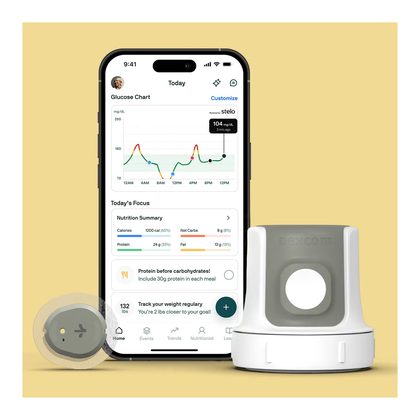
The first over-the-counter CGM, and the pick if you don’t wear an Oura Ring: it ties Signos and Nutrisense, which ship the same sensor, at 8.2 and costs the least. Dexcom’s own study of 130 adults with type 1 or type 2 diabetes put Stelo’s average gap from a lab analyzer at 8.3%, with 94% of readings within 20%, but nobody independent has published a Stelo accuracy study in people without diabetes, so it scores as maker data. It lasts the longest here (15 days plus a 12-hour grace period), warms up in 30 minutes, sends readings straight to an Apple Watch, and its 3-month plan works out to $84 a month. The app shows a new number only every 15 minutes and, per the current user guide, only between 70 and 250 mg/dL. Stelo shares the Dexcom G7’s hardware, and FDA’s March 2025 warning letter to Dexcom about a G6 and G7 sensor-coating change costs it a point; Dexcom says it made no design change. FDA cleared Stelo for ages 2 and up in June 2026, but Dexcom’s site and user guide still say 18 and older. Its homepage claims Stelo can help “Lower prediabetes risk” and “Slow diabetes progression,” and Dexcom’s privacy notice says its ad and social-network sharing counts as a ‘sale’ of data under some state laws.
Best forThe longest wear, the lowest monthly cost, Apple Watch or Oura users
Skip ifYou want minute-by-minute numbers or a refund if it isn’t for you
Sensor & wearStelo biosensor (G7 hardware), back of upper arm, 15 days + 12-hour grace
Warm-up30 minutes
Cost per month$99 one-time (2 sensors); $89/month or $252 every 3 months ($84/month) by subscription
PhoneiOS 18.6+ or Android 13+; Apple Watch direct (app 3.3+)
FSA / HSAEligible
What’s includedApplicators with sensors, overpatches, app with AI coach; a 1:1 nutrition call
Accuracy: Maker MARD 8.3% (adults with diabetes); no independent test in healthy peopleDisplay: Every 15 min · 70–250 mg/dL · no glucose alarms
Signos, Nutrisense, Levels and Oura all run on the Stelo sensor; they’re scored separately below.
Tied at 8.2 with Signos and Nutrisense. Tied products are listed by cost per 30 days of wear (lowest first); that order isn't a quality ranking.
See score breakdown & sources
Accuracy evidence8.0
FDA status & safety record9.0
What you see8.0
Data privacy & control8.0
Claims honesty8.0
Accuracy: maker MARD 8.3% in adults with diabetes, capped at 8 as maker data (8). FDA: OTC clearance verified (10), no recall minus 1 for FDA’s March 2025 warning letter to Dexcom on the G6/G7 platform Stelo shares = 9. What you see: number + trend on your phone 5, updates every 5 min or faster 0, wear 14+ days 1, warm-up 30 min or less 1, shows 55–250 mg/dl 0, data export 1 = 8. Privacy: own policy 8 = 8. Claims: minus 1 each for preventing, slowing or reversing a disease, other health outcomes (energy, focus, mood, heart, “metabolism”) = 8.
Maker's dataStelo User Guide AW-1000421-10 Rev 004 (rev. date 07/2026): 130 adults with type 1 or type 2 diabetes at 6 U.S. centers, 20,330 paired readings vs YSI lab analyzer: 94.0% within 20/20%, 88.6% on Day 1, MARD 8.3%; readings shown only between 70 and 250 mg/dL; sends data to Apple Health or Health Connect “with a 3-hour delay”; non-diabetes target range 70–140 mg/dL; 77.9% of sensors lasted 15 days; 18 and older. Open source · [23]
FDA databaseFDA 510(k) K234070, Dexcom Stelo Glucose Biosensor System, cleared Mar. 5, 2024 (code SAF): adults 18 and older not on insulin; “The Stelo System uses the same hardware design as the predicate G7 CGM System”; app displays glucose every 15 minutes (sensor sends every 5); 70–250 mg/dL; “does not provide any glucose or system alerts.” Open source · [3]
FDA databaseFDA decision summary for K234070: MARD by wear period 9.1% (beginning), 7.8%, 7.3%, 9.1% (end) in 130 adults; 19.8% of sensors (26 of 131) had early sensor shut-off; 73.5% of evaluable sensors lasted to the final day in the original study. Open source · [4]
FDA databaseFDA 510(k) K260935, Stelo, cleared June 12, 2026 (code SBH): “people 2 years and older not on insulin” (caregiver supervision under 18); reportable range 55–350 mg/dL; direct-to-Apple-Watch; “not for people on dialysis, with problematic hypoglycemia, are modifying medication without HCP consultation, or have a history of eating disorders”; no glucose alerts; pediatric accuracy on days 11–15 “not directly assessed.” Open source · [6]
FDA databaseFDA warning letter to Dexcom, Inc., CMS 700835, Mar. 4, 2025: after inspections in San Diego (Oct.–Nov. 2024) and Mesa, Ariz. (June 2024), FDA cited G6 and G7 sensors as adulterated and misbranded; Dexcom changed “a component used in the resistance layer” of its sensors; its equivalence study “resulted in determining your primary endpoints were not met”; sensors with the new component showed “significantly greater variability.” No close-out letter was posted as of Sept. 30, 2026. Open source · [15]
Public record / studyMedTech Dive, Mar. 27, 2025: Dexcom spokesperson: “Dexcom qualified a second source for one of its raw materials,” “extensive testing” showed it met specifications, no design changes were made, it notified FDA “through 510(k) submissions, following the guidelines for non-significant changes,” and it is “committed to resolving this issue promptly.” Open source · [28]
Maker's dataStelo buy page, Sept. 30, 2026: $99 one-time (2 biosensors); $89 1-month subscription ($99 struck, “SAVE 10%”); $252 3-month subscription ($297 struck), “starting at just $84/month”; “For people not using insulin, ages 18 years and older”; don’t use with a history of eating disorders; 15-day lifespan + 12-hour buffer; 30-minute warmup; HSA/FSA eligible; “All sales are final”; 77.9% of sensors lasted 15 days. Open source · [22]
Maker's dataStelo by Dexcom homepage, Sept. 30, 2026: benefit list “Stabilize energy,” “Improve focus,” “Reveal patterns around mood,” “Improve metabolism,” “Lower prediabetes risk,” “Slow diabetes progression”; footnote “Results obtained from previous Dexcom device(s) in patients with diabetes”; paid spokesperson labeled. Open source · [21]
Maker's dataDexcom Privacy Notice (last updated July 2024), on stelo.com: disclosure of personal data to “advertising networks” and “social networks” “qualifies as the “sale” of Personal Data” or targeted advertising under certain state laws; opt-out offered; “we do not “sell” any consumer data in the traditional sense for monetary compensation”; rights to deletion and portability. Open source · [26]
FDA databaseFDA MAUDE adverse-event reports via openFDA (data current to Sept. 22, 2026), counted by DrAxe.com: Stelo, Sept. 9, 2024 to Aug. 31, 2026: 2,448 malfunction, 156 injury, 7 other; Lingo, Oct. 17, 2024 to Aug. 25, 2026: 69 injury, 33 malfunction. Reports are unverified, depend on how many people use a device and how makers report, and are not rates. Open source · [18]
Signos is the only program here whose app has its own FDA clearance: in March 2025 FDA cleared it as an over-the-counter display for the Stelo sensor, with an added line that the information “may be useful in helping users to maintain a healthy weight.” Every plan ships two Stelo sensors a month, so it inherits Stelo’s accuracy data, display limits and the point Dexcom loses for its 2025 warning letter. The app adds meal logging, AI predictions and nudges to move after a spike, plus in-app dietitian chat. It’s built around weight loss rather than weight maintenance, with pitches like ‘Discover Your Fat-Loss Foods’ and ‘Supercharge Your Metabolism,’ and its privacy policy lists “targeted ads, retargeted ads” among the uses of personal data. It’s also expensive: $127 a month on the 6-month plan with a 25%-off code, $169 regular, and all sales are final.
Best forPeople who want an app built around weight goals with an FDA-cleared display
Skip ifYou want to try it for a month without a big bill
Accuracy: Inherits Stelo: maker MARD 8.3%Display: Every 15 min · 70–250 mg/dL · no glucose alarms
Tied at 8.2 with Dexcom Stelo and Nutrisense. Tied products are listed by cost per 30 days of wear (lowest first); that order isn't a quality ranking.
See score breakdown & sources
Accuracy evidence8.0
FDA status & safety record9.0
What you see8.0
Data privacy & control8.0
Claims honesty8.0
Accuracy: maker MARD 8.3% in adults with diabetes, capped at 8 as maker data (8) (inherited from the Stelo sensor it ships). FDA: OTC clearance verified (10), no recall minus 1 for FDA’s March 2025 warning letter to Dexcom on the G6/G7 platform Stelo shares = 9. What you see: number + trend on your phone 5, updates every 5 min or faster 0, wear 14+ days 1, warm-up 30 min or less 1, shows 55–250 mg/dl 0, data export 1 = 8. Privacy: own policy 8; requires a Dexcom account, so Dexcom’s terms (8) count = 8. Claims: minus 1 each for weight loss, other health outcomes (energy, focus, mood, heart, “metabolism”) = 8.
FDA databaseFDA 510(k) K250106, Signos Glucose Monitoring System (mobile app), cleared Mar. 21, 2025 (code SAF): displays data from the Stelo sensor; 18 and older not on insulin; “This information may be useful in helping users to maintain a healthy weight”; 70–250 mg/dL every 15 minutes; glucose alerts: none. Open source · [10]
Maker's dataSignos plans page, Sept. 30, 2026: “Save 25% with code AUTUMN25”; 6-month CGM plan $127/month ($169 regular), 3-month $150 ($199), 1-month $225 ($299); 2 sensors a month; “All plans include the Stelo glucose biosensor by Dexcom”; “Hit Your Weight Goals,” “Discover Your “Fat-Loss Foods”,” “Supercharge Your Metabolism”; “All sales final. No refunds or exchanges”; HSA/FSA “Possibly.” Open source · [41]
Maker's dataSignos Privacy Policy: personal information used to provide “advertising and promotional information (e.g., targeted ads, retargeted ads)”; shared with service providers including “advertising partners”; right to delete. Open source · [42]
Maker's dataSignos Help Center, “The Dexcom Authorization Process [Stelo]” (updated Feb. 5, 2026): a one-time Dexcom account and authorization step when setting up Stelo. Open source · [43]
Maker's dataDexcom Privacy Notice (last updated July 2024), on stelo.com: disclosure of personal data to “advertising networks” and “social networks” “qualifies as the “sale” of Personal Data” or targeted advertising under certain state laws; opt-out offered; “we do not “sell” any consumer data in the traditional sense for monetary compensation”; rights to deletion and portability. Open source · [26]
FDA databaseFDA warning letter to Dexcom, Inc., CMS 700835, Mar. 4, 2025: after inspections in San Diego (Oct.–Nov. 2024) and Mesa, Ariz. (June 2024), FDA cited G6 and G7 sensors as adulterated and misbranded; Dexcom changed “a component used in the resistance layer” of its sensors; its equivalence study “resulted in determining your primary endpoints were not met”; sensors with the new component showed “significantly greater variability.” No close-out letter was posted as of Sept. 30, 2026. Open source · [15]
$152[45]a month on the 6-month plan, on sale (maker)
June 2026[48]Dexcom bought Nutrisense (announced June 2026; news)
The program to pick if what you really want is a dietitian reading your data with you. Nutrisense ships two Stelo sensors a month, gives you its own app with an AI assistant, and recommends two video calls a month with a dietitian, billed to insurance (“Most pay $0 out-of-pocket,” it says). Dexcom bought Nutrisense (announced June 2026), so this is now Dexcom’s coaching arm; Stelo’s own site already routes its 1:1 nutrition calls through Nutrisense. It inherits all of Stelo’s scores, including the warning-letter point and Dexcom’s ad-sharing privacy terms, because you set the sensor up in the Stelo app. Its homepage promises to help you “cut cravings, boost energy, and lose weight, for good.” At $152 a month on the 6-month plan (sale) it’s the most expensive route to a Stelo.
Best forPeople who want regular dietitian calls built around their glucose data
Skip ifYour insurance won’t cover the calls, or you want the cheapest Stelo
Sensor & wearStelo biosensors, 2 a month (15 days each)
Warm-up30 minutes (Stelo)
Cost per month$212 (month-to-month), $178 (3-month) or $152 (6-month) a month on sale; $75 late-cancel fee for calls
PhoneNutrisense app: iOS 16.2+ or Android 12+; Stelo app: iOS 18.6+ or Android 13+
FSA / HSANot stated on the program page
What’s includedSensors, Nutrisense app + AI, dietitian and stress-management calls via insurance, lab-testing access
Accuracy: Inherits Stelo: maker MARD 8.3%Display: Every 15 min · 70–250 mg/dL · dietitian video calls
Tied at 8.2 with Dexcom Stelo and Signos. Tied products are listed by cost per 30 days of wear (lowest first); that order isn't a quality ranking.
See score breakdown & sources
Accuracy evidence8.0
FDA status & safety record9.0
What you see8.0
Data privacy & control8.0
Claims honesty8.0
Accuracy: maker MARD 8.3% in adults with diabetes, capped at 8 as maker data (8) (inherited from the Stelo sensor it ships). FDA: OTC clearance verified (10), no recall minus 1 for FDA’s March 2025 warning letter to Dexcom on the G6/G7 platform Stelo shares = 9. What you see: number + trend on your phone 5, updates every 5 min or faster 0, wear 14+ days 1, warm-up 30 min or less 1, shows 55–250 mg/dl 0, data export 1 = 8. Privacy: own policy 10; requires a Dexcom account, so Dexcom’s terms (8) count = 8. Claims: minus 1 each for weight loss, other health outcomes (energy, focus, mood, heart, “metabolism”) = 8.
Maker's dataNutrisense products page, Sept. 30, 2026: “15% Off All Programs”; 6-month $179 → $152/month, 3-month $209 → $178, month-to-month $249 → $212; monthly delivery of 2 Stelo biosensors with Stelo app access; 2 dietitian video calls a month recommended, “Most pay $0 out-of-pocket with insurance coverage”; Nutrisense app iOS 16.2+/Android 12+; all sales final. Open source · [45]
Maker's dataNutrisense homepage: “24/7 glucose data and expert coaching to help you cut cravings, boost energy, and lose weight, for good”; “Understand your body’s data and what’s behind your exhaustion, weight, and anxiety.” Open source · [44]
Maker's dataNutrisense Privacy Policy (last updated Apr. 13, 2026): “We do not sell any Personal Information”; “Nutrisense does not track its users over time and across third party websites to provide targeted advertising”; rights to delete and to a portable copy. Open source · [46]
Maker's dataNutrisense Help Center, “How to Set Up Your Stelo Sensor with the Nutrisense App”: download the Stelo by Dexcom app and scan the applicator’s QR code. Open source · [47]
Public record / studyMedTech Dive, June 5, 2026: “Dexcom has bought Nutrisense,” which sells subscription packages that include Stelo and dietitian coaching; terms not disclosed. Open source · [48]
Maker's dataDexcom Privacy Notice (last updated July 2024), on stelo.com: disclosure of personal data to “advertising networks” and “social networks” “qualifies as the “sale” of Personal Data” or targeted advertising under certain state laws; opt-out offered; “we do not “sell” any consumer data in the traditional sense for monetary compensation”; rights to deletion and portability. Open source · [26]
FDA databaseFDA warning letter to Dexcom, Inc., CMS 700835, Mar. 4, 2025: after inspections in San Diego (Oct.–Nov. 2024) and Mesa, Ariz. (June 2024), FDA cited G6 and G7 sensors as adulterated and misbranded; Dexcom changed “a component used in the resistance layer” of its sensors; its equivalence study “resulted in determining your primary endpoints were not met”; sensors with the new component showed “significantly greater variability.” No close-out letter was posted as of Sept. 30, 2026. Open source · [15]
77.1%[31]of sensors lasted the full 14 days (maker)
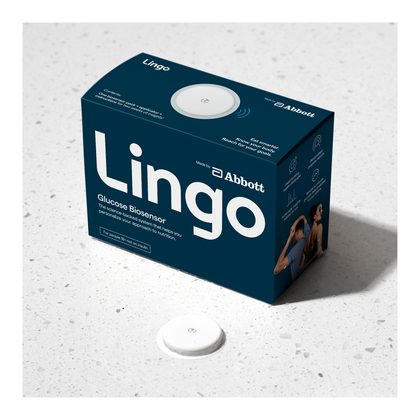
The only over-the-counter sensor that anyone independent has tested in people without diabetes, which is why it’s our pick if accuracy evidence matters most to you; it scores a tenth of a point behind the Stelo routes because of its marketing. In a 2026 University of South Florida study, 39 healthy young adults wore Lingo while researchers checked it against fingerstick readings: the average gap (MARD) was 12.9%, rising to 15.3% after a sugary drink, and the sensor ran about 6 minutes behind the blood. The authors called it good for trends and less reliable for exact numbers, which is the honest way to use any of these. Abbott didn’t run a new study for Lingo’s clearance; it leaned on FreeStyle Libre 2 data from people with diabetes. Lingo updates every minute, the fastest here, but it takes 60 minutes to warm up and its screen tops out at 200 mg/dL. Abbott’s November 2025 Libre 3 correction doesn’t touch it: FDA’s posted notice says no other Libre products “or Abbott biowearables” are affected. FDA’s January 2026 warning letter to Abbott Diabetes Care says Abbott released finished FreeStyle Libre sensors without accuracy-testing the finished devices. The letter doesn’t name Lingo; its examples center on the Libre 3. Lingo’s sensor is based on the FreeStyle Libre 2, per its FDA clearance, so under our same-platform rule we take the same 1 point we take from Stelo for Dexcom’s letter. Abbott hasn’t said whether Lingo’s production is affected. The marketing reaches past the label, with weight-loss, prediabetes-risk and heart-health pitches, and Abbott’s privacy notice says some ad-related sharing may count as a “sale” under state law.
Best forSeeing minute-by-minute swings after meals and workouts
Skip ifYou want readings above 200 mg/dL or an Apple Watch view
Sensor & wearLingo biosensor (Libre 2 platform), back of upper arm, up to 14 days
Warm-up60 minutes
Cost per month$54 for 2 weeks; $89 for 4 weeks; $249 per 12 weeks by subscription (≈$89 per 30 days)
PhoneiPhone or Android; no Apple Watch, iPad or tablets
FSA / HSAEligible
What’s includedBiosensors, app; optional Berry Street dietitian billed to insurance
Accuracy: Independent MARD 12.9% (healthy adults, fingerstick); cleared on Libre 2 dataDisplay: Every minute · 55–200 mg/dL · no glucose alarms
Ultrahuman’s M2 Live ships the same Lingo biosensor with Ultrahuman’s app ($99 a month).
Tied at 8.1 with Levels and Ultrahuman M2 Live. Tied products are listed by cost per 30 days of wear (lowest first); that order isn't a quality ranking.
See score breakdown & sources
Accuracy evidence8.0
FDA status & safety record9.0
What you see8.0
Data privacy & control8.0
Claims honesty7.0
Accuracy: independent MARD 12.9% in people without diabetes (8). FDA: OTC clearance verified (10), no recall minus 1 for FDA’s January 2026 warning letter to Abbott on the FreeStyle Libre platform Lingo uses = 9. What you see: number + trend on your phone 5, updates every 5 min or faster 1, wear 14+ days 1, warm-up 30 min or less 0, shows 55–250 mg/dl 0, data export 1 = 8. Privacy: own policy 8 = 8. Claims: minus 1 each for weight loss, preventing, slowing or reversing a disease, other health outcomes (energy, focus, mood, heart, “metabolism”) = 7.
Independent testPrakash N, et al. Agreement of over-the-counter continuous glucose monitors with capillary-meter glucose in young adults without diabetes. J Diabetes Sci Technol, 2026 (39 adults without diabetes, University of South Florida; Abbott Lingo biosensor vs Contour Next fingerstick meter; overall MARD 12.9%, bias −4.8 mg/dL, 66.5% within 15%/15 mg/dL; MARD 15.3% after a sugar-sweetened drink vs 10.6% after placebo; 6.2-minute estimated lag, MARD 11.2% with a 5-minute shift; 13.8% of trend arrows moderate-to-extreme risk; “No independent study has yet evaluated OTC CGM accuracy”; no direct funding). Cited as independent because no maker funded it. Open source · [1]
FDA databaseFDA 510(k) K233655, Abbott Lingo Glucose System, cleared May 29, 2024 (code SAF): 18 and older not on insulin; based on the FreeStyle Libre 2 sensor (K222447); readings every 1 minute; 55–200 mg/dL; “There are no alarms”; 1-hour warm-up. No new clinical study: Abbott leveraged FreeStyle Libre 2 clinical data from people with diabetes as “a worst-case scenario” and states the system meets the iCGM special controls. Open source · [8]
FDA databaseFDA warning letter to Abbott Diabetes Care, Inc., CMS 722046, Jan. 23, 2026 (posted Feb. 3, 2026): after an October 2025 inspection in Alameda, Calif., which makes “FreeStyle Libre Flash and Continuous Glucose Monitoring Systems including the FreeStyle Libre 3,” FDA said Abbott “releases finished FreeStyle Libre integrated continuous glucose monitoring system (iCGM) devices without performance-testing the finished ... devices for accuracy prior to distribution” and found its responses inadequate. Open source · [16]
FDA databaseFDA, posted company announcement: “Abbott Initiates Medical Device Correction for Certain FreeStyle Libre 3 and FreeStyle Libre 3 Plus Sensors” (Nov. 24, 2025): incorrect low glucose readings; 736 severe adverse events (57 in the U.S.) and 7 deaths (none in the U.S.) reported globally; “no other Libre products (FreeStyle Libre 14 day, FreeStyle Libre 2, FreeStyle Libre 2 Plus, or Libre Pro sensors) or Abbott biowearables are impacted.” Open source · [14]
FDA databaseFDA device recall database (searched via openFDA, Sept. 30, 2026; link is FDA’s public recall search): no recall of Stelo, Lingo, Libre Rio or Signos. Dexcom recalls since 2025 include the G7 receiver speaker (Z-1944-2025, 602,445 units), G7/ONE+ app software with no “Sensor Failed” alert (Z-2446 to Z-2450-2025), a G7 app defect (Z-2163-2026) and stolen scrap G7 sensors resold (Z-2574-2026). FreeStyle Libre 3 and Libre 3 Plus correction initiated Nov. 24, 2025 (Z-1020-2026 to Z-1023-2026; 1,060,723 + 1,663,241 + 258,913 + 8,062 sensors); Medtronic Simplera sensor recall Z-0033-2026 (cap label may not adhere, sterility). Open source · [13]
Maker's dataLingo plans page, Sept. 30, 2026: $54 2-week plan (1 biosensor), $89 4-week plan (2), $249 12-week subscription (6); HSA/FSA eligible; 30-day money-back on first purchase; iOS and Android; data appears in 60 minutes; 77.1% of biosensors lasted 14 days, 14.7% may last under 11; Apple Health and Health Connect integration; 18 and older not on insulin. Open source · [31]
Maker's dataLingo homepage, Sept. 30, 2026: menu items “Lower prediabetes risk,” “Manage your weight,” “Support heart health”; “Tried everything, but still not losing weight?”; “A CGM can help provide insights that support weight-loss efforts”; sign-up promising insights “to supercharge your metabolism.” Open source · [30]
Maker's dataLingo Privacy Notice (Global), July 2026: “We do not sell your Personal Information for money, but some of the ways in which we may disclose your Personal Information to certain third parties ... such as analytics and targeted advertising services, may be considered a “sale””; categories: identifiers, internet activity, geolocation; account deletion by request, including in the app. Open source · [32]
FDA databaseFDA MAUDE adverse-event reports via openFDA (data current to Sept. 22, 2026), counted by DrAxe.com: Stelo, Sept. 9, 2024 to Aug. 31, 2026: 2,448 malfunction, 156 injury, 7 other; Lingo, Oct. 17, 2024 to Aug. 25, 2026: 69 injury, 33 malfunction. Reports are unverified, depend on how many people use a device and how makers report, and are not rates. Open source · [18]
$15/month app + $89 SteloApp $15/month or $80/year; Stelo from Levels $89 per shipment or $99 one-time. Core ($399/year) and Complete ($1,329/year) add lab panels.
Best if you also want labs in the same app
Levels
Metabolic-health app (with optional labs) + Stelo biosensors sold separately
Levels helped start the glucose-for-everyone trend and is now more of a metabolic-health app than a CGM program: meal logging, habit tracking, lab uploads and optional blood panels, with glucose as one input. It sells Stelo sensors ($89 per shipment of two, or $99 one-time) and works with Stelos bought anywhere; it can also connect you with a physician for a prescription Dexcom G7, which we don’t score. On privacy it has the clearest terms of any brand here, promising it doesn’t sell your data for advertising and offering a CSV export, but your Stelo readings still run through a Dexcom account. It loses the most on claims: its homepage says that among members who started in the prediabetes range, “many reversed course,” based on its own retrospective data, and it offers weight-loss and heart-health programs.
Best forPeople who want glucose, labs and habits in one app
Tied at 8.1 with Abbott Lingo and Ultrahuman M2 Live. Tied products are listed by cost per 30 days of wear (lowest first); that order isn't a quality ranking.
See score breakdown & sources
Accuracy evidence8.0
FDA status & safety record9.0
What you see8.0
Data privacy & control8.0
Claims honesty7.0
Accuracy: maker MARD 8.3% in adults with diabetes, capped at 8 as maker data (8) (inherited from the Stelo sensor it ships). FDA: OTC clearance verified (10), no recall minus 1 for FDA’s March 2025 warning letter to Dexcom on the G6/G7 platform Stelo shares = 9. What you see: number + trend on your phone 5, updates every 5 min or faster 0, wear 14+ days 1, warm-up 30 min or less 1, shows 55–250 mg/dl 0, data export 1 = 8. Privacy: own policy 10; requires a Dexcom account, so Dexcom’s terms (8) count = 8. Claims: minus 1 each for weight loss, preventing, slowing or reversing a disease, other health outcomes (energy, focus, mood, heart, “metabolism”) = 7.
Maker's dataLevels homepage, Sept. 30, 2026: “Bring your own CGM or get one through Levels”; app $15/month or $80 billed annually; Core $399/year, Complete $1,329/year; “Among members who started in the prediabetes range, most improved their level and many reversed course” (“Based on retrospective analysis of Levels members. Not a clinical trial”); programs for “glucose control, heart health, and weight loss”; “energy, cravings, and focus.” Open source · [49]
Maker's dataLevels Support, “Stelo Biosensor Pricing” (June 18, 2026): $89 per subscription shipment or $99 one-time two-pack; HSA/FSA reimbursement through Truemed. Open source · [50]
Maker's dataLevels Support, “Bring Your Own Sensors to Levels” (June 1, 2026): Stelo connects “by logging into your Dexcom/Stelo account in the Levels app”; Dexcom G7 and G6 also connect; Levels “can connect you with a physician” for a G7 prescription. Open source · [51]
Maker's dataLevels Health Privacy Policy: “We don’t sell (or sell access to) your data to third parties (for advertising, or for other purposes)”; export biometric data and logs “in CSV format” at app.levels.com; deletion by emailing privacy@levels.com. Open source · [52]
Maker's dataDexcom Privacy Notice (last updated July 2024), on stelo.com: disclosure of personal data to “advertising networks” and “social networks” “qualifies as the “sale” of Personal Data” or targeted advertising under certain state laws; opt-out offered; “we do not “sell” any consumer data in the traditional sense for monetary compensation”; rights to deletion and portability. Open source · [26]
FDA databaseFDA warning letter to Dexcom, Inc., CMS 700835, Mar. 4, 2025: after inspections in San Diego (Oct.–Nov. 2024) and Mesa, Ariz. (June 2024), FDA cited G6 and G7 sensors as adulterated and misbranded; Dexcom changed “a component used in the resistance layer” of its sensors; its equivalence study “resulted in determining your primary endpoints were not met”; sensors with the new component showed “significantly greater variability.” No close-out letter was posted as of Sept. 30, 2026. Open source · [15]
12.9%[1]Lingo’s independent MARD in people without diabetes
$99[33]a month for 2 sensors, introductory (maker)
NFC[33]phone needed to activate the sensor (maker)
Ultrahuman scores the same as Lingo because it ships the same Abbott Lingo biosensor, so it inherits the same independent accuracy data and the same FDA record, including the point for Abbott’s 2026 warning letter; it’s listed after Lingo and Levels on cost. What you get extra is Ultrahuman’s app, with a Metabolic Score, food scores, an AI coach and access to human performance coaches, plus syncing with workout apps. Ultrahuman doesn’t hold its own FDA clearance; the clearance belongs to Abbott’s Lingo system. At $99 a month for two 14-day sensors (an introductory price the page says saves 23%), it costs more than buying Lingo direct. Its pricing page goes further than the sensor’s label, promising you can “Lose weight sustainably” and saying better glucose is crucial for “reducing the risk of T2 diabetes, obesity, PCOS/PMOS, hypertension.” Its privacy policy says it doesn’t sell personal information, but that website pixel tags feed “tailored advertisements.”
Best forAthletes who want food and fueling scores on top of a Lingo sensor
Skip ifYou want the lowest monthly cost or an FDA-cleared app
Accuracy: Inherits Lingo: independent MARD 12.9%Display: Every minute · Ultrahuman app · human coaches included
Tied at 8.1 with Abbott Lingo and Levels. Tied products are listed by cost per 30 days of wear (lowest first); that order isn't a quality ranking.
See score breakdown & sources
Accuracy evidence8.0
FDA status & safety record9.0
What you see8.0
Data privacy & control8.0
Claims honesty7.0
Accuracy: independent MARD 12.9% in people without diabetes (8) (inherited from the Lingo sensor it ships). FDA: OTC clearance verified (10), no recall minus 1 for FDA’s January 2026 warning letter to Abbott on the FreeStyle Libre platform Lingo uses = 9. What you see: number + trend on your phone 5, updates every 5 min or faster 1, wear 14+ days 1, warm-up 30 min or less 0, shows 55–250 mg/dl 0, data export 1 = 8. Privacy: own policy 8 = 8. Claims: minus 1 each for weight loss, preventing, slowing or reversing a disease, other health outcomes (energy, focus, mood, heart, “metabolism”) = 7.
Maker's dataUltrahuman M2 Live pricing page (U.S.), Sept. 30, 2026: “No prescription needed”; subscription $99 for “2 CGM Sensors/Month,” “At Introductory Pricing,” “save 23%”; “In the US, we integrate with Abbott’s Libre 3 Plus and Lingo Biosensors”; “We use ... Abbott Lingo™, in their original packaging”; NFC needed to activate; 14-day sensors; performance coaches included; “Lose weight sustainably”; “reducing the risk of T2 diabetes, obesity, PCOS/PMOS, hypertension”; “improve cognitive performance.” Open source · [33]
Independent testPrakash N, et al. Agreement of over-the-counter continuous glucose monitors with capillary-meter glucose in young adults without diabetes. J Diabetes Sci Technol, 2026 (39 adults without diabetes, University of South Florida; Abbott Lingo biosensor vs Contour Next fingerstick meter; overall MARD 12.9%, bias −4.8 mg/dL, 66.5% within 15%/15 mg/dL; MARD 15.3% after a sugar-sweetened drink vs 10.6% after placebo; 6.2-minute estimated lag, MARD 11.2% with a 5-minute shift; 13.8% of trend arrows moderate-to-extreme risk; “No independent study has yet evaluated OTC CGM accuracy”; no direct funding). Cited as independent because no maker funded it. Open source · [1]
FDA databaseFDA 510(k) K233655, Abbott Lingo Glucose System, cleared May 29, 2024 (code SAF): 18 and older not on insulin; based on the FreeStyle Libre 2 sensor (K222447); readings every 1 minute; 55–200 mg/dL; “There are no alarms”; 1-hour warm-up. No new clinical study: Abbott leveraged FreeStyle Libre 2 clinical data from people with diabetes as “a worst-case scenario” and states the system meets the iCGM special controls. Open source · [8]
FDA databaseFDA warning letter to Abbott Diabetes Care, Inc., CMS 722046, Jan. 23, 2026 (posted Feb. 3, 2026): after an October 2025 inspection in Alameda, Calif., which makes “FreeStyle Libre Flash and Continuous Glucose Monitoring Systems including the FreeStyle Libre 3,” FDA said Abbott “releases finished FreeStyle Libre integrated continuous glucose monitoring system (iCGM) devices without performance-testing the finished ... devices for accuracy prior to distribution” and found its responses inadequate. Open source · [16]
Maker's dataUltrahuman Privacy Policy (updated Sept. 13, 2026): “We do not sell your personal information”; “We use pixel tags to collect personal information from website visitors, which may then be used to ... provide tailored advertisements”; third parties include Facebook Ads and Google Ads; rights to deletion and a portable copy. Open source · [34]
Our calculation from each brand's cheapest ongoing plan, per 30 days of sensor wear. Stelo sensors last 15 days and Lingo sensors 14, so a Lingo “month” of two sensors covers 28 days.
Official-site prices on Sept. 30, 2026; sale prices are marked. Stelo, Signos and Nutrisense sales are final[22][41][45]; Lingo offers 30-day money back on a first purchase[31]. Both sensors are HSA/FSA eligible[22][31]. Nutrisense's dietitian calls are billed to insurance[45].
Signature chart
Accuracy: what's actually been tested
MARD is the average gap between the sensor and a reference, ignoring direction; lower is better. Only one number here comes from people like most buyers, healthy adults, and it's measured against a fingerstick meter, a less exact reference than a lab analyzer, which tends to push MARD up.
Mean absolute relative difference (MARD), by who tested and on whom
Independent, healthy adultsMaker, adults with diabetesBorrowed data10%: our top accuracy band
0%4%8%12%16%
Independent study, people without diabetes
Lingo: overall[1]39 adults without diabetes vs fingerstick meter12.9%MARD
Lingo: readings shifted 5 min[1]same study, correcting the ~6-min lag11.2%MARD
Maker’s study, people with diabetes
Stelo: overall[23]130 adults with type 1 or 2 diabetes vs lab analyzer8.3%MARD
Stelo: first days of wear[4]same study, beginning of sensor life9.1%MARD
Stelo: middle of wear[4]same study, late middle7.3%MARD
Borrowed from a sibling device
Lingo: FDA clearance data[8]FreeStyle Libre 2 study in people with diabetes; no Lingo MARD publishedLingo MARD not publishedn/anot published
Lingo's clearance used FreeStyle Libre 2 clinical data from people with diabetes, which Abbott called a “worst-case scenario” for accuracy[8]; Abbott publishes no Lingo MARD. Stelo's study compared against a YSI lab analyzer; Dexcom's “93% accurate” means 93% of readings fell within 20% of the lab value[24]. FDA's iCGM rules require, among other things, more than 87% of readings within 20% across the range[20]. Signos, Nutrisense, Levels and Oura use Stelo; Ultrahuman uses Lingo. No independent Stelo study in healthy people was published as of Sept. 30, 2026.
The FDA record
What the brand says vs. what FDA's records say
We looked up every clearance in FDA's 510(k) database on Sept. 30, 2026. “Cleared” means FDA agreed a device is similar to one already sold, for specific uses. Here's who holds each clearance, whether it covers what you'd buy, and what it's actually cleared for.
Clearance check, product by product
7over-the-counter CGM clearances exist, held by just Dexcom, Abbott and Signos[2]
0recalls of Stelo, Lingo, Libre Rio or Signos in FDA's database[13]
2FDA warning letters, one to each sensor maker: Dexcom (March 2025, G6/G7) and Abbott (January 2026, FreeStyle Libre)[15][16]
0over-the-counter systems with glucose alarms[3][8][10]
ProductWhat the brand saysFDA record · holderMatchCleared for vs. sold with
Cleared forStelo; Levels app not clearedSold withPrediabetes “reversed course”[49]
Ultrahuman M2 Live#5= · 8.1/10
Since Lingo Biosensor is available over-the-counter, no prescription is required[33]
K233655 (Abbott’s Lingo) · no Ultrahuman 510(k)[2]
Sensor only
Cleared forLingo system: adults 18+ not on insulinSold withLose weight sustainablyT2 diabetes, PCOS risk[33]
Adverse-event reports to FDA through August 2026: Stelo 2,448 malfunction and 156 injury reports (most injury reports for skin infection, redness or pain); Lingo 69 injury and 33 malfunction reports. These are unverified, scale with how many people use a device, and aren't rates[18]. Ultrahuman, Levels and Oura hold no clearance of their own; a second screen showing a cleared sensor's data isn't the same as a cleared app.
Reference
A normal glucose day, in numbers
The best reference for a CGM wearer without diabetes is a 2019 study of 153 healthy people aged 7 to 80 who wore blinded sensors for up to 10 days[54].
How a healthy 24 hours splits up
96%median time at 70–140 mg/dL; average 98–99 mg/dL (104 over age 60)
~30 mina day above 140 mg/dL (2.1%)
~15 mina day below 70 mg/dL (1.1%)
Where the lines are, mg/dL
70–140: where healthy people spend 96% of the day5470100126140200250
Fasting normal (lab)Fasting prediabetes range (lab)Fasting diabetes range (lab)2-hour test: prediabetes range70–140: healthy day
What each sensor can show
Stelo app today: 70–250
Lingo: 55–200
Lab thresholds: a fasting blood test of 99 or below is normal and 100–125 is the prediabetes range; a 2-hour glucose-tolerance result of 140 or below is normal[64]. A CGM reading isn't a lab test: in 8,315 adults, 40% of people with a normal first fasting reading landed in the prediabetes range on some later morning[57]. Display ranges: Stelo's current user guide[23] and Lingo's clearance[8]; FDA cleared Stelo for 55–350 in June 2026[6].
Experiments worth running
What moves your numbers
These are the tests in our 14-day experiment, with how strong the evidence is. Most trials were small and short and many were in people with type 2 diabetes, so your own sensor is the real test. Effect sizes (−0.72 and so on) are standardized: about −0.2 is small, −0.5 moderate, −0.8 large.
of 30 people went above 140 mg/dL (a spike, not a cut)
Sleep and stress change glucose too, but we didn't find strong data in people without diabetes, so log them as your own experiment. The walking-break trials used short breaks, typically 2 minutes every 20[62].
How we score: the Dr. Axe Clean Glucose Score™
Most CGM reviews rank on app features and how the tester felt. Ours starts with what you can check: who tested the accuracy and on whom, what FDA's own records say, what the app really shows, what the privacy policy allows, and whether the marketing stays inside the label. It's an editorial assessment built from FDA databases, user guides, privacy policies, product pages and studies, not our own testing. Price isn't scored; see the cost chart.
Accuracy evidence30%
Independent MARD measured in people without diabetes: 10% or lower 10; 10.1–12% 9; 12.1–14% 8; over 14% 6. The maker’s own MARD for the same device (any population) is scored on the same table but capped at 8; maker data borrowed from a sibling device is capped at 7. Programs inherit the sensor they ship; a program that doesn’t say which sensor it ships gets 5.
FDA status & safety record20%
An over-the-counter clearance for this use that we verified in FDA’s 510(k) database 10; a program shipping a prescription sensor under its own prescription 7; no clearance, or not a medical device, 3. A recall of this product within 3 years costs 2; an FDA warning letter to the sensor’s maker about the same sensor platform within 3 years costs 1.
What you see20%
A glucose number and trend on your phone 5 (trend graph only, no number, 1). Plus 1 each for: readings that update at least every 5 minutes; a sensor that lasts 14 days or more; a warm-up of 30 minutes or less; a display range that covers 55 to 250 mg/dL; and a way to get your data out (health-app sync, CSV or API). None of the over-the-counter systems sends low- or high-glucose alarms, so alarms aren’t scored.
Data privacy & control15%
Starts at 10. Minus 2 when the privacy policy says personal data goes to advertising networks or partners for targeted advertising, or that sharing may count as a “sale” under state privacy law; minus 1 with no way to export your data; minus 1 with no account-deletion path. When a program requires the sensor maker’s account, the weaker of the two policies counts.
Claims honesty15%
Starts at 10. Minus 1 for each kind of claim beyond the device’s FDA labeling on the pages that sell it: weight loss (saying the product helps you lose weight or fat); preventing, slowing or reversing a disease (prediabetes, diabetes, PCOS and the like); and other health outcomes (energy, focus, mood, heart health, “metabolism”). Up to minus 3; floor 3.
Accuracy. The only independent accuracy study of an over-the-counter sensor in people without diabetes tested Lingo: 12.9% MARD against fingersticks[1], which lands in our 12.1–14% band (8). Stelo's 8.3% comes from Dexcom's own study in adults with diabetes[23]; it would score 10 on the table, but maker data is capped at 8. So the two sensors tie on this pillar, for different reasons. Programs inherit the sensor they ship.
FDA status and safety record. We verified every clearance in FDA's 510(k) database[2] and searched FDA's recall database[13]. No recall touches Stelo or Lingo; Abbott's Libre 3 correction excludes Lingo[14]. Both sensors lose 1 point for a warning letter to their maker on the same platform: FDA's March 2025 letter to Dexcom concerned the G7 sensor[15], and Stelo “uses the same hardware design as the predicate G7”[3]; FDA's January 2026 letter to Abbott concerned FreeStyle Libre sensors released without finished-device accuracy testing[16]. That letter doesn't name Lingo; it covers FreeStyle Libre sensors, and Lingo's sensor is based on the Libre 2[8], so under our same-platform rule Lingo loses the same point. Every program inherits its sensor's point. Without the Abbott deduction, Lingo and Ultrahuman would score 8.3, above Stelo, Signos and Nutrisense but still behind Oura + Stelo; without both platform deductions, Oura + Stelo would score 8.6, Stelo, Signos and Nutrisense 8.4, and Lingo 8.3. None of the ranked programs ships a prescription sensor.
What you see, point by point. Both sensors earn 8, differently:
Feature
Stelo
Lingo
Number + trend on your phone
5
5
Updates every 5 min or faster
0
1
Wear 14+ days
1
1
Warm-up 30 min or less
1
0
Shows 55–250 mg/dL
0
0
Data export
1
1
Total
8
8
Stelo's June 2026 clearance allows 55–350 mg/dL[6], but its current user guide still shows 70–250[23], so it doesn't get that point yet.
Privacy. Dexcom's and Abbott's policies both say ad-related sharing can count as a “sale” under state law[26][32]; Ultrahuman uses website pixels for “tailored advertisements”[34]; Signos lists “targeted ads, retargeted ads”[42]. Levels and Nutrisense say they don't share data for targeted ads[52][46]; Oura says it doesn't sell or share personal data for cross-context behavioral advertising but uses website cookies to build ad audiences[39], which we treat like Ultrahuman's pixels. Each of those three requires a Dexcom/Stelo account for the sensor[51][47][36], as does Signos[43], so Dexcom's terms count too. Every brand offers export and deletion. HIPAA mostly doesn't apply to consumer apps, which is why the policy matters.
Claims honesty. Three kinds of claims cost 1 point each: weight loss (saying the product helps you lose weight or fat), disease prevention or reversal, and other health outcomes such as energy, focus or heart health. Oura's line about moving toward “a healthy weight” doesn't say you'll lose weight, so it isn't deducted[38]. Signos's own clearance allows that its data “may be useful in helping users to maintain a healthy weight”[10]; its fat-loss pitch goes further, so it still loses the point. A site stating an older age range than its newest clearance (Stelo: 18+ on the site, 2+ in FDA's June 2026 clearance) is noted, not deducted[22][6].
Who's in, and ties. One entry per product. Prescription CGMs are listed for context only. Libre Rio is cleared but we found nowhere to buy it; Veri has no pricing. Ties at one decimal go to the higher unrounded score, then the lower cost per 30 days of sensor wear, our lead practical metric. All 7 entries score within 0.30 points: treat them as a tie on quality and choose by sensor, price and features. Tied scores share a rank on this page.
One caveat applies to every score: only one sensor has been tested independently in the people who buy these most, and in just 39 young adults. Every other accuracy number comes from the makers, in people with diabetes.
Why we don't chase every spike
That's our dividing line: we reward monitors that help you see patterns and sell themselves honestly, and we mark down marketing that turns a normal post-meal rise into a disease warning or a weight-loss promise.
Healthy people spike too
Median time above 140 mg/dL in healthy adults is about 30 minutes a day[54], and cornflakes pushed 80% of people in one study past 140[55].
One reading isn't a diagnosis
Fasting CGM values swing about 7.5 mg/dL from day to day; 40% of people with a normal first reading hit the prediabetes range on another morning[57].
The sensor is behind and a bit off
Lingo trailed fingersticks by about 6 minutes and missed by 15.3% on average after sugar[1]. Chasing a single peak means chasing noise.
Worry is a real side effect
68% of CGM users in one survey feared diabetes when they saw a high reading[59]; the best review found psychosocial evidence too thin to rule out harm[58].
What to do: judge patterns over days, not single peaks. Look at how high a meal takes you above your starting point and how long it takes to come back. If your numbers worry you, get a lab fasting glucose or A1C[64].
Does wearing a CGM help? What the evidence shows
The solid findings describe what glucose does in healthy people. The findings on whether wearing a CGM changes your health are thin: a 2026 systematic review of 12 studies rated the dietary evidence low certainty and the rest very low[58]. Here's how we'd grade it:
feared type 2 diabetes after a high reading (56 adults with and without diabetes, not on insulin); eating-disorder symptoms tracked with distress about the sensor’s appearance.
Obes Res Clin Pract, 2025
Two practical takeaways: use a CGM as a two-week teacher, not a lifelong scoreboard, and trust the pattern over the peak.
How to read a glucose monitor's specs
The same 8.3% can mean very different things depending on who wore the sensor and what it was compared with[23][1], and the update interval and display range decide what you'll actually see[3][8]. Here's what each spec tells you:
Spec
What it tells you
Where to check it
MARD
Average % gap from a reference, ignoring direction. Lower is better; check who was tested and against what.
User guide’s accuracy table
20/20% agreement
Share of readings within 20% (or 20 mg/dL when low) of the lab value. Stelo’s “93% accurate” is this number.
Maker’s accuracy page
Update interval
Lingo shows a reading every minute; Stelo’s app every 15 minutes, though the sensor sends every 5.
FDA 510(k) summary
Display range
Readings outside it show as “low” or “high.” Stelo: 70–250 today; Lingo: 55–200.
User guide
Warm-up
Time before the first reading: Stelo 30 minutes, Lingo 60.
Buy page
Wear time and survival
Stelo 15 days (77.9% of sensors lasted); Lingo 14 days (77.1%). Both replace early failures.
Buy page footnotes
Lag
Sensors read the fluid under the skin, which trails blood by minutes (about 6 for Lingo).
Independent study
Glucose alarms
Prescription CGMs have them; none of the over-the-counter systems does.
FDA 510(k) summary
Product code SAF / SBH
FDA’s two over-the-counter CGM codes. A brand app without one is a second screen.
FDA 510(k) database
“Sale” in the privacy policy
Under state laws, ad-network sharing can count as a sale even with no money changing hands.
Privacy policy, U.S. state section
More picks by category
Best ways to use a Dexcom Stelo
Five ways to buy the same 15-day sensor. The cheapest is Stelo direct; the programs add coaching, labs or a different app, and all run through a Dexcom account[43][51].
The first over-the-counter CGM, and the pick if you don’t wear an Oura Ring: it ties Signos and Nutrisense, which ship the same sensor, at 8.2 and costs the least.
FDA OTC clearedMARD 8.3% (diabetes)Updates Every 15 min
Our top score, by a small margin and only if you already wear an Oura Ring: it’s the simplest way to see glucose next to your sleep, stress and activity, and Oura sells it with the fewest marketing claims of any brand here.
FDA Via SteloMARD 8.3% (diabetes)Updates Every 15 min
Signos is the only program here whose app has its own FDA clearance: in March 2025 FDA cleared it as an over-the-counter display for the Stelo sensor, with an added line that the information “may be useful in helping users to maintain a healthy weight.” Every plan ships two Stelo sensors a month, so it inherits Stelo’s accuracy data, display limits and the point Dexcom loses for its 2025 warning letter.
FDA Own app clearanceMARD 8.3% (diabetes)Updates Every 15 min
Levels helped start the glucose-for-everyone trend and is now more of a metabolic-health app than a CGM program: meal logging, habit tracking, lab uploads and optional blood panels, with glucose as one input.
FDA Via SteloMARD 8.3% (diabetes)Updates Every 15 min
The only over-the-counter sensor that anyone independent has tested in people without diabetes, which is why it’s our pick if accuracy evidence matters most to you; it scores a tenth of a point behind the Stelo routes because of its marketing.
FDA OTC clearedMARD 12.9% (healthy)Updates Every minute
Ultrahuman scores the same as Lingo because it ships the same Abbott Lingo biosensor, so it inherits the same independent accuracy data and the same FDA record, including the point for Abbott’s 2026 warning letter; it’s listed after Lingo and Levels on cost.
FDA Via Lingo; app not clearedMARD 12.9% (healthy)Updates Every minute
Nutrisense recommends two dietitian calls a month, billed to insurance[45]; Signos offers in-app dietitian chat[41]; Ultrahuman includes performance coaches[33]. Stelo and Lingo both point you to insurance-billed dietitians too[22][31].
Signos is the only program here whose app has its own FDA clearance: in March 2025 FDA cleared it as an over-the-counter display for the Stelo sensor, with an added line that the information “may be useful in helping users to maintain a healthy weight.” Every plan ships two Stelo sensors a month, so it inherits Stelo’s accuracy data, display limits and the point Dexcom loses for its 2025 warning letter.
FDA Own app clearanceMARD 8.3% (diabetes)Updates Every 15 min
Ultrahuman scores the same as Lingo because it ships the same Abbott Lingo biosensor, so it inherits the same independent accuracy data and the same FDA record, including the point for Abbott’s 2026 warning letter; it’s listed after Lingo and Levels on cost.
FDA Via Lingo; app not clearedMARD 12.9% (healthy)Updates Every minute
The first over-the-counter CGM, and the pick if you don’t wear an Oura Ring: it ties Signos and Nutrisense, which ship the same sensor, at 8.2 and costs the least.
FDA OTC clearedMARD 8.3% (diabetes)Updates Every 15 min
The only over-the-counter sensor that anyone independent has tested in people without diabetes, which is why it’s our pick if accuracy evidence matters most to you; it scores a tenth of a point behind the Stelo routes because of its marketing.
FDA OTC clearedMARD 12.9% (healthy)Updates Every minute
Our top score, by a small margin and only if you already wear an Oura Ring: it’s the simplest way to see glucose next to your sleep, stress and activity, and Oura sells it with the fewest marketing claims of any brand here.
FDA Via SteloMARD 8.3% (diabetes)Updates Every 15 min
Levels helped start the glucose-for-everyone trend and is now more of a metabolic-health app than a CGM program: meal logging, habit tracking, lab uploads and optional blood panels, with glucose as one input.
FDA Via SteloMARD 8.3% (diabetes)Updates Every 15 min
In February 2024 FDA told people not to use smartwatches or smart rings that claim to measure blood glucose “without piercing the skin,” because inaccurate readings can lead to wrong decisions; the warning covers any brand[19]. That's different from a watch or ring app that shows data from a real CGM: Stelo can send readings straight to an Apple Watch[25], and the Oura App shows Stelo data[36]. If a wearable promises glucose with no sensor under the skin, skip it.
Prescription CGMs and devices we couldn't rate
These are diabetes devices with alarms and insulin-pump links, sold by prescription. We list them for context, not as recommendations for people without diabetes.
Device
FDA route
What to know
Dexcom G7 15 Day
Prescription iCGM (510(k) K243214, Apr. 9, 2025)
Same hardware family as Stelo, with alarms and insulin-pump links. Named in FDA’s March 2025 warning letter (G6 and G7). G7 recalls since 2025: app software (no “Sensor Failed” alert), receiver speakers and stolen scrap sensors resold; none involves Stelo.[11][15][13]
FreeStyle Libre 3 / 3 Plus
Prescription iCGM
Corrected in November 2025 after incorrect low readings: about 3 million U.S. sensors from one production line (four Libre 3 and 3 Plus product codes); 736 severe adverse events (57 in the U.S.) and 7 deaths (none in the U.S.) reported worldwide. None involves Lingo.[14][13]
Eversense 365
Prescription, implanted (PMA P160048)
A sensor a clinician implants under the skin for up to a year. Latest PMA filing approved Mar. 19, 2026.[12]
Medtronic Simplera / Simplera Sync
Prescription (PMA P160007, P250012)
Built for Medtronic insulin pumps. One 2025 recall for a cap label that may not stick, compromising sterility.[12][13]
·
Abbott Libre RioCleared, not found for sale
Cleared over the counter on June 7, 2024 for adults 18 and older who don’t use insulin (Abbott has positioned it for type 2 diabetes); 40–400 mg/dL, 15-day wear, no glucose alarms. We found no official place to buy it on Sept. 30, 2026: librerio.com redirects to Abbott’s homepage.[9][2]
Not rated
·
VeriNo pricing found
Its site says “Veri is joining ŌURA”; we found no pricing page, so there’s nothing current to score.[53]
Not rated
What about the Dexcom warning letter and the Libre 3 recall?
Both sensor makers have had a warning letter and recalls of their prescription products: Abbott's Libre 3 correction, and Dexcom's G7 app, receiver and diverted-sensor recalls[13]. None involves Stelo or Lingo. Here's what the records say.
The Dexcom warning letterOn March 4, 2025, FDA sent Dexcom a warning letter after inspecting its San Diego and Mesa, Ariz., plants. FDA said Dexcom changed a component in the resistance layer of its G6 and G7 sensors without a new clearance, that its own equivalence study didn't meet its primary endpoints, and that sensors with the new component showed “significantly greater variability”[15]. Dexcom disputes that: its spokesperson said it “qualified a second source for one of its raw materials,” that testing showed the material met specifications, and that no design changes were made[28]. Dexcom said it notified FDA through 510(k) submissions under the rules for non-significant changes[28], reverted to its original supplier, according to an analyst, and said at the time there was no need yet for a recall[27]. FDA hadn't posted a close-out letter as of Sept. 30, 2026.
Why it matters for SteloStelo isn't named in the letter, but FDA's Stelo clearance says it “uses the same hardware design” as the G7[3]. That's why we take 1 point from Stelo and every program that ships it. Proposed class actions filed since September 2025, including Levens v. Dexcom, Inc. in federal court in San Diego, allege the change made G6 and G7 readings more variable; these are allegations, and the case was open on Sept. 30, 2026[29].
The Libre 3 recallIn November 2025 Abbott began correcting FreeStyle Libre 3 and 3 Plus sensors that could give incorrect low readings: about 3 million sensors in the U.S. from one production line, with 736 severe adverse events (57 in the U.S.) and 7 deaths (none in the U.S.) reported worldwide[14][13]. Abbott's notice says no other Libre products “or Abbott biowearables are impacted,” and Lingo is built on the Libre 2 platform[14][8], so the recall doesn't count against Lingo.
The Abbott warning letterOn January 23, 2026, FDA sent Abbott Diabetes Care a warning letter after inspecting its Alameda, Calif., site, which makes FreeStyle Libre sensors. FDA said Abbott released finished FreeStyle Libre sensors “without performance-testing the finished ... devices for accuracy prior to distribution” and hadn't given its contract manufacturers the accuracy specifications[16]. Analysts said it didn't require a recall and that Abbott is working on corrective actions[17]. The letter doesn't name Lingo. Because Lingo's sensor is based on the FreeStyle Libre 2, our same-platform rule takes 1 point, the same as Stelo.
Who owns whomDexcom bought Nutrisense (announced June 2026)[48] and invested $75 million in Oura in November 2024[40]. Four of our seven entries run on Dexcom's sensor. That doesn't change any score, but you should know it when a “program” recommends Stelo.
Our adviceNeither Stelo nor Lingo has been recalled, and both makers have warning letters about their manufacturing controls. For a food-and-habits experiment that's a reason to read trends rather than single numbers, not a reason to avoid them. Pick Lingo for independent accuracy data in healthy people and minute-by-minute readings; pick Stelo for longer wear, Apple Watch support or an Oura link.
What we'd skip
Two things to avoid, whichever monitor you buy.
·
Any watch or ring that reads glucose without a sensorA category, not a brand
FDA’s 2024 safety communication says don’t use them[19].
Skip
·
Programs that promise weight loss or reversalA pitch to watch for
None of these sensors is cleared to treat anything; claims like prediabetes that “reversed course” come from brands’ own retrospective data[49].
Skip
When the label says more than the test
The biggest gaps aren't lies; they're fine print. About 1 in 5 sensors doesn't last its full wear time, accuracy slips on day one and after sugar, and Stelo's newest clearance hasn't reached its app or site yet.
Stelo sensor life[22]Advertised vs. lasted in Dexcom’s study
Days (bar for 77.9% = share of 15 days)
Advertised15 days
Sensors that lasted 15 days77.9%
Lingo sensor life[31]Advertised vs. lasted in Abbott’s data
Youngest cleared age: bar = years below 18 opened up
FDA clearance2+
Stelo site18+
DA
Dr. Axe's Take
A continuous glucose monitor is one of the most useful two-week experiments you can run on yourself. It shows you, in your own numbers, what a bowl of cereal does compared with eggs and vegetables, and what a short walk after dinner does compared with the couch. That kind of feedback changes habits faster than any list of rules.
My first non-negotiable is to use it as a teacher, not a scoreboard. Run a baseline, test meal order, walk after meals, try a protein-first breakfast, and then take it off. Look at patterns across days, not a single peak, and remember that healthy people rise above 140 for a little while most days.
Second, buy the sensor, not the promise. Stelo and Lingo are the only two over-the-counter sensors you can actually buy, and every program on this list ships one of them. If a brand tells you a sensor will melt fat or reverse a disease, that's marketing, not the label.
Third, protect your data. Your glucose readings say a lot about you, and several of these companies share data with advertising partners. Opt out of targeted advertising in each app, and delete your account when you're done. Then put your energy where it matters most: whole-food meals built around protein and vegetables, daily movement and real sleep.
— Dr. Axe
Frequently asked questions
What is the best over-the-counter CGM?
All seven we scored are within 0.30 points, so treat them as a tie on quality and choose by sensor, price and features. The top score goes to Oura + Stelo (8.4/10) for Oura Ring owners: the same Dexcom Stelo sensor, sold with the fewest marketing claims. Without a ring, Dexcom Stelo (8.2) is the cheapest route at $84 a month, with 15-day wear and Apple Watch support. Abbott Lingo (8.1) has the only independent accuracy data in people without diabetes and updates every minute.
Do I need a prescription for a CGM?
Not for Dexcom Stelo or Abbott Lingo, which FDA cleared for over-the-counter use in adults who don’t use insulin. Signos, Nutrisense, Levels, Oura and Ultrahuman ship one of those two sensors. Prescription CGMs such as the Dexcom G7 and FreeStyle Libre 3 are diabetes devices with alarms.
How accurate are over-the-counter CGMs for people without diabetes?
Good for trends, less exact for single numbers. The only independent study, 39 healthy young adults wearing Lingo, found a 12.9% average gap from fingersticks, 15.3% after a sugary drink, and a lag of about 6 minutes. Dexcom’s own Stelo study found 8.3% against a lab analyzer, but in adults with diabetes.
What’s a normal glucose reading on a CGM?
In 153 healthy people, the median time between 70 and 140 mg/dL was 96% of the day, average glucose was 98–99 mg/dL, and about 30 minutes a day above 140 was typical. Stelo’s preset target range for people without diabetes is 70–140.
Can a CGM tell me if I have prediabetes?
No. Prediabetes is diagnosed with lab tests: a fasting glucose of 100–125 mg/dL, a 2-hour glucose-tolerance result of 140–199, or an A1C of 5.7–6.4%. CGM readings vary: in 8,315 adults, 40% of those with a normal first fasting reading hit the prediabetes range on a later morning. If your numbers look high, get a lab test.
Do Stelo and Lingo have low or high glucose alarms?
No. Neither over-the-counter sensor, nor the Signos app, sends glucose alarms. That’s one reason they aren’t for people on insulin or with problematic low blood sugar.
Stelo or Lingo: which should I buy?
Lingo if you want a reading every minute, independent accuracy data in healthy people and a 30-day money-back guarantee on your first purchase. Stelo if you want 15-day wear, a 30-minute warm-up, Apple Watch or Oura support and the lowest monthly cost ($84 on the 3-month plan).
Can a smartwatch or smart ring measure blood sugar?
Not on its own. FDA warned in February 2024 not to use watches or rings that claim to measure glucose without piercing the skin. Apps that display data from a real CGM, like Stelo on an Apple Watch or in the Oura App, are different.
Who shouldn’t use an over-the-counter CGM?
People on insulin or dialysis, anyone with problematic hypoglycemia, and, per Stelo’s June 2026 labeling, anyone with a history of eating disorders. Remove the sensor before an MRI or CT scan. FDA cleared Stelo for ages 2 and up with caregiver supervision in June 2026, but Dexcom still sells it for adults 18 and older.
Does wearing a CGM help you eat better or lose weight?
Maybe a little, with education. In one 8-week trial from a 2026 review, people wearing a CGM plus low-glycemic coaching ate about 15 grams fewer carbohydrates a day than coaching alone; activity didn’t change, and the review called the evidence low certainty. It’s a feedback tool, not a treatment.
Were Stelo or Lingo part of the Libre 3 recall or the warning letters?
Neither was recalled. Abbott’s November 2025 Libre 3 correction says no other Libre products or Abbott biowearables, which includes Lingo, are affected. FDA’s March 2025 warning letter named Dexcom’s G6 and G7; Stelo shares the G7’s hardware, and Dexcom disputes FDA’s findings. FDA’s January 2026 warning letter to Abbott concerned accuracy testing of FreeStyle Libre sensors, the platform Lingo is built on.
References
Update history
Sept. 30, 2026: First published. Scores built from FDA's 510(k), recall, PMA and adverse-event databases, user guides, privacy policies and product pages, one independent accuracy study and peer-reviewed research, all checked Sept. 30, 2026. Prices from official sites on Sept. 30, 2026.
Independent test Prakash N, et al. Agreement of over-the-counter continuous glucose monitors with capillary-meter glucose in young adults without diabetes. J Diabetes Sci Technol, 2026 (39 adults without diabetes, University of South Florida; Abbott Lingo biosensor vs Contour Next fingerstick meter; overall MARD 12.9%, bias −4.8 mg/dL, 66.5% within 15%/15 mg/dL; MARD 15.3% after a sugar-sweetened drink vs 10.6% after placebo; 6.2-minute estimated lag, MARD 11.2% with a 5-minute shift; 13.8% of trend arrows moderate-to-extreme risk; “No independent study has yet evaluated OTC CGM accuracy”; no direct funding). Cited as independent because no maker funded it. Open source
FDA database FDA 510(k) database via openFDA (data current to Sept. 21, 2026), searched by DrAxe.com on Sept. 30, 2026: every clearance under the two over-the-counter CGM product codes (SAF, non-intensive monitoring; SBH, non-intensive management): K234070, K261359, K260935 and K262472 (Dexcom Stelo), K233655 (Abbott Lingo), K233861 (Abbott Libre Rio), K250106 (Signos). No other company holds one. Open source
FDA database FDA 510(k) K234070, Dexcom Stelo Glucose Biosensor System, cleared Mar. 5, 2024 (code SAF): adults 18 and older not on insulin; “The Stelo System uses the same hardware design as the predicate G7 CGM System”; app displays glucose every 15 minutes (sensor sends every 5); 70–250 mg/dL; “does not provide any glucose or system alerts.” Open source
FDA database FDA decision summary for K234070: MARD by wear period 9.1% (beginning), 7.8%, 7.3%, 9.1% (end) in 130 adults; 19.8% of sensors (26 of 131) had early sensor shut-off; 73.5% of evaluable sensors lasted to the final day in the original study. Open source
FDA database FDA 510(k) K261359, Stelo (special 510(k)), cleared May 21, 2026: app changes including glucose response scores; same 18+ indication; 70–250 mg/dL; no glucose alerts. Open source
FDA database FDA 510(k) K260935, Stelo, cleared June 12, 2026 (code SBH): “people 2 years and older not on insulin” (caregiver supervision under 18); reportable range 55–350 mg/dL; direct-to-Apple-Watch; “not for people on dialysis, with problematic hypoglycemia, are modifying medication without HCP consultation, or have a history of eating disorders”; no glucose alerts; pediatric accuracy on days 11–15 “not directly assessed.” Open source
FDA database FDA 510(k) K262472, Stelo alternate adhesive patch, cleared Aug. 11, 2026; same 2+ indication as K260935. Open source
FDA database FDA 510(k) K233655, Abbott Lingo Glucose System, cleared May 29, 2024 (code SAF): 18 and older not on insulin; based on the FreeStyle Libre 2 sensor (K222447); readings every 1 minute; 55–200 mg/dL; “There are no alarms”; 1-hour warm-up. No new clinical study: Abbott leveraged FreeStyle Libre 2 clinical data from people with diabetes as “a worst-case scenario” and states the system meets the iCGM special controls. Open source
FDA database FDA 510(k) K233861, Abbott Libre Rio CGM System, cleared June 7, 2024 (code SBH): non-insulin-using persons 18 and older; 40–400 mg/dL; up to 15 days; no glucose alarms. Open source
FDA database FDA 510(k) K250106, Signos Glucose Monitoring System (mobile app), cleared Mar. 21, 2025 (code SAF): displays data from the Stelo sensor; 18 and older not on insulin; “This information may be useful in helping users to maintain a healthy weight”; 70–250 mg/dL every 15 minutes; glucose alerts: none. Open source
FDA database FDA 510(k) K243214, Dexcom G7 15 Day Continuous Glucose Monitoring System (prescription, code QBJ), cleared Apr. 9, 2025. Open source
FDA database FDA premarket approval database via openFDA: Eversense (Senseonics) P160048, original approval June 21, 2018, latest approved change (S031) Mar. 19, 2026; Medtronic P160007 (Guardian Connect, 2018) and P250012 (Simplera Sync, approved Aug. 6, 2025; an approved change covering Simplera and Simplera Sync May 26, 2026). Open source
FDA database FDA device recall database (searched via openFDA, Sept. 30, 2026; link is FDA’s public recall search): no recall of Stelo, Lingo, Libre Rio or Signos. Dexcom recalls since 2025 include the G7 receiver speaker (Z-1944-2025, 602,445 units), G7/ONE+ app software with no “Sensor Failed” alert (Z-2446 to Z-2450-2025), a G7 app defect (Z-2163-2026) and stolen scrap G7 sensors resold (Z-2574-2026). FreeStyle Libre 3 and Libre 3 Plus correction initiated Nov. 24, 2025 (Z-1020-2026 to Z-1023-2026; 1,060,723 + 1,663,241 + 258,913 + 8,062 sensors); Medtronic Simplera sensor recall Z-0033-2026 (cap label may not adhere, sterility). Open source
FDA database FDA, posted company announcement: “Abbott Initiates Medical Device Correction for Certain FreeStyle Libre 3 and FreeStyle Libre 3 Plus Sensors” (Nov. 24, 2025): incorrect low glucose readings; 736 severe adverse events (57 in the U.S.) and 7 deaths (none in the U.S.) reported globally; “no other Libre products (FreeStyle Libre 14 day, FreeStyle Libre 2, FreeStyle Libre 2 Plus, or Libre Pro sensors) or Abbott biowearables are impacted.” Open source
FDA database FDA warning letter to Dexcom, Inc., CMS 700835, Mar. 4, 2025: after inspections in San Diego (Oct.–Nov. 2024) and Mesa, Ariz. (June 2024), FDA cited G6 and G7 sensors as adulterated and misbranded; Dexcom changed “a component used in the resistance layer” of its sensors; its equivalence study “resulted in determining your primary endpoints were not met”; sensors with the new component showed “significantly greater variability.” No close-out letter was posted as of Sept. 30, 2026. Open source
FDA database FDA warning letter to Abbott Diabetes Care, Inc., CMS 722046, Jan. 23, 2026 (posted Feb. 3, 2026): after an October 2025 inspection in Alameda, Calif., which makes “FreeStyle Libre Flash and Continuous Glucose Monitoring Systems including the FreeStyle Libre 3,” FDA said Abbott “releases finished FreeStyle Libre integrated continuous glucose monitoring system (iCGM) devices without performance-testing the finished ... devices for accuracy prior to distribution” and found its responses inadequate. Open source
Public record / study MedTech Dive, Feb. 3, 2026: “Abbott receives FDA warning letter over FreeStyle Libre CGMs”; analysts wrote the letter does not require a product recall and that Abbott “is working to implement corrective actions.” Open source
FDA database FDA MAUDE adverse-event reports via openFDA (data current to Sept. 22, 2026), counted by DrAxe.com: Stelo, Sept. 9, 2024 to Aug. 31, 2026: 2,448 malfunction, 156 injury, 7 other; Lingo, Oct. 17, 2024 to Aug. 25, 2026: 69 injury, 33 malfunction. Reports are unverified, depend on how many people use a device and how makers report, and are not rates. Open source
FDA database FDA Safety Communication: “Do Not Use Smartwatches or Smart Rings to Measure Blood Glucose Levels” (Feb. 21, 2024): applies to devices that claim to measure blood glucose “without piercing the skin,” unlike apps that display data from FDA-authorized CGMs. Open source
Public record / study 21 CFR 862.1355, integrated continuous glucose monitoring system special controls: e.g., within ±20% of the lab reference across the range more than 87% of the time (lower confidence bound), within ±15% at 70–180 mg/dL more than 70%, clinical data in the intended-use population. Open source
Maker's data Stelo by Dexcom homepage, Sept. 30, 2026: benefit list “Stabilize energy,” “Improve focus,” “Reveal patterns around mood,” “Improve metabolism,” “Lower prediabetes risk,” “Slow diabetes progression”; footnote “Results obtained from previous Dexcom device(s) in patients with diabetes”; paid spokesperson labeled. Open source
Maker's data Stelo buy page, Sept. 30, 2026: $99 one-time (2 biosensors); $89 1-month subscription ($99 struck, “SAVE 10%”); $252 3-month subscription ($297 struck), “starting at just $84/month”; “For people not using insulin, ages 18 years and older”; don’t use with a history of eating disorders; 15-day lifespan + 12-hour buffer; 30-minute warmup; HSA/FSA eligible; “All sales are final”; 77.9% of sensors lasted 15 days. Open source
Maker's data Stelo User Guide AW-1000421-10 Rev 004 (rev. date 07/2026): 130 adults with type 1 or type 2 diabetes at 6 U.S. centers, 20,330 paired readings vs YSI lab analyzer: 94.0% within 20/20%, 88.6% on Day 1, MARD 8.3%; readings shown only between 70 and 250 mg/dL; sends data to Apple Health or Health Connect “with a 3-hour delay”; non-diabetes target range 70–140 mg/dL; 77.9% of sensors lasted 15 days; 18 and older. Open source
Maker's data Stelo blog, “Stelo accuracy”: “Stelo is 93% accurate” meaning “93% of Stelo readings fall within 20/20% YSI” lab criteria. Open source
Maker's data Stelo app compatibility page: minimum iOS 18.6 or Android 13; app 3.3 and later sends glucose directly to Apple Watch (watchOS 11.6). Open source
Maker's data Dexcom Privacy Notice (last updated July 2024), on stelo.com: disclosure of personal data to “advertising networks” and “social networks” “qualifies as the “sale” of Personal Data” or targeted advertising under certain state laws; opt-out offered; “we do not “sell” any consumer data in the traditional sense for monetary compensation”; rights to deletion and portability. Open source
Public record / study MedTech Dive, Mar. 26, 2025: “Dexcom warning letter...”: Dexcom’s COO said there was “no need yet to recall products”; an analyst wrote Dexcom stopped in-sourcing the compound and reverted to the external supplier. Open source
Public record / study MedTech Dive, Mar. 27, 2025: Dexcom spokesperson: “Dexcom qualified a second source for one of its raw materials,” “extensive testing” showed it met specifications, no design changes were made, it notified FDA “through 510(k) submissions, following the guidelines for non-significant changes,” and it is “committed to resolving this issue promptly.” Open source
Public record / study Levens v. Dexcom, Inc., No. 3:25-cv-02565 (S.D. Cal., filed Sept. 29, 2025; amended Nov. 4, 2025; open on CourtListener, Sept. 30, 2026); a related case, Dalora v. Dexcom, Inc., No. 3:25-cv-03210, was noticed Nov. 25, 2025. ClassAction.org summary: the proposed class action alleges the G6 and G7 material change caused “considerably greater variability.” Allegations only. Open source
Maker's data Lingo homepage, Sept. 30, 2026: menu items “Lower prediabetes risk,” “Manage your weight,” “Support heart health”; “Tried everything, but still not losing weight?”; “A CGM can help provide insights that support weight-loss efforts”; sign-up promising insights “to supercharge your metabolism.” Open source
Maker's data Lingo plans page, Sept. 30, 2026: $54 2-week plan (1 biosensor), $89 4-week plan (2), $249 12-week subscription (6); HSA/FSA eligible; 30-day money-back on first purchase; iOS and Android; data appears in 60 minutes; 77.1% of biosensors lasted 14 days, 14.7% may last under 11; Apple Health and Health Connect integration; 18 and older not on insulin. Open source
Maker's data Lingo Privacy Notice (Global), July 2026: “We do not sell your Personal Information for money, but some of the ways in which we may disclose your Personal Information to certain third parties ... such as analytics and targeted advertising services, may be considered a “sale””; categories: identifiers, internet activity, geolocation; account deletion by request, including in the app. Open source
Maker's data Ultrahuman M2 Live pricing page (U.S.), Sept. 30, 2026: “No prescription needed”; subscription $99 for “2 CGM Sensors/Month,” “At Introductory Pricing,” “save 23%”; “In the US, we integrate with Abbott’s Libre 3 Plus and Lingo Biosensors”; “We use ... Abbott Lingo™, in their original packaging”; NFC needed to activate; 14-day sensors; performance coaches included; “Lose weight sustainably”; “reducing the risk of T2 diabetes, obesity, PCOS/PMOS, hypertension”; “improve cognitive performance.” Open source
Maker's data Ultrahuman Privacy Policy (updated Sept. 13, 2026): “We do not sell your personal information”; “We use pixel tags to collect personal information from website visitors, which may then be used to ... provide tailored advertisements”; third parties include Facebook Ads and Google Ads; rights to deletion and a portable copy. Open source
Maker's data Oura store, Stelo Glucose Biosensor page: pair Stelo with an Oura Membership to see glucose in the Oura App; 2-pack = 30-day supply; “For people NOT on insulin, ages 18 years or older”; “No prescription needed and FDA-cleared”; HSA/FSA eligible. Open source
Maker's data Oura Member Care, “Glucose Tracking” (July 2, 2026) and “Stelo by Dexcom Integration” (July 6, 2026): “you’ll need both an Oura Membership and a Stelo account”; U.S. only; Gen3 or later ring; “We currently integrate only with the Stelo biosensor”; only glucose data flows from Stelo to Oura; meal-level time above range. Open source
Maker's data Oura Membership page: $5.99 a month; first month free for new members; HSA/FSA eligible. Open source
Maker's data Oura “Metabolic Health” page: “so you can feel full of energy every day”; “Beat cravings and energy slumps”; tips toward “more sustained energy levels, better sleep, a healthy weight.” Open source
Maker's data Oura Privacy Policy: “We do not sell or share your personal data for cross-context behavioral advertising”; website cookies used “to create audiences for online advertisement”; Membership Hub data export; right of deletion. Open source
Public record / study Fierce Healthcare, Nov. 19, 2024: Dexcom invested $75 million in Oura’s Series D, valuing Oura at more than $5 billion, and the companies agreed to integrate Stelo data with the Oura Ring. Open source
Maker's data Signos plans page, Sept. 30, 2026: “Save 25% with code AUTUMN25”; 6-month CGM plan $127/month ($169 regular), 3-month $150 ($199), 1-month $225 ($299); 2 sensors a month; “All plans include the Stelo glucose biosensor by Dexcom”; “Hit Your Weight Goals,” “Discover Your “Fat-Loss Foods”,” “Supercharge Your Metabolism”; “All sales final. No refunds or exchanges”; HSA/FSA “Possibly.” Open source
Maker's data Signos Privacy Policy: personal information used to provide “advertising and promotional information (e.g., targeted ads, retargeted ads)”; shared with service providers including “advertising partners”; right to delete. Open source
Maker's data Signos Help Center, “The Dexcom Authorization Process [Stelo]” (updated Feb. 5, 2026): a one-time Dexcom account and authorization step when setting up Stelo. Open source
Maker's data Nutrisense homepage: “24/7 glucose data and expert coaching to help you cut cravings, boost energy, and lose weight, for good”; “Understand your body’s data and what’s behind your exhaustion, weight, and anxiety.” Open source
Maker's data Nutrisense products page, Sept. 30, 2026: “15% Off All Programs”; 6-month $179 → $152/month, 3-month $209 → $178, month-to-month $249 → $212; monthly delivery of 2 Stelo biosensors with Stelo app access; 2 dietitian video calls a month recommended, “Most pay $0 out-of-pocket with insurance coverage”; Nutrisense app iOS 16.2+/Android 12+; all sales final. Open source
Maker's data Nutrisense Privacy Policy (last updated Apr. 13, 2026): “We do not sell any Personal Information”; “Nutrisense does not track its users over time and across third party websites to provide targeted advertising”; rights to delete and to a portable copy. Open source
Maker's data Nutrisense Help Center, “How to Set Up Your Stelo Sensor with the Nutrisense App”: download the Stelo by Dexcom app and scan the applicator’s QR code. Open source
Public record / study MedTech Dive, June 5, 2026: “Dexcom has bought Nutrisense,” which sells subscription packages that include Stelo and dietitian coaching; terms not disclosed. Open source
Maker's data Levels homepage, Sept. 30, 2026: “Bring your own CGM or get one through Levels”; app $15/month or $80 billed annually; Core $399/year, Complete $1,329/year; “Among members who started in the prediabetes range, most improved their level and many reversed course” (“Based on retrospective analysis of Levels members. Not a clinical trial”); programs for “glucose control, heart health, and weight loss”; “energy, cravings, and focus.” Open source
Maker's data Levels Support, “Stelo Biosensor Pricing” (June 18, 2026): $89 per subscription shipment or $99 one-time two-pack; HSA/FSA reimbursement through Truemed. Open source
Maker's data Levels Support, “Bring Your Own Sensors to Levels” (June 1, 2026): Stelo connects “by logging into your Dexcom/Stelo account in the Levels app”; Dexcom G7 and G6 also connect; Levels “can connect you with a physician” for a G7 prescription. Open source
Maker's data Levels Health Privacy Policy: “We don’t sell (or sell access to) your data to third parties (for advertising, or for other purposes)”; export biometric data and logs “in CSV format” at app.levels.com; deletion by emailing privacy@levels.com. Open source
Maker's data Veri homepage, Sept. 30, 2026: “Veri is joining ŌURA”; no pricing page found. Open source
Public record / study Shah VN, et al. Continuous glucose monitoring profiles in healthy nondiabetic participants: a multicenter prospective study. J Clin Endocrinol Metab, 2019 (153 people aged 7–80, blinded Dexcom G6 up to 10 days; mean glucose 98–99 mg/dL, 104 over age 60; median 96% of time at 70–140 mg/dL; 2.1% above 140, about 30 minutes a day; 1.1% below 70, about 15 minutes). Open source
Public record / study Hall H, et al. Glucotypes reveal new patterns of glucose dysregulation. PLoS Biol, 2018 (57 people without a diabetes diagnosis; 30 ate standardized breakfasts; “cornflakes and milk caused glucose elevation in the prediabetic range (>140 mg/dl) in 80% of individuals”; normoglycemic people reached prediabetic and diabetic ranges 15% and 2% of the time). Open source
Public record / study Zeevi D, et al. Personalized nutrition by prediction of glycemic responses. Cell, 2015 (800 people, week-long CGM, 46,898 meals; “high variability in the response to identical meals”; predictions validated in 100 more people). Open source
Public record / study Shilo S, et al. Continuous glucose monitoring and intrapersonal variability in fasting glucose. Nat Med, 2024 (8,315 adults without diabetes aged 40–70; 59,565 mornings; mean fasting glucose 96.2 mg/dL; day-to-day SD 7.52 mg/dL; of 5,328 with normal fasting glucose on the first morning, 40% would have been reclassified into the prediabetes range and 3% into the diabetes range on a later morning). Open source
Public record / study Makkena HB, et al. Behavioral and psychosocial effects of participant-visible continuous glucose monitoring in adults without diabetes: a systematic review. Medicina, 2026 (12 studies; one 8-week trial of CGM + low-glycemic education vs education alone cut carbohydrate intake 15.2 g/day; physical activity unchanged; psychosocial evidence “insufficient to establish benefit or exclude harm”; certainty low to very low). Open source
Public record / study Richardson KM, et al. Understanding the benefits and psychological burdens of using continuous glucose monitoring for lifestyle change. Obes Res Clin Pract, 2025 (56 adults not on insulin; 68% reported fear of type 2 diabetes when they saw high readings; distress linked with younger age and obesity; eating-disorder symptoms correlated with distress about the sensor’s appearance). Open source
Public record / study Shukla AP, et al. Food order has a significant impact on postprandial glucose and insulin levels. Diabetes Care, 2015 (11 adults with type 2 diabetes; ciabatta and orange juice, grilled chicken breast, salad and broccoli; vegetables and protein first cut glucose 28.6%, 36.7% and 16.8% at 30, 60 and 120 minutes; 2-hour glucose rise 73% lower). Open source
Public record / study Shukla AP, et al. Carbohydrate-last meal pattern lowers postprandial glucose and insulin excursions in type 2 diabetes. BMJ Open Diabetes Res Care, 2017 (16 adults; glucose rise 53% lower and peak 54% lower with carbohydrate last vs first). Open source
Public record / study Buffey AJ, et al. The acute effects of interrupting prolonged sitting time with standing and light-intensity walking. Sports Med, 2022 (7 one-day randomized crossover trials, mostly adults with overweight or obesity; walking breaks vs sitting: post-meal glucose effect size −0.72; standing −0.31; walking vs standing −0.30; typical protocol 2 minutes every 20 minutes). Open source
Public record / study Shishehbor F, et al. Vinegar consumption can attenuate postprandial glucose and insulin responses; a systematic review and meta-analysis. Diabetes Res Clin Pract, 2017 (glucose AUC standardized mean difference −0.60; insulin −1.30; trials had “conflicting results”). Open source
Public record / study CDC, “Diabetes Testing”: fasting blood sugar 99 mg/dL or below normal, 100–125 prediabetes, 126 or above diabetes; 2-hour glucose tolerance 140 or below normal, 140–199 prediabetes; A1C below 5.7% normal. These are lab tests. Open source
DA
Dr. Josh Axe, DNM, DC, CNS
Founder, DrAxe.com
Dr. Axe is a doctor of natural medicine, chiropractor and certified nutrition specialist with more than 20 years in functional medicine, and the founder of DrAxe.com.
How we make money: We may earn a commission when you buy through links on this page. It never changes our rankings: products are scored before any affiliate terms are discussed, brands can't pay for placement, and we recommend products whether or not they have an affiliate program. Scores are editorial assessments based on FDA records, brand documents and studies, not our own lab testing.