The Best Reverse Osmosis Water Filters of 2026, Ranked by What They Remove and What They Put Back
We compared 26 reverse osmosis systems, from $200 under-sink kits to dealer-installed units, on how much fluoride, PFAS and lead each is proven to remove, what its mineral stage really puts back, what touches your water, and how much goes down the drain.
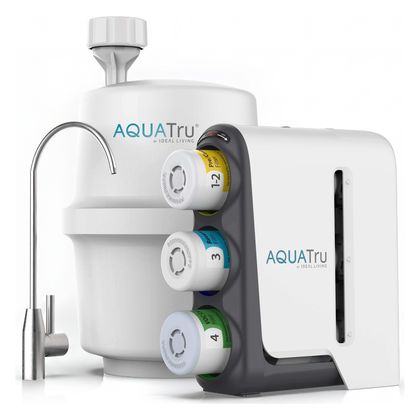
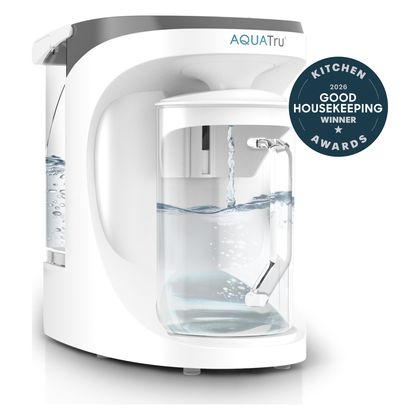
Best overall:AquaTru Carafe with Alkaline Mineral Boost ($395, 8.6/10). Certified for 96.4% fluoride, 99.9% PFOA/PFOS and 97% chloramine, collects in glass, adds magnesium back, no install.
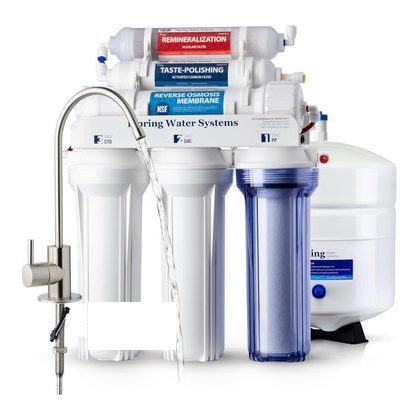
Skip: the iSpring RCC7AK (0.111 ppm vanadium in the filtered water in Water Filter Guru's test, review updated Aug. 4, 2026; Tap Score's guideline is 0.05 ppm)[79] and the US Water American RO (0.825 ppm aluminum in WFG's April 2026 test, 11.8 times Tap Score's 0.07 ppm guideline)[93]. Match any “NSF certified” badge to its listing (our check).
Our #1 pick8.6/10
AquaTru Carafe with Alkaline Mineral Boost
Get this exact version: Alkaline Mineral Boost, $395. The $375 standard model skips the mineral filter.
Countertop RO that collects your water in glass and adds magnesium back. Reject water returns to the tap tank, not a drain. No installation[1].
How we score:Fluoride Out 20%Chlorine & Chloramine 15%Chemical Toxins 25%Mineral Balance 15%Clean Contact 10%Proof 15%Full methodology ↓
The Dr. Axe Clean Water Score (0–10) is the same editorial rubric as our Water Filters guide, starting with fluoride: filters without proven fluoride removal can't score above 7.0. Water to the drain and cost are shown separately, not scored. It isn't a universal safety grade.
Know your water
What's in your tap water?
Most U.S. tap water meets federal limits: 92% of people on community systems had no reported health-based violations in 2021[105]. But fluoride and chlorine are added on purpose, several limits are new or under review[116], and PFAS, lead and plastic particles can turn up in a glass. Reverse osmosis is the one home filter built to take most of them out together. Your local report shows what's in yours.
Fluoride62.8%[103]of Americans got fluoridated water in 2022; CDC's recommended level is 0.7 mg/L[104]CDC
PFAS45%[111]of U.S. tap water has at least one “forever chemical,” USGS estimates (716 taps sampled)USGS, 2023
PFAS limits15.5%[112]of large systems (10,000+ people) averaged above at least one 2024 PFAS limit, mostly PFOA or PFOS. Those two stand; in May 2026 EPA proposed dropping the other four and delaying the deadline[116][117][115]EPA UCMR 5, July 2026
Lead4 million[121]lead service lines are estimated to still be in the groundEPA, Nov. 2025
Chloramine1 in 5[122]Americans drink water treated with chloramine, which many filters missEPA
Microplastics9.24[123]man-made particles per liter, the average in 33 U.S. tap samplesPLOS ONE, 2018
Check your water
Your utility must publish a water quality report every year by July 1[133]. You can also search your ZIP code in EWG's database, an advocacy group whose health guidelines are its own and often stricter than federal limits[134]. On a private well, EPA says to test every year[135].
Is bottled water the answer? Not for plastics. A 2024 study of three bottled-water brands found about 240,000 plastic particles per liter, roughly 90% of them nanoplastics[124]. Filtering tap water into glass avoids the bottle.
Put it together
The Dr. Axe clean water setup
Four steps, in order of impact. The first three matter for every home; the fourth depends on your water.
1Essential
Know your water
Read your utility's yearly report or search your ZIP. On a well, EPA says to test every year for bacteria, nitrate, total dissolved solids and pH, plus anything else you suspect.[135]
RO strips calcium and magnesium, and in lab tests most mineral cartridges added back only a trace (see the chart). Choose a proven mineral stage or add trace minerals.
Chlorine or chloramine: RO covers what you drink. A shower filter, or a whole-house system for every tap, handles the disinfectant you shower in. About 1 in 5 Americans get chloramine[122].
Answer four questions. If nothing we recommend fits, we'll say so and show the closest option.
1Where will it go?
2How many people drink from it?
3Budget to start?
4What matters most?
Compare the top 10
What each RO system is proven to remove
Every claim below is backed one of four ways for that exact model. “ND” means not detected after filtering in an independent lab test. The last column is gallons sent down the drain for each gallon you drink. Product names link to the reviews.
Score = the Dr. Axe Clean Water Score, 0–10: fluoride 20%, chlorine & chloramine 15%, chemical toxins 25%, mineral balance 15%, clean contact 10%, proof 15%. No proven fluoride removal caps a filter at 7.0. Full methodology ↓
Certified An independent certifier (NSF, IAPMO or WQA) lists this claim for this model.Independent lab A reviewer's own before-and-after lab test.Maker's data The brand's own claim or its commissioned lab report.No data No evidence either way. Not the same as "doesn't work."Doesn't remove / adds Tested and didn't reduce it, isn't designed to, or added something unwanted.
Swipe sideways to see every column. System names stay in place.
*Culligan's PFAS, chloramine and microplastics claims need its optional Total Defense cartridge. †Pentair's PFAS claim is IAPMO's Total PFAS (seven compounds), up to 99.7%. ‡IAPMO's current G3P800 certificate lists lead, but its older listing and Waterdrop's data sheet don't, so we don't count it[41]. Green drain figures meet EPA WaterSense's 2.3-gallon bar, though none of these models carries the label[99]. Shaded rows are popular systems that missed our top 10. Three-year costs are in their own chart below.
Full reviews
The 10 best reverse osmosis systems, ranked
Each review lists the proof behind the key numbers, how it fits your kitchen (capacity, speed, water to the drain, setup and filter changes) and what it costs to run. One model per product line; siblings like the AquaTru Classic and Bluevua ROPOT(UV) appear in the category guides below.
1
$395Alkaline Mineral Boost version. The $375 standard Carafe skips the mineral filter.
Best overall · best countertop
AquaTru Carafe with Alkaline Mineral Boost
Countertop reverse osmosis · glass carafe · minerals added back
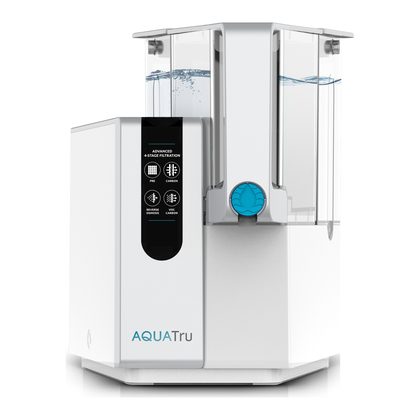
Still our top pick, and its newest data sheet makes the case stronger. IAPMO certifies the Carafe for 96.4% fluoride, 99.9% PFOA/PFOS, 99.2% lead, 98.8% arsenic, 99% of microplastic particles and 97% chloramine, and two independent labs, Water Filter Guru and BOS Water, found no detectable fluoride after filtering. Your water collects in a glass carafe, the Alkaline Mineral Boost filter adds magnesium back, and reject water flows back into the tap tank instead of a drain. One flag: BOS measured aluminum rising slightly in the filtered water, which Water Filter Guru didn't see in three tests.
Best forRenters, and anyone who wants certified fluoride, PFAS and chloramine removal with no installation
Skip ifYou want gallons on demand, or zero plastic (the body and tanks are Tritan plastic)
Capacity64 oz glass carafe; 0.66-gal tap-water tank; 7.5 × 14 × 13 in, 9 lb
SpeedAbout 12 min per carafe (rated 0.042 gal a minute); about 3 fills a day at 1.5 gal
Water to drainAbout 0.6 gal per gal (63% efficiency). It returns to the tap tank, which you empty
SetupNone. Plug into a 120V outlet and fill the tank from your tap
Filter changesPre/carbon every 6 months or 300 gal; Mineral Boost every 12 months or 300 gal (about 6.5 months at 1.5 gal/day); RO every 24 months or 600 gal
BOS Water's lab found aluminum rising in the filtered water, to 0.04 mg/L in 2024 and 0.0809 mg/L in 2025, 7.4 to 15 times below California OEHHA's 0.6 mg/L health guideline. Water Filter Guru found no aluminum rise in three tests of AquaTru systems. (−0.2 points)
Want more water per batch? The AquaTru Classic ($475, or $495 with Mineral Boost) uses the same kind of certified filters with a 0.75-gal plastic tank.
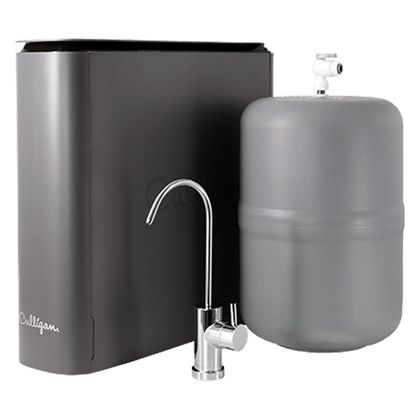
The most completely certified under-sink RO we found, and the most water-efficient under-sink tank system: 54.7% efficiency, about 0.8 gallons to the drain per gallon. WQA certifies 96.8% fluoride and 99.7% lead on average for the Smart RO, and with the optional Total Defense cartridge, more than 99.9% of seven PFAS compounds, 96.3% chloramine and 99.5% of microplastics. Culligan's Mineral Boost cartridge raises TDS by 20–30 ppm. The catches: local dealers set the price and install it, nitrate isn't certified on the Smart RO, and we found no independent lab test.
Best forHomeowners who want the most certified RO, installed for them
Skip ifYou want to install it yourself or see a price online
Capacity3-gal storage tank; unit 19 × 5.7 × 17.8 in
SpeedAbout 34 gal a day
Water to drainAbout 0.8 gal per gal (54.7% efficiency)
SetupDealer installs it: drain, its own faucet (or your existing one with ClearLink PRO) and an outlet for the 12V adapter
Filter changesCarbon, particulate and Mineral Boost at least yearly; RO membrane every 3–5 years; sanitize yearly
Minerals: Optional Mineral Boost adds calcium (+20–30 ppm TDS)Touches water: Plastic housings and tank
*PFAS, chloramine and microplastics figures require the optional Total Defense cartridge. Nitrate is certified only on the standard Aquasential RO and the Smart RO Nitrate model.
See score breakdown & sources
Fluoride Out9.5
Chlorine & Chloramine9.0
Chemical Toxins9.5
Mineral Balance7.0
Clean Contact6.0
Proof9.0
Weighted pillars 8.625 = 8.625, shown as 8.6.
CertifiedCulligan Aquasential RO & Smart RO owner's guide and performance data sheet (WQA; Oct. 2024): Smart RO averages (fluoride 96.8%, lead 99.7%, arsenic 98.8%), 54.7% efficiency, Mineral Boost, yearly sanitizing. No prices. Open source · [15]
CertifiedWQA Gold Seal listing: Culligan Aquasential Smart RO, NSF/ANSI 42, 53, 58 and 401 (checked Sept. 26, 2026). Open source · [16]
Third-party estimateTap Water Data. Culligan reverse osmosis complete guide (Oct. 14, 2025): Smart RO $1,800–$2,500 installed, standard RO $1,200–$1,800, dealer filter service $300–$400 a year. A third-party estimate, not a Culligan price. Open source · [17]
Filters: About $200–$267 a year at 1.5 gal/day (estimate)3-year cost: $2,400–$3,300how we figured itCheck current priceWe may earn a commission.
8.6of 10
Clean Water Score
3
$395$420 Alkaline Mineral Boost version
Best value under-sink
AquaTru Under Sink (ATU200)
Under-sink reverse osmosis · Gen 2 · leak detection
AquaTru's certified filtration, plumbed under the sink, and its IAPMO listing is now confirmed (ATU200, listed June 12, 2026): 93.5% fluoride, 97.5% PFOA/PFOS, 99.1% lead, 98% arsenic, 96% chloramine and 96.5% of microplastics. Water Filter Guru's lab found no detectable fluoride after filtering (from 1.7 mg/L) and nothing added. Leak sensors and filter alerts are built in. The trade-offs: it sends about three gallons to the drain for each gallon it makes (25% efficiency), it made about 33 gallons a day in testing against a 54-gallon rating, and minerals come back only with the $420 Alkaline Mineral Boost version.
Best forHomeowners who want certified RO under the sink for under $400
Every claim on its data sheet is WQA-certified: 90% fluoride, 99.7% PFOA/PFOS, 96.8% chlorine and chloramine, 99.3% of microplastics, 99–99.8% lead and 96% arsenic. Water Filter Guru found fluoride fell from 2.2 mg/L to below detection. Three things hold it back: its remineralizer mostly raises pH (calcium fell from 73.3 to 1.85 mg/L in the same test), the lab found 30 ppb of chloromethane in the filtered water, and its filters cost more to keep up than most systems here.
Best forBudget buyers who want certified fluoride and PFAS removal
Skip ifYou want real minerals back or low running costs
Water Filter Guru's lab found 30 ppb of chloromethane in the filtered water; it wasn't in the tap sample, and EPA has no drinking-water limit for it. (−0.3 points)
The best mineral stage we found in an under-sink system, and the favorite under-sink RO of two independent testing sites. In Water Filter Guru and Quality Water Lab tests, fluoride, lead, uranium and disinfection byproducts were not detected after filtering, and after 12 months (204 gallons) on its original filters fluoride was still below detection. Its built-in mineral stage (Cloud says roughly 15–30 ppm) left 1.5–4.8 mg/L of magnesium and a little zinc in lab tests, more than most under-sink systems, and it sent about one gallon to the drain per gallon. Its only certification covers total dissolved solids, so its PFAS, chlorine and chloramine figures come from the maker's lab (a reviewer's test strip also showed chlorine gone), and in one test nitrate fell only 48%.
Best forHomeowners who want RO water with minerals restored and little waste
Capacity2.8-gal tank with a stainless shell and polypropylene liner
Speed0.625 gal a minute at the faucet; about 50 gal a day
Water to drainAbout 1 gal per gal (measured 66 oz per 64 oz)
SetupDIY in 30–60 min: its own faucet, a drain clamp and a 1/4-in hole. Battery-powered sensors, no outlet
Filter changesOne 5-filter set, usage-based; the app tracks it. About yearly for a family of four
Minerals: Adds magnesium and a little zinc; calcium stays lowTouches water: Polypropylene tank liner, plastic housings, stainless faucet
See score breakdown & sources
Fluoride Out9.5
Chlorine & Chloramine6.5
Chemical Toxins8.5
Mineral Balance9.0
Clean Contact6.0
Proof7.0
Weighted pillars 8.000 = 8.000, shown as 8.0.
CertifiedNSF listing: Cloud Version 1, NSF/ANSI 58, total dissolved solids only (checked Sept. 26, 2026). NSF's old directory closes Oct. 1, 2026; the same listings are searchable at listings.nsf.org. Open source · [21]
Independent labWater Filter Guru. Cloud RO review and two lab tests (updated Aug. 5, 2026). Open source · [22]
Independent labQuality Water Lab. Reverse osmosis testing, incl. Cloud RO after 12 months (204 gallons) on its original filters (Sept. 16, 2026). Open source · [23]
Maker's dataCloud RO specification sheet with maker-commissioned SGS results and a 54% efficiency rating. Open source · [19]
Maker's dataCloud Water Filters FAQ: stainless tank shell with a polypropylene liner; “roughly 15-30 ppm of healthy minerals.” Open source · [20]
Maker's dataCloud Water Filters. Cloud RO buy page ($599 sale, $649 list; 5-filter set $200; 5-year warranty; checked Sept. 26, 2026). Open source · [18]
A non-electric, dealer-installed RO system with certified 95.5% fluoride, 99.3% arsenic and 98.1% lead reduction, and WQA lists its PFOA/PFOS claim under NSF/ANSI 58, its chlorine taste-and-odor claim under NSF/ANSI 42, and VOCs (as chloroform) under NSF/ANSI 53. Its MACguard filter shuts the water off when the cartridge is used up, so you never drink through a spent filter. The trade-offs: its 2021 manual rates efficiency at 16.3% with the standard tank (about 5 gallons to the drain per gallon; 3.4 with the QuickFlo tank), the public data sheet with percentages dates from 2012, parts come only from dealers, and we found no independent lab test.
Best forFamilies who want a set-and-forget system with automatic shut-off
Skip ifYou want DIY parts, low waste or published current data
Water to drainAbout 5 gal per gal (16.3%); 3.4 with the QuickFlo tank
SetupDealer installs it: drain connection and its own faucet. No electricity
Filter changesMACguard shuts off at 500 gal (about 11 months at 1.5 gal/day); membrane every 3–5 years
Minerals: Optional Mineral Plus cartridge (not certified)Touches water: Plastic housings and tank
See score breakdown & sources
Fluoride Out9.0
Chlorine & Chloramine8.5
Chemical Toxins8.0
Mineral Balance6.5
Clean Contact6.0
Proof7.5
Weighted pillars 7.775 = 7.775, shown as 7.8.
CertifiedWQA Gold Seal listing: Kinetico K5 Drinking Water Station, NSF/ANSI 58 incl. fluoride, PFOA and PFOS (checked Sept. 26, 2026). Open source · [34]
CertifiedWQA Gold Seal listings: Kinetico K5 Drinking Water Station under NSF/ANSI 42 (aesthetic chlorine, taste and odor) and NSF/ANSI 53 (VOCs as chloroform, MTBE, arsenic) (checked Sept. 26, 2026). Open source · [35]
CertifiedKinetico K5 performance data sheet, WQA/NSF (2012); a dealer-hosted copy. Open source · [33]
Maker's dataKinetico K5 owner's manual (May 2021): 16.3% efficiency with the standard tank, 22.8% with the QuickFlo tank, MACguard 500-gal shutoff, sanitizing. Open source · [36]
Maker's dataKinetico. K5 with VOC Guard product page: dealer-only cartridges, no published price. Open source · [37]
Filters: About $140–$190 a year at 1.5 gal/day (estimate)3-year cost: $1,770–$3,570how we figured itCheck current priceWe may earn a commission.
7.8of 10
Clean Water Score
7
Price not publishedSold through dealers and retailers; Pentair doesn't publish a price
Certified for Total PFAS
Pentair FreshPoint GRO-575B
Under-sink reverse osmosis · 4.4-gal tank · air-gap faucet
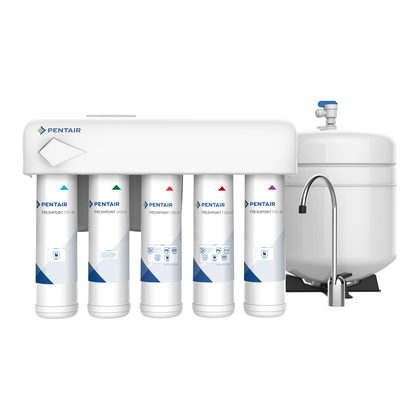
A plain, well-certified five-stage RO system from one of the biggest names in water treatment. NSF certifies it under NSF/ANSI 58 for fluoride (93.6% on Pentair's certified-claims list), lead (98.6%), arsenic and more; under NSF/ANSI 42 for chlorine; under NSF/ANSI 53 for lead, cysts and atrazine; and under NSF/ANSI 401 for microplastics. IAPMO certifies it under NSF/ANSI 53 for Total PFAS, the seven-compound claim, at up to 99.7%. It runs without electricity and comes with an air-gap faucet. What holds it back: no chloramine or nitrate claim, no mineral stage, no independent lab test we could find, and Pentair publishes neither a price nor an efficiency rating (only a 51% recovery rating for the membrane).
Best forHomeowners who want two certifiers behind fluoride, lead and Total PFAS
Skip ifYou want minerals back, published water efficiency, or chloramine removal
Capacity4.4-gal storage tank; unit 17.8 × 5.5 × 12.5 in
Speed21 gal a day on NSF's listing (30.6 on the spec sheet)
Water to drainNot published; its 51% recovery rating covers the membrane only
SetupNo electricity; needs 40–100 psi. The air-gap faucet needs a larger sink or counter hole
Filter changesPre- and post-filters yearly (675-gal rating); RO membrane every 18 months
Minerals: Removes them (no mineral stage)Touches water: Plastic housings and tank
Pentair now sells the current version as the GRO-575M; the NSF and IAPMO listings name the GRO-575B.
See score breakdown & sources
Fluoride Out9.5
Chlorine & Chloramine8.0
Chemical Toxins9.0
Mineral Balance3.0
Clean Contact6.0
Proof9.0
Weighted pillars 7.750 = 7.750, shown as 7.8.
CertifiedNSF listings: Pentair GRO-575B under NSF/ANSI 58 (fluoride, lead, arsenic, radium and more), NSF/ANSI 42 (chlorine, taste and odor), NSF/ANSI 53 (lead, cyst, atrazine) and NSF/ANSI 401 (microplastics) (checked Sept. 26, 2026). NSF's old directory closes Oct. 1, 2026; the same listings are searchable at listings.nsf.org. Open source · [31]
CertifiedIAPMO R&T certificate W-13717: Pentair GRO-575B, NSF/ANSI 53 Total PFAS (checked Sept. 26, 2026). Open source · [32]
Maker's dataPentair. FreshPoint 5-stage under-sink RO product page: “Certified to Reduce” percentages; no price listed. Open source · [29]
Maker's dataPentair FreshPoint GRO-575B spec sheet: 4.4-gal tank, 51.17% recovery rating, filter life. Open source · [30]
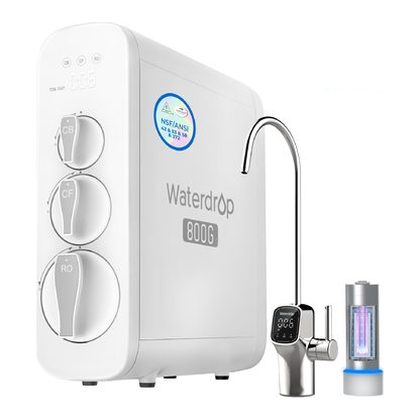
The fastest system in our top 10 (886 gallons a day in Water Filter Guru's test), and now properly certified. IAPMO lists the G3P800 under NSF/ANSI 58 for fluoride (88.2%), cadmium, barium and radium, and under NSF/ANSI 53 for PFOA/PFOS, which settles the certification question our water filter guide raised. IAPMO's current certificate also lists lead, but its older listing and Waterdrop's data sheet show hexavalent chromium and selenium instead, so we don't count lead as certified. In Water Filter Guru's test it cut fluoride 79% (1.9 to 0.4 mg/L) on its own and to not detected with the optional mineral filter, and it sent only about 0.45 gallons down the drain per gallon. The trade-offs: it needs an outlet, the mineral filter is an add-on, that add-on released a little nitrite in the same test, and Waterdrop's product page lists far more substances than its certifications cover.
Best forBusy kitchens that want fast, low-waste RO with certified fluoride and PFOA/PFOS removal
Skip ifYou don't have an outlet under the sink, or want minerals built in
SpeedRated 800 gal a day (886 in Water Filter Guru's test)
Water to drainAbout 0.45 gal per gal measured (maker claims 3 pure to 1 drain)
SetupNeeds an outlet under the sink, a faucet hole and a drain saddle; about 2 hours in Water Filter Guru's install
Filter changesComposite filter every 6 months or 550 gal; carbon every 12 months or 1,100 gal; RO every 24 months or 2,200 gal
Minerals: Removes them; $36.99 add-on mineral filterTouches water: Polypropylene housings, brushed-nickel faucet; no tank
With the optional remineralization filter, Water Filter Guru's lab found 0.24 ppm of nitrite (as nitrogen) in the filtered water; it wasn't in the tap sample. EPA's limit is 1 mg/L. (−0.2 points)
If you add the mineral filter, Water Filter Guru suggests flushing it well at installation. See how Waterdrop's claims compare with its listings below.
CertifiedIAPMO R&T certificate WC-13976, NSF/ANSI 58 (Qingdao Ecopure / Waterdrop): G3P800 for TDS, fluoride, cadmium, barium, radium 226/228 and lead (listed Nov. 3, 2025); X12 and X16 for TDS only (checked Sept. 26, 2026). Open source · [40]
CertifiedIAPMO R&T file WC-13976, legacy listing (current as of Sept. 26, 2026): G3P800 for TDS, fluoride, cadmium, hexavalent chromium, selenium, barium and radium 226/228, with no lead; A1 for TDS only. Open source · [41]
CertifiedIAPMO R&T certificate WC-14301, NSF/ANSI 42: Waterdrop G3 and X-series carbon filters, chlorine, taste and odor. Open source · [43]
CertifiedWaterdrop G3P800 performance data sheet: IAPMO-certified results (fluoride 88.23%, PFOA >98%, PFOS >99%; certified metals listed as cadmium, hexavalent chromium and selenium) alongside maker-tested ones. Open source · [39]
Independent labWater Filter Guru. Waterdrop G3P800 review and lab tests with and without the mineral filter (updated Aug. 5, 2026). Open source · [44]
Independent labQuality Water Lab. Water filters for PFAS: Waterdrop G3P800, 14 of 14 PFAS not detected after filtering (after-filter results only). Open source · [45]
Public record / studyEPA. National Primary Drinking Water Regulations: limits for nitrite (1 mg/L as nitrogen), arsenic (0.010 mg/L) and antimony (0.006 mg/L). Open source · [118]
Maker's dataWaterdrop. G3P800 product page ($999 list, $759 with a checkout code; filters; certification wording; checked Sept. 26, 2026). Open source · [38]
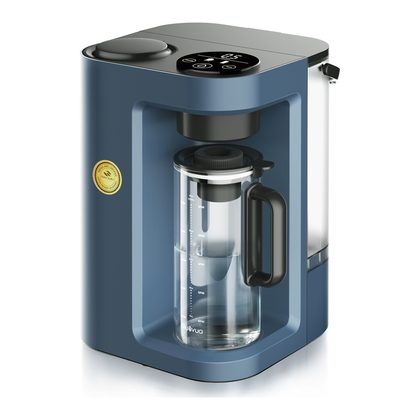
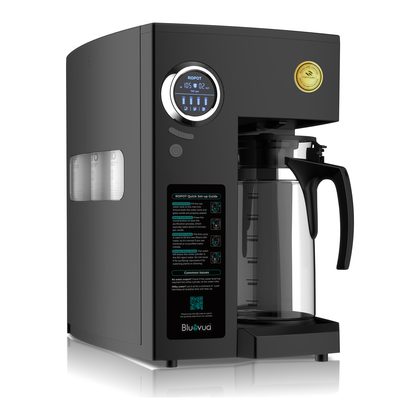
The best-proven glass-carafe unit after the AquaTru, for less. WQA certifies the ROPOT-Lite to NSF/ANSI 58 for lead, cadmium, trivalent chromium and total dissolved solids, and in BOS Water's 2025 tests fluoride fell from 1.04 mg/L to not detected (and from 0.69 to below 0.1 in a second round). Filtered water goes straight into a 40-ounce glass carafe, and a mineral filter is included. The catches: its fluoride and PFAS numbers come from maker-commissioned SGS tests, not a certification; BOS found a trace of methylene chloride in the filtered water in both rounds; and Bluevua's page says the RO stage “removes 99.9% of contaminants including lead, arsenic, PFAS, fluoride, and microplastics,” but its certifications cover lead, cadmium, trivalent chromium and TDS (WQA) plus lead-free materials (NSF and WQA).
Best forRenters who want water collected in glass for under $400
Skip ifYou want certified fluoride or PFAS removal
Water to drain1.2 gal per gal in WQA's lab test (46.1%); BOS measured about 0.4. It collects in a tank you empty
SetupNone. Plug in and fill the tank
Filter changes5-in-1 cartridge yearly ($79.90); mineral filter about every 6 months ($33.99 for two)
Minerals: Mineral filter included (amount not published)Touches water: Borosilicate glass carafe; plastic body
BOS Water's lab found methylene chloride in the filtered water in both 2025 rounds (2.41 and 1.24 ppb), 1.7 to 3.2 times below California OEHHA's 4 ppb guideline. (−0.2 points)
CertifiedWQA Gold Seal listings for Bluevua: ROPOT-Lite under NSF/ANSI 58 (cadmium, lead, TDS, trivalent chromium); ROPOT and ROPOT(UV) under NSF/ANSI/CAN 372 only (checked Sept. 26, 2026). Open source · [57]
CertifiedNSF listing, NSF/ANSI/CAN 372 (lead-free materials): Bluevua ROPOT, ROPOT(UV), ROPOT-Lite, ROPOT-Lite(UV), ROPOT-Travel and ROPOT-Go and their filters; certificate C0878345-01, June 12, 2026 (checked Sept. 26, 2026). NSF's old directory closes Oct. 1, 2026; the same listings are searchable at listings.nsf.org. Open source · [60]
CertifiedWQA lab report posted by Bluevua: ROPOT-Lite NSF/ANSI 58 TDS test (96.2% TDS reduction; 46.1% efficiency). Open source · [58]
Independent labBOS Water. Bluevua ROPOT-Lite review with two 2025 lab tests (Sept. 21, 2026). Open source · [64]
Maker's dataSGS report commissioned by Bluevua, ROPOT-Lite: fluoride 5.669 → 0.009 mg/L (99.84%), lead and arsenic (Nov. 18, 2022). Open source · [61]
Everything it claims is WQA-certified: 83.8% fluoride, 98.1% lead, 99.8% arsenic, 99.8% of VOCs and 99% chlorine. The filters and a 1.6-gallon flexible reservoir fit in one compact case that runs without electricity, and its 33.5% efficiency (about 2 gallons to the drain per gallon) beats most tank systems. What it lacks: no PFAS, nitrate, chloramine or microplastics claim, the lowest certified fluoride figure in our top 10, no mineral stage and no independent lab test.
Best forSmall sinks that need a compact, non-electric system with certified claims
Skip ifYou need PFAS, nitrate or chloramine removal
Capacity1.6-gal flexible reservoir inside a 13.8 × 9.25 × 16.5 in case
SpeedAbout 40 gal a day
Water to drainAbout 2 gal per gal (33.5% efficiency)
SetupNo electricity. DIY with the included drain clamp and T-valve; needs a faucet hole
Filter changesSediment and carbon pack every 6 months ($79.99); RO membrane every 24 months ($89.99)
Minerals: Removes them (no mineral stage)Touches water: Flexible plastic reservoir, chrome faucet
Brondell lists different rated capacities on its page and its data sheet (3,500 vs 6,500 gal for chlorine), and its certified VOC reduction is rated for only 180 gallons (about 4 months at 1.5 gal/day). Its 6-month schedule assumes 2.6 gal/day; we used the 6-month schedule for cost.
See score breakdown & sources
Fluoride Out8.0
Chlorine & Chloramine8.5
Chemical Toxins7.0
Mineral Balance3.0
Clean Contact6.0
Proof9.0
Weighted pillars 7.025 = 7.025, shown as 7.0.
CertifiedWQA Gold Seal listing: Brondell RC100, NSF/ANSI 42, 53, 58 and 372 (checked Sept. 26, 2026). Open source · [69]
CertifiedBrondell Circle RC100 performance data sheet (WQA): fluoride 83.8%, lead 98.1%, arsenic 99.8%, 33.5% efficiency (Feb. 6, 2025). Open source · [68]
Maker's dataBrondell. Circle RC100 product page ($449.99; replacement filters; checked Sept. 26, 2026). Open source · [67]
We counted every replacement cartridge over three years at 1.5 gallons of drinking and cooking water a day, replacing each at its time limit or gallon rating, whichever comes first. The water sent down the drain is shown separately, in gallons and dollars, because it depends on your water rate.
Bluevua ROPOT-Lite#9 · Countertop, glass carafe$5773-year total · est.+ 1,922 gal to drain$349 to buy + $228 in filters:[55]2 × 5-in-1 cartridge, $79.90 each, every 12 months2 × Mineral filter 2-pack, $33.99 each, every 12 monthsPlus about 1,922 gallons of reject water poured out over 3 years (certified efficiency), about $5.67 at EPA's sample water rate[136]. List price; the cart showed $261.75 during a fall sale. No gallon ratings published, so we used the time limits.
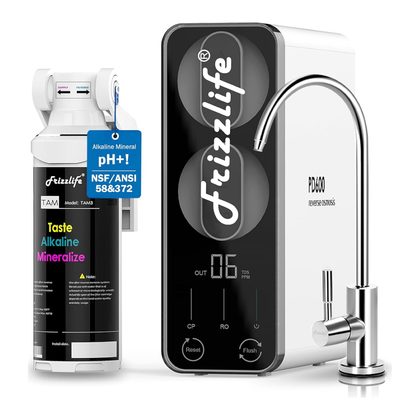
Frizzlife PD600Tankless, remineralizing$6843-year total+ 1,085 gal to drain$470 to buy + $214 in filters:[73]2 × ASR211 sediment/carbon, $33.99 each, every 12 months1 × RO membrane, $85.99 each, every 24 months2 × FZ-4 mineral cartridge, $29.99 each, every 12 monthsPlus about 1,085 gallons of reject water sent down the drain over 3 years (independent measurement), about $3.20 at EPA's sample water rate[136]. $399.99 with Frizzlife's checkout code; we used the low end of its “about 900–1,000 gal” ratings. Needs an outlet.
AquaTru Under Sink#3 · Under-sink$7653-year total+ 4,932 gal to drain$395 to buy + $370 in filters:[12][13]5 × Pre-filter, $29.95 each, every 6 months4 × VOC filter, $39.95 each, every 360 gal (≈7.9 months)1 × RO filter, $59.95 each, every 24 monthsPlus about 4,932 gallons of reject water sent down the drain over 3 years (certified efficiency), about $14.55 at EPA's sample water rate[136]. DIY install assumed.
AquaTru ClassicCountertop$7653-year total+ 548 gal to drain$475 to buy + $290 in filters:[8][4]5 × Pre/carbon filter, $29.95 each, every 6 months2 × VOC filter, $39.95 each, every 12 months1 × RO filter, $59.95 each, every 24 monthsPlus about 548 gallons of reject water poured out over 3 years (certified efficiency), about $1.62 at EPA's sample water rate[136]. Standard VOC version; the Mineral Boost version is $495 with a $49.95 mineral filter.
AquaTru Carafe · Mineral Boost#1 · Countertop$9143-year total+ 966 gal to drain$395 to buy + $519 in filters:[1][4]5 × Pre/carbon filter, $29.95 each, every 6 months5 × Mineral Boost VOC filter, $49.95 each, every 300 gal (≈6.6 months)2 × RO filter, $59.95 each, every 600 gal (≈13.1 months)Plus about 966 gallons of reject water poured out over 3 years (certified efficiency), about $2.85 at EPA's sample water rate[136]. AquaTru's one-year packs don't cover 1.5 gal/day, because the gallon limits come first.
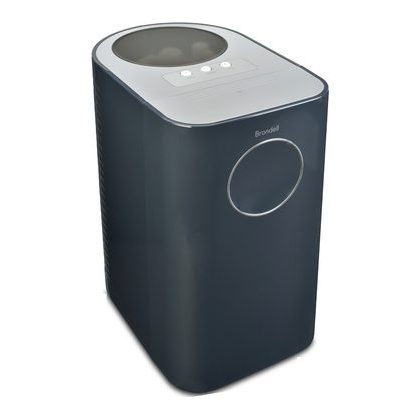
Brondell Circle#10 · Under-sink, compact$9403-year total+ 3,263 gal to drain$450 to buy + $490 in filters:[67][68]5 × Sediment and carbon pack, $79.99 each, every 6 months1 × RO membrane, $89.99 each, every 24 monthsPlus about 3,263 gallons of reject water sent down the drain over 3 years (certified efficiency), about $9.63 at EPA's sample water rate[136]. Brondell sells the RO membrane for $89.99 (the $65.99–$75.99 range on its page is for open-box filters). Its certified VOC reduction is rated for 180 gallons (about 4 months at 1.5 gal/day), shorter than Brondell's 6-month schedule, which assumes 2.6 gal/day; we used the 6-month schedule.
Cloud RO#5 · Under-sink, remineralizing$9993-year total · est.+ 1,693 gal to drain$599 to buy + $400 in filters:[18]2 × 5-filter replacement set, $200 each, every 12 monthsPlus about 1,693 gallons of reject water sent down the drain over 3 years (independent measurement), about $4.99 at EPA's sample water rate[136]. Sale price ($649 list). Filter life is usage-based; Cloud estimates 9–12 months for a family of four, so we assumed one set a year.
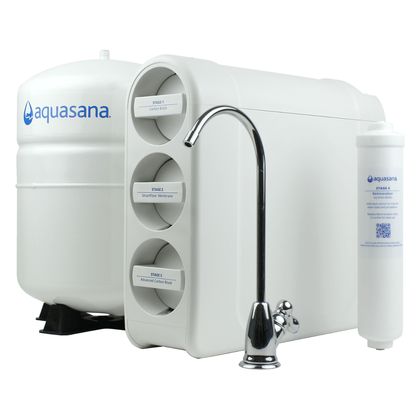
Aquasana SmartFlow RO#4 · Under-sink$1,0353-year total+ 4,356 gal to drain$200 to buy + $835 in filters:[26][27]6 × Carbon pre/post pair, $91.99 each, every 250 gal (≈5.5 months)2 × RO membrane, $62.99 each, every 12 months5 × Remineralizer, $31.49 each, every 6 monthsPlus about 4,356 gallons of reject water sent down the drain over 3 years (certified efficiency), about $12.85 at EPA's sample water rate[136]. Sale price; list is $449.99.
Waterdrop G3P800#8 · Tankless$1,3493-year total+ 740 gal to drain$999 to buy + $350 in filters:[38]5 × CF composite filter, $29.99 each, every 6 months2 × CB carbon filter, $29.99 each, every 12 months1 × RO filter, $139.99 each, every 24 monthsPlus about 740 gallons of reject water sent down the drain over 3 years (independent measurement), about $2.18 at EPA's sample water rate[136]. List price; $759 with Waterdrop's checkout code when we checked. Needs an outlet.
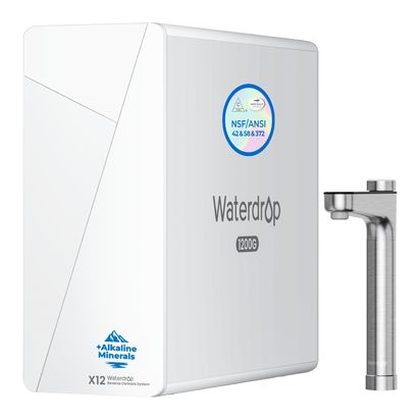
Waterdrop X12Tankless, remineralizing$1,6803-year total+ 548 gal to drain$1,299 to buy + $381 in filters:[46]5 × F2 sediment/carbon, $30.99 each, every 6 months2 × F1A mineral filter, $32.99 each, every 12 months1 × X12 RO filter, $159.99 each, every 24 monthsPlus about 548 gallons of reject water sent down the drain over 3 years (maker's claim), about $1.62 at EPA's sample water rate[136]. List price; $1,039 with a checkout code when we checked.
Kinetico K5#6 · Under-sink, dealer$1,770–$3,5703-year total · est.+ 8,442 gal to drain$1,350–$3,000 to buy + $420–$570 in filters:[36]3 × MACguard filter set, $140–$190 each, every 500 gal (≈10.9 months)Plus about 8,442 gallons of reject water sent down the drain over 3 years (certified efficiency), about $24.90 at EPA's sample water rate[136]. Kinetico publishes no prices; both the installed price and the filter price are our estimates, so get a dealer quote. The 500-gal MACguard limit is from Kinetico's manual.
Culligan Aquasential Smart RO#2 · Under-sink, dealer$2,400–$3,3003-year total · est.+ 1,361 gal to drain$1,800–$2,500 to buy + $600–$800 in filters:[17][15]2 × Yearly cartridge set, $300–$400 each, every 12 monthsPlus about 1,361 gallons of reject water sent down the drain over 3 years (certified efficiency), about $4.01 at EPA's sample water rate[136]. Culligan publishes no prices. Third-party estimate for the Smart RO, installed ($1,800–$2,500), and for dealer filter service ($300–$400 a year); get a dealer quote. The RO membrane lasts 3–5 years.
Pentair FreshPoint #7 · Under-sinkPentair publishes no system or cartridge prices (dealers and retailers set them).[29] Its filters are rated for a year (675 gal) and its membrane for 18 months.
Assumes 1.5 gallons a day: about 548 gallons a year and 1,644 over three years. The filters in the box cover the first round. One-time prices from each maker's site, checked Sept. 26, 2026, without checkout codes (code prices are noted); subscriptions cut filter costs further. “est.” marks dealer estimates, usage-based schedules or unclear filter prices. Reject water uses the same basis as the drain chart below.
The fluoride test, in detail
How much fluoride each RO system actually removes
Reverse osmosis is the most reliable way to take fluoride out at home, but proof varies. Independent lab results are shown as real measurements: fluoride in the tap water before filtering and in the glass after. Certified results are the average reduction in the certifier's own test.
Independent lab tests: fluoride before and after filtering
Tap water before filteringAfter filtering (ND = not detected)0.7 mg/L, the U.S. recommended fluoridation level
00.511.522.50.7mg/L
#1AquaTru Carafe · Mineral Boost[6][7]Water Filter Guru 0.9 → ND; BOS Water 2025 1.04 → ND0.9–1.04 → ND
“ND” means fluoride fell below the lab's detection limit in that test. It isn't a lifetime guarantee: results depend on your water and how worn the membrane is. BOS Water's 2024 fluoride results (for example 67% for the AquaTru Carafe and 69% for the SimPure) used a detection method it now considers less accurate; its 2025 results are shown[7]. No independent fluoride test was found for the Culligan, Pentair, Kinetico or Brondell systems.
Certified fluoride reduction
Average reduction in NSF, IAPMO or WQA testing, from each model's performance data sheet or listing.
APEC RO-90 Ultimate[84]WQA lists fluoride; no % publishedListed; no % publishedCertified
Fluoride claims with no fluoride certification
Figures from brand-commissioned tests or quoted by the brand. They may be accurate, but no certifier lists fluoride for the exact model sold.
iSpring RCC7AK[77]iSpring quotes 97.4% from NSF testing. NSF lists fluoride for the RCC7AK-BN and -BLK variants (no % published); the RCC7AK iSpring sells is listed for TDS only. Independent lab: 87.5%97.4%
Reverse osmosis rinses the membrane with some of the water it takes in. EPA says a typical system sends five gallons or more down the drain for every gallon it makes[102]; to earn its WaterSense label, a system must send 2.3 gallons or less[100]. Over three years at 1.5 gallons a day, that's the difference between about 386 and 12,922 gallons here.
Certified efficiency (NSF/ANSI 58 test data)Independent measurementMaker's claim onlyA second figure for the same modelWaterSense maximum, 2.3 gal
0123456782.3gal to drain per gal
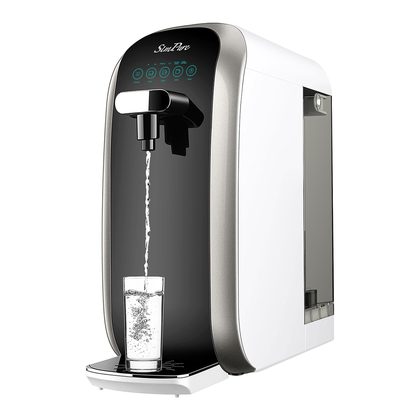
SimPure Y7P[98]BOS measured 1:0.23–0.24; reject water recirculates to the feed tank · ◆ maker 4:10.23 gal386 gal in 3 yrspoured out
AquaTru Classic[8]75% efficiency; reject water returns to the tap tank · ◆ BOS ~0.60.33 gal548 gal in 3 yrspoured out
Waterdrop X12[46]Maker's 3:1 pure-to-drain claim; no efficiency test published0.33 gal548 gal in 3 yrs
#8Waterdrop G3P800[44]Water Filter Guru measured 29 oz to drain per 64 oz · ◆ maker 3:10.45 gal740 gal in 3 yrs
Waterdrop A1[54]BOS measured about 1:0.58 in 2025 (its 2024 figure, 1:0.36, came from a test it called unreliable) · ◆ maker 2:10.58 gal954 gal in 3 yrspoured out
#1AquaTru Carafe · Mineral Boost[1]63% efficiency; reject water returns to the tap tank, which you empty · ◆ BOS 0.44–0.550.59 gal966 gal in 3 yrspoured out
Frizzlife PD600[76]Water Filter Guru, 64-oz draw (1:1 on a 12-oz draw), plus auto-flush water · ◆ maker 2:10.66 gal1,085 gal in 3 yrs
RKIN ZIP with AlcaPure[70]55.08% efficiency in its NSF/ANSI 58 test (on RKIN's page; it also advertises a 50% “recovery rate”)0.82 gal1,341 gal in 3 yrspoured out
#2Culligan Aquasential Smart RO[15]54.7% efficiency (Smart RO)0.83 gal1,361 gal in 3 yrs
#5Cloud RO[22]Water Filter Guru measured 66 oz to drain per 64 oz · ◆ maker 54%1.0 gal1,693 gal in 3 yrs
Bluevua ROPOT(UV)[59]49.0% efficiency in a WQA lab test posted by Bluevua · ◆ BOS 1.03–1.161.0 gal1,711 gal in 3 yrspoured out
#9Bluevua ROPOT-Lite[58]46.1% efficiency in a WQA lab test posted by Bluevua · ◆ BOS 0.38–0.411.2 gal1,922 gal in 3 yrspoured out
#10Brondell Circle[68]33.5% efficiency2.0 gal3,263 gal in 3 yrs
iSpring RCC7AK[79]Water Filter Guru, 64-oz draw (2.5 on a 12-oz draw)2.1 gal3,518 gal in 3 yrs
#4Aquasana SmartFlow RO[24]27.4% efficiency · ◆ WFG 2.02.6 gal4,356 gal in 3 yrs
#3AquaTru Under Sink[12]25% efficiency · ◆ WFG 3.273.0 gal4,932 gal in 3 yrs
APEC ROES-PH75[83]19.4% efficiency (NSF/ANSI 58 test data in the manual) · ◆ WFG 5.14.2 gal6,830 gal in 3 yrs
#6Kinetico K5[36]16.3% efficiency with the standard tank (22.8% with the QuickFlo tank) · ◆ QuickFlo 3.45.1 gal8,442 gal in 3 yrs
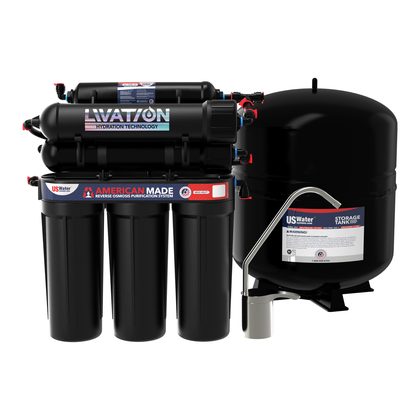
US Water American RO[93]Water Filter Guru measured 7.86 gal to drain per gal7.9 gal12,922 gal in 3 yrs
#7Pentair FreshPoint[30]Efficiency not published (recovery rating 51%, membrane only)Not published—
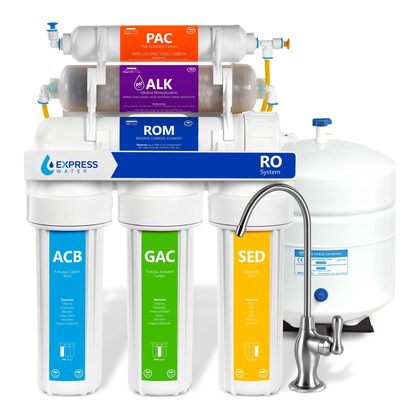
Express Water Alkaline RO[87]Maker says 1–3 gal to drain per gal; no test publishedNot published—
Gallons to drain per gallon = (1 − efficiency) ÷ efficiency. Efficiency ratings come from the NSF/ANSI 58 test with the tank in use; recovery ratings (membrane only) run higher and aren't comparable[15]. Countertop units send reject water to a tank you empty, so you can reuse it for plants or cleaning. Measured results depend on water pressure and draw size.
No system on this page carries the WaterSense label. When we checked EPA's product search on Sept. 26, 2026, only three RO systems were labeled: the Delta DWQ1001012, the Brizo BWQ1001012 and the Kinetico Hydro Eco 600 GPD[99]. EPA estimates about a million point-of-use RO systems are sold each year and says there's no federal efficiency standard for them[101]. We haven't reviewed the three labeled models yet.
What goes back in
Do “remineralizing” RO filters really put minerals back?
Only two makers publish how much their mineral stage adds: Culligan (20–30 ppm)[15] and Cloud (roughly 15–30 ppm)[20]. So we pulled the calcium and magnesium results from independent lab tests of every mineral stage we could find, and compared them with WHO's suggested minimums of 20 mg/L calcium and 10 mg/L magnesium[126].
0 of 10tested mineral stages reached WHO's calcium minimum; the most was 10.3 mg/L
1 of 10put magnesium above the tap level (AquaTru's Mineral Boost: 7.32 → 9.78 mg/L)
Mostly pHMost stages raise pH more than minerals; calcium still fell 75–99%
Tap water before filteringAfter the mineral stageBelow WHO's minimumWHO minimum (20 mg/L Ca, 10 mg/L Mg)
#1AquaTru Mineral Boost filter*[9]Water Filter Guru, tested in the AquaTru ClassicCa 30.5 → 0.9 mg/LMg 7.32 → 9.78 mg/LMaker saysRaises pH “by as much as 1 to 4”; amount not published[5]
Waterdrop X12 (F1A filter)[49]Water Filter GuruCa 40.9 → 10.3 mg/LMg 8.73 → 1.42 mg/LMaker saysAdds Ca and Mg, pH 7.5; amount not published[46]
Express Water alkaline cartridge[89]Water Filter Guru, on the sibling RO5DXCa 52.1 → 0.847 mg/LMg 12.6 → 3.01 mg/LMaker says“Adds calcium, potassium, magnesium”; amount not published[87]
#4Aquasana SmartFlow (remineralizer)[28]Water Filter GuruCa 73.3 → 1.85 mg/LMg 15.5 → 0 mg/LMaker says“Adds back calcium”; amount not published[26]
RO with no mineral stage (AquaTru Carafe, VOC filter)[6]For comparison: Water Filter GuruCa 30.5 → 1.8 mg/LMg 7.32 → 0.47 mg/LNo mineral stageThe standard VOC filter
Mineral stages with no independent mineral test
#2Culligan Mineral BoostNot independently measuredMaker: raises TDS by 20–30 ppm and pH by 1–2[15]
#9Bluevua ROPOT-LiteNot independently measuredMineral filter included; amount not published[55]
RKIN ZIP (AlcaPure)Not independently measuredAdds Ca and Mg, “pH 7–8”; amount not published[70]
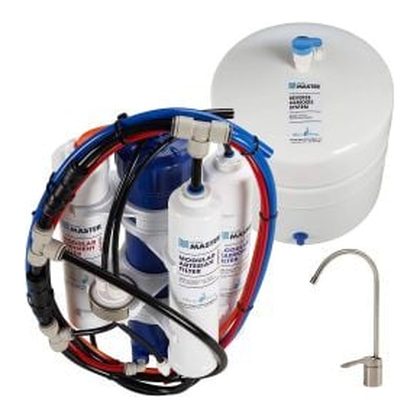
Home Master TMAFC-ERPNot independently measuredCalcium and magnesium from crushed marble; amount not published[90]
Each row is one lab test on that tester's tap water, so starting levels differ. *The AquaTru Mineral Boost result comes from Water Filter Guru's test of the same filter media in the AquaTru Classic. Cloud's 12-month Quality Water Lab sample showed 0.888 mg/L calcium and 2.53 mg/L magnesium[23]. Food is still your main source of calcium and magnesium.
How we score: the Dr. Axe Clean Water Score™
This is the same rubric as our Water Filters guide, with the same weights and rules, so a system on both pages gets the same score unless new data changed one of its inputs. It ranks drinking water on the priorities DrAxe.com holds: get fluoride, chlorine and chemicals out, keep or restore minerals, keep plastic away from your water, and prove it. It's an editorial assessment built from certification listings and published lab tests, not our own lab testing and not a universal safety grade.
Fluoride Out20%
Verified fluoride reduction. Filters that leave fluoride in can't score above 7.0.
Chlorine & Chloramine15%
The disinfectants added at the plant, plus the byproducts they form (THMs).
Chemical Toxins25%
PFAS, lead, arsenic and other metals, pesticides, pharmaceuticals, VOCs, microplastics.
Mineral Balance15%
Keeps calcium and magnesium, or puts them back. Loses points for adding anything unwanted.
Clean Contact10%
Stainless steel and glass beat plastic touching your finished water.
Proof15%
Independent certification scores highest, then independent lab tests, then the maker's own data.
No fluoride removal, no top pick. A system without verified fluoride reduction is capped at 7.0. Every system we scored here passed this bar.
Proof beats promises. A certifier's listing counts most, then independent lab tests, then the maker's own data. A listing for total dissolved solids or materials only doesn't prove contaminant removal. A system with no certification and no independent data isn't rated.
Adding things costs points. When an independent test finds something added to filtered water: −0.15 for a mineral like sodium or manganese at trace levels, −0.2 for one trace compound below the tester's health guideline, −0.3 for a compound at or above a guideline, a compound with no established guideline at 10 ppb or more, or two trace compounds, −0.5 for several compounds with one well above a guideline.
Test strips count like maker data. Reviewers check chlorine on-site with test strips, because it fades before a lab can measure it. We credit a strip result the way we credit a maker's own data, not as an independent lab test; disinfection byproducts (THMs) measured by a lab still count as independent.
Waste and cost are shown, not scored. Water sent down the drain and three-year cost aren't pillars (the Water Filters guide works the same way). We chart both so you can weigh them.
Ties go to proof. Scores are rounded to one decimal, half up. Systems are ordered by their unrounded score, and an exact tie goes to the one with stronger proof.
Certified figures come first. When a certifier publishes an average fluoride reduction, that number sets the fluoride score, even if a lab test did better; lab results set it only when nothing is certified.
Why we avoid RO water with nothing put back
Reverse osmosis is the most complete filter you can put in a kitchen: its membrane's pores are about 0.0001 micron, as makers describe them[77], small enough to hold back fluoride, PFAS, lead and nitrate. But it can't tell the good minerals from the bad, so it strips calcium and magnesium too. That's our dividing line on this page: a system that takes everything out and puts nothing back can't score well on Mineral Balance, and a “remineralizer” has to show what it adds.
Stripped water
Without a mineral stage, RO water loses nearly all its calcium and magnesium: 94% in Water Filter Guru's AquaTru Carafe test[6].
WHO's minimums
A 2005 WHO review suggested at least 20 mg/L calcium and 10 mg/L magnesium, and noted that water demineralized by household treatment usually isn't restabilized with minerals[126].
Cooking losses
The same review found soft, low-mineral water can pull up to 60% of the magnesium and calcium out of foods cooked in it[126].
The other side
A 2025 review found very-low-mineral water hasn't been linked to health risks for the general population, as long as your diet supplies minerals[128].
Swipe sideways to see all six stages.
How an RO system with a mineral stage works. The minerals go in at the very end, after the tank and the polishing filter, just before your glass. Countertop units send reject water back to the tap tank instead of a drain.
What to do: pick a system with a mineral stage whose results are published (Cloud RO and AquaTru's Mineral Boost did the most in lab tests), or add trace mineral drops to your filtered water, and keep eating mineral-rich foods like leafy greens, pumpkin seeds, avocado and bone broth.
What the research says about RO water and health
Reverse osmosis removes the contaminants with the strongest health signals, but the evidence behind each one is worth stating precisely:
high-quality studies linked higher fluoride exposure to lower IQ in children. NTP's moderate-confidence finding covers levels above 1.5 mg/L; it found the data insufficient for the U.S. level of 0.7 mg/L
per 1 mg/L rise in children's urinary fluoride (13 studies with individual measures). Below 1.5 mg/L in drinking water, the authors called the evidence limited and uncertain
plastic particles in bottled water, about 90% of them nanoplastics (3 brands). RO certification tests cover particles 0.5 micron and up, not the smallest
GI illnesses per person a year in 299 homes given RO vs 307 on tap water, over 15 months (not blinded). Within RO homes, higher bacteria counts in the units tracked with more symptoms
AJPH and AEM, 1991
Fluoride. The IQ findings are strongest above 1.5 mg/L, more than twice the U.S. recommended level. On the other side, a 2024 Cochrane review found that in studies since 1975, starting fluoridation may reduce decay in children's baby teeth by about a quarter of a tooth (2 studies, 2,908 children; low-certainty evidence that includes the possibility of no benefit)[108]. CDC's website still lists 0.7 mg/L as the recommended level[104]; Utah and Florida banned community fluoridation in 2025[109]; and EPA's legal limit is still 4.0 mg/L while it reassesses fluoride[110].
PFAS. EPA's 2024 limits of 4 parts per trillion for PFOA and PFOS remain in effect[113]. In May 2026 EPA proposed giving water systems until 2031 instead of 2029 to meet them[114][115] and, separately, rescinding the limits for PFHxS, PFNA, GenX and the Hazard Index mixture[116][117]. Both are proposals only. A certified PFOA/PFOS claim means a filter cut a 1,500 ppt challenge to 20 ppt or less, not that it reaches 4 ppt[120].
Microplastics and minerals. WHO said in 2019 that microplastics in drinking water don't appear to pose a health risk at current levels, and called for more research[125]. For minerals, a 2008 review pooled seven case-control studies and found more magnesium in drinking water linked to lower cardiovascular death (odds ratio 0.75); the cohort studies it reviewed found no such link[127].
Bacteria. The 1991 trial's RO homes had fewer GI illnesses than tap-water homes, but units with more bacterial growth tracked with more symptoms[130]. A blinded 2005 trial of a different home device found no drop in GI illness[131]. Minnesota's health department warns that unmaintained units can make water worse[132], so change filters on schedule and sanitize the system yearly, as Culligan's manual advises[15].
How to read a reverse osmosis system's specs
NSF, IAPMO and WQA are all accredited to certify RO systems, but a certification covers only the claims listed for that model. “Tested to NSF standards” means the brand paid for a test; it isn't a certification.
Spec
What it tells you
Where to check it
NSF/ANSI 58 “certified”
Each contaminant is a separate claim. Many RO systems are listed for total dissolved solids only, so check the model and claim on the listing.[40][84][78]
NSF, WQA or IAPMO directory
Efficiency rating
Share of the water going in that comes out as drinking water, with the tank in use. Typical systems: 10–20%. WaterSense: 30% or more.[101]
Performance data sheet
Recovery rating
A membrane-only figure with the tank bypassed. It usually runs higher than efficiency, so don't compare the two.[15]
Performance data sheet
Gallons to drain per gallon
(1 − efficiency) ÷ efficiency. At 25% efficiency, 3 gallons go down the drain for each gallon you drink. WaterSense allows 2.3 or less.[100]
Our math from the data sheet
PFOA/PFOS claim
Tested at 1,500 ppt; passing means 20 ppt or less comes out. It doesn't prove 4 ppt, the federal limit. “Total PFAS” adds five more compounds.[120]
NSF/ANSI 53 or 58 data sheet
Microplastics (NSF/ANSI 401)
At least 85% reduction of particles 0.5 to 1 micron. Smaller nanoplastics aren't tested.[1]
Performance data sheet
Mineral stage
Look for a published amount and an independent test. WHO's suggested minimums: 20 mg/L calcium, 10 mg/L magnesium.[126]
Maker data, independent tests
Tank, shutoff and sanitizing
Tanks and carbon can grow bacteria. Change filters on schedule and sanitize yearly; an automatic shutoff (Kinetico's MACguard) stops a spent filter.[36]
Owner's manual
More picks by category
Best countertop RO (no installation, great for renters)
Countertop RO is the most complete filtering you can get without touching your plumbing. You fill a tank from the tap, and the best ones collect your water in glass.
Same kind of certified filters as the Carafe with a 0.75-gal plastic tank: 93.5% fluoride, 96% chloramine and 97.5% PFOA/PFOS, and all 14 PFAS Quality Water Lab measured were undetectable after filtering. It has the lowest certified waste here (75% efficiency). BOS found aluminum at 0.05 mg/L after filtering.[8][11][10]
Fluoride 93.5%PFAS 14 NDDrain 0.3 gal
8.4/10
4
RKIN ZIP with AlcaPure$369.95 sale ($489.95 list)
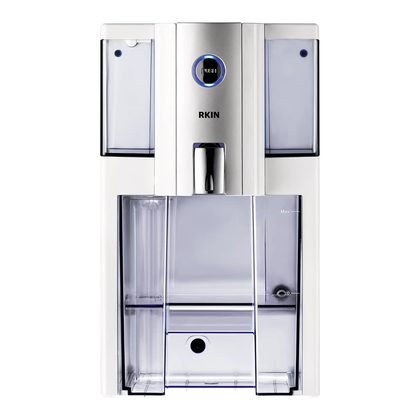
No-install countertop RO (the Zero Installation Purifier), and the only countertop outside AquaTru we found with a certified fluoride claim: IAPMO lists it under NSF/ANSI 58 for fluoride, lead and chromium. RKIN posts its certification lab's reports: fluoride fell 81–95% across 26 samples (about 89% on average), and it sends about 0.8 gallons to the drain per gallon (55.08% efficiency). RKIN's page also calls PFOA/PFOS certified; its lab's 2020 report shows a pass, but IAPMO's listing doesn't include it. No independent test; its AlcaPure stage adds calcium and magnesium.[71][72][70]
Fluoride 88.8%LeadPFAS not listed
6.9/10
5
Bluevua ROPOT(UV)$454 ($340.50 in cart)
The larger 60-oz glass-carafe model, now with a mineral filter in the box. Fluoride fell 83% in Water Filter Guru's test and to not detected in BOS Water's 2025 test. NSF and WQA list it only under NSF/ANSI/CAN 372 (lead-free materials), not for contaminant reduction.[66][65][60][62][56]
Fluoride 83% to NDPFAS >97%Listing materials only
6.9/10
6
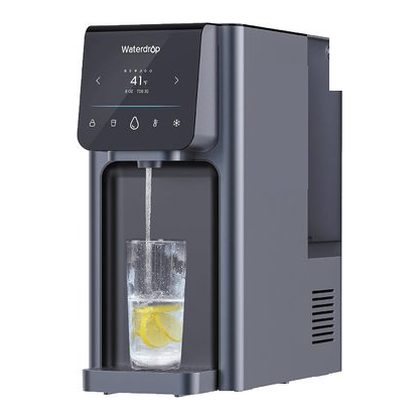
Waterdrop A1$649 ($509 sale)
Hot-and-cold countertop RO. Fluoride fell to not detected in both Water Filter Guru's and BOS Water's tests, but it's certified for TDS only, adds no minerals back (pH 6.5), and BOS found trace xylenes and methylene chloride in the filtered water.[53][54][52]
Fluoride NDMinerals strippedVOCs trace added
6.3/10
·
Waterdrop M6SL$329 ($249 sale)
A glass-pitcher countertop RO sold next to an “NSF/ANSI 58 & 372 Certified” badge and a list of contaminants. IAPMO's NSF/ANSI 58 listing covers total dissolved solids only, and we found no independent test.[50][51]
Not rated
Best under-sink reverse osmosis systems
Under-sink RO gives you filtered water on demand from its own faucet. Look for certified fluoride and PFAS claims, a mineral stage and a low drain figure.
The most completely certified under-sink RO we found, and the most water-efficient under-sink tank system: 54.7% efficiency, about 0.8 gallons to the drain per gallon.
AquaTru's certified filtration, plumbed under the sink, and its IAPMO listing is now confirmed (ATU200, listed June 12, 2026): 93.5% fluoride, 97.5% PFOA/PFOS, 99.1% lead, 98% arsenic, 96% chloramine and 96.5% of microplastics.
Every claim on its data sheet is WQA-certified: 90% fluoride, 99.7% PFOA/PFOS, 96.8% chlorine and chloramine, 99.3% of microplastics, 99–99.8% lead and 96% arsenic.
A non-electric, dealer-installed RO system with certified 95.5% fluoride, 99.3% arsenic and 98.1% lead reduction, and WQA lists its PFOA/PFOS claim under NSF/ANSI 58, its chlorine taste-and-odor claim under NSF/ANSI 42, and VOCs (as chloroform) under NSF/ANSI 53.
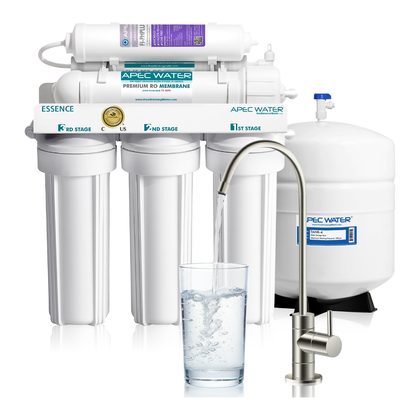
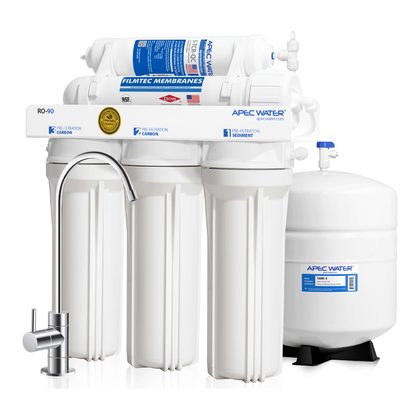
APEC's model with a real WQA fluoride listing: NSF/ANSI 58 for fluoride, lead, arsenic and more. No percentages published, no independent test, no PFAS or chloramine claim, and no mineral stage (the RO-PH90 adds one for $409.99).[84][85]
FluorideLeadPFAS
6.8/10
9
APEC ROES-PH75$268.99
A best-selling budget system. Water Filter Guru found no detectable fluoride after filtering (from 2.4 mg/L), but its WQA listing covers TDS only, it sent 5.1 gallons down the drain per gallon in the same test, and manganese rose slightly.[86][84]
Fluoride NDListing TDS onlyDrain 5.1 gal
6.7/10
Best tankless reverse osmosis systems
Tankless systems filter on demand with an electric pump, so there's no storage tank to sanitize and they waste less water. They need an outlet under the sink.
Tankless, 1,200 gal a day, with a calcium-magnesium filter built in. Water Filter Guru measured fluoride 0.5 → 0.1 mg/L and lead and uranium not detected, and its mineral filter left the most calcium we saw in any test (10.3 mg/L). Certified for TDS and chlorine only.[49][43]
Fluoride 80%Chlorine 98.8%Calcium 10.3 mg/L
7.0/10
3
Frizzlife PD600-TAM3$469.99
Tankless with an alkaline mineral stage. Water Filter Guru measured fluoride 2.4 → 0.1 mg/L and nitrate down 50%, but calcium still fell 86%. IAPMO lists it only for lead-free materials (NSF/ANSI 372), despite certification wording on its page.[76][75]
Fluoride 96%Nitrate 50%Minerals pH mostly
6.7/10
·
iSpring RO500AK-BN tankless$692.99
Tankless RO with an alkaline stage. NSF lists it for total dissolved solids only, and we found no independent lab test of its fluoride, lead or PFAS claims.[81][78]
Not rated
Best remineralizing RO systems (minerals added back)
The most completely certified under-sink RO we found, and the most water-efficient under-sink tank system: 54.7% efficiency, about 0.8 gallons to the drain per gallon.
Tankless, 1,200 gal a day, with a calcium-magnesium filter built in. Water Filter Guru measured fluoride 0.5 → 0.1 mg/L and lead and uranium not detected, and its mineral filter left the most calcium we saw in any test (10.3 mg/L). Certified for TDS and chlorine only.[49][43]
Fluoride 80%Chlorine 98.8%Calcium 10.3 mg/L
7.0/10
5
Frizzlife PD600-TAM3$469.99
Tankless with an alkaline mineral stage. Water Filter Guru measured fluoride 2.4 → 0.1 mg/L and nitrate down 50%, but calcium still fell 86%. IAPMO lists it only for lead-free materials (NSF/ANSI 372), despite certification wording on its page.[76][75]
Fluoride 96%Nitrate 50%Minerals pH mostly
6.7/10
6
Express Water ROALK10D$232.99
An inexpensive tank system with a 5-stage alkaline cartridge. We scored it on Water Filter Guru's test of its sibling RO5DX with the alkaline upgrade (fluoride 2.4 → ND; calcium still down 98%), because the ROALK itself has no independent test and is listed only for lead-free materials.[89][88]
Fluoride ND*Listing materials only
6.3/10
·
Home Master TMAFC-ERP (Artesian Full Contact + permeate pump)$419.90 as configured
Adds calcium and magnesium twice through a crushed-marble stage and claims “up to 99%” removal of fluoride, chloramine and more, but only its components are NSF-listed (materials), there's no performance data sheet, and we found no independent lab test.[90][91]
Not rated
Lowest-wastewater RO systems
Ranked by certified efficiency or independent measurement, lowest waste first, among systems we'd buy. Countertop units send reject water to a tank you can reuse. None of these carries EPA's WaterSense label[99].
1
AquaTru Classic$475 ($495 with Mineral Boost)
Same kind of certified filters as the Carafe with a 0.75-gal plastic tank: 93.5% fluoride, 96% chloramine and 97.5% PFOA/PFOS, and all 14 PFAS Quality Water Lab measured were undetectable after filtering. It has the lowest certified waste here (75% efficiency). BOS found aluminum at 0.05 mg/L after filtering.[8][11][10]
Hot-and-cold countertop RO. Fluoride fell to not detected in both Water Filter Guru's and BOS Water's tests, but it's certified for TDS only, adds no minerals back (pH 6.5), and BOS found trace xylenes and methylene chloride in the filtered water.[53][54][52]
No-install countertop RO (the Zero Installation Purifier), and the only countertop outside AquaTru we found with a certified fluoride claim: IAPMO lists it under NSF/ANSI 58 for fluoride, lead and chromium. RKIN posts its certification lab's reports: fluoride fell 81–95% across 26 samples (about 89% on average), and it sends about 0.8 gallons to the drain per gallon (55.08% efficiency). RKIN's page also calls PFOA/PFOS certified; its lab's 2020 report shows a pass, but IAPMO's listing doesn't include it. No independent test; its AlcaPure stage adds calcium and magnesium.[71][72][70]
The most completely certified under-sink RO we found, and the most water-efficient under-sink tank system: 54.7% efficiency, about 0.8 gallons to the drain per gallon.
Every one of these removed fluoride in certification testing or an independent lab test. Check the three-year cost chart too: filters can cost more than the system.
AquaTru's certified filtration, plumbed under the sink, and its IAPMO listing is now confirmed (ATU200, listed June 12, 2026): 93.5% fluoride, 97.5% PFOA/PFOS, 99.1% lead, 98% arsenic, 96% chloramine and 96.5% of microplastics.
Every claim on its data sheet is WQA-certified: 90% fluoride, 99.7% PFOA/PFOS, 96.8% chlorine and chloramine, 99.3% of microplastics, 99–99.8% lead and 96% arsenic.
No-install countertop RO (the Zero Installation Purifier), and the only countertop outside AquaTru we found with a certified fluoride claim: IAPMO lists it under NSF/ANSI 58 for fluoride, lead and chromium. RKIN posts its certification lab's reports: fluoride fell 81–95% across 26 samples (about 89% on average), and it sends about 0.8 gallons to the drain per gallon (55.08% efficiency). RKIN's page also calls PFOA/PFOS certified; its lab's 2020 report shows a pass, but IAPMO's listing doesn't include it. No independent test; its AlcaPure stage adds calcium and magnesium.[71][72][70]
Fluoride 88.8%LeadPFAS not listed
6.9/10
7
APEC ROES-PH75$268.99
A best-selling budget system. Water Filter Guru found no detectable fluoride after filtering (from 2.4 mg/L), but its WQA listing covers TDS only, it sent 5.1 gallons down the drain per gallon in the same test, and manganese rose slightly.[86][84]
Fluoride NDListing TDS onlyDrain 5.1 gal
6.7/10
Certification badges vs. real listings
Many of the most-advertised RO systems show NSF or WQA badges. We checked each claim against the certifier's public database. Here's what we found.
iSpring RCC7AK
Page says“Tested and certified by NSF International against NSF/ANSI to standard 58 for reduction of Asbestos (>99.7%), Barium (98.4%), Cadmium (98.8%), Chromium (99.2%), Copper (97.8%), Fluoride (97.4%), Lead (98.9%), Selenium (99.0%), TDS (97.9%).” The page also says it removes “up to 99% of over 1,000 harmful contaminants like PFAS.”[77]
Listing showsNSF lists two variants, the RCC7AK-BN and RCC7AK-BLK, for fluoride, lead and seven other claims. The RCC7AK iSpring sells is listed for TDS only, and we couldn't confirm which build a buyer receives (checked Sept. 26, 2026). NSF publishes no percentages. We found no PFAS certification; iSpring's RO500AK tankless is listed for TDS only.[78]
Bluevua ROPOT-Lite and ROPOT(UV)
Page saysBoth product pages say: “Independently certified by NSF and WQA to key NSF/ANSI/CAN standards for reverse osmosis systems.” The Lite page adds that the RO stage “removes 99.9% of contaminants including lead, arsenic, PFAS, fluoride, and microplastics.”[55][56]
Listing showsWQA lists the ROPOT-Lite under NSF/ANSI 58 for cadmium, lead, TDS and trivalent chromium, and the ROPOT(UV) only under NSF/ANSI/CAN 372, a lead-content standard for materials. NSF lists Bluevua's ROPOT models only under NSF/ANSI/CAN 372 (lead-free materials), not for contaminant reduction (checked Sept. 26, 2026). Neither certifier lists fluoride or PFAS for any Bluevua model.[57][60]
SimPure Y7P
Page saysThe page lists “Certification: NSF/ANSF 58” and says the system is “independently verified by SGS to NSF/ANSI 58 standards.”[94]
Listing showsNSF's public listing covers only the membrane inside it (ROULP-Y7P-100, made by Membrane Solutions), certified to NSF/ANSI 58 “material requirements only” (checked Sept. 26, 2026). The SGS report is a test SimPure commissioned, and the page's “microplastics >99.6%” figure isn't in it.[95][96]
Waterdrop X-series and M6
Page saysThe X16 page shows “NSF/ANSI 42&58&372 Certified” above a list of reduced substances that includes PFOA, PFOS, fluoride, arsenic, lead and microplastics; it also says the system was “Tested and Certified by IAPMO R&T against NSF/ANSI 58 for the reduction of the claims specified on the Performance Data Sheet.” The M6SL page puts the same list next to “NSF/ANSI 58 & 372 Certified.”[47][50]
Listing showsIAPMO lists the X12 and X16 under NSF/ANSI 58 for TDS only and under NSF/ANSI 42 for chlorine, taste and odor; the M6's NSF/ANSI 58 listing is TDS only (checked Sept. 26, 2026). The G3P800 is the exception: IAPMO lists it for fluoride and PFOA/PFOS, though Waterdrop's product page places “NSF/ANSI 42, 53, 58 & 372 Certified” next to a longer list of substances, several asterisked as not certified.[40][42][43][51][38]
APEC ROES-PH75
Page saysThe product title reads “WQA Certified,” and the page lists fluoride, lead, arsenic and chloramines among contaminants it's “Guaranteed to Remove.”[82]
Listing showsWQA's public listing for the ROES-PH75 shows NSF/ANSI 58 for TDS reduction only, plus NSF/ANSI/CAN 372 (checked Sept. 26, 2026). The page itself says the system “has been tested for TDS reduction.” APEC's RO-90 and RO-PH90 are the models WQA lists for fluoride, lead and arsenic.[84]
Frizzlife PD600-TAM3
Page saysThe page says it's “SGS-tested to NSF/ANSI 42/53/58 for TDS, PFAS, lead, fluoride & more.”[73]
Listing showsIAPMO lists the PD600-TAM3 only under NSF/ANSI/CAN 372 for lead-free materials (checked Sept. 26, 2026). Being tested to a standard by a paid lab isn't the same as being certified to it.[75]
How to check any badge yourself: search the exact model on NSF's, WQA's or IAPMO's public directory, then look for the contaminant you care about by name. A badge covers only the claims on that listing, and NSF/ANSI 372 is about lead-free materials, not what the filter removes[75][60].
What independent labs found added to filtered water
These compounds weren't in the tap sample (or rose after filtering) in an independent test. Most were at trace levels, and each lab compares results with its own choice of health guideline, which we name. Plastic housings, tanks and mineral media are the likely sources, but no test proves the cause.
System
What appeared
Level vs. guideline
Who tested
Score effect
Aquasana SmartFlow RO
Chloromethane
30 ppb; not in the tap sample; no EPA drinking-water limit[28]
Water Filter Guru (review Aug. 13, 2026)
−0.3
SimPure Y7P-BW
Styrene
1.06 ppb, 2.12 times California OEHHA's 0.5 ppb guideline[98]
BOS Water, 2024 test
−0.3
Bluevua ROPOT-Lite
Methylene chloride
2.41 and 1.24 ppb, 1.7 and 3.2 times below OEHHA's 4 ppb[64]
BOS Water, 2025 (2 rounds)
−0.2
Waterdrop A1
Methylene chloride; m+p-xylenes
0.53 ppb (7.5 times below OEHHA's 4 ppb); 1.32 ppb (379 times below WHO's 500 ppb)[54]
BOS Water, 2025
−0.3
AquaTru Carafe
Aluminum
0.04 mg/L (2024) and 0.0809 mg/L (2025), 15 and 7.4 times below OEHHA's 0.6 mg/L; not seen in 3 Water Filter Guru tests of AquaTru systems[7]
0.825 ppm aluminum (none detected in the tap sample), 11.8 times Tap Score's 0.07 ppm guideline; 0.0013 ppm antimony, above Tap Score's 0.001 ppm (EPA's limit is 0.006 ppm)[93][118]
Water Filter Guru, Apr. 2026 test
−0.5
Waterdrop G3P800 + mineral add-on
Nitrite
0.24 ppm as nitrogen; not in the tap sample; EPA's limit is 1 mg/L[44][118]
Water Filter Guru (review updated Aug. 5, 2026)
−0.2
iSpring RCC7 with mineral stage
Arsenic; vanadium; manganese
Arsenic 0.00333 ppm (none in the tap sample; Tap Score's guideline is zero, EPA's limit 0.010 ppm); vanadium 0.0017 → 0.111 ppm, above Tap Score's 0.05 ppm guideline; manganese 0.0011 → 0.0019 ppm[79][118]
Water Filter Guru (review updated Aug. 4, 2026)
−0.5
APEC ROES-PH75
Manganese
0.0011 → 0.00155 ppm, attributed to the mineral filter[86]
Water Filter Guru (review updated Aug. 4, 2026)
−0.15
Cloud RO
Zinc
0.024–0.0315 ppm, an intended mineral from its mineral stage[22]
Water Filter Guru; Quality Water Lab
None
What we'd skip
Each of these took fluoride out in an independent test, but the same tests found something added to the water, and none is certified for PFAS.
1
iSpring RCC7AK$241.99
Fluoride fell 87.5% in Water Filter Guru's test (2.4 → 0.3 mg/L), below the 97.4% iSpring quotes from NSF testing, and the same test found arsenic and vanadium in the filtered water (see the table below). NSF lists two variants, the RCC7AK-BN and RCC7AK-BLK, for fluoride, lead and seven other claims. The RCC7AK iSpring sells is listed for TDS only, and we couldn't confirm which build a buyer receives (checked Sept. 26, 2026).[79][78]
Fluoride 87.5%Arsenic addedVanadium added
6.1/10
2
US Water Systems American RO$785.61–$796.05
No certification yet. The maker told Water Filter Guru in May 2026 it expected NSF/ANSI 58 certification by early August; we found no listing on Sept. 26, 2026. In WFG's April 2026 test it sent 7.86 gallons to the drain per gallon, and the filtered water had 0.825 ppm of aluminum (none detected in the tap sample), 11.8 times Tap Score's 0.07 ppm guideline, plus 0.0013 ppm of antimony (above Tap Score's 0.001 ppm; EPA's limit is 0.006 ppm). WFG and US Water attribute the aluminum to the alumina-based mineral media; WFG says a retest with a used or new cartridge could differ.[93][92][118]
Fluoride NDAluminum addedDrain 7.9 gal
6.1/10
3
SimPure Y7P-BW$369.99 ($269.99 with coupon)
No-install countertop RO that took fluoride below detection in two independent labs, but its only NSF listing covers the membrane's materials, it adds no minerals back (pH 6.3), and BOS Water found styrene at 2.12 times California's guideline in the filtered water.[98][95]
Fluoride NDStyrene addedListing membrane only
6.1/10
·
iSpring RCD100 countertop$419.99
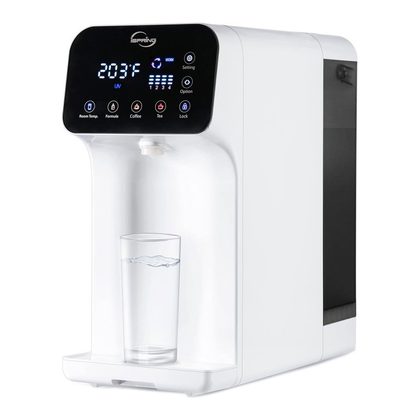
Instant-hot countertop RO. iSpring cites SGS report numbers (fluoride 99.9%, PFOA >99.1%) but doesn't post the reports, and we found no certification listing or independent test.[80]
Not rated
When the label promises more than the lab finds
These are the biggest gaps we found between what brands claim and what independent tests measured. For water to the drain, a higher measured number means more waste than claimed.
APEC ROES-PH75[86]Gallons to drain per gallon (lower is better)
APEC's chat tool3 gal
Water Filter Guru5.1 gal
The G3P800's certified fluoride figure is 88.2%[39]; the 99% comes from a separate, unnamed lab on the same data sheet, and Water Filter Guru's 79% was measured without the optional mineral filter. One more: Aquasana's manual says the SmartFlow's remineralizer “adds back calcium”[26], but in Water Filter Guru's test calcium fell from 73.3 to 1.85 mg/L while pH rose from 8.0 to 9.3[28].
DA
Dr. Axe's Take
Reverse osmosis is the one home filter I trust to take fluoride, PFAS and lead out of drinking water at the same time, and cut nitrate. My non-negotiables are simple. First, filter what you drink and cook with at the kitchen tap, and make sure the fluoride and PFAS claims are on a certifier's listing, not just a badge on a product page.
Second, put the minerals back. RO strips calcium and magnesium, and most “remineralizing” cartridges return only a trace. Choose a system with a proven mineral stage, add trace minerals to your water, and eat mineral-rich foods like leafy greens, pumpkin seeds, avocado and bone broth.
Third, keep it clean: change every filter on schedule and sanitize the system once a year.
— Dr. Josh Axe
Frequently asked questions
What is the best reverse osmosis system?
The AquaTru Carafe with Alkaline Mineral Boost ($395, 8.6/10). IAPMO certifies it for 96.4% fluoride, 99.9% PFOA/PFOS, 99.2% lead, 98.8% arsenic and 97% chloramine; two independent labs found no detectable fluoride after filtering; it collects water in a glass carafe; its Mineral Boost filter adds magnesium back; and it needs no installation. The $375 standard version filters the same way but skips the mineral stage.
What is the best under-sink reverse osmosis system?
The Culligan Aquasential Smart RO is the most certified and the most water-efficient under-sink tank system (54.7%), but it's dealer-installed at an estimated $1,800–$2,500 (a third-party estimate; get a dealer quote). The AquaTru Under Sink ($395) has certified fluoride, PFAS and chloramine removal for far less. Cloud RO ($599 on sale) puts the most minerals back and wastes about a gallon per gallon.
Does reverse osmosis remove fluoride?
Yes, better than any other common home filter. Certified averages on this page range from 83.8% (Brondell Circle) to 96.8% (Culligan Smart RO), and independent labs found fluoride below detection after filtering with the AquaTru Carafe, AquaTru Under Sink, Cloud RO, Aquasana SmartFlow and others. Results vary by model, so check the listing or a lab test for the one you buy.
Does reverse osmosis remove PFAS?
Certified RO systems do. The AquaTru Carafe (99.9%), Aquasana SmartFlow (99.7%), AquaTru Under Sink (97.5%) and Waterdrop G3P800 (over 98%) are certified for PFOA/PFOS, as is the Kinetico K5 (WQA; no percentage published), and Culligan and Pentair for Total PFAS. In a study of 73 North Carolina homes, every under-sink RO tested removed PFAS nearly completely. A certified claim means 20 ppt or less from a 1,500 ppt challenge, not 4 ppt.
Is reverse osmosis water bad for you?
RO water is very low in minerals. A 2005 WHO review suggested drinking water keep at least 20 mg/L calcium and 10 mg/L magnesium, while a 2025 review found very-low-mineral water hasn't been linked to health risks for the general population. Our advice: choose a system with a proven mineral stage or add trace minerals, and eat mineral-rich foods.
Do remineralizing RO filters actually add minerals?
Mostly a little. In independent tests of 10 mineral stages, none brought calcium to WHO's 20 mg/L minimum (the most was 10.3 mg/L, Waterdrop X12), and only AquaTru's Mineral Boost raised magnesium above the tap level (9.78 vs 7.32 mg/L). Most mainly raise pH. Cloud RO left the most magnesium among under-sink systems and adds a little zinc.
How much water does reverse osmosis waste?
EPA says a typical RO system sends five gallons or more down the drain for every gallon it makes; WaterSense-labeled systems send 2.3 or less. On this page, measured and certified figures range from about 0.2 gallons (SimPure, which recycles reject water) to 7.9 gallons (US Water American RO). Only three RO systems carry the WaterSense label, and none is on this page.
Does “NSF certified” on the box mean it removes fluoride?
Not necessarily. Many RO systems are certified to NSF/ANSI 58 for total dissolved solids only, and NSF/ANSI 372 covers only lead-free materials. Bluevua, SimPure, Waterdrop, APEC and Frizzlife pages all make certification claims that go beyond their listings. For iSpring, NSF lists two variants, the RCC7AK-BN and RCC7AK-BLK, for fluoride, lead and seven other claims; the RCC7AK iSpring sells is listed for TDS only, and we couldn't confirm which build a buyer receives (checked Sept. 26, 2026). Search the exact model in NSF's, WQA's or IAPMO's directory and look for fluoride or PFOA/PFOS by name.
Can bacteria grow in a reverse osmosis system?
Yes. Storage tanks and carbon filters can grow bacteria. In a 1991 trial, RO units with higher bacterial counts tracked with more stomach symptoms, even though RO households had fewer illnesses overall. Change filters on schedule and sanitize the system once a year, as Culligan's manual advises.
How much does a reverse osmosis system cost to own?
Over three years at 1.5 gallons a day, counting every replacement cartridge at its time or gallon limit, our do-it-yourself picks run from about $577 (Bluevua ROPOT-Lite) to $1,680 (Waterdrop X12); the AquaTru Carafe with Mineral Boost costs about $914. Dealer-installed systems run about $1,770–$3,570 by our estimates; get a dealer quote. Reject water adds a few dollars over three years at EPA's sample water rate, from about 548 to 8,442 gallons.
Should I get a countertop or under-sink RO system?
Countertop units like the AquaTru Carafe need no plumbing, which makes them best for renters, and their reject water goes into a tank you empty. They make about half a gallon per batch, so households of five or more are usually happier with an under-sink or tankless system, which fills on demand from its own faucet.
References
Update history
Sept. 26, 2026: First published. Scored with the Clean Water Score from our Water Filters guide. Certification listings checked one by one in the NSF, WQA and IAPMO directories on Sept. 26, 2026; independent tests from Water Filter Guru, BOS Water and Quality Water Lab. Compared with the Water Filters guide, new data or rules changed 8 scores: AquaTru Carafe 8.8 → 8.6 (chloramine certification added from the current data sheet; BOS aluminum finding), AquaTru Under Sink (ATU200) 8.5 → 8.6 (IAPMO listing confirmed), Cloud RO 8.4 → 8.0 (chlorine shown only by a reviewer's test strip, which we now score like maker data), Kinetico K5 7.5 → 7.8 (chlorine certification now scored per the rubric; exact half-up rounding), AquaTru Classic 8.6 → 8.4 (BOS aluminum finding), Waterdrop A1 6.7 → 6.3 (BOS found trace solvents; chlorine by test strip), Bluevua ROPOT(UV) 6.7 → 6.9 (new BOS test; mineral filter now included; chlorine by test strip) and Waterdrop G3P800 7.2 → 7.7 (IAPMO certification confirmed; fluoride scored on its certified 88.2%).
Certified AquaTru Carafe performance data sheet, rev. 09.25.R5 (IAPMO R&T; NSF/ANSI 42, 53, 58, 401, 372): fluoride 96.4%, PFOA/PFOS 99.9%, chloramine 97.01%, microplastics 98.96%, 63% efficiency and each filter's limit. Open source
Certified IAPMO R&T listing W-10188, NSF/ANSI 42: AquaTru AT100–AT140 (Carafe), AT2000 series (Classic) and ATU200 (Under Sink), each listed for chloramine (checked Sept. 26, 2026). Open source
Certified IAPMO R&T listing W-10194, NSF/ANSI 58: AquaTru models, incl. the ATU200 Under Sink listed June 12, 2026 (checked Sept. 26, 2026). Open source
Maker's data AquaTru. Carafe product page and replacement filter prices (Carafe with Alkaline Mineral Boost $395; checked Sept. 26, 2026). Open source
Maker's data AquaTru support. How much the pH Mineral Boost Alkaline VOC filter raises pH (“by as much as 1 to 4 pH levels”). Open source
Independent lab Water Filter Guru. AquaTru Carafe review and lab test (updated Aug. 30, 2026). Open source
Independent lab BOS Water. AquaTru Carafe / Carafe Smart review with 2024 and 2025 lab tests, incl. aluminum results (Sept. 7, 2026). Open source
Certified AquaTru Classic performance data sheet, rev. 10.24.R4 (IAPMO): fluoride 93.5%, 75% efficiency, filter limits. Open source
Independent lab Water Filter Guru. AquaTru Classic review and lab tests, incl. the Mineral Boost filter (updated Jul. 22, 2026). Open source
Independent lab BOS Water. AquaTru Classic / Classic Smart review with lab tests (Sept. 7, 2026). Open source
Independent lab Quality Water Lab. AquaTru Classic lab test: 14 PFAS not detected after filtering (Aug. 14, 2026). Open source
Certified AquaTru Under Sink (ATU200) performance data sheet, rev. 06.26: IAPMO-certified reductions, 25% efficiency, filter limits. Open source
Maker's data AquaTru. Under Sink product page and filters ($395; $420 Alkaline Mineral Boost; 1.7-gal tank; leak detection; checked Sept. 26, 2026). Open source
Independent lab Water Filter Guru. AquaTru Under Sink review and lab test (updated Aug. 30, 2026). Open source
Certified Culligan Aquasential RO & Smart RO owner's guide and performance data sheet (WQA; Oct. 2024): Smart RO averages (fluoride 96.8%, lead 99.7%, arsenic 98.8%), 54.7% efficiency, Mineral Boost, yearly sanitizing. No prices. Open source
Certified WQA Gold Seal listing: Culligan Aquasential Smart RO, NSF/ANSI 42, 53, 58 and 401 (checked Sept. 26, 2026). Open source
Third-party estimate Tap Water Data. Culligan reverse osmosis complete guide (Oct. 14, 2025): Smart RO $1,800–$2,500 installed, standard RO $1,200–$1,800, dealer filter service $300–$400 a year. A third-party estimate, not a Culligan price. Open source
Maker's data Cloud Water Filters. Cloud RO buy page ($599 sale, $649 list; 5-filter set $200; 5-year warranty; checked Sept. 26, 2026). Open source
Maker's data Cloud RO specification sheet with maker-commissioned SGS results and a 54% efficiency rating. Open source
Maker's data Cloud Water Filters FAQ: stainless tank shell with a polypropylene liner; “roughly 15-30 ppm of healthy minerals.” Open source
Certified NSF listing: Cloud Version 1, NSF/ANSI 58, total dissolved solids only (checked Sept. 26, 2026). NSF's old directory closes Oct. 1, 2026; the same listings are searchable at listings.nsf.org. Open source
Independent lab Water Filter Guru. Cloud RO review and two lab tests (updated Aug. 5, 2026). Open source
Independent lab Quality Water Lab. Reverse osmosis testing, incl. Cloud RO after 12 months (204 gallons) on its original filters (Sept. 16, 2026). Open source
Certified Aquasana SmartFlow RO (AQ-SFRO2) performance data sheet (WQA): fluoride 90%, PFOA/PFOS 99.7%, chloramine 96.8%, 27.4% efficiency. Open source
Certified WQA Gold Seal listing: Aquasana AQ-SFRO2, NSF/ANSI 42, 53, 58 and 401 (checked Sept. 26, 2026). Open source
Maker's data Aquasana SmartFlow RO installation manual: remineralizer “adds back calcium,” 2.5-gal tank, filter schedule. Open source
Maker's data Aquasana. SmartFlow RO product page and replacement filters ($199.99 sale, $449.99 list; checked Sept. 26, 2026). Open source
Independent lab Water Filter Guru. Aquasana SmartFlow RO review and lab test (Aug. 13, 2026). Open source
Maker's data Pentair. FreshPoint 5-stage under-sink RO product page: “Certified to Reduce” percentages; no price listed. Open source
Maker's data Pentair FreshPoint GRO-575B spec sheet: 4.4-gal tank, 51.17% recovery rating, filter life. Open source
Certified NSF listings: Pentair GRO-575B under NSF/ANSI 58 (fluoride, lead, arsenic, radium and more), NSF/ANSI 42 (chlorine, taste and odor), NSF/ANSI 53 (lead, cyst, atrazine) and NSF/ANSI 401 (microplastics) (checked Sept. 26, 2026). NSF's old directory closes Oct. 1, 2026; the same listings are searchable at listings.nsf.org. Open source
Certified IAPMO R&T certificate W-13717: Pentair GRO-575B, NSF/ANSI 53 Total PFAS (checked Sept. 26, 2026). Open source
Certified Kinetico K5 performance data sheet, WQA/NSF (2012); a dealer-hosted copy. Open source
Certified WQA Gold Seal listing: Kinetico K5 Drinking Water Station, NSF/ANSI 58 incl. fluoride, PFOA and PFOS (checked Sept. 26, 2026). Open source
Certified WQA Gold Seal listings: Kinetico K5 Drinking Water Station under NSF/ANSI 42 (aesthetic chlorine, taste and odor) and NSF/ANSI 53 (VOCs as chloroform, MTBE, arsenic) (checked Sept. 26, 2026). Open source
Maker's data Kinetico K5 owner's manual (May 2021): 16.3% efficiency with the standard tank, 22.8% with the QuickFlo tank, MACguard 500-gal shutoff, sanitizing. Open source
Maker's data Kinetico. K5 with VOC Guard product page: dealer-only cartridges, no published price. Open source
Maker's data Waterdrop. G3P800 product page ($999 list, $759 with a checkout code; filters; certification wording; checked Sept. 26, 2026). Open source
Certified Waterdrop G3P800 performance data sheet: IAPMO-certified results (fluoride 88.23%, PFOA >98%, PFOS >99%; certified metals listed as cadmium, hexavalent chromium and selenium) alongside maker-tested ones. Open source
Certified IAPMO R&T certificate WC-13976, NSF/ANSI 58 (Qingdao Ecopure / Waterdrop): G3P800 for TDS, fluoride, cadmium, barium, radium 226/228 and lead (listed Nov. 3, 2025); X12 and X16 for TDS only (checked Sept. 26, 2026). Open source
Certified IAPMO R&T file WC-13976, legacy listing (current as of Sept. 26, 2026): G3P800 for TDS, fluoride, cadmium, hexavalent chromium, selenium, barium and radium 226/228, with no lead; A1 for TDS only. Open source
Certified IAPMO R&T certificate WC-14301, NSF/ANSI 42: Waterdrop G3 and X-series carbon filters, chlorine, taste and odor. Open source
Independent lab Water Filter Guru. Waterdrop G3P800 review and lab tests with and without the mineral filter (updated Aug. 5, 2026). Open source
Independent lab Quality Water Lab. Water filters for PFAS: Waterdrop G3P800, 14 of 14 PFAS not detected after filtering (after-filter results only). Open source
Maker's data Waterdrop. X12 product page ($1,299 list; F1A mineral filter; 3:1 claim; checked Sept. 26, 2026). Open source
Maker's data Waterdrop. X16 product page: “NSF/ANSI 42&58&372 Certified” badge above a reduced-substances list (checked Sept. 26, 2026). Open source
Maker's data Waterdrop X16 data sheet (Jan. 2026): certified TDS and chlorine; maker/SGS-tested fluoride 99.18% and other claims. Open source
Independent lab Water Filter Guru. Waterdrop X-series (X12) review and lab test (updated Sept. 3, 2025). Open source
Maker's data Waterdrop. M6SL product page: “NSF/ANSI 58 & 372 Certified” next to a contaminant list (checked Sept. 26, 2026). Open source
Certified IAPMO R&T certificate W-17249, NSF/ANSI 58: Waterdrop M6 models, TDS only (checked Sept. 26, 2026). Open source
Maker's data Waterdrop. A1 product page ($649 list, $509 sale; checked Sept. 26, 2026). Open source
Independent lab Water Filter Guru. Waterdrop A1 review and lab test (Dec. 29, 2025). Open source
Independent lab BOS Water. Waterdrop A1 review with two 2025 lab tests. Open source
Maker's data Bluevua. ROPOT(UV) product page ($454 list; 60-oz glass carafe; mineral filter included; “NSF & WQA Certified” wording). Open source
Certified WQA Gold Seal listings for Bluevua: ROPOT-Lite under NSF/ANSI 58 (cadmium, lead, TDS, trivalent chromium); ROPOT and ROPOT(UV) under NSF/ANSI/CAN 372 only (checked Sept. 26, 2026). Open source
Certified WQA lab report posted by Bluevua: ROPOT-Lite NSF/ANSI 58 TDS test (96.2% TDS reduction; 46.1% efficiency). Open source
Certified WQA lab report posted by Bluevua: ROPOT NSF/ANSI 58 TDS test (94.5% TDS reduction; 49.0% efficiency; Mar. 12, 2024). A test report, not a certification listing. Open source
Certified NSF listing, NSF/ANSI/CAN 372 (lead-free materials): Bluevua ROPOT, ROPOT(UV), ROPOT-Lite, ROPOT-Lite(UV), ROPOT-Travel and ROPOT-Go and their filters; certificate C0878345-01, June 12, 2026 (checked Sept. 26, 2026). NSF's old directory closes Oct. 1, 2026; the same listings are searchable at listings.nsf.org. Open source
Maker's data SGS report commissioned by Bluevua, ROPOT-Lite: fluoride 5.669 → 0.009 mg/L (99.84%), lead and arsenic (Nov. 18, 2022). Open source
Maker's data SGS report commissioned by Bluevua, ROPOT: PFOA >97.36%, PFOS >99.25%. Open source
Maker's data SGS report commissioned by Bluevua, ROPOT: fluoride 98.57%, plus lead, arsenic, chlorine residue and microbes. Open source
Independent lab BOS Water. Bluevua ROPOT-Lite review with two 2025 lab tests (Sept. 21, 2026). Open source
Independent lab BOS Water. Bluevua ROPOT review with lab tests (Sept. 7, 2026). Open source
Independent lab Water Filter Guru. Bluevua ROPOT(UV) review and lab test (updated Apr. 24, 2026). Open source
Maker's data Brondell. Circle RC100 product page ($449.99; replacement filters; checked Sept. 26, 2026). Open source
Certified Brondell Circle RC100 performance data sheet (WQA): fluoride 83.8%, lead 98.1%, arsenic 99.8%, 33.5% efficiency (Feb. 6, 2025). Open source
Certified WQA Gold Seal listing: Brondell RC100, NSF/ANSI 42, 53, 58 and 372 (checked Sept. 26, 2026). Open source
Maker's data RKIN. Zero Installation Purifier (ZIP) product page ($369.95 sale, $489.95 list; AlcaPure stage; 55.08% efficiency and 45.4 gal a day in its NSF/ANSI 58 test; checked Sept. 26, 2026). Open source
Certified IAPMO R&T file W-12496, NSF/ANSI 58: RKIN ZIP models for TDS, lead, trivalent and hexavalent chromium and fluoride (checked Sept. 26, 2026). Open source
Certified QFT Laboratory (IAPMO-recognized) NSF/ANSI 58 test reports for the RKIN ZIP, posted by RKIN (2020–2021): fluoride 81.25–95.12% across 26 samples (88.8% average), plus lead, chromium, TDS and a PFOA/PFOS pass that isn't on IAPMO's listing. Open source
Maker's data Frizzlife. PD600-TAM3 product page ($469.99; $399.99 with a code; filters; “SGS-tested to NSF/ANSI 42/53/58” wording; checked Sept. 26, 2026). Open source
Maker's data Frizzlife PD600 leaflet with SGS data (fluoride 94.78%, PFOA, PFOS, lead). Open source
Certified IAPMO R&T certificate W-29648: Frizzlife PD600-TAM3, NSF/ANSI/CAN 372 lead-free materials only (checked Sept. 26, 2026). Open source
Independent lab Water Filter Guru. Frizzlife PD600-TAM3 review and lab test (updated Mar. 16, 2026). Open source
Maker's data iSpring. RCC7AK product page (“certified by NSF International” percentages; “over 1,000 harmful contaminants like PFAS”; $241.99; checked Sept. 26, 2026). Open source
Certified NSF listing: iSpring Water Systems, NSF/ANSI 58. The RCC7AK-BN and RCC7AK-BLK (and UV versions) are listed for asbestos, barium, cadmium, trivalent chromium, copper, fluoride, lead, selenium and TDS; the RCC7AK, RCC7AK-UV and RO500AK are listed for TDS reduction only (checked Sept. 26, 2026). NSF's old directory closes Oct. 1, 2026; the same listings are searchable at listings.nsf.org. Open source
Independent lab Water Filter Guru. iSpring RCC7 with remineralization, review and lab test (updated Aug. 4, 2026). Open source
Maker's data iSpring. RCD100 countertop product page: cites SGS report numbers without posting the reports ($419.99). Open source
Maker's data iSpring. RO500AK-BN tankless product page ($692.99; “NSF 58 certified for TDS reduction”). Open source
Maker's data APEC. ROES-PH75 product page (“WQA Certified”; “Guaranteed to Remove” list; “tested for TDS reduction”; $268.99; checked Sept. 26, 2026). Open source
Maker's data APEC ROES-PH75 owner's manual: NSF/ANSI 58 test data (19.4% efficiency), filter schedule. Open source
Certified WQA Gold Seal listings for APEC: ROES-PH75 under NSF/ANSI 58 for TDS only; RO-90 and RO-PH90 for fluoride, lead, arsenic and more (checked Sept. 26, 2026). Open source
Maker's data APEC. RO-90 Ultimate product page ($264.99; no mineral stage; RO-PH90 $409.99). Open source
Independent lab Water Filter Guru. APEC ROES-PH75 review and lab test (updated Aug. 4, 2026). Open source
Maker's data Express Water. Alkaline RO System ROALK10D product page ($232.99; “1-3 gallons per gallon produced”; checked Sept. 26, 2026). Open source
Certified WQA listing: Express Water ROALK10D and ROALK10M, NSF/ANSI/CAN 372 only (checked Sept. 26, 2026). Open source
Independent lab Water Filter Guru. Express Water RO5DX review, incl. its alkaline-upgrade test (updated Sept. 23, 2026). Open source
Maker's data Perfect Water Technologies. Home Master Artesian Full Contact product page ($329.95 plus $89.95 permeate pump; “NSF Certified Components”). Open source
Certified NSF listing: Perfect Water Technologies, components only, material requirements (checked Sept. 26, 2026). NSF's old directory closes Oct. 1, 2026; the same listings are searchable at listings.nsf.org. Open source
Maker's data US Water Systems. American Made Reverse Osmosis System (6-stage alkaline version $785.61–$796.05; checked Sept. 26, 2026). Open source
Independent lab Water Filter Guru. US Water American RO review and lab test (installed Apr. 6, 2026; updated Aug. 17, 2026). Open source
Maker's data SimPure. Y7P-BW product page (“Certification: NSF/ANSF 58”; “Independently verified by SGS to NSF/ANSI 58 standards”; $369.99 list; checked Sept. 26, 2026). Open source
Certified NSF listing: Membrane Solutions ROULP-Y7P-100 membrane element, NSF/ANSI 58 “material requirements only” (checked Sept. 26, 2026). NSF's old directory closes Oct. 1, 2026; the same listings are searchable at listings.nsf.org. Open source
Maker's data SGS report NBF22-010777-02 commissioned by SimPure, Y7P (Sept. 9, 2022). Open source
Independent lab Water Filter Guru. SimPure Y7P review and lab test (May 28, 2025). Open source
Independent lab BOS Water. SimPure Y7P-BW review with 2024 and 2025 lab tests, incl. styrene. Open source
Public record / study EPA WaterSense product search, point-of-use reverse osmosis: 3 labeled models (Delta DWQ1001012, Brizo BWQ1001012, Kinetico Hydro Eco 600 GPD; checked Sept. 26, 2026). Open source
Public record / study EPA WaterSense specification for point-of-use RO systems, v1.0 (Nov. 2024): 2.3 gallons or less to drain per gallon, efficiency 30% or more, NSF/ANSI 58 certification. Open source
Public record / study EPA WaterSense supporting statement for the RO specification (typical systems 10–20% efficient; about 1 million sold a year; no federal efficiency standard). Open source
Public record / study EPA WaterSense. Point-of-use reverse osmosis systems: a typical system sends five gallons or more down the drain per gallon. Open source
Public record / study CDC. 2022 water fluoridation statistics (62.8% of the U.S. population). Open source
Public record / study CDC. About community water fluoridation: “The recommended fluoride concentration in drinking water … is 0.7 milligrams of fluoride per liter” (page updated Nov. 3, 2023; still posted Sept. 26, 2026). Open source
Public record / study EPA Report on the Environment. Population served by community water systems with no reported violations of health-based standards: 92% in FY 2021. Open source
Public record / study National Toxicology Program. Monograph on fluoride exposure and neurodevelopment and cognition (Aug. 2024). Open source
Public record / study Taylor et al. Fluoride exposure and children's IQ scores: a systematic review and meta-analysis. JAMA Pediatrics, 2025. Open source
Public record / study Iheozor-Ejiofor et al. Water fluoridation for the prevention of dental caries. Cochrane Database of Systematic Reviews, 2024. Open source
Public record / study MultiState. Utah and Florida enact statewide fluoridation bans (May 27, 2025). Open source
Public record / study EPA. Fluoride in drinking water: MCL 4.0 mg/L; assessment protocol released Aug. 3, 2026. Open source
Public record / study USGS. Tap water study detects PFAS across the U.S. (Smalling et al., Environment International, 2023). Open source
Public record / study EPA. UCMR 5 data summary, July 2026: 662 of 4,277 large systems (15.5%) averaged above at least one 2024 PFAS limit, mostly PFOS (12.2%) and PFOA (11.0%). Open source
Public record / study EPA. PFAS National Primary Drinking Water Regulation, 89 FR 32532 (Apr. 26, 2024): PFOA and PFOS limits of 4.0 ppt. Open source
Public record / study EPA. Proposed PFOA and PFOS compliance extension rule (May 2026): deadline 2029 to 2031, proposed only. Open source
Public record / study Federal Register. Extending the compliance deadline for the PFOA and PFOS maximum contaminant levels, proposed rule (May 20, 2026; comments closed July 20, 2026). Open source
Public record / study EPA. Proposed PFAS rescission rule (May 2026): would remove the limits for PFHxS, PFNA, HFPO-DA (GenX) and the Hazard Index mixture; PFOA and PFOS limits stay. Proposed only. Open source
Public record / study Federal Register. Rescission of regulatory determinations and removal of related provisions for four PFAS substances, proposed rule (May 20, 2026; comments closed July 20, 2026). Open source
Public record / study EPA. National Primary Drinking Water Regulations: limits for nitrite (1 mg/L as nitrogen), arsenic (0.010 mg/L) and antimony (0.006 mg/L). Open source
Public record / study Herkert et al. Assessing the effectiveness of point-of-use residential drinking water filters for PFASs. Environ Sci Technol Lett, 2020. Open source
Public record / study NSF. Forever chemicals and the advancement of filtration standards: PFOA/PFOS and Total PFAS test levels (Sept. 27, 2024). Open source
Public record / study EPA. 7th Drinking Water Infrastructure Needs Survey, 2025 update: an estimated 4 million lead service lines (3 million reported plus unknown lines predicted to be lead). Open source
Public record / study EPA. Chloramines in drinking water (more than 1 in 5 Americans). Open source
Public record / study Kosuth et al. Anthropogenic contamination of tap water, beer and sea salt. PLOS ONE, 2018 (33 U.S. samples). Open source
Public record / study Qian et al. Rapid single-particle chemical imaging of nanoplastics by SRS microscopy. PNAS, 2024. Open source
Public record / study World Health Organization. WHO calls for more research into microplastics (Aug. 22, 2019). Open source
Public record / study World Health Organization. Nutrients in drinking-water (2005), ch. 12: Health risks from drinking demineralised water. Open source
Public record / study Catling et al. Cardiovascular disease and drinking water hardness: a systematic review. J Water Health, 2008. Open source
Public record / study Pereira & Martins. Should children drink water with very low mineral content? Nutrients, 2025. Open source
Public record / study Payment et al. A randomized trial to evaluate the risk of gastrointestinal disease due to consumption of drinking water meeting current microbiological standards. Am J Public Health, 1991. Open source
Public record / study Payment et al. Gastrointestinal health effects associated with the consumption of drinking water produced by point-of-use domestic reverse-osmosis filtration units. Appl Environ Microbiol, 1991. Open source
Public record / study Colford et al. A randomized, controlled trial of in-home drinking water intervention to reduce gastrointestinal illness. Am J Epidemiol, 2005. Open source
Public record / study Minnesota Department of Health. Home water treatment (rev. Mar. 29, 2024). Open source
Public record / study EPA. Find your local Consumer Confidence Report (yearly water quality report, due by July 1). Open source
Public record / study EWG Tap Water Database (advocacy group; its health guidelines are its own and not enforceable). Open source
Public record / study EPA. Protect your home's water: test private wells every year for total coliform bacteria, nitrates, total dissolved solids and pH. Open source
Public record / study EPA WaterSense. Understanding your water bill (sample rate $0.00295 per gallon). Open source
DA
Dr. Josh Axe, DNM, DC, CNS
Founder, DrAxe.com
Dr. Axe is a doctor of natural medicine, chiropractor and certified nutrition specialist with more than 20 years in functional medicine, and the founder of DrAxe.com.
How we make money: We may earn a commission when you buy through links on this page. It never changes our rankings: products are scored before any affiliate terms are discussed, brands can't pay for placement, and we recommend products whether or not they have an affiliate program. Scores are editorial assessments based on certification records and published lab tests, not our own lab testing.