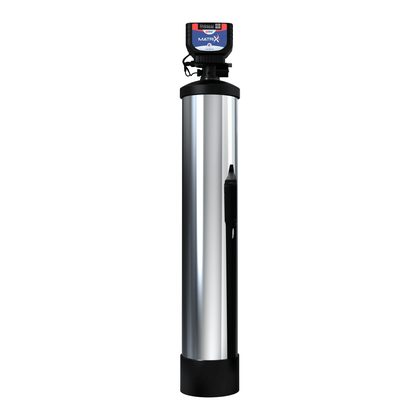
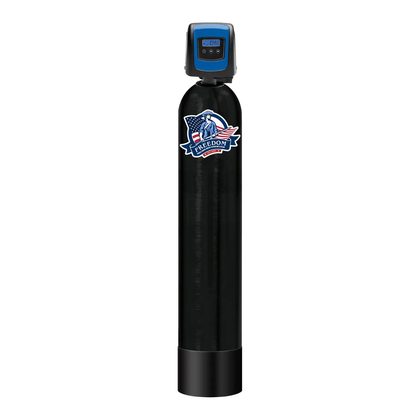
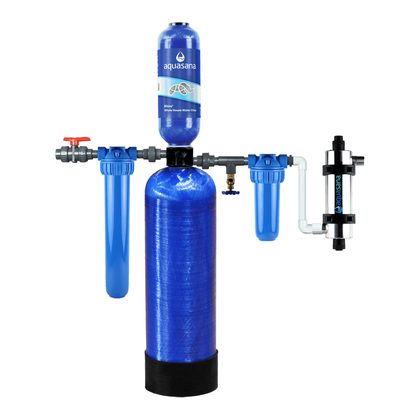
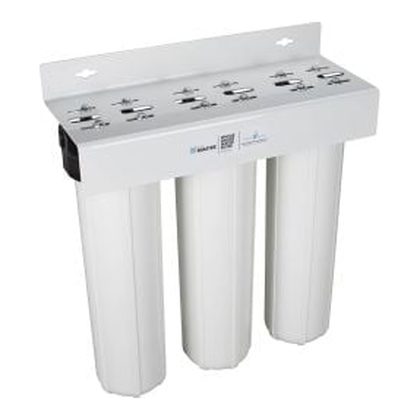
The Best Whole-House Water Filters of 2026, Ranked for Chlorine, Chloramine and Chemicals
We compared more than 25 whole-house systems, from a $166 cartridge rack to dealer-installed tanks, on how well each is proven to remove chlorine, chloramine, PFAS and shower byproducts, what it really costs over 10 years, and whether it can keep up with your home.
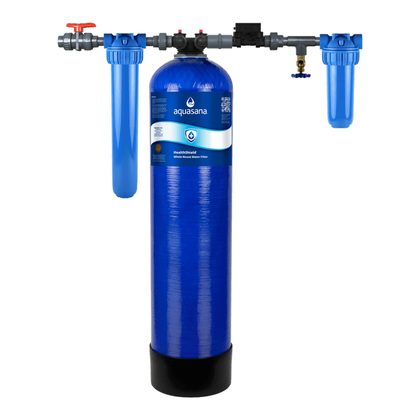
Best overall:Aquasana HealthShield ($2,099, 7.6/10). Certified to cut five PFAS by more than 99.9% and VOCs by 99.8% at every tap, but it costs about $14,023 over 10 years at average family use.
Chloramine:Kinetico Chloraban (6.4) is the only whole-house system we found certified for chloramine (WQA, NSF and IAPMO listings checked Sept. 26, 2026)[44][111][114]; Aquasana Rhino Chloramines (5.1) is the lowest-priced system with published chloramine test data.
Best value:SpringWell CF1 (6.3): independent lab data and about $1,856 over 10 years, the lowest total we could price without estimates. Fluoride:SoftPro (6.4) is the only system an independent test found removing fluoride, with big caveats.
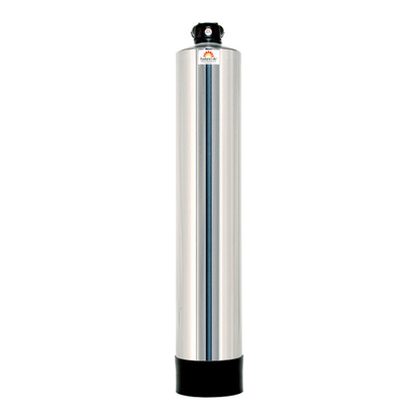
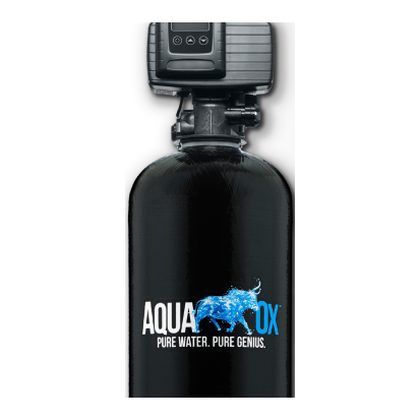
Skip: systems with no certification or published data, like Crystal Quest, AquaOx and Radiant Life (why). For fluoride and PFAS in what you drink, add RO at the kitchen sink.
Our #1 pick7.6/10
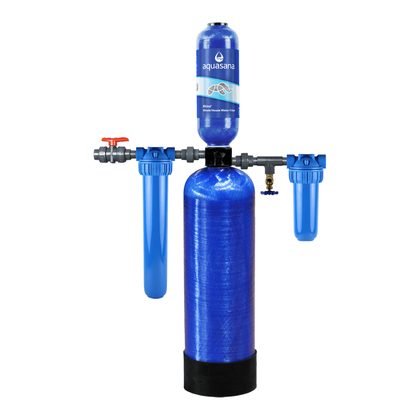
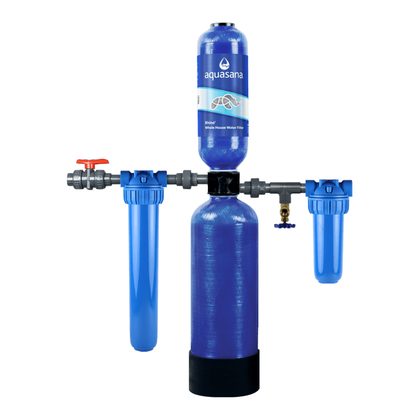
Aquasana HealthShield whole-house system
WQA certified to NSF/ANSI 53 for more than 99.9% of five PFAS and 99.8% of VOCs, the only whole-house system we found certified for both[1][2].
Chlorine and chloramine results (97.4% and 97.5%) are Aquasana's own. Rated 5.7 gpm; each $1,749 tank lasts 165,000 gallons or 2 years.
How we score:Chlorine & Chloramine 30%Chemicals 25%Proof 20%Fluoride 10%Minerals 10%Contact 5%Full methodology ↓
The Dr. Axe Clean Water Score (0–10) here uses whole-house weights. Unlike our drinking-water ranking, there's no fluoride cap: fluoride belongs at the kitchen tap. It's an editorial score, not a universal safety grade.
Know your water
What's in your water, and your shower?
A whole-house filter treats far more than the water you drink. A hot shower moves chloroform and other disinfection byproducts into the air you breathe, and whatever is in the main line reaches every tap. Here's what can come through it.
Shower chloroform> 2 liters[74]of drinking water: a 10-minute shower gave a bigger internal chloroform dose in a small breath study (4 people per test). It measured dose, not disease.EHP, 1996
Chloramine1 in 5+[78][44][111][114]Americans drink water treated with chloramine, and only one whole-house system we found is certified to reduce it (WQA, NSF and IAPMO listings)EPA; WQA
PFAS15.5%[79][118][119][81]of large U.S. water systems averaged above a 2024 PFAS limit (an estimated 7.8% of all systems), mostly PFOA and PFOS. EPA has proposed rescinding four of the six limits; PFOA and PFOS stay, with a proposed extension to 2031EPA UCMR 5, July 2026; EPA proposals, May 2026
Lead4 million[84]lead service lines are still in the groundEPA, Nov. 2025
Trihalomethanes+44%[76]odds of bladder cancer in men with long-term THM exposure above 50 µg/L, pooled from 6 studies (observational; no link in women)Epidemiology, 2004
Filters can backfire4 of 8[83]whole-house carbon systems in one study raised PFAS levels in the filtered waterES&T Letters, 2020
Check your water
Your utility's yearly water quality report lists what it detected, including its disinfectant, chlorine or chloramine[105]. EWG's database adds unregulated contaminants by ZIP code, judged against its own stricter guidelines[104]. On a private well, test yearly for bacteria, nitrate, dissolved solids and pH[106].
Four steps, in order of impact. Whole-house filtration handles what you bathe in and breathe in the shower; your drinking water gets its own filter.
1Essential
Test or read your water report
Find out whether your city uses chlorine or chloramine, and check PFAS, lead and hardness. On a well, test first: carbon isn't a disinfection system.[105][106]
Most whole-house systems don't remove fluoride or PFAS. Under-sink RO removed PFAS nearly completely in one study, and certified RO carries fluoride claims, for far less.[83]
Softener or conditioner, UV for wells, a shower filter if you rent
Hard water: a salt softener removes calcium and magnesium and adds about 8 mg/L of sodium per grain of hardness[95]; a salt-free TAC conditioner keeps the minerals and cut water-heater scale by more than 88% in lab tests[97].
Well or renting: for bacteria, choose UV certified to NSF/ANSI 55 Class A; Class B is for nuisance organisms only[109]. Renting? A certified shower filter covers the water you breathe in.
Answer five questions. If nothing we recommend fits your home and budget, we'll say so and show the closest option.
1Where does your water come from?
2What does your city disinfect with?
3How big is your home?
4Budget to buy?
5What else matters most?
Compare the top 10
What each system is proven to remove
For each contaminant we show how the claim is backed for that exact model. “ND” means not detected after filtering in an independent test (for chlorine, a test strip). Product names link to the full reviews.
Score = the Dr. Axe Clean Water Score with whole-house weights: chlorine & chloramine 30%, chemicals 25%, proof 20%, fluoride 10%, minerals 10%, contact 5%. No fluoride cap. Full methodology ↓
Certified NSF, WQA or IAPMO lists this claim for this exact model.Independent lab An independent tester measured it (Water Filter Guru, Quality Water Lab); chlorine by test strip.Maker's data The maker's published test data, guarantee or claim.No data No data published either way.No / lapsed Not designed to remove it, barely reduced it, or the certificate has lapsed.
Swipe sideways to see every column. System names stay in place.
*Waterdrop's 97.7% is the first reading in a third-party lab test Waterdrop reports (no report published). “Unsupported” means the brand's pages list it but its own data sheet doesn't. Pentair links an IAPMO certificate that reads “Void After: February 2024.” Shaded rows are outside the ranked 10: the plain Rhino is the same product line as #8 (one pick per line), and iSpring and Crystal Quest aren't rated (NR). Ten-year costs are in their own chart below.
Full reviews
The 10 best whole-house water filters, ranked
Each review lists the proof behind its key numbers, how it fits your home (flow, capacity, space, install and media changes) and what it costs over 10 years. One model per product line; siblings like the Rhino Chloramines Max Flow and SpringWell CF4 appear in the guides below.
1
$2,099Sale price ($4,198 list). $2,898 bundled with the Max Flow UV.
The most thoroughly certified whole-house system we found. WQA certifies it to NSF/ANSI 53 for more than 99.9% reduction of five PFAS (PFOA, PFOS, PFHpA, PFHxS and PFNA) and 99.8% of VOCs, tested with chloroform, the main byproduct you breathe in a hot shower. It's also certified to NSF/ANSI 401 for BPA and ibuprofen (94.7%). Its chlorine (more than 97.4%) and chloramine (97.49%) figures come from Aquasana's own testing; the data sheet says WQA didn't evaluate them. Two catches. At 5.7 gallons a minute it has the lowest rated flow here, and Aquasana gives no bathroom rating. And each $1,749 tank is rated for 165,000 gallons or about 2 years: at EPA's average family use of 300 gallons a day, that's a new tank about every 18 months, which makes it by far the most expensive system here that we could price.
Best forCity homes with PFAS in the water report that want every tap and shower covered
Skip ifYou need high flow for a large home, or want low running costs
Flow & home size5.7 gpm rated, 11.2 gpm peak. No bathroom rating; Aquasana notes most homes use 2 to 3 gpm most of the time
Capacity165,000 gal or about 2 years, whichever comes first (about 18 months at 300 gal/day)
Space57 in tall, 12 in wide, plus pre- and post-filter housings
InstallMain line; a 120V outlet within 10 ft for the flow display; no drain. Aquasana strongly recommends a licensed plumber
Media changesTank $1,749; 20-in pre-filter every 2 months; post-filter every 6 months
Minerals: Keeps them (salt-free conditioner optional, +$824)Touches water: Tank material not published
Buying it mainly for PFAS in your drinking water? A certified under-sink reverse osmosis system handles that for far less. HealthShield earns its place when you want PFAS and VOCs reduced at every tap and shower.
See score breakdown & sources
Chlorine & Chloramine8.25
Chemicals9.0
Proof8.5
Fluoride0.0
Minerals9.0
Contact6.0
Chlorine half 8.5 (maker's data sheet); chloramine half 8.0 (maker's published test data, 97.49%). Proof 8.5: certified to NSF/ANSI 53 for its headline claims. Weighted total 7.625, rounded to 7.6. No cap applies.
CertifiedAquasana HealthShield (WH-HS) performance data sheet. WQA certified to NSF/ANSI 53 (PFOA, PFOS, PFHpA, PFHxS and PFNA >99.9%; VOCs 99.8% by chloroform surrogate) and 401 (BPA and ibuprofen 94.7%). Chlorine (>97.4%) and chloramine (97.49%) are Aquasana's own tests: “WQA did not evaluate chlorine or chloramine reduction.” Open source · [1]
CertifiedWQA certified product listing: Aquasana WH-HS under NSF/ANSI 53 (point-of-entry), 401, 372 and CSA B483.1. Checked Sept. 26, 2026. Open source · [2]
Maker's dataAquasana. HealthShield product page: $2,099 sale ($4,198 list), $2,898 with Max Flow UV; 5.7 gpm rated, 11.2 peak; 165,000 gal or about 2 years; 57 × 12 in; 120V outlet; 2-year warranty; tall salt-free conditioner +$824; “Most homes use only 2 to 3 GPM the majority of the time.” Checked Sept. 26, 2026. Open source · [3]
Maker's dataAquasana. HealthShield replacement tank (WH-HS-R), $1,749 sale. Checked Sept. 26, 2026. Open source · [4]
Maker's dataAquasana. HealthShield installation manual: pre-filter every 2 months, post-filter every 6 months; 120V outlet within 10 ft; warranty 2 years or 165,000 gal. Open source · [5]
Maker's dataAquasana. 20-in pre-filter 3-pack ($36.99; replace every 2 months) and post-filter ($36.99; every 6 months). Checked Sept. 26, 2026. Open source · [6]
Maker's dataAquasana. Certified products page: describes the Rhino Max Flow as “Independently tested and certified to NSF/ANSI Standard 42” and doesn't list HealthShield. Checked Sept. 26, 2026. Open source · [11]
Upkeep: $1,749 tank every 165,000 gal or 2 years, plus pre- and post-filters10-year cost: $14,023 · $10,525 at 150 gal/day how we figured itCheck current priceWe may earn a commission.
7.6of 10
Clean Water Score
2
$1,267$1,926.50 list. Sold earlier as the SoftPro Chlorine+ & Fluoride for about $900.
The only whole-house system where an independent test found fluoride removed. Water Filter Guru's lab found fluoride fell from 0.30 mg/L to undetectable, trihalomethanes from 13.9 ppb to undetectable, and chlorine was undetectable on a test strip. (SpringWell, tested the same way, cut fluoride only from 0.6 to 0.5 mg/L.) It pairs 1.0 cubic foot of catalytic carbon, the media makers use for chloramine, with 0.5 cubic foot of bone char[117]. Read the fluoride result carefully: it was one test, at less than half the usual 0.7 mg/L, early in the media's life, and the before and after samples were taken six weeks apart while other minerals in the water rose 3 to 12 times over (calcium from 3.6 to 35.8 ppm), so the source water may have changed too. SoftPro says the media lasts 600,000 to 1,000,000 gallons, but its own sizing guide says a cubic foot of bone char treats about 100,000 gallons at 1.0 mg/L; scaled to this unit's 0.5 cubic foot at the usual 0.7 mg/L, that's about 71,000 gallons, roughly 8 months at 300 gallons a day[30]. It isn't certified, its chloramine claim has no published data, and it isn't meant for wells.
Best forCity homes of up to 4–6 bathrooms that want fluoride lowered at every tap, and will retest
Flow & home sizeUp to 4–6 bathrooms (maker); 14 gpm maximum, per Water Filter Guru
CapacityMaker: 600,000–1,000,000 gal or 6–10 years. Its sizing guide implies about 71,000 gal for the fluoride media at 0.7 mg/L
SpaceOne upflow tank; dimensions not published
InstallMain line; no power, drain or backwash. Water Filter Guru's installer, an experienced DIYer, took just under 2 hours
Media changesCatalytic carbon $189 per cu ft; bone char refill price not published
Minerals: Keeps them (calcium rose in the lab test; cause unclear)Touches water: Tank with neoprene jacket; some plastic fittings
Relying on it for fluoride? Retest a few months in, and filter drinking water at the kitchen tap too. We couldn't find a SoftPro price for replacement bone char.
See score breakdown & sources
Chlorine & Chloramine7.25
Chemicals5.0
Proof5.0
Fluoride8.0
Minerals9.0
Contact6.0
Chlorine half 8.5 (reviewer's test strip, scored like a maker's data sheet); chloramine half 6.0 (claim or guarantee, catalytic carbon). Proof 5.0: one independent lab test. Weighted total 6.425, rounded to 6.4. No cap applies.
Independent labWater Filter Guru. SoftPro whole-house fluoride and chlorine filter review and Tap Score lab test, Steamboat Springs, Colo.: “before” sample in early March 2024, before install, and “after” sample at the end of April 2024; calcium 3.6 to 35.8 ppm and magnesium 0.84 to 10.3 ppm between samples; installed by “a friend with a lot of professional DIY experience”; 14 gpm maximum flow (updated Nov. 1, 2024). Open source · [34]
Independent labWater Filter Guru. Best fluoride water filters: SoftPro is “the only whole house system we have tested that removed 100% of fluoride” (modified Sept. 7, 2026). Open source · [35]
Maker's dataSoftPro. Fluoride & Chlorine+ SUPER Filter: $1,267 ($1,926.50 list); up to 4–6 bathrooms; “up to 99%” fluoride; “Media lifespan tested to 600,000 to 1,000,000 gallons”; not recommended for private wells. Checked Sept. 26, 2026. Open source · [29]
Maker's dataQuality Water Treatment (SoftPro's sister site). Whole-house upflow catalytic bone char filter: “1.5 CUFT size tank / (1.0 CUFT of catalytic carbon + 0.5 CUFT of bone char carbon)”; up to 4–6 bathrooms. Checked Sept. 26, 2026. Open source · [117]
Maker's dataSoftPro. What size fluoride filter do I need?: “Whole house systems using 1 cubic foot of bone char carbon effectively treat approximately 100,000 gallons”; it says one cubic foot reduces fluoride “by about 1.0 mg/L.” Open source · [30]
Maker's dataSoftPro. Replacement catalytic carbon, 1.0 cu ft, $189. Checked Sept. 26, 2026. Open source · [31]
Maker's dataSoftPro. Warranty and returns: lifetime on tanks and control valve; filter media final sale. Open source · [32]
Maker's dataUS Water Systems. Bone char, 40 lb bag (about 1 cu ft), $549; our price proxy for SoftPro's bone char. Checked Sept. 26, 2026. Open source · [33]
Upkeep: One rebed in 10 years by the maker's life claim (about $464, est.)10-year cost: $1,731 (est.) · up to about $5,574 if you replace the bone char as its sizing guide implies how we figured itCheck current priceWe may earn a commission.
6.4of 10
Clean Water Score
3
Dealer quoteKinetico doesn't publish prices. Ask the dealer for the installed price and the media refill price in writing.
Best for chloramine
Kinetico Chloramine Reduction System (Chloraban)
Catalytic media · the only certified chloramine claim we found
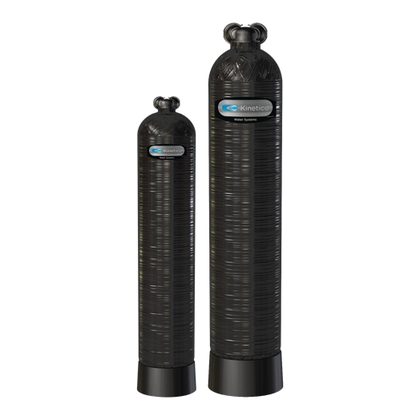
The only whole-house system we found with a certified chloramine claim (WQA, NSF and IAPMO listings checked Sept. 26, 2026)[44][111][114]. WQA lists Kinetico's CRS 1060 and CRS 1100 Chloraban systems under NSF/ANSI 42 for chloramine and chlorine reduction; that standard's chloramine test starts at 3.0 mg/L and requires at least 80% reduction. It's non-electric, uses no water to clean itself and carries a 10-year warranty. The trade-off is that it does one job. It makes no PFAS, VOC, lead or fluoride claims, Kinetico doesn't publish prices, flow rates or reduction percentages, and the media typically lasts at least a year at average chloramine levels (Kinetico's 2012 literature said up to two years). Kinetico's literature names the media Chloraban in one place and Sulfaban in another.
Best forHomes on chloraminated city water that want the one certified whole-house option
Skip ifYou want PFAS or VOC reduction too, or a published price
Flow & home sizeFlow rate not published; two sizes (CRS 1060 and CRS 1100), sized by the dealer
CapacityMedia typically lasts at least a year at average chloramine levels (2012 literature: up to two years)
Space8 × 42.5 in (CRS 1060) or 10 × 56 in (CRS 1100)
InstallDealer-installed; non-electric, uses no water to clean itself
Media changesDealer-priced; get the refill price before you buy
Minerals: Keeps them (often paired with a softener)Touches water: Polyglass tanks
Want certified PFAS reduction as well? Culligan's Whole Home PFAS filter (below) is certified for PFAS but not for chlorine or chloramine, so the two do different jobs.
See score breakdown & sources
Chlorine & Chloramine9.5
Chemicals3.0
Proof8.0
Fluoride0.0
Minerals9.0
Contact6.0
Chlorine half 9.5 (certified); chloramine half 9.5 (certified). Proof 8.0: certified for its headline claims. Weighted total 6.400, rounded to 6.4. No cap applies.
CertifiedWQA certified product listing: Kinetico CRS 1060 and CRS 1100 Chloraban under NSF/ANSI 42, “Aesthetic Chloramine, Aesthetic Chlorine” (point-of-entry), plus 61, 372 and CSA B483.1. Checked Sept. 26, 2026. Open source · [44]
Public record / studyNSF certified drinking water treatment unit listings, NSF/ANSI 42 and 53 point-of-entry sections (searched Sept. 26, 2026 at info.nsf.org, which NSF replaced with listings.nsf.org on Oct. 1, 2026). Open source · [111]
Public record / studyIAPMO R&T Product Listing Directory (searched Sept. 26, 2026): no current listing for the PC600-P, Pelican Water Systems or file W-10918; no point-of-entry chloramine claim among its NSF/ANSI 42 and 53 certificates. Open source · [114]
Maker's dataKinetico. Chloramine Reduction System page: “the only residential systems certified by the Water Quality Association for whole-house reduction of chloramine”; Chloraban media; non-electric. Open source · [41]
Maker's dataKinetico. CRS sell sheet (Nov. 2022): media “typically at least one year”; 8 × 42.5 in (CRS 1060) and 10 × 56 in (CRS 1100); non-electric; “No water consumption”; names “Sulfaban” media. Open source · [42]
Maker's dataKinetico. Chloramine Reducing System literature (2012, dealer-hosted): “High-Capacity Catalytic Carbon Bed”; media “typically up to two years.” Open source · [43]
Maker's dataKinetico. Residential limited warranty: chloramine reducing systems, 10 years on parts and tanks. Open source · [45]
Maker's dataAquasana Rhino Chloramines (WH-1011) performance data sheet: “independently tested according to NSF/ANSI Standard 42” (lab not named), whose chloramine test uses a 3.0 mg/L challenge and requires at least 80% reduction; chloramine 83%, free chlorine 97.4%; “Not certified for contaminant reductions by WQA.” Open source · [8]
Upkeep: Media typically lasts at least a year (dealer-priced)10-year cost: dealer-priced, not publishedsee media scheduleFind a dealerWe may earn a commission.
6.4of 10
Clean Water Score
4
$1,160.25Sale price ($1,365 regular). CF4 $1,294.13 and CF+ $2,142 for larger homes.
$1,856[20][23][24]10-year cost, the lowest with no estimates
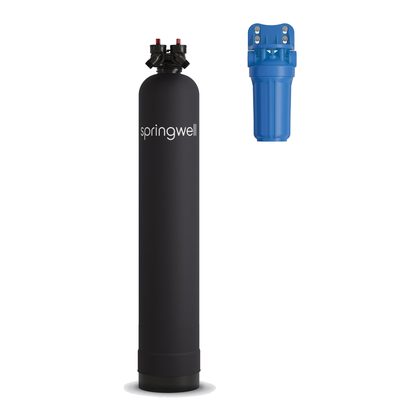
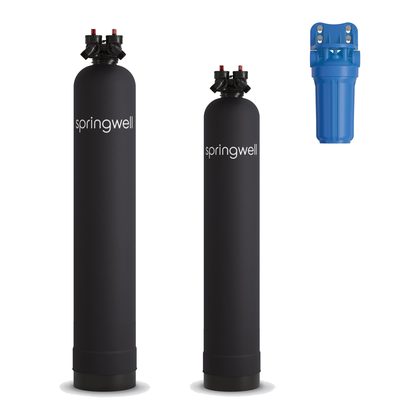
The whole-house system with the most independent lab data, at the lowest 10-year cost we could price without estimates, about $1,856. In Water Filter Guru's test, total trihalomethanes fell from 29.12 ppb to undetectable, lead fell 96% and chlorine was undetectable on a test strip, and Quality Water Lab's Tap Score testing found THMs went from 31.83 ppb (2022 baseline) to undetectable after installation (2025). It uses coconut catalytic carbon plus copper-zinc (KDF) media, and SpringWell's warranty promises chlorine and chloramine below detection for 6 years or 1 million gallons[22]. What's missing: any certification, and published data for its chloramine, PFAS and pesticide claims. Fluoride fell only 17%. The product page says the media lasts 10 years; the manual and warranty say 6.
Best forCity homes that want tested chlorine and byproduct removal at a 10-year cost we could fully price
Skip ifYou need certified claims, or proof for chloramine or PFAS
Capacity1 million gallons; 10 years on the product page, 6 years in the manual and warranty
Space9 × 48 in tank (CF1) plus a sediment filter housing
InstallDIY or plumber; no power, drain or backwash. Soak the carbon 48 hours before use
Media changesSediment filter every 6–9 months ($72.53 per 4-pack); carbon media $351.70
Minerals: Keeps them (salt-free combo available)Touches water: Tank with a stainless sleeve, per the reviewer
Bigger home? The CF4 (12 gpm, 4–6 bathrooms) and CF+ (20 gpm, 7+) use the same media. Want scale control without salt? The CSF1 adds a salt-free conditioner ($2,320.50).
See score breakdown & sources
Chlorine & Chloramine7.25
Chemicals6.5
Proof5.5
Fluoride1.7
Minerals9.0
Contact6.0
Chlorine half 8.5 (reviewer's test strip, scored like a maker's data sheet); chloramine half 6.0 (claim or guarantee, catalytic carbon). Proof 5.5: two independent lab tests. Weighted total 6.270, rounded to 6.3. No cap applies.
Independent labWater Filter Guru. SpringWell CF1 review and Tap Score lab test in a two-bathroom Colorado home (updated May 31, 2025). Open source · [27]
Independent labQuality Water Lab. SpringWell vs. Aquasana: CF1 Tap Score tests, total THMs 31.83 ppb (2022 baseline) to non-detect (2025 post-install) (updated July 23, 2026). Open source · [28]
Maker's dataSpringWell. CF whole-house filter page: CF1 $1,160.25 sale ($1,365), CF4 $1,294.13, CF+ $2,142; 9, 12 and 20 gpm for 1–3, 4–6 and 7+ bathrooms; KDF plus catalytic carbon and a 5-micron sediment filter; “1M gallons or 10-year media life”; sediment every 6–9 months; lifetime warranty. Checked Sept. 26, 2026. Open source · [20]
Maker's dataSpringWell. CF1/CF4/CF+ installation manual: media “Every 6 years or 1 Million Gallons”; coconut catalytic carbon; 48-hour pre-soak. Open source · [21]
Maker's dataSpringWell. Warranty: chlorine and chloramine guaranteed below detection for 6 years or 1 million gallons; lifetime on tanks, valves, housings and fittings. Open source · [22]
Maker's dataSpringWell. Replacement carbon media for the CF1 or CF4, $351.70 sale. Checked Sept. 26, 2026. Open source · [23]
Upkeep: Carbon media $351.70 about every 6 years; sediment filter every 6–9 months10-year cost: $1,856how we figured itCheck current priceWe may earn a commission.
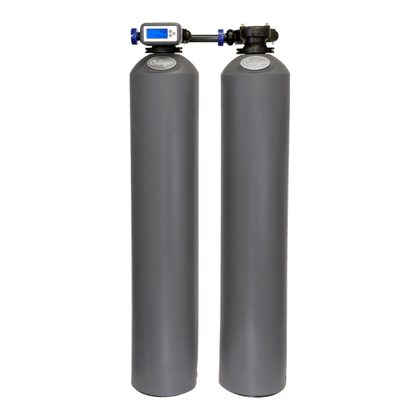
The second system in our ranking with a certified PFAS claim, covering seven compounds. WQA certifies it under NSF/ANSI 53 for total PFAS: more than 99.9% of a 2,160 ng/L mix of seven compounds (PFOA, PFOS, PFHxS, PFHpA, PFNA, PFBS and PFDA), with each above 99.8%. It pairs 2.0 cubic feet of Calgon F600 carbon with 1.5 cubic feet of PFAS-selective resin, and a flow monitor tells you when the media is spent. But it's built for PFAS, not disinfectants: Culligan says it will reduce chlorine, then notes it is “not certified for chlorine reduction,” and it makes no chloramine claim. It's priced and installed only through local dealers, and its 158,000-gallon rating means new media about every 17 months at average family use.
Best forHomes with PFAS above EPA limits that want a certified whole-house answer
Skip ifChloramine is your main concern, or you want a published price
Flow & home size7.5 gpm at a 7.5 psi pressure drop; no bathroom rating
Capacity158,000 gal (about 17 months at 300 gal/day)
SpaceTwo 10 × 54 in tanks, plus a sediment pre-filter
InstallDealer-installed; 24V flow monitor; no backwash or drain
Media changesWhen the monitor alerts at 158,000 gal; dealer-priced
Minerals: Not measured (the resin swaps charged ions)Touches water: Fiberglass or Quadra-Hull tanks
Culligan recommends a 50-micron sediment pre-filter ahead of it, and bypassing irrigation lines so outdoor water doesn't use up the media.
See score breakdown & sources
Chlorine & Chloramine4.25
Chemicals5.5
Proof8.5
Fluoride0.0
Minerals8.0
Contact6.0
Chlorine half 7.0 (maker's claim, no data); chloramine half 1.5 (no claim). Proof 8.5: certified to NSF/ANSI 53 for its headline claims. Weighted total 5.450, rounded to 5.5. No cap applies.
CertifiedCulligan Aquasential Whole Home PFAS Filter owner's guide and performance data (2024): Calgon F600 carbon 2.0 cu ft + Cullex PFAS resin 1.5 cu ft; 158,000 gal; 7.5 gpm at 7.5 psi; total PFAS >99.9% (2,160 ng/L challenge); “not certified for chlorine reduction”; 50-micron sediment pre-filter recommended. Open source · [37]
CertifiedWQA certified product listing: Culligan Aquasential Whole Home PFAS Filter, NSF/ANSI 53 Total PFAS (point-of-entry), 372 and CSA B483.1. Checked Sept. 26, 2026. Open source · [38]
Maker's dataCulligan. Aquasential Whole Home PFAS Water Filter product page (dealer-priced). Checked Sept. 26, 2026. Open source · [36]
Upkeep: New media every 158,000 gal: about every 17 months at 300 gal/day (dealer-priced)10-year cost: dealer-priced, not publishedsee media scheduleFind a dealerWe may earn a commission.
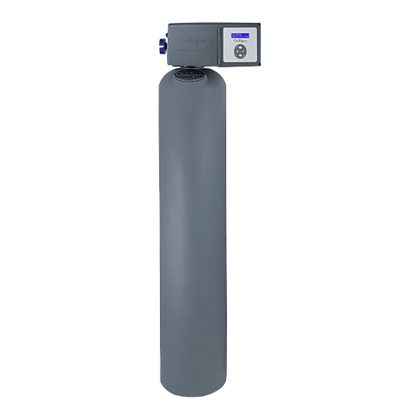
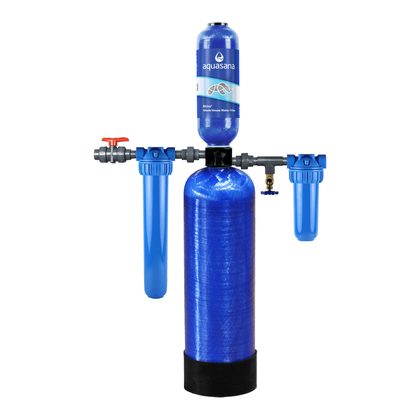
Culligan's standard whole-house carbon filter, and one of three systems here with a certified chlorine claim. WQA lists its Cullar carbon under NSF/ANSI 42 for chlorine, taste and odor reduction. It backwashes itself, so it needs a drain and an outlet, and the Quadra-Hull tank carries a lifetime warranty. It makes no chloramine, PFAS or VOC claims, Culligan doesn't publish prices, and its rated capacity of 120,000 to 180,000 gallons works out to new carbon every 13 to 20 months at average family use.
Best forChlorinated (not chloraminated) city water, with a local Culligan dealer
Flow & home sizeFlow rate not published; 9-in and 10-in tanks, sized by the dealer
Capacity120,000 gal (9-in tank) or 180,000 gal (10-in)
SpaceOne backwashing tank
InstallDealer-installed; needs a drain and an outlet for backwash
Media changesAbout every 13–20 months at 300 gal/day; dealer-priced
Minerals: Keeps themTouches water: Quadra-Hull or fiberglass tank
See score breakdown & sources
Chlorine & Chloramine5.5
Chemicals3.0
Proof8.0
Fluoride0.0
Minerals9.0
Contact6.0
Chlorine half 9.5 (certified); chloramine half 1.5 (no claim). Proof 8.0: certified for its headline claims. Weighted total 5.200, rounded to 5.2. No cap applies.
CertifiedWQA certified product listing: Culligan Cullar carbon filters under NSF/ANSI 42 (aesthetic chlorine, taste and odor). Checked Sept. 26, 2026. Open source · [40]
Maker's dataCulligan. Aquasential Smart High Efficiency whole-house filter: 9-in tank 120,000 gal, 10-in 180,000 gal; backwashing (drain and outlet); lifetime Quadra-Hull tank warranty; dealer-priced. Open source · [39]
Upkeep: Carbon rated 120,000–180,000 gal, by tank size (dealer-priced)10-year cost: dealer-priced, not publishedsee media scheduleFind a dealerWe may earn a commission.
5.2of 10
Clean Water Score
7
About $432Retailer price; Solventum lists none. Cartridges about $312.
Lowest-priced certified system in our ranking
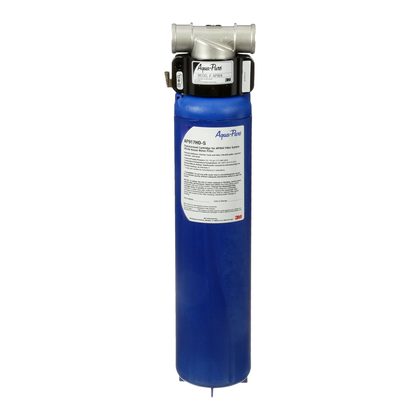
Aqua-Pure AP904 (Solventum, formerly 3M)
Single carbon-block cartridge · certified for chlorine
The least expensive certified chlorine filter in our ranking. (NSF also lists other point-of-entry systems certified for chlorine, including small cartridge units rated 4 gallons a minute, which we didn't rank[112].) NSF lists the AP904 (with the AP917HD-S cartridge) under NSF/ANSI 42 for chlorine, taste and odor reduction, for 100,000 gallons at 10 gallons a minute, and it has a 304 stainless steel head with a quick-change cartridge and no tank. It's a single carbon block, not catalytic carbon, and it makes no chloramine, PFAS, lead or VOC claims. The low price is also misleading: at average family use you'll replace the $312 cartridge about every 11 months, which makes it one of the more expensive systems here over 10 years. The cartridge includes “scale inhibition media” whose makeup isn't published.
Best forChlorinated city water, if you want certified chlorine removal with no tank
Skip ifYour city uses chloramine, or you're counting 10-year costs
Flow & home size10 gpm certified service flow; Solventum pitches it for homes with at least 2.5 bathrooms
Capacity100,000 gal per cartridge (about 11 months at 300 gal/day)
SpaceOne wall- or pipe-mounted housing, no tank
Install1-in plumbing; no power or drain. Add a sediment pre-filter on dirty water
Media changesAP917HD-S cartridge, about $312, swapped without tools
Minerals: Scale-inhibitor media (makeup not published)Touches water: Stainless head; cartridge sump material not published
See score breakdown & sources
Chlorine & Chloramine5.5
Chemicals3.0
Proof8.0
Fluoride0.0
Minerals8.0
Contact6.0
Chlorine half 9.5 (certified); chloramine half 1.5 (no claim). Proof 8.0: certified for its headline claims. Weighted total 5.100, rounded to 5.1. No cap applies.
CertifiedNSF listing: Solventum Aqua-Pure AP904 (replacement element AP917HD-S), NSF/ANSI 42 chlorine reduction, taste and odor reduction, particulate Class III; 100,000 gal at 10 gpm. Checked Sept. 26, 2026 (search “Solventum”). Open source · [52]
Public record / studyNSF/ANSI 42 listings, point-of-entry sections (current Sept. 26, 2026): other whole-house systems certified for chlorine reduction, including cartridge units rated 4 gpm and 10,000 to 40,000 gal. Open source · [112]
Maker's dataSolventum. Aqua-Pure AP904 system and AP917HD-S cartridge pages: 304 stainless steel head; “up to 20 gpm”; for “large homes with at least 2.5 bathrooms”; carbon block with scale inhibition media. Open source · [53]
Upkeep: $312.21 cartridge every 100,000 gal or about a year10-year cost: $3,554 · $3,242 at 150 gal/day how we figured itCheck current priceWe may earn a commission.
5.1of 10
Clean Water Score
8
$1,399Sale price ($2,798 list). Max Flow version (10 gpm, up to 6 bathrooms) $1,749.
Lowest price with chloramine data
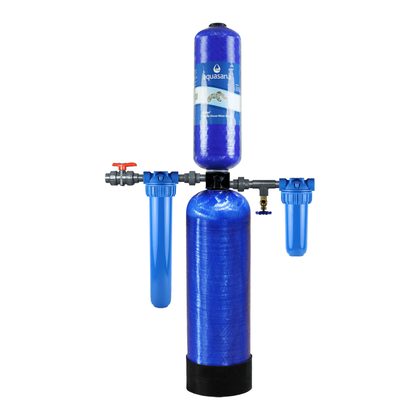
Aquasana Rhino Chloramines (WH-1011)
Two-tank catalytic carbon · sold online
83%[8]chloramine, Aquasana data sheet (NSF/ANSI 42 test)
The least expensive system with published chloramine test data, sold online rather than through dealers. Both tanks hold catalytic carbon, and Aquasana's data sheet reports 83% chloramine and 97.4% chlorine reduction when tested to NSF/ANSI 42 (the chloramine test requires 80%). But that's Aquasana's published data, from testing it says was done independently (the lab isn't named), not a certification: WQA certifies the Rhino only for materials safety, and the data sheet says it's “not certified for contaminant reductions.” Aquasana's product pages still show a generic contaminant list, including lead and PFAS, that the Rhino data sheets don't support. The tanks are rated for 1 million gallons or 10 years, and at 7 gallons a minute it's sized for up to 2.5 bathrooms.
Best forChloraminated city homes of up to 2.5 bathrooms that want chloramine data without a dealer
Skip ifYou need certified claims or PFAS reduction
Flow & home size7 gpm rated, 10.3 peak; up to 2.5 bathrooms and 4 people
Capacity1,000,000 gal or 10 years (about 9 years at 300 gal/day)
SpaceTwo stacked tanks, 57 in tall and 11 in wide, plus filter housings
InstallNo power or drain; Aquasana recommends a licensed plumber
Media changes20-in pre-filter every 2 months; post-filter every 6 months; tank $1,299
Minerals: Keeps them (salt-free conditioner optional)Touches water: HDTE plastic tanks
Aquasana's plain Rhino (WH-1000, $999) swaps catalytic carbon for regular carbon plus KDF and makes no chloramine claim. On chloraminated water, get this version.
See score breakdown & sources
Chlorine & Chloramine7.75
Chemicals3.0
Proof4.0
Fluoride0.0
Minerals9.0
Contact6.0
Chlorine half 8.5 (maker's data sheet); chloramine half 7.0 (maker's published test data, 83%). Proof 4.0: maker's data sheet; minus 0.5 because its pages claim a certification or contaminant list its data sheet or certifier doesn't show. Weighted total 5.075, rounded to 5.1. No cap applies.
Maker's dataAquasana Rhino Chloramines (WH-1011) performance data sheet: “independently tested according to NSF/ANSI Standard 42” (lab not named), whose chloramine test uses a 3.0 mg/L challenge and requires at least 80% reduction; chloramine 83%, free chlorine 97.4%; “Not certified for contaminant reductions by WQA.” Open source · [8]
CertifiedWQA certified product listing: Aquasana Rhino tanks under NSF/ANSI/CAN 61, 372 and CSA B483.1 (materials; no reduction claims). Checked Sept. 26, 2026. Open source · [10]
Maker's dataAquasana. Rhino Chloramines (WH-1011) product page: $1,399 sale ($2,798 list); “Both the top and bottom tanks contain 100% catalytic carbon”; 7 gpm rated, 10.3 peak; up to 2.5 bathrooms and 4 people; 1,000,000 gal or 10 years; 57 × 11 in; HDTE tanks; 10-year warranty. Checked Sept. 26, 2026. Open source · [7]
Maker's dataAquasana. Rhino Chloramines replacement tank (WH-1011R), $1,299. Checked Sept. 26, 2026. Open source · [9]
Maker's dataAquasana. 20-in pre-filter 3-pack ($36.99; replace every 2 months) and post-filter ($36.99; every 6 months). Checked Sept. 26, 2026. Open source · [6]
Maker's dataAquasana. Certified products page: describes the Rhino Max Flow as “Independently tested and certified to NSF/ANSI Standard 42” and doesn't list HealthShield. Checked Sept. 26, 2026. Open source · [11]
Upkeep: $1,299 tank every 1 million gal or 10 years, plus pre- and post-filters10-year cost: $4,128 · $2,829 at 150 gal/day how we figured itCheck current priceWe may earn a commission.
5.1of 10
Clean Water Score
9
About $828–$1,049Last listed prices at two online retailers, both out of stock Sept. 26, 2026. Pentair lists no price and sends buyers to local sellers.
Chlorine and chloramine guarantee
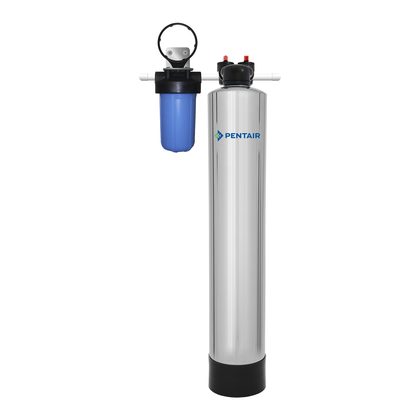
Pentair PC600-P (formerly Pelican PC600)
Carbon + KDF in a stainless jacket
95.93%[47]chlorine, average in its NSF/ANSI 42 test (manual)
Feb. 2024[48]when its linked IAPMO certificate expired
A long-lived, low-maintenance carbon system with a performance guarantee behind it. Pentair's manual reports 95.93% average chlorine reduction in NSF/ANSI 42 testing, and its PC Systems Performance Guarantee promises chlorine and chloramine below detection for 650,885 gallons or 5 years[49]. Retailers describe the media as catalytic carbon plus copper-zinc (KDF); Pentair doesn't name it. The problem is proof. Pentair's page says the system is certified by IAPMO R&T to NSF/ANSI 42, but the certificate it links was issued to Pelican Water Systems and reads “Void After: February 2024,” and IAPMO's directory shows no current listing for the PC600-P, Pelican Water Systems or file W-10918 (checked Sept. 26, 2026)[114]. There's no chloramine test data, and Pentair doesn't sell it directly.
Best forCity homes of 1–3 bathrooms that want long media life, if the seller honors the guarantee
Flow & home size8 gpm rated (12 peak) for 1–3 bathrooms; the PC1000-P is rated 12 gpm
Capacity650,885 gal or 5 years (the manual says 662,400 gal)
SpaceOne tank plus a 5-micron prefilter housing
InstallIndoors or outdoors where it won't freeze; no power or drain; 13 psi pressure drop at rated flow
Media changesPC600-R media $263–$279; prefilter every 6–9 months (price not published)
Minerals: Keeps themTouches water: Tank inside a stainless steel jacket
If Pentair shows a current IAPMO listing, we'll re-score it: a certified chlorine claim would lift its proof score.
See score breakdown & sources
Chlorine & Chloramine7.25
Chemicals3.0
Proof4.0
Fluoride0.0
Minerals9.0
Contact6.0
Chlorine half 8.5 (maker's data sheet); chloramine half 6.0 (claim or guarantee, catalytic carbon). Proof 4.0: maker's data sheet; minus 0.5 because its pages claim a certification or contaminant list its data sheet or certifier doesn't show. Weighted total 4.925, rounded to 4.9. No cap applies.
Maker's dataPentair. PC600-P/PC1000-P system manual (Rev. E, 2024): 8 gpm rated, 12 peak (PC1000-P 12 and 16); 13 psi drop at rated flow; NSF/ANSI 42 free chlorine average 95.93%; 662,400 gal. Open source · [47]
Public record / studyExpired IAPMO R&T certificate W-10918 (NSF/ANSI 42), issued to Pelican Water Systems for the PC 600: “Void After: February 2024”; “This certificate is not evidence of current listing.” Linked from Pentair's product page. Open source · [48]
Public record / studyIAPMO R&T Product Listing Directory (searched Sept. 26, 2026): no current listing for the PC600-P, Pelican Water Systems or file W-10918; no point-of-entry chloramine claim among its NSF/ANSI 42 and 53 certificates. Open source · [114]
Maker's dataPentair. PC600-P whole-house filter page: “Certified By IAPMO R&T to NSF/ANSI 42”; media every 5 years or 650,885 gal; no online price (“Buy Locally”). Checked Sept. 26, 2026. Open source · [46]
Maker's dataPentair. Warranty information and PC Systems Performance Guarantee: chlorine and chloramine below the minimum detection level for 650,885 gal or 5 years. Open source · [49]
Maker's dataRetailer listings for the PC600-P: Water Filter Direct $828; FactoryPure $1,049; both out of stock when checked Sept. 26, 2026. Open source · [50]
Maker's dataRetailer listings for PC600-R replacement media: $263 (Home Depot) to $279 (FactoryPure). Checked Sept. 26, 2026. Open source · [51]
Public record / studyWQA certified product directory (searched Sept. 26, 2026). Open source · [110]
Public record / studyNSF certified drinking water treatment unit listings, NSF/ANSI 42 and 53 point-of-entry sections (searched Sept. 26, 2026 at info.nsf.org, which NSF replaced with listings.nsf.org on Oct. 1, 2026). Open source · [111]
Upkeep: Media ($263–$279) every 5 years or 650,885 gal10-year cost: $1,091–$1,328 (est.)how we figured itCheck current priceWe may earn a commission.
4.9of 10
Clean Water Score
10
$369.99The 2-stage WHF21-PG is $165.99.
Lowest upfront price
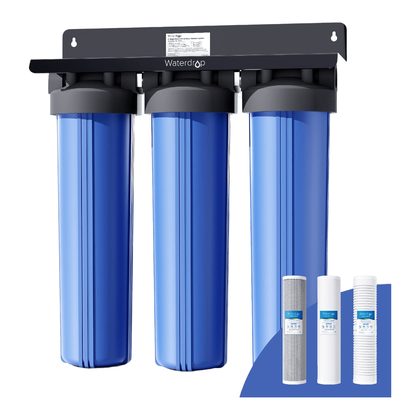
Waterdrop WHF3T-PG 3-Stage
Three cartridges: KDF carbon, sediment, carbon block
97.7%[55]chlorine, first reading, third-party lab (Waterdrop's description)
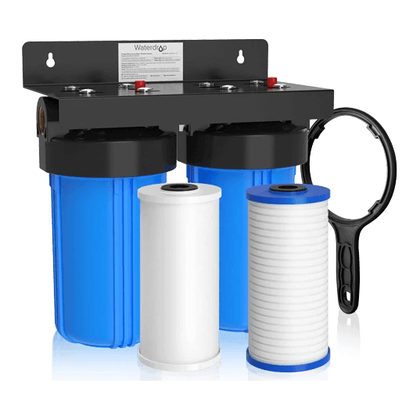
The cheapest system in our top 10, with the thinnest evidence. It's three 20-inch cartridges (KDF carbon, sediment and carbon) on a wall bracket, with no tank, power or drain. Waterdrop's only performance figure is 97.7% chlorine reduction, which it describes as the initial result from a third-party lab; no report is published. It makes no chloramine, PFAS or lead-reduction claims. Its NSF/ANSI 372 badge is real: IAPMO lists the WHF3T-PG under NSF/ANSI 372 for lead-free materials (checked Sept. 26, 2026)[115]. That standard covers what the parts are made of, not what the filter removes. Each cartridge is rated for 100,000 gallons, about 11 months at average family use.
Best forChlorinated city water on a tight budget, as a first step
Skip ifYour city uses chloramine, or you want tested claims
Waterdrop's listing for the replacement set was tagged out of stock when we checked. Our cost assumes one $118.99 WD-WF20PG set replaces all three cartridges.
See score breakdown & sources
Chlorine & Chloramine4.75
Chemicals3.0
Proof3.5
Fluoride0.0
Minerals9.0
Contact6.0
Chlorine half 8.0 (one maker-reported lab figure); chloramine half 1.5 (no claim). Proof 3.5: one lab figure reported by the maker, no report published. Weighted total 4.075, rounded to 4.1. No cap applies.
Maker's dataWaterdrop. WHF3T-PG product page: $369.99; 15 gpm; each filter 100,000 gal; 97.7% “being the initial chlorine filtration result” from a third-party lab; “certified by NSF/ANSI 372 for lead-free materials.” Checked Sept. 26, 2026. Open source · [55]
CertifiedIAPMO R&T file W-13936, Qingdao Ecopure Filter Co. (Waterdrop): Lead Free Water Filtration Product, NSF/ANSI/CAN 372-2022; lists WD-WHF3T-PG and WD-WHF21-PG; active, expires Aug. 21, 2027. Checked Sept. 26, 2026. Open source · [115]
Maker's dataWaterdrop. WD-WF20PG replacement for the WHF3T-PG, $118.99 (listing tagged out of stock). Checked Sept. 26, 2026. Open source · [56]
Upkeep: $118.99 replacement set every 100,000 gal (est.)10-year cost: $1,560 (est.) · $1,441 at 150 gal/day how we figured itCheck current priceWe may earn a commission.
4.1of 10
Clean Water Score
Cost to own
What each system really costs over 10 years
Whole-house media wears out by the gallon, so your water use drives the bill. We counted the purchase plus every replacement tank, cartridge and filter over 10 years at 300 gallons a day, EPA's figure for an average family[73], replacing each at its time or gallon limit, whichever comes first. The dark marker shows the total at 150 gallons a day.
PurchaseReplacement media and filters, years 1–10Price range or higher estimateTotal at 150 gal/day
Pentair PC600-P#9 · Chlorine$1,091–$1,32810-year total · est.▼ $1,091–$1,328 at 150 gal/day$828–$1,049 to buy + $263–$279 in replacements at 300 gal/day:[50][51][46]1 × PC600-R media, $263–$279 each, every 5 years or 650,885 galLast listed retailer prices for the system (both listings out of stock Sept. 26, 2026) and the media. The 5-micron prefilter (every 6–9 months) isn't priced anywhere we found, so it's not included.
Waterdrop WHF3T-PG#10 · Budget$1,56010-year total · est.▼ $1,441 at 150 gal/day$370 to buy + $1,190 in replacements at 300 gal/day:[55][56]10 × WD-WF20PG replacement set, $118.99 each, every 12 months or 100,000 gal (9 at 150 gal/day)Waterdrop gives no time limit; we assumed at least yearly changes and that one set covers all three cartridges.
SoftPro Fluoride & Chlorine+#2 · Fluoride$1,73110-year total · est.▼ $1,731 at 150 gal/day$1,267 to buy + $464 in replacements at 300 gal/day:[117][29][31][33][30]1 × Media rebed: 1.0 cu ft catalytic carbon ($189) + 0.5 cu ft bone char (≈$274.50), $463.50 each, every 6 years or 600,000 galUses the low end of SoftPro's claim (600,000 gal or 6 years). SoftPro doesn't list bone char, so we priced it at US Water Systems' $549 per cubic foot. Hatched: if you replace the bone char as often as SoftPro's own sizing guide implies (about every 71,000 gallons at 0.7 mg/L fluoride), the total rises to about $5,574 ($3,378 at 150 gal/day), est.
SpringWell CF1#4 · Lab-tested$1,85610-year total▼ $1,856 at 150 gal/day$1,160 to buy + $696 in replacements at 300 gal/day:[20][21][23][24]1 × Carbon media, $351.70 each, every 6 years or 1,000,000 gal19 × Sediment filter (4-pack $72.53), $18.13 each, every 6 monthsUses the 6-year media life in SpringWell's manual and warranty; with the product page's 10 years, the total at 150 gal/day drops to about $1,505.
Aqua-Pure AP904#7 · Budget$3,55410-year total▼ $3,242 at 150 gal/day$432 to buy + $3,122 in replacements at 300 gal/day:[54][52]10 × AP917HD-S cartridge, $312.21 each, every 12 months or 100,000 gal (9 at 150 gal/day)Retailer prices; Solventum lists none.
Aquasana Rhino Chloramines#8 · Chloramine$4,12810-year total▼ $2,829 at 150 gal/day$1,399 to buy + $2,729 in replacements at 300 gal/day:[7][9][6]1 × Replacement tank (WH-1011R), $1,299 each, every 10 years or 1,000,000 gal (0 at 150 gal/day)59 × 20-in pre-filter (3-pack $36.99), $12.33 each, every 2 months19 × Post-filter, $36.99 each, every 6 monthsAt 150 gal/day the tank outlasts the 10 years.
Aquasana HealthShield#1 · Certified PFAS$14,02310-year total▼ $10,525 at 150 gal/day$2,099 to buy + $11,924 in replacements at 300 gal/day:[3][4][6]6 × Replacement tank (WH-HS-R), $1,749 each, every 2 years or 165,000 gal (4 at 150 gal/day)59 × 20-in pre-filter (3-pack $36.99), $12.33 each, every 2 months19 × Post-filter, $36.99 each, every 6 monthsThe tank is rated 165,000 gal or 2 years, so at 300 gal/day it's replaced about every 18 months.
Culligan Whole Home PFAS#5 · Dealer-installedPrice not publishedDealer quoteask for media pricesMedia rated 158,000 gal: 6 media replacements in 10 years at 300 gal/day, 3 at 150.[37]
Culligan Smart HE#6 · Dealer-installedPrice not publishedDealer quoteask for media pricesCarbon rated 120,000–180,000 gal by tank size (10-in shown): 6 media replacements in 10 years at 300 gal/day, 3 at 150.[39]
Kinetico Chloraban#3 · Dealer-installedPrice not publishedDealer quoteask for media pricesMedia “typically at least one year” at average chloramine levels (2012 literature: up to two years): at most about 9 replacements in 10 years, if it lasts only a year.[42][43]
300 gallons a day is 109,500 a year and 1,095,000 over 10 years. The first media set comes with the system. Installation, bypass valves, shipping, backwash water and electricity aren't included. One-time prices checked Sept. 26, 2026 (sale prices where shown; retailer prices where the maker lists none). “est.” marks price ranges, prices we had to estimate, or schedules we partly assumed. About 30% of household use is outdoors[73]; if you bypass irrigation, as Culligan recommends for its PFAS filter[37], your costs fall toward the 150 gal/day marker.
Flow and home size
Will it keep up with your showers?
A whole-house filter has to handle every tap at once. Here's each system's rated flow in gallons per minute and the home size its maker says it fits. Rated flow is what it treats continuously; peak flow is for short bursts, with less time in contact with the media.
Rated flow vs. home size
Rated service flow (maker)Peak or maximum flow2–3 gpm: what most homes use most of the time (Aquasana)Baths Maker's home-size rating
Makers' own sizing: Aquasana rates 7 gpm for up to 2.5 bathrooms and 10–14 gpm for up to 6[12]; SpringWell rates 9 gpm for 1–3 bathrooms, 12 for 4–6 and 20 for 7 or more[20]. HealthShield, Culligan and Waterdrop give no bathroom rating, and Kinetico doesn't publish flow. Aquasana says most homes use 2 to 3 gpm most of the time[3]. A higher rated flow also means less contact time with the media, which matters most for chloramine and fluoride.
The fluoride question
Can a whole-house filter remove fluoride?
Rarely, and it's hard to prove. Two whole-house systems have independent fluoride tests, and only one showed fluoride removed; several make claims with no data, and most don't try. Fluoride is 10% of this score with no cap, because the reliable place to remove it is the kitchen tap, where reverse osmosis is certified for it.
Independent lab tests
Fluoride in tap water before filtering and after, in mg/L. The dashed line is 0.7 mg/L, the U.S. recommended level.
BeforeAfter (ND = not detected)
00.510.7mg/L
#2SoftPro Fluoride & Chlorine+[34]Water Filter Guru; before and after samples 6 weeks apart0.30 → ND
#4SpringWell CF1[27]Water Filter Guru (no fluoride media: −17%)0.6 → 0.5
SoftPro's result is one test at 0.30 mg/L, less than half the usual level. The before and after samples were taken six weeks apart, and other minerals rose 3 to 12 times over between them, so the source water may have changed. SpringWell has no fluoride media.
No fluoride claim
These systems don't claim to remove fluoride, and some say so outright.
Aquasana HealthShield & Rhino[1]Kinetico Chloraban[41]Culligan (all whole-house)[37]Pentair PC600-P[46]Aqua-Pure AP904[52]Waterdrop[55]iSpring (“does not remove fluoride”)[58]Pure Effect ULTRA-WH-PRO (says treat it at the tap)[71]
Maker's claim, no independent test
Hatched bars are the brand's own figure. None of these systems holds a fluoride certification.
SoftPro Fluoride & Chlorine+[29]Maker headline; its independent result is under lab tests“Up to 99%”
Freedom Water Fluoride Series[66]Generic page, no model named; at 6.0 mg/L; no lab, flow, volume or date“>99%”
Crystal Quest Fluoride[61]Bone char; no percentage or test publishedNo figure publishedNo figure
US Water Matrixx Fluoride[63]Bone char; needs a carbon tank ahead of itNo figure publishedNo figure
Radiant Life Series 4[67]“Fluoride (all forms)”; no percentageNo figure publishedNo figure
How long the water touches the fluoride media
Contact time at the maker's rated flow: media volume (cu ft) × 7.48 gallons per cubic foot ÷ flow (gpm). Our calculation from published specs.
SoftPro bone char layer[117][34]0.5 cu ft at 14 gpm16 s
US Water Matrixx Fluoride[63]1.5 cu ft at 10 gpm67 s
Crystal Quest Fluoride[61]1.5 cu ft at 9–11 gpm61–75 s
Activated alumina, per Crystal Quest's data sheet[62]1 gpm per cu ft recommended7.5 min
SoftPro's bone char is a 0.5 cu ft layer under its carbon. At a single shower's flow, contact time is several times longer; at full-house flow it's shortest. By SoftPro's own sizing guide, its fluoride media would treat about 71,000 gallons at 0.7 mg/L.
Why whole-house fluoride removal is hard
pH
Crystal Quest's alumina data sheet says it works best at pH 5.5 and loses capacity at higher pH[62]. EPA's recommended range for tap water is 6.5 to 8.5[94].
Contact time
The same data sheet recommends about 1 gpm per cubic foot of alumina: 7.5 minutes of contact[62]. At full flow, SoftPro's bone char gets about 16 seconds (our calculation)[117].
Media vs. flow
SoftPro's own guide says 1 cu ft of bone char treats about 100,000 gallons at 1.0 mg/L[30]. Scaled to its 0.5 cu ft at 0.7 mg/L, that's about 71,000 gallons, roughly 8 months at 300 gal/day. WHO notes household use is often more than 10 times what's needed for drinking and cooking[90].
Aluminum
Alumina can shed aluminum: in first tests, Water Filter Guru found 0.689 and 1.44 ppm after two alumina-based fluoride filters, above EPA's 0.05–0.2 mg/L secondary range; retests with new filters found little or none[92][93]. High fluoride can make aluminum more soluble[91].
How we score: the Dr. Axe Clean Water Score™ for whole-house systems
Most reviews rank whole-house filters on flow and price. Ours ranks them on what DrAxe.com cares about for the water you bathe in and breathe in the shower: get chlorine, chloramine and their byproducts out, cut chemicals like PFAS where you can, keep your minerals, and prove it. It's the same Clean Water Score as our drinking-water guide, with whole-house weights. It's an editorial assessment built from certification records and published lab tests, not a universal safety grade and not our own lab testing. Price and home fit aren't part of the score; they're in each review and the charts.
Chlorine & Chloramine30%
Half for chlorine, half for chloramine. A certified claim scores highest, then an independent lab test, then the maker's published test data or a reviewer's test strip, then a bare claim. No chloramine claim at all scores low on that half.
Chemicals25%
PFAS, VOCs and trihalomethanes (the byproducts you breathe in a hot shower), lead and other metals. Certified health claims count most, then independent lab results.
Proof20%
Certification to NSF/ANSI standards scores highest, then two independent lab tests, then one, then the maker's data sheet. Brands that claim more than their data sheet or certifier shows lose points.
Fluoride10%
Two whole-house systems have independent fluoride tests: SoftPro's fell to undetectable, SpringWell's fell 17%. No cap here: fluoride belongs at the kitchen tap, where reverse osmosis is certified for it.
Minerals10%
Keeps calcium and magnesium and adds nothing. Carbon and salt-free conditioners keep them; salt softeners remove them and add sodium.
Contact5%
What your water touches. Nearly every whole-house system we found uses plastic, fiberglass or lined tanks (Crystal Quest sells a stainless option, but it isn't rated), so this pillar doesn't separate them.
Certified beats claimed. Each half of the chlorine and chloramine pillar is scored by its proof: certified 9.5, independent lab 9 to 9.5, the maker's published test 8 to 8.5 (7 below 95% chloramine), a reviewer's chlorine test strip 8.5 (the same as a maker's data sheet, since it isn't a lab test), a claim or guarantee with catalytic carbon 6, no chloramine claim at all 1.5.
Chemicals need proof by group. A carbon bed with no supported claims scores 3. Certified PFAS or VOC claims add 2.5 each, an independent THM test 2, an independent lead result 1.5, certified extras such as BPA 1. A single trace PFAS reading near the detection limit doesn't count.
Proof has tiers. NSF/ANSI 53 certification for the headline claims 8.5, NSF/ANSI 42 certification 8, two independent lab tests 5.5, one 5, a maker's data sheet 4.5, a single maker figure 3.5. Claiming a certification the certifier doesn't list, or contaminants the data sheet doesn't cover, costs 0.5.
No data, no score. A system with no certification, no independent test and no published test data (a data sheet or a measured result, not “up to 99%”) is Not rated.
No fluoride cap. Fluoride is 10% here: an independent result of not detected scores 9 (8 for a single early test at low fluoride), a measured reduction scores its percentage ÷ 10, no claim scores 0. We don't cap scores for it, because the right place to remove fluoride is the kitchen tap.
Minerals and contact. Carbon, bone char and salt-free conditioners keep calcium and magnesium (9); media with unpublished effects on minerals scores 8; a salt softener would score 3. Contact is 6 for every system, since none we rated keeps water off plastic or fiberglass.
Why a whole-house filter isn't your drinking-water filter
A whole-house system's job is the disinfectant and its byproducts in every shower, bath and tap. Asking the same tank to handle fluoride, PFAS and lead in your drinking water is where claims outrun proof. That's our dividing line, and it's why we rank on chlorine and chloramine first.
Contact time
Whole-house systems treat 5 to 20 gallons a minute. Dialysis practice uses 10 minutes of carbon contact to remove chloramine[88]; a whole-house tank at its rated flow gets about one to two minutes (our calculation from published media volumes)[64][37].
PFAS can come back
In a study of 73 North Carolina homes, 4 of 8 whole-house carbon systems raised PFAS in the filtered water, while under-sink RO and two-stage filters removed it nearly completely[83].
Volume
Households often use more than 10 times the water needed for drinking and cooking, so treating all of it for fluoride costs far more[90].
Regrowth
Carbon strips the disinfectant that keeps pipes clean. Removing it “may increase the potential of bacterial regrowth in plumbing”[88], and unmaintained units “can make water quality worse”[89].
What to do: use a whole-house system for chlorine, chloramine and shower byproducts, and put certified reverse osmosis at the kitchen sink for fluoride, PFAS and lead. See our reverse osmosis rankings.
Do whole-house filters help your health?
Here's the evidence, stated plainly. We found no study showing that a whole-house or shower filter improves any health outcome, or even lowers blood trihalomethane levels in real homes. What the research shows is where exposure comes from, and what proven filters take out:
Bladder cancer odds for the most shower and bath time in high-THM water vs. the least, in a Spanish study of 1,219 cases. Drinking the water alone wasn't a significant link.
Carbon contact time dialysis practice uses to remove chloramine. Water meeting EPA's 4.0 mg/L chloramine limit is treated as safe to drink and bathe in.
EPA's lead action level from Nov. 1, 2027 (now 0.015); its health goal for lead is zero. Of the systems we rated, only SpringWell has an independent whole-house lead result (−96%).
Per 1 mg/L of urinary fluoride across 13 studies. But NTP found too little data to judge the U.S. level of 0.7 mg/L, and today's cavity benefit is small and low-certainty.
Added when a salt softener treats 10-grain water. EPA's guidance for people on a 500 mg/day sodium diet is 20 mg/L; for most people, water isn't a big sodium source.
Univ. of Nebraska; EPAEstablished chemistry
Shower exposure is real but measured in small studies. In 31 adults, blood THMs were highest after a 10-minute shower and lowest after drinking a liter of water[75]. Men with long-term THM exposure above 50 µg/L had 44% higher odds of bladder cancer in a pooled analysis; women showed no link[76]. Fluoride policy is shifting too: Utah and Florida banned community fluoridation in 2025[102], and EPA is reviewing its fluoride limit[103].
What proven whole-house filters reliably do: take chlorine out of the water you bathe in (and chloramine, where there's data), cut trihalomethanes in the water feeding your shower (two independent labs found them undetectable after SpringWell and SoftPro systems[27][28][34]), and, where certified, reduce PFAS and VOCs.
How to read a whole-house filter's specs
A certification covers only the claims listed for that model, so a standard number alone doesn't tell you what a filter removes[108]. The NSF/ANSI 42 chloramine test values (3.0 mg/L challenge, at least 80% reduction) come from performance data sheets[1][8], the PFAS pass line from NSF[82], and hardness classes from USGS: over 120 mg/L is hard, over 180 very hard[98].
Spec
What it tells you
Where to check it
Rated flow (gpm)
What the system treats continuously. Peak flow is short bursts. Check the pressure drop at rated flow; Pentair lists 13 psi at 8 gpm.
Data sheet or manual
Bathroom rating
The maker's own home-size guide. Aquasana: 7 gpm for up to 2.5 bathrooms. SpringWell: 9 gpm for 1–3, 12 for 4–6, 20 for 7+.
Product page
Capacity: gallons and years
Divide gallons by your use: 300 gal/day is 109,500 a year. Whichever limit comes first applies.
Data sheet
Chloramine claim
NSF/ANSI 42 starts at 3.0 mg/L and requires at least 80% reduction. Look for “certified,” not “tested to.”
NSF, WQA or IAPMO listing
PFAS claim (NSF/ANSI 53)
Proves the filter gets a high challenge below 20 ppt, not EPA's 4 ppt. “Total PFAS” covers seven compounds.
Performance data sheet
VOC or THM claim
NSF/ANSI 53 VOC claims are tested with chloroform, the main shower byproduct.
Performance data sheet
Media type and volume
Catalytic carbon for chloramine; bone char or activated alumina for fluoride. Contact time = cu ft × 7.48 ÷ gpm.
Spec sheet
Softener vs. conditioner
Salt softeners (NSF/ANSI 44) trade hardness for sodium. Salt-free TAC units keep calcium and magnesium.
Product page
Materials (NSF/ANSI 61, 372)
Safe, lead-free materials. Not a claim that the filter removes anything.
Certifier listing
More picks by category
Within each guide, picks are listed in order of fit for that need, not overall score.
Best whole-house filters for chloramine
If your water report lists chloramine, proof matters more than anywhere else on this page. Only one whole-house system we found is certified for it (WQA, NSF and IAPMO listings checked Sept. 26, 2026)[44][111][114]; the rest range from the maker's published test data to a bare claim. Makers use catalytic carbon for chloramine, and contact time matters: slower flow through more media gives it more time to work.
US Water Systems Matrixx Catalytic Carbon$1,325.50–$1,775.50
Backwashing catalytic carbon, 1.0 to 2.5 cu ft by size, one of the few systems that publishes media volume. It claims chloramine reduction but publishes no performance data.[64]
Not rated
For the shower only? Vitamin C neutralizes chloramine[88], which is why some shower filters use it. We found no vitamin C shower filter certified for chloramine reduction; NSF/ANSI 177, the shower-filter standard, covers only free chlorine[113].
Best whole-house filters for PFAS
Two systems in our ranking are certified to reduce PFAS at every tap, and they're the only ones here we'd trust for it. IAPMO also lists several other point-of-entry systems certified for PFAS, mostly lower-flow cartridge units rated 4 to 6 gallons a minute, including Aquasana's EQ-OPTM, which we didn't rank[116]. Both of ours are tested to get a high challenge below 20 ppt, not EPA's 4 ppt limit[82]. And a whole-house carbon tank that isn't built for PFAS can make things worse: 4 of 8 in one study raised PFAS[83].
Claims PFAS “to non-detect levels below 1 ng/L” with a specialty media, rated 350,000 gallons at 7 gpm. Not certified, and no test report published.[26]
Not rated
·
iSpring WGB32B-PFKS$749.99
Adds a PFAS block “SGS-Tested to Reduce Up to 99% PFOA & PFOS.” No report is linked, and replacement sets cost $429.99 a year.[59]
Not rated
PFAS mainly in your drinking water? Under-sink reverse osmosis removed PFAS nearly completely in the same study[83], for far less than a whole-house tank. See our RO rankings.
Best whole-house filters with salt-free conditioning
A salt softener is the only thing that truly softens water: it swaps calcium and magnesium for sodium, adding about 8 mg/L per grain of hardness[95]. A salt-free conditioner keeps those minerals and changes how they form scale; in lab water heaters, template-assisted crystallization (TAC) cut scale by more than 88%[97]. These are scored as their filters, since conditioning doesn't change what's removed.
The CF1 filter plus a FutureSoft conditioner that uses template-assisted crystallization (TAC): no salt, no sodium, and it doesn't remove calcium or magnesium. SpringWell says it prevents up to 95% of scale buildup (maker claim). CSF4 $2,588.25; CSF+ $4,016.25. Scored as the CF1.[25]
6.3/10
2
Aquasana HealthShield + Salt-Free Water Conditioner$2,923
HealthShield with Aquasana's tall salt-free conditioner (+$824), which uses “Scale Control Media” to change how minerals behave. It adds no salt or sodium and doesn't remove calcium or magnesium; we found no published scale-reduction data for it. Scored as HealthShield.[3][19]
7.6/10
On a low-sodium diet? EPA's guidance for people limited to 500 mg of sodium a day is 20 mg/L in drinking water[96]. If you use a salt softener, keep an unsoftened line or an RO system for drinking water.
Best budget whole-house filters
Cheapest to buy isn't always cheapest to own. The Aqua-Pure AP904 costs $431.99, but its cartridge is rated for 100,000 gallons, so at 300 gallons a day you'd buy about 10 of them in 10 years, roughly $3,554 in all. SpringWell CF1 costs $1,160.25 up front and about $1,856 over the same 10 years. See the 10-year cost chart for every system.
Sibling of #8 (one pick per product line); at 4.3 it would otherwise rank 10th. Regular carbon plus KDF, 7 gpm for up to 2.5 bathrooms, and a 1-million-gallon, 10-year tank. Its data sheet shows more than 97.4% chlorine reduction when tested to NSF/ANSI 42; it isn't certified for reductions and makes no chloramine claim.[12][13]
4.3/10
5
Waterdrop WHF21-PG 2-Stage$165.99
Sediment plus a carbon cartridge for $165.99, with $35.99 filters every 6 months. Its only data is a 95.6% initial chlorine figure from a third-party lab Waterdrop reports (no report published). IAPMO lists it under NSF/ANSI 372 for lead-free materials.[57][115]
4.1/10
Best whole-house filters for large homes
Bigger homes need more flow, and more media to keep contact time up. For 7 or more bathrooms, SpringWell's CF+ is the only rated system with a published size; Aquasana builds custom systems for homes that size[12], and Culligan and Kinetico size theirs on site.
1
SpringWell CF4 and CF+$1,294.13 / $2,142
The CF1's tested media in bigger tanks: the CF4 (10 × 54 in, 12 gpm) for 4–6 bathrooms and the CF+ (13 × 54 in, 20 gpm) for 7 or more. Scored as the CF1.[20]
6.3/10
2
Aquasana Rhino Chloramines Max Flow (WH-1021)$1,749
The Rhino Chloramines' catalytic carbon and 83% chloramine data, at 10 gpm for homes with up to 6 bathrooms and 8 people.[14][15]
5.1/10
3
Aquasana Rhino Max Flow (WH-1010)$1,399
Same product line as #8, so it isn't ranked separately; at 4.3 it would otherwise rank 10th. 14 gpm for up to 6 bathrooms, carbon plus KDF, no chloramine claim. Aquasana's certified-products page calls it certified to NSF/ANSI 42; its own data sheet says it isn't certified for reductions.[16][17][11]
Best whole-house filters for fluoride (honest caveats)
Two whole-house systems have independent fluoride tests: SoftPro's fell from 0.30 mg/L to undetectable[34][35] and SpringWell's from 0.6 to 0.5 mg/L[27]. SoftPro's result was early, at low fluoride, from one pair of samples taken six weeks apart. Everything else is a claim. Before you spend $1,300 to $3,300 on whole-house fluoride media, read why it's so hard.
Bone char plus redox media, rated 1,000,000 gallons for the 1.5 cu ft tank. No fluoride percentage, test or certification; the page also links an activated-alumina data sheet.[61]
Not rated
·
US Water Systems Matrixx Fluoride$1,385–$2,285
Backwashing bone char that US Water says needs dechlorinated water first, so it's really a second tank. No fluoride figure, and its claim that backwashing “purge[s] captured fluoride” has no data behind it.[63]
Not rated
·
Freedom Water Systems Fluoride Series$2,795–$3,289
Bone char plus activated alumina. Its generic performance-data page, not tied to a model, lists fluoride “>99%” at 6.0 mg/L (and chloramine >98%) with no lab, flow, media volume or date.[66]
Not rated
·
Whole-house reverse osmosis (US Water Falcon)$6,789.95+
RO for every tap, with storage tanks and pumps. At its standard 41% recovery (58% on the larger model, up to 75% with concentrate recycle), supplying 300 gallons a day would send about 430 gallons a day down the drain (our calculation); no whole-house RO system holds a fluoride certification we could find.[72]
Not rated
Our advice: remove fluoride where you drink it. Certified reverse osmosis at the kitchen sink is tested for it. Even Pure Effect, which sells whole-house systems, says fluoride “is best removed directly at the kitchen tap”[71]. See our RO rankings.
Best for well water (brief)
Our score is built for disinfected city water, so we don't rank well systems. Start with a test: EPA recommends testing private wells every year for coliform bacteria, nitrate, dissolved solids and pH[106], and more often after flooding or repairs. Then match treatment to what you find: sediment and iron filters for particles and staining, a softener or conditioner for hardness, and for bacteria, UV certified to NSF/ANSI 55 Class A. Class B UV is meant only for harmless nuisance organisms[109].
·
Aquasana Rhino Well Water with UV$1,749
Carbon and KDF tank with a UV lamp, rated 500,000 gallons or 5 years. Its UV is NSF/ANSI 55 Class B, meant for harmless nuisance bacteria, not disease-causing germs. Not scored: our score is built for disinfected city water.[18]
Not scored
·
Home Master HMF3SdgFeC$550
Sediment, iron (up to 3 ppm) and carbon cartridges built for wells. “Removes up to 95%” of VOCs and more, with no data; no chloramine claim.[70]
Not rated
Certified vs. “tested to” in whole-house filters
WQA puts it plainly: a product built to meet NSF standards isn't the same as a certified one[107]. In whole-house filters, that gap shows up on some of the biggest brands.
Aquasana RhinoAquasana's certified-products page says the Rhino Max Flow is “independently tested and certified to NSF/ANSI Standard 42”[11]. Its own data sheet says it's “Not certified for contaminant reductions by WQA”[17], and WQA's public listing shows Rhino tanks only under NSF/ANSI 61, 372 and CSA B483.1, which cover materials (checked Sept. 26, 2026)[10]. Rhino product pages also show a generic contaminant list, including lead and PFAS, that the Rhino data sheets don't include[12]. The same certified-products page leaves out HealthShield, which WQA does certify[2].
Pentair PC600-PPentair's page says the system is “Certified By IAPMO R&T to NSF/ANSI 42”[46]. The certificate it links was issued to Pelican Water Systems and reads “Void After: February 2024”[48]. WQA and NSF show no listing under Pelican or Pentair[110][111], and IAPMO's directory shows no current listing for the PC600-P, Pelican Water Systems or file W-10918 (checked Sept. 26, 2026)[114]. The linked certificate itself says it “is not evidence of current listing.”
Badges and “tested to”iSpring says its carbon blocks are “tested by a third-party to meet NSF/ANSI standards” and shows an “NSF Certified Collections” menu; NSF's public listing shows only iSpring's reverse osmosis systems (checked Sept. 26, 2026)[58]. Waterdrop's “372 certified” badge checks out at IAPMO[115], but 372 is a materials standard, not a reduction claim[55]. Crystal Quest's certification claims cover media components, not the system[60], and US Water Systems says it “uses all NSF and FDA approved components”[64].
Bacteria regrowthEvery whole-house carbon filter removes the disinfectant your utility adds to keep pipes clean. SFPUC notes that removing it “may increase the potential of bacterial regrowth in plumbing”[88], and Minnesota's health department warns that unmaintained units “can make water quality worse”[89]. Change pre-filters and media on schedule, and keep your drinking water on a certified filter at the tap.
How to checkSearch the exact model at NSF, WQA or IAPMO, then read its performance data sheet for the contaminant you care about. “Tested to” means the brand paid for a test; only a certifier's listing means certified.
Not rated: whole-house systems we'd skip for now
These brands publish no certification, no independent test and no test data for their headline claims. If they publish lab reports, we'll score them.
·
Radiant Life Whole House Filtration, Series 4$2,299–$4,299
“Mixed Bed Carbon” that it says reduces “Fluoride (all forms)” and chloramine, based on “filtration media manufacturer specifications.” No test report or certification.[67]
Not rated
·
Crystal Quest SMART Whole House$1,791–$2,750
Multimedia tank claiming chlorine, chloramine, VOC, THM, pesticide, heavy-metal and PFAS reduction, with no data published. Its certification claims cover components (media “meet Standards 61/42”), not the system.[60]
Not rated
·
iSpring WGB32B$516.99 (extended warranties extra)
Sediment plus two carbon blocks. “Up to 99%” chlorine and blocks “tested by a third-party to meet NSF/ANSI standards,” with no report published; NSF lists only iSpring's reverse osmosis models. iSpring says this system “does not remove fluoride.”[58]
Not rated
·
AquaOx$3,999
Eight-layer carbon and KDF tank. Says it reduces fluoride “up to about 40% in independent lab testing” without naming the lab, and “NSF-certified parts & media” without a listing.[65]
Not rated
About “structured water.” Radiant Life also sells a $1,499 “Whole House Structured Water/Revitalizer.” Its page says “Subtle energies and properties are altered in the water to improve and restore natural functions” and describes “energetically and molecularly organized coherent water”[68]. Its point-of-use system lists “Stages 8 & 9 - Restructuring - Homeopathic Memory, Molecule Coherence”[69]. We found no published lab data for these claims, and structuring devices don't filter anything, so we don't score them.
When the label promises more than the data shows
These are the biggest gaps we found between what whole-house brands claim and what their own documents or certifiers show.
SoftPro Fluoride & Chlorine+[29][30]Fluoride media life
Two more. SoftPro's own arithmetic, “around 100 gallons per day, that's a practical service life of 6 to 10 years,” doesn't add up: 600,000 gallons at 100 a day is over 16 years[29]. And US Water Systems says backwashing its bone char tank purges “captured fluoride”; we found no data showing a backwash restores fluoride capacity[63].
DA
Dr. Axe's Take
Every time you shower, your lungs and skin meet your water, not just your stomach. Hot water moves chloroform and other chlorine byproducts into the air of a closed bathroom, so a whole-house filter is about more than taste. My non-negotiables are simple. First, find out what your city adds. Chlorine and chloramine need different filters, and your water report tells you which one you have.
Second, match the system to it: carbon with real chloramine data if that's your water, and replace the media and pre-filters on schedule. An old filter can make your water worse, not better. Third, don't ask one tank to do everything. Filter what you drink and cook with at the kitchen sink with certified reverse osmosis for fluoride, PFAS and lead, then put the minerals back.
And choose systems with proof. A certification or an independent lab test beats a longer list of claims.
— Dr. Axe
Frequently asked questions
What is the best whole-house water filter?
The Aquasana HealthShield ($2,099) scores highest, at 7.6/10. WQA certifies it to NSF/ANSI 53 for more than 99.9% reduction of five PFAS and 99.8% of VOCs, and its own tests show more than 97.4% chlorine and 97.5% chloramine reduction. The trade-offs are cost and flow: at 300 gallons a day it needs a $1,749 tank about every 18 months, about $14,023 over 10 years, and it's rated at 5.7 gallons a minute. For chloramine, Kinetico's Chloraban is the only certified option we found (WQA, NSF and IAPMO listings checked Sept. 26, 2026); for the lowest 10-year cost with independent lab data, choose the SpringWell CF1.
Do whole-house water filters remove chloramine?
Some do, with very different proof. Kinetico's Chloraban systems are the only ones we found certified for chloramine: WQA lists them under NSF/ANSI 42 (WQA, NSF and IAPMO listings checked Sept. 26, 2026). Aquasana's data sheets show 97.49% for HealthShield (its own testing) and 83% for the Rhino Chloramines (testing it calls independent); SpringWell and Pentair back chloramine claims with guarantees, and SoftPro with a claim. Makers use catalytic carbon for chloramine; systems with regular carbon or KDF, like the Aqua-Pure AP904, Waterdrop and the plain Rhino, make no chloramine claim.
Can a whole-house filter remove fluoride?
Rarely, and it's hard to prove. Two whole-house systems have independent tests: in the SoftPro Fluoride & Chlorine+, fluoride fell from 0.30 mg/L to undetectable; in the SpringWell CF1, which has no fluoride media, from 0.6 to 0.5 mg/L. SoftPro's was one early test at low fluoride, with before and after samples taken six weeks apart, and SoftPro's own sizing guide suggests its bone char handles about 71,000 gallons at typical fluoride levels. Fluoride media needs slow flow and long contact time, activated alumina works best at a pH far below tap water's, and alumina can release aluminum. Remove fluoride at the kitchen tap with certified reverse osmosis.
Do whole-house water filters remove PFAS?
Two of the systems we rank are certified for it: the Aquasana HealthShield (five PFAS, more than 99.9%) and Culligan's Aquasential Whole Home PFAS filter (more than 99.9% total PFAS across seven compounds). A handful of lower-flow point-of-entry cartridge systems also hold IAPMO PFAS certifications. Both of ours are tested to get water below 20 parts per trillion, not EPA's 4 ppt limit. Ordinary whole-house carbon can backfire: in one study, 4 of 8 systems raised PFAS levels. For drinking water, under-sink RO removed PFAS nearly completely in the same study.
How much does a whole-house water filter cost over 10 years?
At 300 gallons a day, EPA's figure for an average family, and counting the purchase plus every replacement tank, cartridge and filter, our rated systems run from about $1,091–$1,328 (Pentair PC600-P at last-listed retail prices, prefilters not included) to $14,023 (Aquasana HealthShield). The SpringWell CF1 costs about $1,856, the lowest total we could price without estimates. Cheap cartridge systems add up: the $432 Aqua-Pure AP904 costs about $3,554 over 10 years. At 150 gallons a day, HealthShield drops to about $10,525. Culligan and Kinetico don't publish prices.
What size whole-house filter do I need?
Use the maker's bathroom rating and rated flow. Aquasana rates 7 gallons a minute for up to 2.5 bathrooms and 10 to 14 for up to 6; SpringWell rates 9 for 1–3 bathrooms, 12 for 4–6 and 20 for 7 or more. Aquasana notes most homes use 2 to 3 gallons a minute most of the time, but a bigger system keeps pressure up when several showers run and gives the water more contact time with the media.
Do I still need a drinking-water filter with a whole-house system?
Yes, for most homes. Whole-house systems are built for chlorine, chloramine and shower byproducts. Most don't remove fluoride or PFAS, and none is certified for fluoride. Certified reverse osmosis at the kitchen sink handles fluoride, PFAS and lead in the water you drink and cook with; choose one that puts minerals back.
Should I get a water softener or a salt-free conditioner?
A salt softener is the only true softener: it removes calcium and magnesium and adds about 8 mg/L of sodium for every grain per gallon of hardness, so 10-grain water gets about 80 mg/L. A salt-free conditioner keeps those minerals and adds no sodium; in lab tests, template-assisted crystallization cut water-heater scale by more than 88%. If you use a salt softener and watch your sodium, drink RO or unsoftened water.
Is filtering shower water worth it?
The exposure is real: in a small study, a 10-minute shower gave a bigger internal chloroform dose than drinking 2 liters of the same water, and blood THMs were highest after showers in another study of 31 adults. But the studies are small, the disease links are observational, and no study has shown that a whole-house or shower filter improves a health outcome. Proven filters do take chlorine and THMs out of the water feeding your shower.
Can a whole-house filter make my water worse?
It can. Carbon removes the disinfectant that keeps pipes clean, and SFPUC notes this may increase bacterial regrowth in plumbing. Minnesota's health department warns unmaintained units can make water quality worse. In one study, 4 of 8 whole-house carbon systems raised PFAS levels. Change pre-filters and media on schedule, and keep drinking water on a certified filter at the tap.
How do I know if my city uses chlorine or chloramine?
Check your utility's yearly water quality report (Consumer Confidence Report), which lists the disinfectant it detected; EPA's Find Your CCR tool links to it. You can also call your utility. More than 1 in 5 Americans drink chloraminated water. If you're on a private well, neither applies unless you add it: test the well first.
References
Update history
Sept. 26, 2026: First published. Scores use the Dr. Axe Clean Water Score with whole-house weights. Certifications checked in the NSF, WQA and IAPMO directories on Sept. 26, 2026. Prices are one-time, official-site prices, or retailer prices where the maker lists none.
Certified Aquasana HealthShield (WH-HS) performance data sheet. WQA certified to NSF/ANSI 53 (PFOA, PFOS, PFHpA, PFHxS and PFNA >99.9%; VOCs 99.8% by chloroform surrogate) and 401 (BPA and ibuprofen 94.7%). Chlorine (>97.4%) and chloramine (97.49%) are Aquasana's own tests: “WQA did not evaluate chlorine or chloramine reduction.” Open source
Certified WQA certified product listing: Aquasana WH-HS under NSF/ANSI 53 (point-of-entry), 401, 372 and CSA B483.1. Checked Sept. 26, 2026. Open source
Maker's data Aquasana. HealthShield product page: $2,099 sale ($4,198 list), $2,898 with Max Flow UV; 5.7 gpm rated, 11.2 peak; 165,000 gal or about 2 years; 57 × 12 in; 120V outlet; 2-year warranty; tall salt-free conditioner +$824; “Most homes use only 2 to 3 GPM the majority of the time.” Checked Sept. 26, 2026. Open source
Maker's data Aquasana. HealthShield replacement tank (WH-HS-R), $1,749 sale. Checked Sept. 26, 2026. Open source
Maker's data Aquasana. HealthShield installation manual: pre-filter every 2 months, post-filter every 6 months; 120V outlet within 10 ft; warranty 2 years or 165,000 gal. Open source
Maker's data Aquasana. 20-in pre-filter 3-pack ($36.99; replace every 2 months) and post-filter ($36.99; every 6 months). Checked Sept. 26, 2026. Open source
Maker's data Aquasana. Rhino Chloramines (WH-1011) product page: $1,399 sale ($2,798 list); “Both the top and bottom tanks contain 100% catalytic carbon”; 7 gpm rated, 10.3 peak; up to 2.5 bathrooms and 4 people; 1,000,000 gal or 10 years; 57 × 11 in; HDTE tanks; 10-year warranty. Checked Sept. 26, 2026. Open source
Maker's data Aquasana Rhino Chloramines (WH-1011) performance data sheet: “independently tested according to NSF/ANSI Standard 42” (lab not named), whose chloramine test uses a 3.0 mg/L challenge and requires at least 80% reduction; chloramine 83%, free chlorine 97.4%; “Not certified for contaminant reductions by WQA.” Open source
Maker's data Aquasana. Rhino Chloramines replacement tank (WH-1011R), $1,299. Checked Sept. 26, 2026. Open source
Certified WQA certified product listing: Aquasana Rhino tanks under NSF/ANSI/CAN 61, 372 and CSA B483.1 (materials; no reduction claims). Checked Sept. 26, 2026. Open source
Maker's data Aquasana. Certified products page: describes the Rhino Max Flow as “Independently tested and certified to NSF/ANSI Standard 42” and doesn't list HealthShield. Checked Sept. 26, 2026. Open source
Maker's data Aquasana. Rhino (WH-1000) product page: $999; carbon plus copper-zinc (KDF); 7 gpm; up to 2.5 bathrooms (Max Flow models up to 6; custom builds for 7+); a generic “List of Contaminants” including lead and PFAS; salt-free conditioner +$774. Checked Sept. 26, 2026. Open source
Maker's data Aquasana Rhino (WH-1000) performance data sheet: tested to NSF/ANSI 42, free chlorine >97.4%; not certified for contaminant reductions by WQA. Open source
Maker's data Aquasana. Rhino Chloramines Max Flow (WH-1021): $1,749; wood catalytic carbon; 10 gpm rated, 12 peak; up to 6 bathrooms and 8 people. Checked Sept. 26, 2026. Open source
Maker's data Aquasana Rhino Chloramines Max Flow (WH-1021) performance data sheet: chloramine 83%, free chlorine 97.4% (“independently tested” to NSF/ANSI 42, lab not named; not certified for reductions). Open source
Maker's data Aquasana. Rhino Max Flow (WH-1010): $1,399; carbon plus KDF; 14 gpm rated, 14.5 peak. Checked Sept. 26, 2026. Open source
Maker's data Aquasana Rhino Max Flow (WH-1010) performance data sheet: free chlorine >97.4%; “Not certified for contaminant reductions by WQA.” Open source
Maker's data Aquasana. Rhino Well Water with UV: $1,749; 500,000 gal or 5 years; UV certified to NSF/ANSI 55 Class B. Checked Sept. 26, 2026. Open source
Maker's data Aquasana. Salt-Free Water Conditioner: “Scale Control Media”; no salt or sodium; doesn't remove hardness minerals. Open source
Maker's data SpringWell. CF whole-house filter page: CF1 $1,160.25 sale ($1,365), CF4 $1,294.13, CF+ $2,142; 9, 12 and 20 gpm for 1–3, 4–6 and 7+ bathrooms; KDF plus catalytic carbon and a 5-micron sediment filter; “1M gallons or 10-year media life”; sediment every 6–9 months; lifetime warranty. Checked Sept. 26, 2026. Open source
Maker's data SpringWell. CF1/CF4/CF+ installation manual: media “Every 6 years or 1 Million Gallons”; coconut catalytic carbon; 48-hour pre-soak. Open source
Maker's data SpringWell. Warranty: chlorine and chloramine guaranteed below detection for 6 years or 1 million gallons; lifetime on tanks, valves, housings and fittings. Open source
Maker's data SpringWell. Replacement carbon media for the CF1 or CF4, $351.70 sale. Checked Sept. 26, 2026. Open source
Maker's data SpringWell. 5-micron sediment filters: 2-pack $42.19, 4-pack $72.53. Checked Sept. 26, 2026. Open source
Maker's data SpringWell. Water Filter and Salt-Free FutureSoft System: CSF1 $2,320.50, CSF4 $2,588.25, CSF+ $4,016.25; template-assisted crystallization; “No salt, no sodium”; “prevents up to 95% of scale buildup.” Checked Sept. 26, 2026. Open source
Maker's data SpringWell. PFAS Water Filter System: claims PFAS “to non-detect levels below 1 ng/L”; 350,000 gal; 7 gpm; $2,910.40; no certification listed. Checked Sept. 26, 2026. Open source
Independent lab Water Filter Guru. SpringWell CF1 review and Tap Score lab test in a two-bathroom Colorado home (updated May 31, 2025). Open source
Independent lab Quality Water Lab. SpringWell vs. Aquasana: CF1 Tap Score tests, total THMs 31.83 ppb (2022 baseline) to non-detect (2025 post-install) (updated July 23, 2026). Open source
Maker's data SoftPro. Fluoride & Chlorine+ SUPER Filter: $1,267 ($1,926.50 list); up to 4–6 bathrooms; “up to 99%” fluoride; “Media lifespan tested to 600,000 to 1,000,000 gallons”; not recommended for private wells. Checked Sept. 26, 2026. Open source
Maker's data SoftPro. What size fluoride filter do I need?: “Whole house systems using 1 cubic foot of bone char carbon effectively treat approximately 100,000 gallons”; it says one cubic foot reduces fluoride “by about 1.0 mg/L.” Open source
Maker's data SoftPro. Replacement catalytic carbon, 1.0 cu ft, $189. Checked Sept. 26, 2026. Open source
Maker's data SoftPro. Warranty and returns: lifetime on tanks and control valve; filter media final sale. Open source
Maker's data US Water Systems. Bone char, 40 lb bag (about 1 cu ft), $549; our price proxy for SoftPro's bone char. Checked Sept. 26, 2026. Open source
Independent lab Water Filter Guru. SoftPro whole-house fluoride and chlorine filter review and Tap Score lab test, Steamboat Springs, Colo.: “before” sample in early March 2024, before install, and “after” sample at the end of April 2024; calcium 3.6 to 35.8 ppm and magnesium 0.84 to 10.3 ppm between samples; installed by “a friend with a lot of professional DIY experience”; 14 gpm maximum flow (updated Nov. 1, 2024). Open source
Independent lab Water Filter Guru. Best fluoride water filters: SoftPro is “the only whole house system we have tested that removed 100% of fluoride” (modified Sept. 7, 2026). Open source
Maker's data Culligan. Aquasential Whole Home PFAS Water Filter product page (dealer-priced). Checked Sept. 26, 2026. Open source
Certified Culligan Aquasential Whole Home PFAS Filter owner's guide and performance data (2024): Calgon F600 carbon 2.0 cu ft + Cullex PFAS resin 1.5 cu ft; 158,000 gal; 7.5 gpm at 7.5 psi; total PFAS >99.9% (2,160 ng/L challenge); “not certified for chlorine reduction”; 50-micron sediment pre-filter recommended. Open source
Certified WQA certified product listing: Culligan Aquasential Whole Home PFAS Filter, NSF/ANSI 53 Total PFAS (point-of-entry), 372 and CSA B483.1. Checked Sept. 26, 2026. Open source
Maker's data Culligan. Aquasential Smart High Efficiency whole-house filter: 9-in tank 120,000 gal, 10-in 180,000 gal; backwashing (drain and outlet); lifetime Quadra-Hull tank warranty; dealer-priced. Open source
Certified WQA certified product listing: Culligan Cullar carbon filters under NSF/ANSI 42 (aesthetic chlorine, taste and odor). Checked Sept. 26, 2026. Open source
Maker's data Kinetico. Chloramine Reduction System page: “the only residential systems certified by the Water Quality Association for whole-house reduction of chloramine”; Chloraban media; non-electric. Open source
Maker's data Kinetico. CRS sell sheet (Nov. 2022): media “typically at least one year”; 8 × 42.5 in (CRS 1060) and 10 × 56 in (CRS 1100); non-electric; “No water consumption”; names “Sulfaban” media. Open source
Maker's data Kinetico. Chloramine Reducing System literature (2012, dealer-hosted): “High-Capacity Catalytic Carbon Bed”; media “typically up to two years.” Open source
Certified WQA certified product listing: Kinetico CRS 1060 and CRS 1100 Chloraban under NSF/ANSI 42, “Aesthetic Chloramine, Aesthetic Chlorine” (point-of-entry), plus 61, 372 and CSA B483.1. Checked Sept. 26, 2026. Open source
Maker's data Kinetico. Residential limited warranty: chloramine reducing systems, 10 years on parts and tanks. Open source
Maker's data Pentair. PC600-P whole-house filter page: “Certified By IAPMO R&T to NSF/ANSI 42”; media every 5 years or 650,885 gal; no online price (“Buy Locally”). Checked Sept. 26, 2026. Open source
Maker's data Pentair. PC600-P/PC1000-P system manual (Rev. E, 2024): 8 gpm rated, 12 peak (PC1000-P 12 and 16); 13 psi drop at rated flow; NSF/ANSI 42 free chlorine average 95.93%; 662,400 gal. Open source
Public record / study Expired IAPMO R&T certificate W-10918 (NSF/ANSI 42), issued to Pelican Water Systems for the PC 600: “Void After: February 2024”; “This certificate is not evidence of current listing.” Linked from Pentair's product page. Open source
Maker's data Pentair. Warranty information and PC Systems Performance Guarantee: chlorine and chloramine below the minimum detection level for 650,885 gal or 5 years. Open source
Maker's data Retailer listings for the PC600-P: Water Filter Direct $828; FactoryPure $1,049; both out of stock when checked Sept. 26, 2026. Open source
Maker's data Retailer listings for PC600-R replacement media: $263 (Home Depot) to $279 (FactoryPure). Checked Sept. 26, 2026. Open source
Certified NSF listing: Solventum Aqua-Pure AP904 (replacement element AP917HD-S), NSF/ANSI 42 chlorine reduction, taste and odor reduction, particulate Class III; 100,000 gal at 10 gpm. Checked Sept. 26, 2026 (search “Solventum”). Open source
Maker's data Solventum. Aqua-Pure AP904 system and AP917HD-S cartridge pages: 304 stainless steel head; “up to 20 gpm”; for “large homes with at least 2.5 bathrooms”; carbon block with scale inhibition media. Open source
Maker's data Retailer listings (aquapurefilters.com): AP904 $431.99; AP917HD-S cartridge $312.21, 100,000 gal, “approximately one year.” Checked Sept. 26, 2026. Open source
Maker's data Waterdrop. WHF3T-PG product page: $369.99; 15 gpm; each filter 100,000 gal; 97.7% “being the initial chlorine filtration result” from a third-party lab; “certified by NSF/ANSI 372 for lead-free materials.” Checked Sept. 26, 2026. Open source
Maker's data Waterdrop. WD-WF20PG replacement for the WHF3T-PG, $118.99 (listing tagged out of stock). Checked Sept. 26, 2026. Open source
Maker's data Waterdrop. WHF21-PG: $165.99; six-month filters ($35.99); 95.6% initial chlorine reduction from a third-party lab. Checked Sept. 26, 2026. Open source
Maker's data iSpring. WGB32B product page: $516.99, with optional extended warranties (3, 5 or 10 years) at extra cost; carbon blocks “tested by a third-party to meet NSF/ANSI standards”; up to 99% chlorine; “This whole home water filter system does not remove fluoride.” NSF lists only iSpring reverse osmosis models (checked Sept. 26, 2026). Open source
Maker's data iSpring. WGB32B-PFKS: $749.99; “SGS-Tested to Reduce Up to 99% PFOA & PFOS” (no report linked); replacement set $429.99. Checked Sept. 26, 2026. Open source
Maker's data Crystal Quest. SMART whole-house filter page and brochure: $1,791 to $2,750; claims chlorine, chloramine, VOC, THM, pesticide, heavy-metal and PFAS reduction; component claims (ceramic balls “meet Standards 61/42 WQA Seal Certification”). Open source
Maker's data Crystal Quest. Fluoride Whole House Water Filter: bone char plus redox media; 1.5 or 2.0 cu ft at 9–11 or 10–13 gpm; 1,000,000 or 1,500,000 gal; from $1,665; no fluoride percentage stated. Checked Sept. 26, 2026. Open source
Maker's data Crystal Quest. Activated alumina (aluminum oxide) fluoride media data sheet: “best results are obtained when the flow is limited to about 1 gpm/ft³ and the pH is held at 5.5”; capacity about 0.2 lb per cu ft. Open source
Maker's data US Water Systems. Matrixx Smart Whole House Backwashing Fluoride Filter: bone char, 1.0–2.5 cu ft, 5–20 gpm, $1,385–$2,285; water “must be dechlorinated before entering the bone char filter.” Checked Sept. 26, 2026. Open source
Maker's data US Water Systems. Matrixx Catalytic Carbon backwashing filter: 1.0–2.5 cu ft, 5–20 gpm, $1,325.50–$1,775.50; claims chloramine reduction; no performance data published. Checked Sept. 26, 2026. Open source
Maker's data AquaOx. Fluoride page and product page: reduces fluoride “up to about 40% in independent lab testing” (lab not named); $3,999; “NSF-certified parts & media.” Checked Sept. 26, 2026. Open source
Maker's data Freedom Water Systems. Generic performance data page (no product model named): fluoride “>99%” at 6.0 mg/L, chloramine “>98%” (no lab, flow, media volume or date given); Fluoride Series $2,795–$3,289. Checked Sept. 26, 2026. Open source
Maker's data Radiant Life. Whole House Filtration Series 4: $2,299–$4,299; “Mixed Bed Carbon”; “Reduces Radionuclides, Fluoride (all forms)”; reductions “Based on filtration media manufacturer specifications.” Checked Sept. 26, 2026. Open source
Maker's data Radiant Life. Whole House Structured Water/Revitalizer, $1,499. Checked Sept. 26, 2026. Open source
Maker's data Radiant Life. 14-Stage system page (“Stages 8 & 9 - Restructuring - Homeopathic Memory, Molecule Coherence”). Open source
Maker's data Home Master (The Perfect Water). HMF3SdgFeC: $550; sediment, iron (up to 3 ppm) and carbon cartridges; “Removes up to 95% of VOCs, TOCs, herbicides, pesticides, iron, sediment.” Checked Sept. 26, 2026. Open source
Maker's data Pure Effect. ULTRA-WH-PRO whole-house system: “Optimal fluoride removal requires slower flow and more contact time”; fluoride “is best removed directly at the kitchen tap.” Open source
Maker's data US Water Systems. Falcon whole-house reverse osmosis: from $6,789.95; “Standard Recovery Rate 41% / 58%”; “Recovery with Concentrate Recycle Up to 75%.” Checked Sept. 26, 2026. Open source
Public record / study EPA WaterSense. How we use water: “The average American family uses more than 300 gallons of water per day at home. Roughly 70 percent of this use occurs indoors.” Open source
Public record / study Weisel CP, Jo WK. Ingestion, inhalation, and dermal exposures to chloroform and trichloroethene from tap water. Environ Health Perspect, 1996 (four subjects per shower test; breath analysis). Open source
Public record / study Backer LC et al. Household exposures to drinking water disinfection by-products: whole blood trihalomethane levels (31 adults). J Expo Anal Environ Epidemiol, 2000. Open source
Public record / study Villanueva CM et al. Disinfection byproducts and bladder cancer: a pooled analysis of 6 case-control studies (2,806 cases, 5,254 controls). Epidemiology, 2004. Open source
Public record / study Villanueva CM et al. Bladder cancer and exposure to water disinfection by-products through ingestion, bathing, showering, and swimming in pools (1,219 cases, 1,271 controls). Am J Epidemiol, 2007. Open source
Public record / study EPA. Chloramines in drinking water: “More than one in five Americans uses drinking water treated with chloramines” (updated Mar. 12, 2026). Open source
Public record / study EPA. UCMR 5 data summary (July 2026): 15.5% of large systems (662 of 4,277; mostly PFOS 12.2% and PFOA 11.0%) and an estimated 7.8% of systems nationwide averaged above a 2024 PFAS limit. EPA notes UCMR 5 results don't indicate compliance with the limits. Open source
Public record / study EPA. PFAS National Primary Drinking Water Regulation, 89 FR 32532 (Apr. 26, 2024): PFOA and PFOS limits of 4.0 ppt with a health goal of zero. Open source
Public record / study EPA. Proposed PFOA and PFOS compliance extension rule (May 2026): the 4.0 ppt limits stay; the deadline could move from 2029 to 2031. Open source
Public record / study NSF. PFAS in drinking water: “To make a PFAS reduction claim, a water filter must be able to reduce PFAS to below 20 parts per trillion.” Open source
Public record / study Herkert NJ et al. Assessing the effectiveness of point-of-use residential drinking water filters for perfluoroalkyl substances (73 N.C. homes). Environ Sci Technol Lett, 2020. Open source
Public record / study EPA. Lead service line inventory estimate: about 4 million lead service lines (Nov. 2025). Open source
Public record / study EPA. Lead and Copper Rule Improvements fact sheet (Oct. 2024): lead action level lowered from 15 to 10 µg/L (0.010 mg/L); most lead pipes replaced within 10 years. Open source
Public record / study EPA. National Primary Drinking Water Regulations for Lead and Copper: Improvements (LCRI), final rule, Federal Register, Oct. 30, 2024: compliance date Nov. 1, 2027. Open source
Public record / study EPA. National Primary Drinking Water Regulations: total trihalomethanes 0.080 mg/L; chlorine and chloramine maximum residual 4.0 mg/L; lead health goal zero (updated Aug. 31, 2026). Open source
Public record / study SFPUC. Chloramine questions and answers (2015): carbon can reduce chloramine; dialysis practice uses 10 minutes of carbon contact; removing disinfectant “may increase the potential of bacterial regrowth in plumbing”; vitamin C neutralizes chloramine. Open source
Public record / study Minnesota Department of Health. Home water treatment (rev. Mar. 29, 2024): unmaintained units “can make water quality worse”; softening with salt adds sodium. Open source
Public record / study Fawell J et al. Fluoride in Drinking-water. WHO and IWA Publishing, 2006: alumina works best near pH 5; household demand is “often more than 10 times the water needed for drinking and cooking.” Open source
Public record / study George S, Pandit P, Gupta AB. Residual aluminium in water defluoridated using activated alumina adsorption. Water Research, 2010. Open source
Independent lab Water Filter Guru. British Berkefeld with Ultra Fluoride (alumina) cartridges: aluminum 0.689 ppm in the first test's filtered water; a retest with new filters 'didn't leach any activated alumina' (updated Apr. 22, 2026). Open source
Independent lab Water Filter Guru. Big Berkey with PF-2 fluoride filters: aluminum 0 to 1.44 ppm in one test, “almost completely resolved in our second test” (updated Apr. 30, 2026). Open source
Public record / study EPA. Secondary drinking water standards: pH 6.5–8.5; aluminum 0.05–0.2 mg/L (updated May 26, 2026). Open source
Public record / study University of Nebraska–Lincoln Extension. NebGuide G1491 (2014): softening adds about 8 mg/L of sodium per grain per gallon of hardness. Open source
Public record / study EPA. Drinking water advisory for sodium (2003): 20 mg/L for people on a 500 mg/day sodium diet; drinking water “does not play a significant role in sodium exposure for most individuals.” Open source
Public record / study Fox P et al. Evaluation of Alternatives to Domestic Ion Exchange Water Softeners. WateReuse Research Foundation, 2014: template-assisted crystallization cut water-heater scale by more than 88% in lab tests. Open source
Public record / study USGS. Hardness of water: 0–60 mg/L soft, 61–120 moderately hard, 121–180 hard, over 180 very hard. Open source
Public record / study National Toxicology Program. Fluoride monograph (Aug. 2024). Open source
Public record / study Taylor KW et al. Fluoride exposure and children's IQ scores: a systematic review and meta-analysis. JAMA Pediatrics, 2025. Open source
Public record / study Iheozor-Ejiofor Z et al. Water fluoridation for the prevention of dental caries. Cochrane Database Syst Rev, 2024. Open source
Public record / study MultiState. Utah and Florida fluoridation bans (2025). Open source
Public record / study EPA. Fluoride in drinking water review (assessment protocol Aug. 2026). Open source
Public record / study EWG Tap Water Database (2025 edition, nearly 50,000 systems). EWG's health guidelines are its own and often stricter than legal limits. Open source
Public record / study EPA. Find your local Consumer Confidence Report (annual water quality report, due by July 1). Open source
Public record / study EPA. Protect your home's water: test private wells yearly for total coliform bacteria, nitrates, total dissolved solids and pH. Open source
Public record / study WQA. Product certification: “People are often confused into thinking that products then must have NSF certification. This is not correct.” Open source
Public record / study NSF. Standards for water treatment systems (NSF/ANSI 42, 53 and 401). Open source
Public record / study Ohio Department of Health. Ultraviolet disinfection fact sheet (2013): NSF/ANSI 55 Class A delivers 40 mJ/cm² for disinfection; Class B, 16 mJ/cm², is for nuisance organisms only. Open source
Public record / study WQA certified product directory (searched Sept. 26, 2026). Open source
Public record / study NSF certified drinking water treatment unit listings, NSF/ANSI 42 and 53 point-of-entry sections (searched Sept. 26, 2026 at info.nsf.org, which NSF replaced with listings.nsf.org on Oct. 1, 2026). Open source
Public record / study NSF/ANSI 42 listings, point-of-entry sections (current Sept. 26, 2026): other whole-house systems certified for chlorine reduction, including cartridge units rated 4 gpm and 10,000 to 40,000 gal. Open source
Public record / study NSF/ANSI 177 shower filter listings: certified for free available chlorine reduction only (searched Sept. 26, 2026). Open source
Public record / study IAPMO R&T Product Listing Directory (searched Sept. 26, 2026): no current listing for the PC600-P, Pelican Water Systems or file W-10918; no point-of-entry chloramine claim among its NSF/ANSI 42 and 53 certificates. Open source
Certified IAPMO R&T file W-13936, Qingdao Ecopure Filter Co. (Waterdrop): Lead Free Water Filtration Product, NSF/ANSI/CAN 372-2022; lists WD-WHF3T-PG and WD-WHF21-PG; active, expires Aug. 21, 2027. Checked Sept. 26, 2026. Open source
Certified IAPMO R&T NSF/ANSI 53 point-of-entry PFAS listings, including Aquasana EQ-OPTM (file WP-10707; 4.82 gpm, 106,750 gal; PFOA/PFOS), Pentair Floplus Protect 20BB (W-13717; 5.0 gpm) and others rated about 4 to 9 gpm. Checked Sept. 26, 2026. Open source
Maker's data Quality Water Treatment (SoftPro's sister site). Whole-house upflow catalytic bone char filter: “1.5 CUFT size tank / (1.0 CUFT of catalytic carbon + 0.5 CUFT of bone char carbon)”; up to 4–6 bathrooms. Checked Sept. 26, 2026. Open source
Public record / study EPA. Proposed PFAS rescission rule (announced May 18, 2026; page updated July 23, 2026): would rescind the limits for PFHxS, PFNA, HFPO-DA (GenX) and Hazard Index mixtures. A proposal, not a final rule. Open source
Public record / study Federal Register, 91 FR 29413 (May 20, 2026): Rescission of Regulatory Determinations and Removal of Related Provisions for Four PFAS Substances (proposed rule). Open source
DA
Dr. Josh Axe, DNM, DC, CNS
Founder, DrAxe.com
Dr. Axe is a doctor of natural medicine, chiropractor and certified nutrition specialist with more than 20 years in functional medicine, and the founder of DrAxe.com.
How we make money: We may earn a commission when you buy through links on this page. It never changes our rankings: products are scored before any affiliate terms are discussed, brands can't pay for placement, and we recommend products whether or not they have an affiliate program. Scores are editorial assessments based on certification records and published lab tests, not our own lab testing.