





Advertisement
Supplements · Proteins
What collagen is, why your body makes less of it with age, what the research shows for your gut, joints, skin, bones and muscles, and how to get it from bone broth, skin-on fish and chicken, bovine or fish gelatin and collagen peptides.
More human research on the gut would raise it. An editorial score, weighted Evidence 30%, Absorption 25%, Effectiveness 25% and Safety 20%.
What's your biggest goal right now?
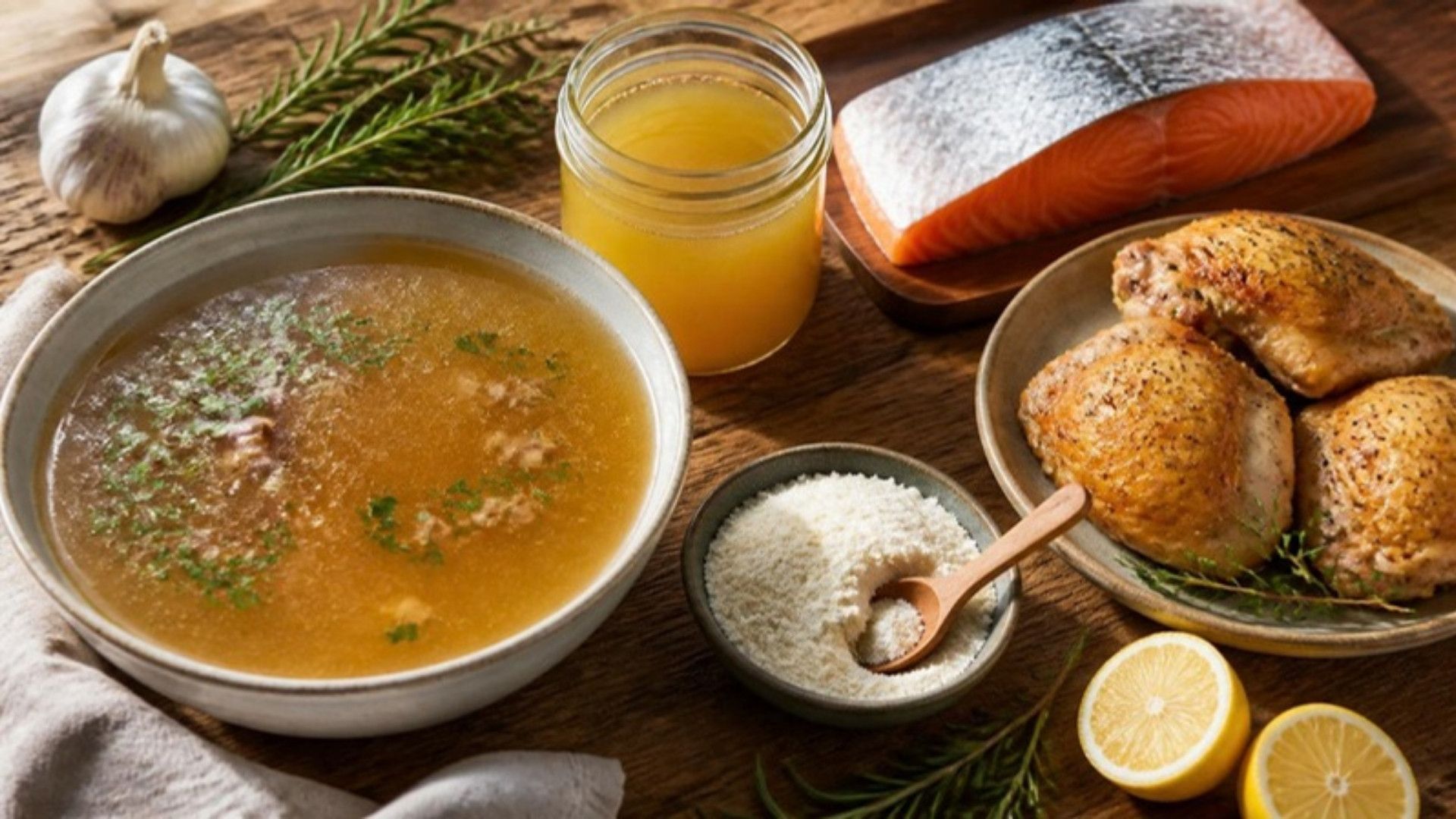
Collagen is the protein that holds your body together, about a third of all the protein in your body, and you can eat its building blocks in bone broth, skin-on fish and chicken, bovine or fish gelatin and collagen peptides.1
The free Healing Leaky Gut protocol puts collagen and bone broth into a 30-day plan.
Collagen is the main structural protein in your body. It gives skin its firmness and tendons their pull, and it forms the framework your bones are built on.17 I describe it as the scaffolding of your body, the glue that holds everything together and keeps it from sagging.8
You make collagen every day from the amino acids you eat, mainly glycine, proline and hydroxyproline, and the richest sources are the parts of the animal modern diets throw away.9 My approach starts in the kitchen. Bone broth comes first, chicken broth in particular, because along with its collagen it brings chondroitin and hyaluronic acid.810 After broth come skin-on fish and chicken, then bovine or fish gelatin and collagen peptides.
Collagen also sits at the center of my approach to rebuilding the gut lining,2 and it supports your joints, skin, bones and muscles too.
Bone broth and animal skin restore the balance that modern diets lack. Nearly one-third of your body's protein is collagen, but most people eat almost exclusively muscle meat. Bone broth provides glycine, proline, and hydroxyproline, the amino acids your body uses to rebuild skin, joints, ligaments, vascular walls, and gut lining.Dr. Josh Axe, DC, DNM, CNSFrom Heal Your Cells (2026), p. 131
Collagen and bone broth are part of the Repair step in this free 30-day protocol. It lays out:
Free with your Dr. Axe account (email or Google). You'll also get the protocol's short email series and the Dr. Axe newsletter; unsubscribe anytime.
Open the free protocol →Did you know?
Collagen is a family of 28 proteins, and every one of them contains at least one triple helix, three protein strands wound around each other.11
Collagen accounts for about three-quarters of the dry weight of your skin.1
About 90% of the organic part of your bones is collagen, the framework the minerals are laid into.7
Collagen is the most abundant protein in your body, a rope-like structural protein that makes up about a third of your total protein. Type I collagen forms the fibers of skin, bone, tendons and ligaments, and type II forms cartilage.111
Collagen is the scaffolding in the extracellular matrix, the material between your cells: it gives tissues their shape and strength and gives cells something to attach to, move along and multiply on.11 Its three strands are built on a repeating pattern in which glycine sits at every third position, with proline and hydroxyproline packed in between.11
Of the 28 types, five come up again and again, and three do most of the work you'd notice: type I, type II and type III.111
| Type | Where it's found | What it does |
|---|---|---|
Type I | Skin, bones, tendons and ligaments; the most abundant type | Gives tissues their strength and structure1 |
Type II | Cartilage and the clear gel inside your eyes | Forms the cushioning cartilage in your joints1 |
Type III | Skin, blood vessels and intestines, alongside type I | |
Type IV | Basement membranes, the thin sheets that cells rest on | Forms a mesh instead of fibers1 |
Type V | Bone, skin, the cornea and the placenta |
The section on which type is best, further down, covers what this means for choosing a supplement.
For most of history, people got their collagen from the pot. In Ancient Remedies, I describe bone broth this way: "Made by simmering the bones and ligaments of beef, chicken, fish, and lamb, this nourishing food was a staple for our ancestors, who used every part of an animal as sustenance."12 Gastroenterologists at Mayo Clinic open their 2025 review of broth the same way, calling it a traditional remedy revered by different peoples from ancient times to today.13 Collagen powders are a modern convenience built on that old habit.
Your collagen declines year by year as you get older, and on my show I've described how that shows up as more wrinkles, joint pain, digestive issues and slower recovery.8 Skin collagen content falls by roughly 1% a year through adult life, a figure researchers trace to a 1975 study of forearm skin in a large group of adults.1415 The cells that make collagen slow down too: skin cells from people over 80 made about a third less type I procollagen, collagen's starting material, than cells from people aged 18 to 29.16
Skin collagen falls about 1% a year through adult life
Beyond age, several everyday drivers speed the loss, and most of them are yours to change:
Menopause. In 76 women aged 20 to 60, skin collagen dropped significantly after the 40s and again after menopause, in step with bone density.17 Our guide to menopause supplements and diet covers the natural steps.
Smoking. In a study of 47 smokers and 51 people who had never smoked, smokers' skin made 18% less type I collagen and 22% less type III.18 Here's how to start quitting smoking.
Sunburn. UV light raises MMP-1, the enzyme that starts most of the collagen breakdown UV causes in skin.19 Get your sunshine in sensible doses, and don't burn.
Sugar. On my show, I've explained that a high-sugar diet speeds collagen breakdown through compounds called advanced glycation end products, or AGEs.20 See the foods that damage collagen.
Feeding your collagen matters as much as protecting it. Alongside collagen, I tell people to get plenty of zinc, copper and vitamin C.20 Vitamin C has the clearest research: healthy skin holds high levels of it, and it stimulates collagen production.21
A 7-gram envelope (about 1 tablespoon) of unflavored gelatin has about 23 calories and 6 grams of protein, with no fat or carbohydrate. Gelatin is the USDA's closest record to collagen powder, and it's rich in glycine and proline and has no tryptophan.22
Values from USDA FoodData Central, FDC ID 169599 (gelatin, dry powder, unsweetened). Per-serving amounts are calculated from the per-100-gram values, using USDA's 7-gram envelope.22
| Nutrient | 1 envelope (about 1 tablespoon, 7 g) | 20 g | Per 100 g |
|---|---|---|---|
| Calories | 23 | 67 | 335 |
| Protein | 6.0 g | 17.1 g | 85.6 g |
| Glycine | 1.33 g | 3.8 g | 19.0 g |
| Proline | 0.86 g | 2.46 g | 12.3 g |
| Glutamic acid | 0.61 g | 1.75 g | 8.75 g |
| Alanine | 0.56 g | 1.60 g | 8.01 g |
| Arginine | 0.46 g | 1.32 g | 6.62 g |
| Lysine | 0.24 g | 0.69 g | 3.46 g |
| Leucine | 0.17 g | 0.49 g | 2.45 g |
| Tryptophan | 0 g | 0 g | 0 g |
| Calcium | 4 mg | 11 mg | 55 mg |
| Sodium | 14 mg | 39 mg | 196 mg |
Glycine leads the amino acids in the record at 19 grams per 100, followed by proline,22 so a scoop of collagen delivers a concentrated dose of both, the raw materials your body uses to make its own collagen.9 Twenty grams of gelatin supplies about 17 grams of protein.22
No. Collagen has no tryptophan, one of the nine essential amino acids, so it counts as an incomplete protein.2322 It still fits comfortably in a healthy diet: a modeling study found that collagen peptides could supply up to 36% of the protein in a typical Western diet while every essential amino acid need was still met.23 Eat collagen alongside complete proteins such as eggs, fish and poultry, and see how many grams of protein a day you need in total.
Collagen supports the tissues it builds: your gut lining, joints, skin, bones and muscles. It's a core part of my gut-repair protocol, and in trials it eased osteoarthritis pain and improved function across 35 trials, improved skin hydration and elasticity across 26, and raised bone density in a 12-month trial of 131 women.2456
The joint and skin research runs deepest, with the largest pooled analyses of randomized trials.45242526 The bone, muscle, sleep, hair and gut findings rest on smaller bodies of research, and every result below names its study type and the product studied.
| Use | Evidence | Product studied | What the research shows |
|---|---|---|---|
Gut lining and digestion | Emerging | Bone broth; collagen peptides, 20 g a day | Gut-barrier proteins protected in inflamed intestinal cells, less colitis damage in mice, and fewer digestive symptoms, including bloating, in an 8-week study without a placebo group1327283 |
Joint pain and osteoarthritis | Strong | Collagen peptides, gelatin and undenatured type II collagen | Less pain and better function than control, with no more side effects4 |
Skin hydration, elasticity and wrinkles | Moderate | Hydrolyzed collagen, 0.4 to 12 g a day | Better hydration and elasticity than placebo across 26 trials in 1,721 people5 |
Bone density | Moderate | Collagen peptides, 5 g a day | |
Muscle and strength, with training | Moderate | Collagen peptides with exercise training | More fat-free mass, changes in tendon structure and more strength than training alone30 |
Sleep | Emerging | Collagen peptides, 15 g an hour before bed | Fewer awakenings during the night31 |
Hair and nails | Emerging | Fish collagen peptides, 1,000 mg; collagen peptides, 2.5 g |
Here's what happens when you eat collagen: digestion breaks most of it down, but some survives as tiny pieces just two or three amino acids long that reach your blood and signal the cells that build new collagen.
Bone broth, skin-on fish and chicken, bovine or fish gelatin and collagen peptides all deliver collagen's building blocks: glycine, proline and hydroxyproline.11
After volunteers drank gelatin hydrolysates, hydroxyproline-containing peptides, mostly one called Pro-Hyp, peaked in their blood 1 to 2 hours later.34
In lab studies of mouse skin cells, Pro-Hyp and Hyp-Gly spurred the growth of fibroblasts, the cells that make collagen.3536
Among women who gave skin samples after 8 weeks of 2.5 grams of collagen peptides a day, the samples held 65% more procollagen type I, collagen's starting material, and 18% more elastin than samples from women on placebo.37
Researchers propose that this signaling explains much of what the skin and joint trials measured.36 Collagen from fish and cattle is absorbed well: in a study in which 6 healthy adults each tried hydrolysates from several sources, both fish collagen and bovine collagen produced meaningful blood levels of these peptides.38
Gut repair leads this list because collagen and bone broth are at the center of my gut-healing protocol. Then come joint pain, skin, bone density, muscle, sleep and hair and nails.
Collagen and bone broth supply the amino acids your gut lining uses for repair.13 In lab tests, fish collagen peptides kept inflamed intestinal cells from losing their tight-junction seals,27 and in mice with colitis, beef bone broth lowered the inflammatory signal IL-6 by about 95%.28 The gut section covers the human research and the full plan.
Study takeaway: collagen and bone broth are part of the Repair step of Dr. Axe's gut-healing protocol, with supporting lab, animal and human studies.
A 2024 pooled analysis of 35 randomized trials in 3,165 people with osteoarthritis found that collagen products eased pain and improved function compared with control. The effect was small to moderate, rated moderate certainty for pain and high certainty for function, and collagen caused no more side effects or dropouts than the comparison.4 In a 6-month placebo-controlled trial of 120 adults aged 30 to 81 with knee osteoarthritis, 10 grams of collagen peptides a day, taken with 80 milligrams of vitamin C, lowered pain, improved function and lowered the inflammation markers CRP and ESR.39 Active young adults benefit too: 180 people aged 18 to 30 with knee pain during exercise took 5 grams a day or a placebo for 12 weeks, and their knee pain fell 21.9 mm on a 100 mm scale, against 15.6 mm on placebo.40 Collagen also adds to what a pain reliever does: in a 3-month trial of 39 adults with knee osteoarthritis who all took acetaminophen (1,500 milligrams a day), those who added 10 milligrams a day of native (undenatured) type II collagen had significantly less pain when walking than those on acetaminophen alone.64 For more steps, see collagen for joints and knee pain relief.
Study takeaway: collagen eased osteoarthritis pain and improved function across 35 trials.
5 g of collagen a day: bigger drop in exercise knee pain than placebo
A 2023 analysis of 26 placebo-controlled trials with 1,721 people found better skin hydration and elasticity with hydrolyzed collagen.5 A 2026 review of 25 trials counted improvements over placebo in hydration in 10 of 15 trials, elasticity in 10 of 13 and wrinkle depth or volume in 9 of 10.26 A 2025 analysis of 23 trials also found gains in hydration, elasticity and wrinkles, though not in the subsets of trials without industry funding or rated high quality.25 In one placebo-controlled trial, 114 women aged 45 to 65 who took 2.5 grams of collagen peptides a day had 20% less eye-wrinkle volume than the placebo group after 8 weeks, and the difference held 4 weeks after they stopped.37 Our natural skin care guide covers the habits that support it.
Study takeaway: hydrolyzed collagen improved skin hydration and elasticity compared with placebo across 26 trials.
In a 12-month placebo-controlled trial, 131 postmenopausal women with age-related bone loss took 5 grams of collagen peptides a day or a placebo. Their spine T-score rose 0.10 while the placebo group's fell 0.03, and at the hip it rose 0.09 against a 0.01 drop. A blood marker of bone building rose on collagen, while a marker of bone breakdown rose on placebo.6 A 2025 pooled analysis also found higher bone density at the hip and spine with collagen peptides, with results that varied from trial to trial, plus better bone-turnover markers and added benefit when collagen was paired with vitamin D and calcium.29 See the best foods for bone health to build the rest of your plate.
Study takeaway: 5 grams of collagen peptides a day raised spine and hip bone density over 12 months compared with placebo.
Spine bone density rose on collagen and slipped on placebo
Paired with strength training, collagen helps the training pay off. In 53 men with age-related muscle loss, average age 72, 15 grams a day through 12 weeks of training added 4.2 kilograms (about 9 pounds) of fat-free mass, against 2.9 kilograms on placebo, and more than doubled the gain in leg strength, 16.5 against 7.3 newton-meters, while fat mass fell more too.41 A 2024 analysis of 19 studies with 768 people found that collagen plus training produced more fat-free mass, larger changes in tendon structure, more strength and faster recovery than training alone.30 Our sarcopenia guide covers the rest of a muscle-building plan.
Study takeaway: with strength training, collagen added more fat-free mass and strength than training alone.
Collagen plus training: more lean mass than training alone
In a trial of 13 athletic men with sleep complaints, each man took 15 grams of collagen peptides and a placebo an hour before bed for 7 nights each. On the final night of collagen, sleep recordings showed 21.3 awakenings against 29.3 on placebo, and the men did better on a morning attention test; total sleep time and how fast they fell asleep didn't change.31 Glycine, the most plentiful amino acid in collagen, is one I've highlighted on my show for calming the nervous system and supporting sleep,42 and in a 2026 review, all 3 trials of glycine for sleep reported a benefit.43 See more natural sleep aids.
Study takeaway: 15 grams of collagen peptides before bed meant fewer night awakenings than placebo.
In a 2026 placebo-controlled trial, 114 women aged 20 to 50 with thinning hair and cellulite took 1,000 milligrams a day of a low-molecular-weight collagen peptide made from fish skin, or a placebo, for 24 weeks. Collagen increased hair diameter, with more women showing measurable thickening, and improved cellulite and skin elasticity at 12 and 24 weeks.32 For nails, 25 people with brittle nails who took 2.5 grams a day for 24 weeks had 12% faster nail growth and 42% fewer broken nails; that study had no placebo group.33 See brittle nails and hair loss remedies for more.
Study takeaway: fish collagen peptides increased hair diameter compared with placebo over 24 weeks.
These markers show the broader picture of inflammation, bone support and blood sugar, and give you a baseline to track as broth and collagen become part of your day. None of them measures collagen itself. Go over your numbers with your practitioner.
See the cellular bloodwork panel
Have results? Analyze them free →Yes, collagen and bone broth supply the glycine, proline and glutamine your gut lining uses for repair, and they're part of the Repair step in my gut-healing protocol.132 In an 8-week study without a placebo group, 13 of the 14 women who completed 20 grams of collagen peptides a day reported fewer digestive symptoms, including bloating.3
Healing the gut starts with taking away what irritates it and then rebuilding the lining. My gut-healing protocol follows six steps in order, the 6R plan: Remove, Replace, Reinoculate, Repair, Rebalance and Reframe. Collagen peptides are among the essential supplements of the Repair phase, taken alongside bone broth every day.2 I also recommend amino acid–rich foods to heal the intestinal lining, including bone broth, collagen and gelatin, because they support the tight junctions that prevent nutrient loss and inflammation.9 When you use gelatin, choose bovine or fish. On my show, I've put it simply: collagen peptides give your body what it needs to rebuild the gut.44
A 2025 review by Mayo Clinic gastroenterologists lays out the case for broth. Bone broth supplies glutamine, glycine, proline, histidine and arginine, plus calcium, phosphorus, potassium, magnesium and zinc, and the reviewers found that the documented benefits of these nutrients support gut health, calm inflammation in the intestinal barrier and improve barrier function, especially in inflammatory bowel disease. They present broth as a potential remedy, particularly for keeping conditions like IBD in remission.13
Lab and animal studies show the same direction:
In intestinal cells grown in a lab and inflamed on purpose, collagen peptides from fish skin kept the inflammation from breaking down ZO-1 and occludin, two of the tight-junction proteins that seal the gaps between cells.27
In a mouse model of colitis, beef bone broth given for 10 days beforehand meant less damage to the colon and far lower inflammatory signals, with IL-6 down about 95% and TNF-alpha down about 69%.28
In a second mouse study, fish collagen peptides eased chemically induced colitis, restored gut-barrier proteins and shifted the gut bacteria back toward balance.45
People report the difference too. In an 8-week study without a placebo group, 40 healthy women with a BMI over 25 started on 20 grams of collagen peptides a day, split into two doses, and 14 finished; 13 of those 14 reported fewer digestive symptoms, including bloating.3 In a week-long trial in which 20 trained volunteers each tried 10 grams of collagen peptides a day and a placebo before a hard run, gut permeability didn't differ between the two, but LPS, a toxin from gut bacteria that can leak into the blood, rose after the run only on placebo.46
To put collagen to work for your gut, start the free Healing Leaky Gut protocol, which builds collagen and bone broth into the Repair step of its 30-day plan, and see our guides to leaky gut, the leaky gut diet and L-glutamine.
Every form delivers collagen; they differ in how much you get, how they dissolve and what comes along with them. For a closer look at two of them, see collagen vs. bone broth.
Collagen together with the other amino acids and minerals simmered out of bones, skin and cartilage.13 Make it at home with our chicken bone broth or beef bone broth recipe.
The skin on fish and chicken carries collagen with your meal. See the best collagen-rich foods.
The gel-forming form of collagen, sold as a powder; it dissolves in hot liquid and sets as it cools.47 Read more about beef gelatin.
Collagen broken into small pieces (hydrolyzed), so it dissolves in hot or cold drinks without gelling. It's the form used in the skin, bone and muscle trials above.
Collagen from chicken cartilage kept in its native shape and taken in tiny amounts. In 191 adults with knee osteoarthritis, 40 milligrams a day of the supplement, supplying 1.2 milligrams of undenatured collagen, lowered symptom scores more than placebo and more than glucosamine with chondroitin over 180 days.48 Researchers propose it works through the gut's immune tissue, calming the immune response to cartilage.49
Bovine or fish gelatin belongs right beside collagen peptides, because they carry the same amino acids.479 Gelatin has its own human research. In a study in which 8 healthy young men each tried three drinks before 6 minutes of rope-skipping, three times a day for 3 days, 15 grams of gelatin taken an hour beforehand doubled a blood marker of new collagen formation: PINP rose 153% at 4 hours, against 59.2% after 5 grams of gelatin and 53.9% after the placebo. All three drinks were mixed into the same vitamin C–rich concentrate.50
15 g of gelatin before exercise: the biggest rise in a collagen-building marker
The practical difference is texture. Collagen peptides stir into cold drinks and coffee without clumping, which makes them easy to take every day; bovine or fish gelatin works best in warm broth, soups and homemade gummies. See collagen vs. gelatin for a side-by-side comparison.
Type I is the collagen of your skin, bones and tendons, the type that forms every fibrous tissue except cartilage.1 The animal source matters less than you might expect: in the 26-trial skin analysis, collagen from different sources improved elasticity with no significant difference between them.5 For cartilage, undenatured type II collagen is its own category, described above.
The best source is the one your body tolerates. If you have a fish or red meat (alpha-gal) allergy, read the safety section before choosing a source. Our guides to bovine collagen, fish collagen, chicken collagen and the types of collagen go deeper.
Source named: bovine (look for grass-fed or pasture-raised) or fish (look for wild-caught)
Grams of collagen per scoop printed on the label, so you can count it toward your daily amount
Third-party tested for purity and heavy metals, since the FDA doesn't review supplements for safety or effectiveness before they're sold51
Unflavored, with no added sugar; if you want it sweeter, add a little raw honey at home
Bovine or fish on any gelatin you buy
Ask Dr. Axe AI. Answers are grounded in this library, with sources shown.
The richest collagen foods are the parts of the animal most people skip: bone broth, the skin on fish and chicken, and bovine or fish gelatin.5247
I tell people to eat the skin on their fish and chicken, because when you eat the skin, you're getting loads of collagen.5253 In a Japanese study of everyday dishes, the meat in one serving of most dishes held 0.2 to 2.5 grams of collagen, and when volunteers ate cooked fish, nine kinds of the small collagen pieces that supplements deliver showed up in their blood.54 Food builds the foundation, and a scoop of bovine or fish gelatin or collagen peptides gives you a measured amount on top.
Bone broth, chicken first, plus beef, lamb and fish bones.12 Find more ideas in our bone broth recipes.
Skin-on fish, such as wild-caught salmon and the other fish in our guide to the best fish to eat.
Skin-on chicken, roasted or simmered with the bones and cartilage for broth.
Bovine or fish gelatin, stirred into broth and soups or set into gummies.
Collagen peptides, stirred into coffee, smoothies or soups.
I recommend about 20 to 30 grams of collagen a day for most people, counting bone broth, collagen-rich foods and powder together, and my gut-repair protocol uses 10 to 20 grams of collagen peptides a day in coffee, smoothies or soups.202 Research through 2019 found benefits from 2.5 to 15 grams of collagen peptides a day, newer studies at 20 and 30 grams, and the undenatured type II collagen trials use 40 milligrams of the supplement.2335548
| Goal | Form studied | Daily amount | How long |
|---|---|---|---|
Digestive symptoms | Collagen peptides | 20 g, in two doses | 8 weeks3 |
Skin wrinkles and elasticity | Collagen peptides | 2.5 g | 8 weeks37 |
Knee pain with exercise | Collagen peptides | 5 g | 12 weeks40 |
Knee osteoarthritis | Collagen peptides with vitamin C | 10 g, plus 80 mg vitamin C | 6 months39 |
Knee osteoarthritis | Undenatured type II collagen | 40 mg (1.2 mg undenatured collagen) | 180 days48 |
Bone density | Collagen peptides | 5 g | 12 months6 |
Muscle, with strength training | Collagen peptides | 15 g | 12 weeks41 |
Sleep | Collagen peptides | 15 g, an hour before bed | 7 nights31 |
Hair thickness | Fish collagen peptides | 1,000 mg | 24 weeks32 |
My daily target sits at the high end of what's been studied, and there's support for aiming high. In a study in which 10 resistance-trained men each tried three doses an hour before a squat workout, 30 grams of hydrolyzed collagen raised a blood marker of collagen formation more than 15 grams or none.55
Bone broth counts toward that total, and how much it supplies depends on the pot: in a lab analysis, broth made to a standard recipe carried less glycine, proline and hydroxyproline than a 20-gram serving of collagen supplement, and broths made to different recipes varied widely.56 A mug of broth plus a scoop of collagen peptides or bovine or fish gelatin is an easy way to reach the amounts used in the trials. Our guide to how much bone broth to drink daily has more.
There's no single best time, so pick the one that fits your goal. For sleep, take it about an hour before bed, the timing used in the sleep trial.31 Around training, take it about an hour before you exercise along with a source of vitamin C, the approach used in the gelatin and dose studies.5055 For everything else, take it whenever you'll remember it, in your morning coffee or a bowl of soup.
Bone broth and bovine or fish gelatin fit into the meals you already make, and unflavored collagen peptides mix into almost anything.
Collagen is well tolerated: across 35 osteoarthritis trials, it caused no more side effects or dropouts than the comparison groups.4 The people who need to be careful are those with a fish allergy, a red meat (alpha-gal) allergy or a history of calcium oxalate kidney stones.
The skin research agrees: a 2026 review of 25 trials found hydrolyzed collagen generally well tolerated, with a low rate of side effects.26 Medicine works best when it's personal, so these are the situations where the source or the amount should change:
Fish allergy. Anaphylaxis has been reported after hydrolyzed fish collagen and after marshmallows made with fish gelatin.5758 If you're allergic to fish, skip fish collagen and fish gelatin and choose bovine.
Red meat (alpha-gal) allergy. In an allergy clinic that tested 1,335 adults, 30 of the 40 with red meat allergy tested positive for gelatin and 12 were allergic to it, and the alpha-gal sugar was found in bovine gelatin.59 If you have alpha-gal syndrome, skip bovine gelatin and bovine collagen, and choose any source with your allergist.
Calcium oxalate kidney stones. Your body can turn hydroxyproline, an amino acid in collagen, into oxalate. In 10 healthy adults, 30 grams of gelatin a day for 5 days raised urinary oxalate 43% compared with the same amount of whey protein, and single doses of 5 and 10 grams raised it while 1 and 2 grams didn't.60 If you've had kidney stones, keep collagen and gelatin to modest amounts and set your dose with your practitioner.
Kidney disease with a protein limit. Collagen is concentrated protein, about 6 grams in a 7-gram envelope of gelatin, so count it toward your daily limit.22
Pregnancy and nursing. None of the trials on this page enrolled pregnant or nursing women. Broth and collagen-rich foods are everyday foods; if you want a collagen supplement during pregnancy, confirm the dose with your OB.
Lead in broth. One lab study found lead and cadmium in broth at only a few micrograms per serving and judged the risk minimal, while a small test of organic chicken broths found several times the lead of the water they were made with.6162 Make broth from the bones of well-raised animals, and buy powders tested by an independent lab.
For most people, yes. Collagen is the protein that holds your skin, joints, bones and gut lining together, and modern diets supply far less of it than the whole-animal cooking our ancestors relied on. The joint and skin benefits have dozens of trials behind them, the bone and muscle results are encouraging, the sleep and hair research is promising, and collagen and bone broth sit at the center of my gut-repair protocol.
Start with food: bone broth, chicken broth in particular, then skin-on fish and chicken, then bovine or fish gelatin and collagen peptides. Every day, I recommend drinking bone broth or having collagen, toward about 20 to 30 grams a day in all.20 If you have a fish or red meat allergy or a history of kidney stones, read the safety section first. Give your body the building blocks it was designed to heal with, and let it do the rebuilding.
The 30-day protocol with the 6R roadmap, the foods that heal, a 7-day meal plan and the supplement protocol, collagen peptides included. Have recent bloodwork? Analyze it free. Free with your Dr. Axe account (email or Google). You'll also get the protocol's short email series and the Dr. Axe newsletter; unsubscribe anytime.
Open the free protocol →No. Collagen has no tryptophan, so it counts as an incomplete protein, but collagen peptides could supply up to 36% of the protein in a typical Western diet while every essential amino acid need was still met.23 Eat it alongside complete proteins such as eggs, fish and poultry.
Plan on 8 to 12 weeks for skin and joints and about a year for bone density: the skin trial on this page measured results at 8 weeks, the exercise knee-pain trial at 12 weeks and the bone trial at 12 months.37406 For the gut, my Healing Leaky Gut protocol notes that most people feel meaningful relief in 4 to 12 weeks.2
Gelatin is collagen in its gel-forming form, and it carries the same amino acids, so I put bovine or fish gelatin right beside collagen peptides.479 In one study, 15 grams of gelatin before exercise doubled a blood marker of new collagen formation.50 See collagen vs. gelatin for more.
You can use both: whey is a complete protein, and collagen supplies the glycine and proline your connective tissue is built from.22 In a 12-week strength-training trial of 97 middle-aged men, 15 grams of collagen peptides a day added 3.4 kilograms of fat-free mass, against 1.8 kilograms on placebo; a whey protein group fell in between, at 2.3 kilograms.63
With strength training, it can help you lose more fat: in a 12-week trial of 97 middle-aged men, those taking 15 grams of collagen peptides a day lost 5.3 kilograms of fat mass, against 3.4 kilograms on placebo.63 Scale weight fell about the same in both groups, 1.6 against 1.4 kilograms, because collagen also added lean muscle.63 In older men with age-related muscle loss, 15 grams a day with training cut fat mass by 5.4 kilograms, against 3.5 kilograms on placebo.41 Collagen works alongside the training, not in place of it.
Yes. Across 35 trials in 3,165 people with osteoarthritis, collagen eased pain and improved function compared with control.4 See collagen for joints for more.
It helped hair grow thicker in a trial: 114 women aged 20 to 50 with thinning hair who took 1,000 milligrams of fish collagen peptides a day for 24 weeks had a greater increase in hair diameter than the placebo group.32
Yes. Collagen and bone broth are part of the Repair step in my gut-healing protocol, because they supply the amino acids your gut lining uses for repair.213 In an 8-week study without a placebo group, 13 of the 14 women who completed 20 grams a day reported fewer digestive symptoms, including bloating; the gut section has the full research.3
For most people, no. The main kidney concern is for people who form calcium oxalate stones: in 10 healthy adults, 30 grams of gelatin a day raised urinary oxalate 43% compared with whey protein.60 If you've had stones, or you follow a protein limit for kidney disease, keep collagen modest and set the dose with your practitioner.
Bone broth and other collagen-rich foods are everyday foods and the place to start, since none of the collagen trials on this page enrolled pregnant or nursing women. If you want a collagen supplement during pregnancy, confirm the dose with your OB.
October 2, 2026 — Rewritten and re-sourced in full.
October 2, 2026 (Dr. Axe's review) — Added a hero photo, a chart of the roughly 1% a year drop in skin collagen and a table of the main collagen types and where they're found in the body; shortened the Dr. Axe Score explanation, keeping the score at the top.
October 2, 2026 (second update) — Labeled the 8-week digestive study (no placebo group; 13 of the 14 women who completed it) everywhere it appears; added a 39-adult knee trial in which native type II collagen added to acetaminophen eased walking pain (new reference 64); added an FAQ on collagen and weight loss; put bone broth first in the forms heading and the everyday-use ideas; matched the chicken broth line to Dr. Axe's show wording; simplified two mechanism steps; linked the free Healing Leaky Gut protocol from the gut section; pointed the bloodwork link at the inflammation topic; added a chart of the lean-mass result in older men; trimmed a repeated study mention from the bloating FAQ; plainer wording in the what-is, nutrition-facts and how-it-works sections; read time updated to 24 minutes.
October 6, 2026 — Added the page's five charts, including the chart of the roughly 1% a year drop in skin collagen from Dr. Axe's review.
October 9, 2026 — Trimmed repeated book references.

This article is for educational purposes. See our medical disclaimer.