





Advertisement
Advertisement
Foods That Heal
The eight collagen-rich foods Dr. Josh Axe puts first, from bone broth to skin-on wild salmon and bovine or fish gelatin, with what the research shows for each one and the vitamin C, zinc and copper foods your body uses to build its own collagen.
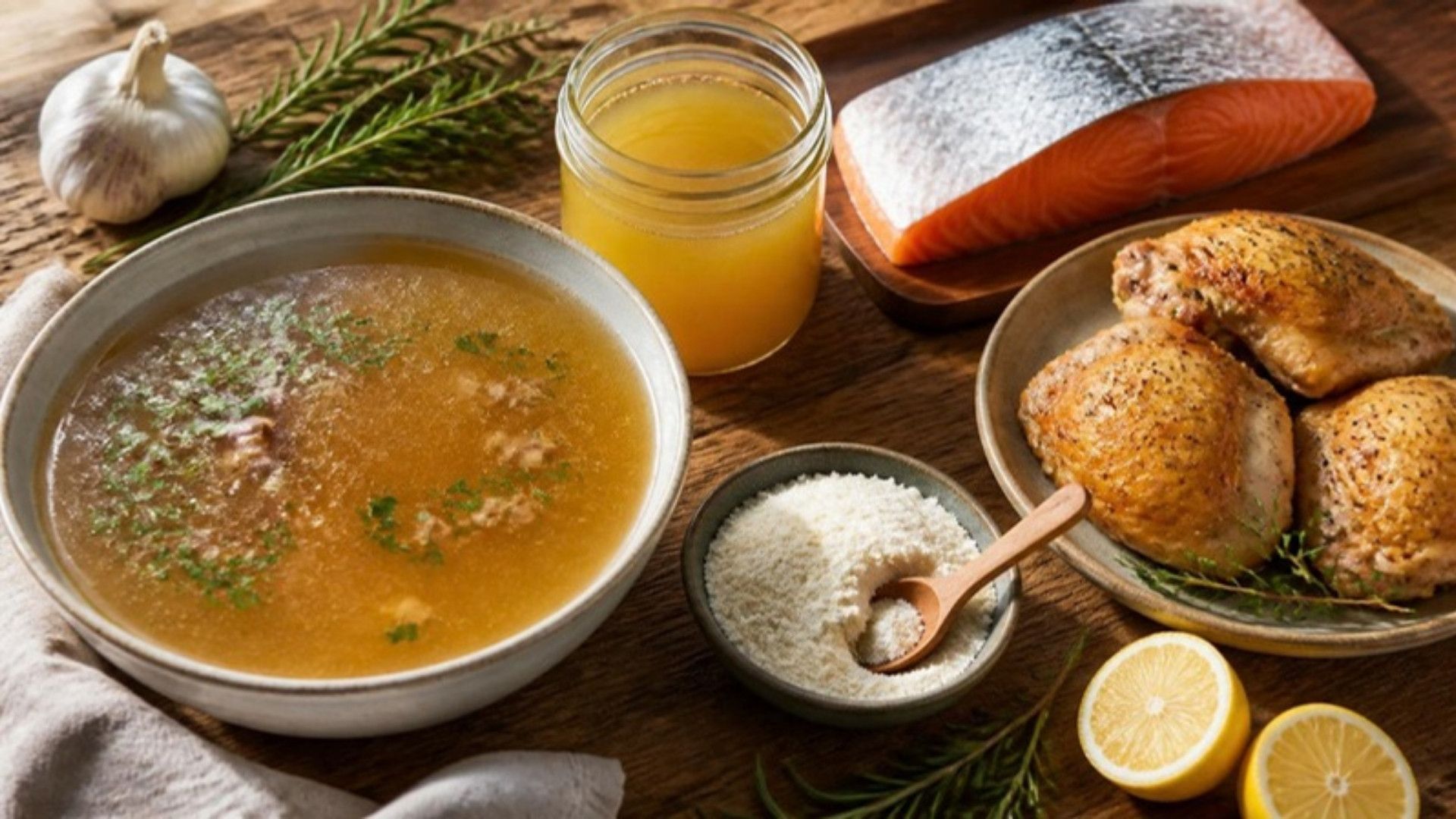
The best food sources of collagen are the bones, skin and connective tissue that modern cooking tends to discard: bone broth first, then skin-on fish and chicken, then bovine or fish gelatin alongside collagen peptides, then slow-cooked beef cuts such as oxtail and short ribs.123
The free Healing Leaky Gut protocol builds bone broth, collagen-rich cuts and collagen peptides into a 30-day plan.
Collagen is the protein your body uses as scaffolding, the framework of your skin, tendons, ligaments, cartilage and bones.9 Your body makes fresh collagen daily out of the amino acids in your food, and the foods richest in those building blocks come from what most kitchens now throw away: bones, skin and the tough cuts that need hours on the stove.
As Dr. Will Cole and I write in Heal Your Cells, most people eat almost nothing but muscle meat, even though nearly a third of the body's protein is collagen.109 Here are the eight foods that bring the rest of the animal back to your plate, ranked, and the three nutrients your body needs to turn them into new collagen.
30-day protocol
Rebuild the gut lining and microbiome: the remove–replace–repair sequence, foods, supplements and the labs that confirm progress.
Free with your Dr. Axe account
View the protocol →
What's your biggest goal right now?
Chicken broth in particular might be the most beneficial because not only does it have collagen, it also has glucosamine, chondroitin, and hyaluronic acid.Dr. Josh Axe, DC, DNM, CNSFrom 11 Supplements Every 40+ Adult Should Consider, The Dr. Josh Axe Show (2026), at 16:33
The best collagen-rich foods, in the order I recommend them, are bone broth (chicken broth in particular), fish and chicken eaten with the skin, and bovine or fish gelatin alongside collagen peptides.211110 Next come oxtail and short ribs, the collagen-rich cuts my gut-healing protocol names, and then shank, tendon and other slow-braised cuts, where lab measurements show the collagen.15
| Rank | Food | What it brings | How to eat it |
|---|---|---|---|
1 | Bone broth | Collagen drawn from bones, skin and cartilage during long simmering, plus glycine, proline and glutamine12 | |
2 | Skin-on wild salmon | Collagen in the skin, plus omega-3 fats141 | 8 to 12 ounces of fish a week, skin on15 |
3 | Sardines, eaten whole | Straight from the can, bones and all | |
4 | Skin-on chicken | Collagen in the skin3 | Roasted with the skin on, then the carcass simmered for broth |
5 | Bovine or fish gelatin | Cooked-down collagen, about 6 grams of protein per envelope17 | Stirred into broth and soup, or set into gummies |
6 | Collagen peptides, bovine or fish | Collagen in small pieces that dissolve in any drink | 10 to 20 grams a day1 |
7 | Oxtail and short ribs | Bone and connective tissue that turn to gelatin as they braise18 | Slow-braised, grass-fed |
8 | Beef shank, tendon and other braising cuts | Collagen-dense: beef tendon was among the dishes with 7.6 to 13.3 grams per serving5 | Simmered in soups and stews, grass-fed |
Pork skin, pork rinds and shellfish such as oysters show up on many collagen lists, but I don't recommend them. I follow The Biblio Diet standard of clean animals and fish with fins and scales, so every fish on this list has both and the gelatin is bovine or fish.19
Several of these foods have been measured for glycine, the amino acid found at every third spot along the collagen chain.20 In USDA records, the skin from half a roasted chicken (56 grams) carries 1.82 grams, 3 ounces of braised brisket 1.39 grams, one 7-gram envelope of gelatin 1.33 grams, 3 ounces of braised chuck 1.22 grams, a 3.75-ounce can of sardines with the bones (92 grams drained) 1.09 grams and 3 ounces of cooked wild salmon 1.04 grams.212217231624
Glycine, collagen's main building block, in one serving
Bone broth is the first of its top 10 gut-healing foods, wild salmon and sardines are second, and collagen-rich cuts and collagen peptides are part of its Repair phase. The free 30-day protocol lays out:
Free with your Dr. Axe account (email or Google). You'll also get the protocol's short email series and the Dr. Axe newsletter; unsubscribe anytime.
Open the free protocol →The order is my ranking; each card's badge grades the research behind that food.
I've called bone broth one of the most healing foods of all time.2 Simmering bones, skin and cartilage for hours draws their collagen into the pot as gelatin, which is why a well-made broth sets like jelly in the fridge.18 In Ancient Remedies, I describe broth made from lamb, beef, chicken and fish as a staple for ancestors who wasted no part of the animal.25 Chicken broth carries more than collagen: a 2024 lab analysis found chondroitin and hyaluronic acid in chicken-vegetable bone broth, two of the reasons I point to chicken broth in particular.2611
Broth is the first of the top 10 gut-healing foods in my Healing Leaky Gut protocol, for the glycine, glutamine and collagen that become the building blocks of new gut lining.1 Gastroenterologists at Mayo Clinic reached a similar conclusion in a 2025 review. They list arginine, glutamine, glycine, histidine and proline among broth's amino acids, with calcium, magnesium, potassium and zinc, and concluded that the documented benefits of those nutrients support the gut barrier, particularly in inflammatory bowel disease.12 Broth itself has been put to the test in people, too. In a trial in which 13 men each tried homemade chicken broth and a placebo soup 40 minutes before an 8-minute cycling time trial, and neither the men nor the researchers knew which was which, average power was 5.2% higher after the broth, a result the researchers linked to its carnosine and anserine.27
When my mom was recovering from cancer, through nutrition and lifestyle alongside her medical care, the foods she leaned on most for amino acids were bone broth and a little salmon.28 My Anti-Inflammatory Reset calls for a cup of broth a day, and my gut-healing protocol ideally 16 ounces.131 Start with our chicken bone broth recipe or the beef bone broth version, and see how much broth to drink a day for amounts.
Fish skin is loaded with collagen, as I've said on my show,14 so cook wild-caught salmon with the skin on and eat it. Three ounces of cooked wild salmon also supplies about 21.6 grams of protein and 0.27 milligrams of copper, one of the collagen helpers covered below.24
Wild salmon and sardines are number 2 on the gut-healing foods list in my protocol, for omega-3 fats that resolve inflammation and rebuild cell membranes.1 Aim for 8 to 12 ounces of low-mercury fish a week,15 and wild-caught fish is always going to win.14 For more fins-and-scales options, see the best fish to eat.
Sardines are small enough to eat whole, skin and soft bones included, which puts their connective tissue on your fork along with the fish. A 3.75-ounce can of Atlantic sardines with the bones supplies about 22.6 grams of protein and 351 milligrams of calcium.16 In The Biblio Diet, Jordan Rubin and I recommend eating whole small fish such as sardines and anchovies.19 Research on whole small fish is encouraging: in a Japanese study that followed 80,802 adults for an average of 9 years, women who ate small fish one to three times a month or more had about 30% lower risk of dying from any cause than women who rarely ate them, though men showed no clear link.29
Sardines are also low in mercury.15 Eat them straight from the can or on a salad with olive oil and lemon.
When you eat chicken skin or fish skin, you're getting loads of collagen, which supports your skin, hair and nails.3 The skin from half a roasted chicken weighs about 56 grams and carries 11.4 grams of protein.21 Roast thighs, legs or a whole bird with the skin on, then simmer the carcass for broth so the bones and cartilage go into the pot too. See chicken collagen for more on this source.
Gelatin is what collagen becomes after heat partly unravels it: the amino acids stay the same, it melts into hot liquid, and it firms up as it cools.18 In Heal Your Cells, Dr. Will Cole and I name gelatin, with bone broth and collagen, among the amino acid–rich foods for healing the intestinal lining, because they help maintain the tight junctions between gut cells.10 USDA lists unflavored gelatin at 85.6 grams of protein and 19.0 grams of glycine per 100 grams, so one envelope, about a tablespoon, gives you about 6 grams of protein.17
Gelatin has been tested in people as well. Eight healthy young men each went through three versions of the same routine, a drink an hour before 6 minutes of rope-skipping, repeated three times a day for 3 days, without the men or the researchers knowing which drink was which. With 15 grams of gelatin, PINP, which signals new collagen being built, rose 153% at 4 hours, compared with 59.2% with 5 grams and 53.9% with the placebo drink; all three drinks used the same blackcurrant base with 48 milligrams of vitamin C.30 Buy bovine or fish gelatin (the label names the source), whisk it into hot broth or soup, or use it for homemade gummies; our beef gelatin guide has more.
Collagen peptides are bovine or fish collagen cut into short pieces (hydrolyzed), which is why they mix into any drink, hot or cold, without gelling; my gut-healing protocol uses them in its Repair phase.1 For joints, the evidence is broad. Pooling 35 randomized trials with 3,165 people who had osteoarthritis, a 2024 analysis found that collagen products, most of them taken by mouth, reduced pain and improved physical function compared with control groups, without adding side effects or dropouts.6 One trial pairs collagen with a helper nutrient: 120 adults with knee osteoarthritis, aged 30 to 81, took a placebo or a daily sachet of 10 grams of bovine collagen peptides plus 80 milligrams of vitamin C for 6 months, without the participants or researchers knowing who got which, and the collagen group ended with less pain, better function and lower CRP and ESR, two blood markers of inflammation.31 Our page on collagen for joints goes further.
For skin, a 2025 review of 23 trials (1,474 people) found improvements in hydration, elasticity and wrinkles overall, though not in the trials without industry funding or in the highest-quality trials,32 and a 2023 review of 26 placebo-controlled trials (1,721 people) found that hydrolyzed collagen improved skin moisture and elasticity more than placebo.33
Oxtail and short ribs are the collagen-rich cuts my gut-healing protocol lists among the foods to eat freely in its Repair phase.1 Both carry plenty of bone and connective tissue, and long, slow, moist cooking turns that tough collagen into gelatin, so the meat goes tender and the braising liquid sets as it cools.18 Choose grass-fed beef. In Heal Your Cells, Dr. Will Cole and I point out that grass-fed and pasture-raised meats carry more omega-3s and CLA while avoiding the inflammatory residues of hormones, antibiotics and pesticide-laced feed.10 Try our bone broth braised short ribs or beef short ribs, and keep red meat fresh and unprocessed, as the safety section explains.
Tough, slow-cooking cuts are full of connective tissue, and some have been measured. In a Japanese lab analysis of everyday dishes, most delivered 0.2 to 2.5 grams of collagen per serving from their meat, and beef tendon was among the three dishes that reached 7.6 to 13.3 grams.5 USDA records also list hydroxyproline, one of collagen's signature amino acids, in braised beef: 0.24 grams in 3 ounces of brisket and 0.14 grams in 3 ounces of chuck.222320 Cross-cut beef shank is a classic cut for soups and stews, and tendon turns soft in long braises and pho-style soups. Choose grass-fed, and start with our beef stew recipe.
Digestion breaks the collagen you eat into amino acids and small pieces, and your cells build fresh collagen from them, with three nutrients doing key jobs along the way.
Broth, fish and chicken eaten with the skin, gelatin and collagen peptides deliver glycine, proline and hydroxyproline.10 Part of that survives digestion as tiny fragments: after healthy volunteers swallowed hydrolyzed gelatin, two-amino-acid fragments such as prolyl-hydroxyproline reached their highest blood levels 1 to 2 hours later.34 Whole food does this too: in a Japanese study, nine kinds of two- and three-amino-acid collagen fragments appeared in volunteers' blood after a meal of cooked fish meat.5
Collagen-making cells string amino acids into long chains with glycine at every third position, then wind three chains into a triple helix.209
Enzymes that run on vitamin C finish the proline and lysine in each chain so the helix holds its shape; without enough vitamin C, collagen synthesis falters and connective tissue weakens.358
Your body needs vitamin C, zinc and copper to build collagen, and food covers all three: one medium red bell pepper has 152 milligrams of vitamin C, 3 ounces of braised beef chuck has 7.1 milligrams of zinc and an ounce of cashews has 0.62 milligrams of copper.72340
Along with collagen itself, you want plenty of vitamin C, zinc and copper, as I've explained on my show; they're the nutrients that support collagen production.241
Vitamin C's role shows up plainly in people. In a trial that began in 1944, 20 volunteers followed diets with different amounts of vitamin C, and neither they nor the researchers knew who got what. A 2022 re-analysis of their healed scars found that scars at an average of 10 milligrams a day were 42% weaker than scars at 80 milligrams a day, and it placed the intake that protects collagen in the 75-to-110-milligram range.42 Men need 90 milligrams a day and women 75,8 and one serving of the foods below covers most or all of it.
Zinc supports protein building and wound healing; men need 11 milligrams a day and women 8.39 Copper is a cofactor for the enzymes behind connective tissue synthesis; adults need 900 micrograms (0.9 milligrams) a day, with an upper limit of 10 milligrams.37 Beef liver is the richest copper food here by far, 12.2 milligrams in 3 ounces braised, more than that daily upper limit in a single serving.43 It's one of the most nutrient-dense foods you can eat,44 and that concentration is why a small weekly portion is plenty. On my show, I've also named the vitamin A in liver and organ meats among the nutrients your skin needs alongside collagen.2 If you're pregnant, see the liver note in the safety section.
| Food | Serving | What it supplies |
|---|---|---|
Red bell pepper | 1 medium | 152 mg vitamin C7 |
1 fruit | 125 mg vitamin C45 | |
1 cup, halved | 89 mg vitamin C46 | |
Broccoli, raw | 1 cup, chopped | 81 mg vitamin C47 |
1 cherry | 81 mg vitamin C48 | |
1 fruit | 70 mg vitamin C49 | |
1 fruit | 64 mg vitamin C50 | |
Beef chuck, braised | 3 ounces | 7.1 mg zinc23 |
Beef brisket, braised | 3 ounces | 5.1 mg zinc22 |
Beef liver, braised | 3 ounces | 4.5 mg zinc; 12.2 mg copper43 |
1 ounce | 2.2 mg zinc; 0.38 mg copper51 | |
Cashews | 1 ounce | 1.6 mg zinc; 0.62 mg copper40 |
1 tablespoon | 0.7 mg zinc; 0.37 mg copper52 | |
Wild salmon, cooked | 3 ounces | 0.27 mg copper24 |
Vitamin C in one serving of six fruits and vegetables
I recommend about 20 to 30 grams of collagen a day for most people, from bone broth, whole foods and powders combined.2 My gut-healing protocol calls for 10 to 20 grams of collagen peptides a day, in coffee, smoothies or soups.1
Everyday diets supply far less. When researchers analyzed the 4-day food diaries of 1,338 adults aged 18 to 90 from Ireland's national nutrition survey, collagen intake averaged 3.2 grams a day: about 4.0 grams for men and 2.3 grams for women, with adults 65 and older eating less than middle-aged adults, 2.9 against 3.3 grams.4 The researchers called that intake low, particularly for women and older adults.
Women eat about 2.3 g of collagen a day; men about 4.0 g
Higher amounts may do more. Ten resistance-trained young men each took 0, 15 and 30 grams of hydrolyzed collagen with 50 milligrams of vitamin C an hour before heavy squats, and neither they nor the researchers knew which dose was which. With 30 grams, PINP, a marker of new collagen, ran about 22% higher across the session than with none and about 14% higher than with 15 grams.53
Broth helps you get there, though its collagen content varies from pot to pot. When Australian sports nutrition researchers analyzed broths in a lab, those made to one standard recipe held lower levels of glycine, proline and hydroxyproline than a 20-gram dose of a collagen supplement; broths from different recipes ranged widely, and café-made broths came out highest.54 So drink the broth, and add a scoop of bovine or fish gelatin or collagen peptides when you want a set amount.
Most of these foods fit into meals you already make. Pair them with a vitamin C food, as the gelatin and knee trials above did.3031
Ask Dr. Axe AI. Its answers draw on this library and show their sources.
For most people these are everyday foods, and the cautions are specific: fish allergy, alpha-gal (red meat) allergy, past calcium oxalate kidney stones, a protein-restricted diet for kidney disease, liver in pregnancy and processed red meat.55565758
Fish allergy: A case of anaphylaxis has been documented after a person took hydrolyzed fish collagen.55 With a fish allergy, leave the fish on this list aside, fish gelatin and fish collagen included, and use bovine sources.
Alpha-gal (red meat) allergy: At one allergy clinic, most patients allergic to red meat also tested positive to gelatin: of 1,335 adults skin-tested, 30 of the 40 with red meat allergy were gelatin-positive, and 12 of those 30 were clinically allergic to it. The alpha-gal sugar turned up in bovine gelatin itself.56 With alpha-gal syndrome, avoid beef, bovine gelatin and any collagen made from cattle, and work out your sources with your allergist.
Calcium oxalate kidney stones: Hydroxyproline, one of collagen's amino acids, can be converted to oxalate in the body. When 10 healthy adults spent 5 days on each of two controlled diets, 30 grams of gelatin a day left 43% more oxalate in their urine than an equal amount of whey protein; single 5- and 10-gram doses raised it, and 1- and 2-gram doses didn't.57 After a stone, keep gelatin and collagen powders modest and set the amount with your practitioner.
On a protein-restricted diet for kidney disease: Gelatin is mostly protein, about 6 grams in each 7-gram envelope, so collagen foods and powders count toward your daily protein.17
Liver during pregnancy: Very high intakes of preformed vitamin A, the kind in liver, can be a problem in pregnancy.59 Three ounces of braised beef liver carries 8,024 micrograms of vitamin A, nearly all of it preformed, well above the 3,000-microgram daily upper limit for adults, so if you're pregnant, check with your OB before eating liver.4359
Lead in broth: Bones can hold lead. A small test of three types of organic chicken broth found several times more lead than in the water used to make them, and a lab study of bone broths measured a few micrograms of lead and cadmium per serving, a minimal risk by the authors' reading.6061
Processed meat: Keep red meat fresh, unprocessed and grass-fed. The WHO's cancer agency classifies processed meat of every kind, processed beef included, as a Group 1 carcinogen, largely on colorectal cancer data, and rates red meat itself Group 2A, probably carcinogenic.58 As I've said on my show, the studies that link red meat to poor health mostly reflect grain-fed and processed meat, not the fresh, grass-fed red meat I recommend.62
Collagen-rich foods give your body the raw material for the tissue that holds it together, and modern diets leave most of them out. Broth leads, fish and chicken with their skin come next, then bovine or fish gelatin and collagen peptides, then slow-cooked cuts like oxtail and short ribs. Collagen's joint research runs deep, the skin research is encouraging, and broth is the first food in my gut-healing protocol.
Start this week with a cup of bone broth a day, keep the skin on your salmon and chicken, and add a scoop of bovine or fish gelatin or collagen peptides toward a daily total of about 20 to 30 grams. Eat a vitamin C food alongside, and get your zinc and copper from beef, seeds and a small weekly portion of liver. Check the safety section first if fish or red meat gives you allergic reactions, you've had kidney stones or you're pregnant.
Your body rebuilds collagen every day. Give it the building blocks, and it knows what to do with them.
Bone broth tops its list of gut-healing foods, and collagen peptides are part of its Repair phase. The 30-day protocol includes the 6R roadmap, the foods that heal, a 7-day meal plan and the supplement protocol. Have recent bloodwork? Analyze it free. Free with your Dr. Axe account (email or Google). You'll also get the protocol's short email series and the Dr. Axe newsletter; unsubscribe anytime.
Open the free protocol →Gelatin, which is collagen that heat has partly unraveled: USDA lists unflavored gelatin at 85.6 grams of protein per 100 grams, and the kind to choose is bovine or fish.1817 Among whole foods, beef tendon stood out in a Japanese analysis of everyday dishes, as one of the three dishes that held 7.6 to 13.3 grams of collagen per serving.5
Eat a collagen-rich food every day, such as a cup of bone broth, and pair it with vitamin C, zinc and copper foods.132 Then protect the collagen you have; check our list of foods that damage collagen and our anti-aging foods.
No. Only animals make collagen, so no plant food contains it; it's an animal protein.9 On a plant-based diet, focus on the nutrients your body uses to build its own: vitamin C from foods like red bell peppers and guava, and zinc and copper from pumpkin seeds, cashews and sesame seeds.845514052
Yes. Chicken feet are one of the sources gelatin is made from, and that gelatin has been tested in people: in a Japanese study, volunteers took gelatin hydrolysates made from chicken feet and other sources, and collagen fragments in their blood peaked 1 to 2 hours later.34 Simmer a few with the bones when you make chicken bone broth; long simmering draws their collagen into the pot as gelatin.18
Use both. Bone broth brings collagen along with glutamine, minerals and other nutrients, and a scoop of bovine or fish gelatin or collagen peptides adds a set amount on top.12 See collagen vs. bone broth for a side-by-side comparison.
Close to it: gelatin is collagen that heat has partly unraveled, with the same amino acids,18 and on my list bovine or fish gelatin sits next to collagen peptides.10 In a trial in which 8 young men each tried two gelatin doses and a placebo drink, 15 grams before exercise lifted PINP, a sign of new collagen being made, by 153%, against 53.9% on a placebo drink.30 See collagen vs. gelatin for more.
Because I don't recommend pork or shellfish. I follow The Biblio Diet standard of clean animals and fish with fins and scales, so this list uses fish skin, chicken skin and bovine or fish gelatin instead.19
Yes. In 35 randomized trials with 3,165 people who had osteoarthritis, collagen products, most of them taken by mouth, lowered pain and helped people move better than control treatments did, with no extra side effects,6 and in a 6-month placebo-controlled trial of 120 adults with knee osteoarthritis, 10 grams of collagen peptides a day with vitamin C lowered pain.31
Yes, they're at the center of my approach: bone broth is the first food in my Healing Leaky Gut protocol, and collagen peptides and collagen-rich cuts are part of its Repair phase.1 A 2025 Mayo Clinic review found that broth's nutrients support the gut barrier, most of all in inflammatory bowel disease.12 See our guide to leaky gut for more.
October 6, 2026 — Matched Dr. Axe's quotes to his own words, with their sources.
October 4, 2026 — Rewritten and re-sourced in full.

This article is for educational purposes. See our medical disclaimer.