





Advertisement
Sweeteners · Natural Sweeteners
What honey is, what the research shows for burns, coughs, blood sugar and seasonal allergies, why raw honey beats the ultra-filtered kind, and how much to eat a day.

Cane sugar scores 2.9 on the same scale. Weighting: Evidence 30% · Antioxidant & Anti-Inflammatory 25% · Clinical Effectiveness 25% · Nutrient Density 20% (7.8×0.30 + 4.0×0.25 + 7.4×0.25 + 2.4×0.20 = 2.34 + 1.00 + 1.85 + 0.48 = 5.67, shown as 5.7). How we score
90-day protocol
The complete root-cause framework for lowering insulin, bringing HbA1c back to healthy and stopping prediabetes before it becomes diabetes — with the labs to prove it’s working.
Free with your Dr. Axe account
View the protocol →
Honey is flower nectar that bees concentrate and enrich with their own enzymes, and if you're going to use a sweetener, honey should be your number-one sweetener: raw local honey or manuka honey, used sparingly, with manuka doing double duty as a natural antibacterial therapy.1755 A tablespoon adds 64 calories and 17.2 grams of sugar, along with enzymes and antioxidant compounds that refined sugar doesn't carry.23
Honey begins as flower nectar, a thin, watery sugar solution. Bees carry it back to the hive, add enzymes of their own and dry it down until it's thick and golden.89 People have been gathering it for a very long time: Stone Age paintings show honey being collected some 8,000 years ago.8
If you're going to use a sweetener, honey should be your number-one sweetener, and raw local honey and manuka are the two I use on a regular basis.17 Manuka does double duty: as a sweetener, it's by far the best, and it's also the honey to use as a therapy, for a sore throat or on a wound.755 The Biblio Diet calls manuka especially valuable as a therapy and advises against cooking with it or stirring it into hot drinks like tea.14 I'd use honey to replace any sweetener you have, and in our house it's what we use to sweeten any dish or dessert.10 It's a far superior option to cane sugar, and as the Bible says, even honey should be used sparingly.
When you buy honey, buy raw honey, local honey or high-quality Manuka honey. Ultra-filtered, pasteurized honey has lost its pollen and some of its enzymes, and a lot of the benefits go with them.Dr. Josh Axe, DC, DNM, CNSFrom 10 Biblical Superfoods That Can Add Years to Your Life, The Dr. Josh Axe Show (2026), at 24:23
Raw manuka honey is one of the top 10 gut-healing foods in this free 30-day protocol. It lays out:
Free with your Dr. Axe account (email or Google). You'll also get the protocol's short email series and the Dr. Axe newsletter; unsubscribe anytime.
Open the free protocol → →Did you know?
Pollen grains in honey work like a fingerprint. The study of them, melissopalynology, is used to trace where a honey came from, and it has been used as evidence in court cases.11
Manuka's signature antibacterial compound, methylglyoxal, is barely present in fresh manuka honey. It forms during storage from dihydroxyacetone, a compound that manuka flower nectar carries in large amounts.12
Color is a clue to antioxidants. In tests of 42 Australian honeys, color intensity tracked every antioxidant and plant-compound measure, and manuka-type honeys were the darkest.13
Honey is the thick, sweet food bees make from flower nectar. By weight it's about 82% sugar, mostly fructose and glucose, and 17% water, with small amounts of enzymes, minerals and plant compounds such as phenolics, the family that includes polyphenols.28
Its color, flavor and chemistry come from the flowers the bees visited.8 Clover, orange blossom and buckwheat honeys come mostly from one kind of flower, while wildflower honey is a blend. Manuka honey comes from bees that feed on the manuka bush of New Zealand.12 Raw honey goes into the jar without being heated or finely filtered, and the buying section below covers why that matters.14
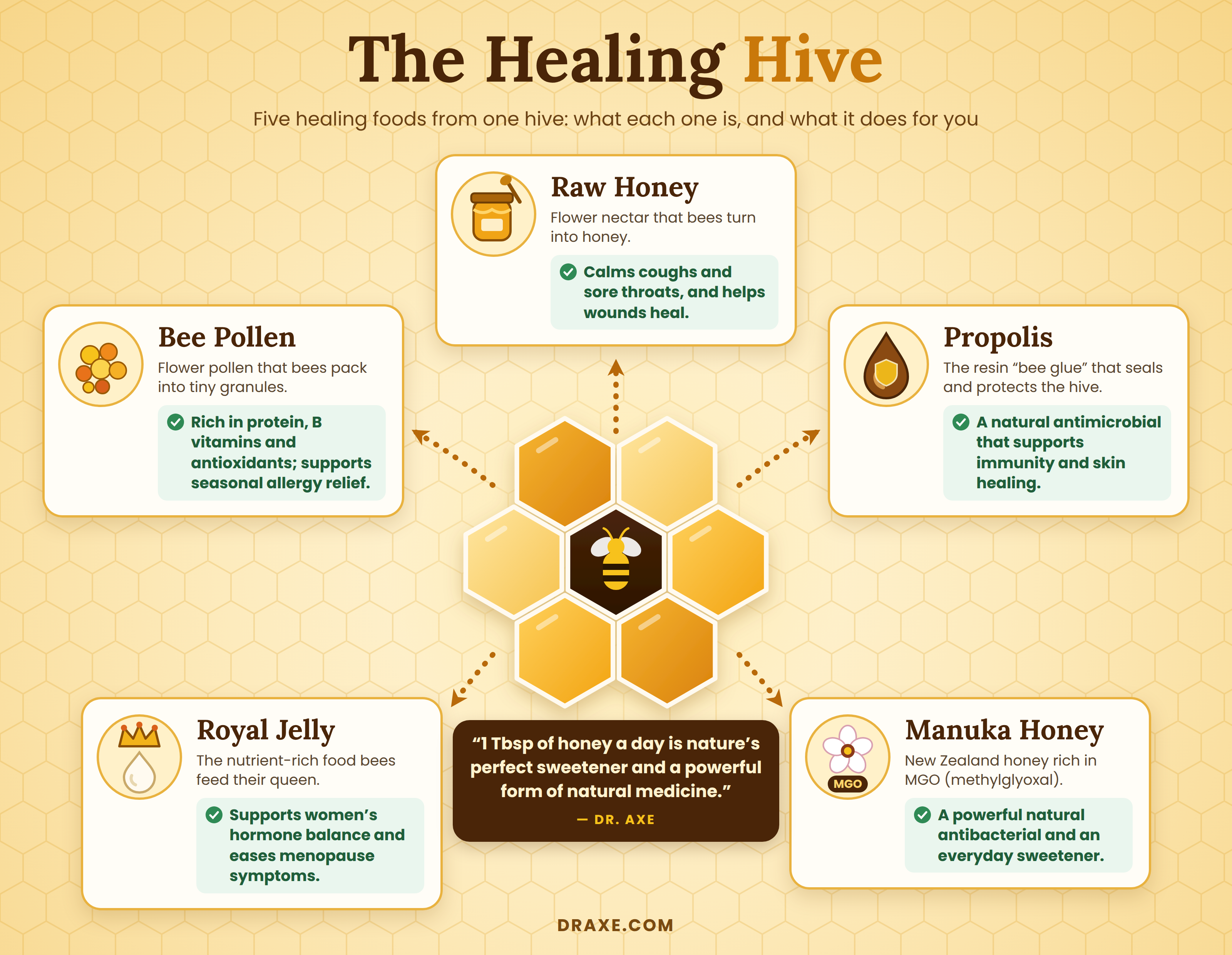
The Healing Hive. Bees make more than honey. Here's what each hive food is, and what it does for you.
What it is: flower pollen that bees pack into tiny granules. Benefit: rich in protein, B vitamins and antioxidants,24 and supports seasonal allergy relief.29 Read the safety section first. See our bee pollen guide.
What it is: the resin "bee glue" that seals and protects the hive. Benefit: a natural antimicrobial that supports immunity and skin healing.56 See our bee propolis guide.
What it is: the nutrient-rich food bees feed their queen. Benefit: supports women's hormone balance and eases menopause symptoms.57 See our royal jelly guide.
What it is: New Zealand honey rich in MGO (methylglyoxal). Benefit: a powerful natural antibacterial and an everyday sweetener.337 See our manuka honey guide.
Since ancient times, honey has served as both food and medicine, including in wound care.84 Scripture treasures it. By a count of the King James text, "honey" appears 56 times and "honeycomb" 9 more, and the words "milk and honey" appear 20 times, first in the promise of "a land flowing with milk and honey" at the burning bush (Exodus 3:8).15 Proverbs 24:13 says, "My son, eat thou honey, because it is good; and the honeycomb, which is sweet to thy taste." John the Baptist lived on "locusts and wild honey" (Matthew 3:4), and when Jonathan dipped the end of his rod in a honeycomb in the middle of a battle and tasted it, "his eyes were enlightened" (1 Samuel 14:27).15
On my show's list of 10 biblical superfoods, raw honey is number 6.10 For more healing foods from Scripture, see the top 10 Bible foods that heal.
One tablespoon of honey (21 grams) has 64 calories and 17.2 grams of sugar, about 8.6 grams of it fructose and 7.5 grams glucose, with no fat and almost no protein or fiber. Its minerals come in small amounts, led by about 11 milligrams of potassium.2
Calculated from USDA FoodData Central FDC ID 169640 (Honey) at the record's tablespoon weight of 21 grams.2
| Nutrient | 1 tablespoon (21 g) | Per 100 g |
|---|---|---|
| Calories | 64 | 304 |
| Carbohydrate | 17.3 g | 82.4 g |
| Total sugars | 17.2 g | 82.1 g |
| Fructose | 8.6 g | 40.9 g |
| Glucose | 7.5 g | 35.8 g |
| Sucrose | 0.19 g | 0.89 g |
| Water | 3.6 g | 17.1 g |
| Fiber | 0.04 g | 0.2 g |
| Protein | 0.06 g | 0.3 g |
| Potassium | 10.9 mg | 52 mg |
| Calcium | 1.3 mg | 6 mg |
| Iron | 0.09 mg | 0.42 mg |
| Vitamin C | 0.1 mg | 0.5 mg |
A tablespoon is mostly energy, with traces of minerals. Where honey separates from refined sugar is in compounds a nutrition label doesn't list: in lab tests of honeys bought at U.S. stores, honey averaged 0.16 millimoles of antioxidant capacity per 100 grams, against 0.009 for refined white sugar and 0.006 for light corn syrup.3
Ranked by evidence, honey is best for healing burns and wounds, easing children's coughs, soothing mouth sores during cancer treatment and raising HDL cholesterol, with newer research on seasonal allergies and gut health.
Wound care is where honey's modern evidence is strongest. In a Cochrane review of 26 trials with 3,011 people, honey dressings healed partial-thickness burns 4.68 days faster than conventional dressings, in 2 trials with 992 people, rated high-quality evidence. In a trial of 50 people, honey also healed infected wounds after surgery more quickly than antiseptic washes and gauze, with fewer side effects.4
A second Cochrane review, of 56 burn trials, found that honey shortened healing by 5.3 days compared with non-antibacterial treatments (4 trials, 1,156 people, high certainty), a group that included amniotic membrane and potato peel dressings. Burns treated with honey also healed at about 2.45 times the rate of burns treated with topical antibiotics (5 trials, 140 people, moderate certainty).16 For diabetic foot ulcers, a 2026 analysis of 16 randomized trials with 1,423 people found that honey dressings more than doubled the odds of complete healing, rated moderate certainty.17
After surgery to repair a torn tendon in my ankle, I put a blend of manuka honey, calendula and essential oils such as helichrysum on the incision, and there's almost no scarring left.7 For a serious burn or a wound that looks infected, see who should be careful below.
Honey dressings healed partial-thickness burns 4.68 days faster
The Biblio Diet notes that generations of grandmothers prepared hot honey drinks to soothe sore throats,14 and for a child aged 1 or older with a cough from a cold, a spoonful of honey has real research behind it. In a Cochrane review of 6 randomized trials with 899 children aged 1 to 18, honey eased how often children coughed by 1.62 points on a 7-point scale more than placebo (2 trials, 402 children) and by 1.05 points more than no treatment (2 trials, 154 children), both rated moderate certainty. It did somewhat better than the antihistamine diphenhydramine (0.57 points, 1 trial, 80 children) and about as well as the cough medicine dextromethorphan (0.07 points, 2 trials, 149 children), both rated low certainty.5
Most of these trials gave a single dose before bed. In one of them, 300 children aged 1 to 5 got 10 grams of honey (about 1½ teaspoons) or a date-syrup placebo, neither the parents nor the researchers knew which, and honey came out ahead on every cough and sleep measure.18 In a randomized Japanese trial of 161 children aged 1 to 5, honey and a honey-flavored syrup eased night coughs about equally,19 and a 2026 analysis of 6 trials in 576 children found that honey relieved coughs about as well as cough medicines.20 Across children and adults with colds and other upper respiratory infections, a review of 14 studies found honey eased overall symptoms more than usual care.21
If you feel a sore throat coming on, manuka is the honey to reach for, and The Biblio Diet advises against cooking with it or stirring it into hot tea.714 The trials enrolled children aged 1 and older, and the safety section below explains why.
Honey eased children's cough frequency more than placebo or no treatment
Chemotherapy and radiation can leave the mouth lined with painful sores, a condition called oral mucositis. In an analysis of 17 randomized trials with 1,265 people in cancer treatment, honey applied in the mouth eased moderate-to-severe mucositis compared with control treatments, with no increase in side effects, and of the honey types tested, pure natural honey ranked best.22
In a University of Toronto meta-analysis of 18 controlled trials with 1,105 people, a median 40 grams of honey a day (about 2 tablespoons) for 8 weeks raised HDL cholesterol by about 2.7 mg/dL (0.07 mmol/L), a result rated high certainty. It also lowered fasting blood sugar by about 3.6 mg/dL, total cholesterol by about 7 mg/dL, LDL cholesterol by about 6 mg/dL, triglycerides by about 11.5 mg/dL and the liver enzyme ALT by 9.75 units per liter (in one trial). Those findings were rated low certainty, and most of the comparisons were with people's usual diet rather than with another sugar.6
A 2022 analysis of 23 trials found no significant change in blood fats,23 and the type of honey matters: raw and clover honey lowered fasting blood sugar, and raw, clover and robinia honeys all lowered total cholesterol and triglycerides, with the raw-honey numbers in the honey-versus-sugar section below.6
Raw local honey is a traditional allergy-season food. My approach to seasonal allergies is simple: 1 teaspoon to 1 tablespoon of raw local honey every day, all year round, plus local bee pollen, and during allergy season, add royal jelly and propolis. It's a food-first approach to natural allergy relief, not a substitute for allergen immunotherapy.72425
Three randomized trials have tested honey for hay fever; the table below sets them side by side. In Malaysia, where everyone took a daily antihistamine for 4 weeks, only the group eating raw honey kept improving through week 8, a month after the honey stopped, though the gap between the groups was too small to rule out chance.26 In Connecticut, a tablespoon a day of local raw honey made no difference to symptoms.27 In Finland, honey with birch pollen added, eaten from November through March, brought a 60% lower symptom score during birch season than usual medication alone, though it didn't differ significantly from regular honey.28 Starting ahead of the season mirrors that trial, which began in November for an April birch season. A 2020 review of the apitherapy literature concluded that a mix of honey and pollen is the best-supported recommendation,29 the same pairing as the approach above. Before you add bee pollen, read the safety section.
| Trial | Who took part | What they ate | What happened |
|---|---|---|---|
Malaysia, 201326 | 40 adults with allergic rhinitis, all on a daily antihistamine for 4 weeks | Raw Tualang honey, 1 g per kg of body weight a day (about 70 g for a 150-pound adult), or a look-alike honey-flavored corn syrup, for 4 weeks; neither the people nor the researchers knew which | Symptom score 17.2 → 11.9 with honey and 16.3 → 13.1 with the syrup by week 8; only the honey group kept improving after week 4, but the week-8 gap could be chance |
Connecticut, 200227 | 36 adults with hay fever | 1 tablespoon a day of local raw honey, pasteurized honey or honey-flavored corn syrup | No difference between the three groups |
Finland, 201128 | 61 adults with birch pollen allergy; 50 finished | Honey with birch pollen added or regular honey, in rising amounts, November through March (44 people), or usual medication only (17 people) | 60% lower symptom score with birch-pollen honey than with medication only; not significantly different from regular honey |
Honey carries small sugar chains called oligosaccharides that your gut bacteria can feed on, the way prebiotics do. In lab tests, honey's oligosaccharides raised bifidobacteria and lactobacilli, two beneficial groups of gut bacteria.30 In a trial of 20 postmenopausal women, funded by the National Honey Board, in which each woman tried both, yogurt sweetened with clover honey (a tablespoon in each of two daily servings) for 4 weeks left IL-33, a signal of inflammation, lower than the same yogurt sweetened with sugar, though IL-23, the main marker the study tracked, didn't change.31
Manuka is my first choice for the gut: with leaky gut, SIBO or IBS, I recommend manuka honey as your only sweetener, if you use one at all.7 Raw manuka honey is also one of the top 10 gut-healing foods in my Healing Leaky Gut protocol.32
Honey's best-understood action happens where it touches tissue. I've made the point on my show that an enzyme in honey called glucose oxidase makes hydrogen peroxide, and that helps heal wounds.10 Here's the chain, step by step, as lab studies have measured it.
Honeybees add glucose oxidase to the nectar they turn into honey.9
Glucose oxidase turns some of honey's glucose into gluconolactone and hydrogen peroxide, though how much peroxide forms varies from one honey to the next.9
Bees also add defensin-1, an antibacterial protein. In lab tests, a medical-grade honey whose activity comes from defensin-1 and hydrogen peroxide killed three kinds of bacteria within 2 hours.33
Manuka honey relies mainly on methylglyoxal instead. In the same lab tests, it killed all four bacteria tested within 24 hours, including methicillin-resistant Staphylococcus aureus (MRSA), and stayed active at higher dilutions.33
Yes. In Dr. Axe's view, honey is a far superior option to cane sugar, though even honey should be used sparingly. Gram for gram it has fewer calories than table sugar and carries antioxidant compounds sugar lacks, and in pooled trials that mostly compared honey with people's usual diet, raw honey lowered fasting blood sugar.23436
Honey does raise blood sugar. It's about 82% sugar by weight, and nearly half of that sugar is glucose, which goes straight into your blood.2 Honey averages a glycemic index of 61, a little below table sugar's 65, and the flower matters: single-flower honeys have tested from about 45 for a Turkish citrus honey to over 70 for several Greek honeys.353637
In a randomized trial funded by the National Honey Board and the USDA, 55 adults, about half of them with impaired glucose tolerance, each ate 50 grams of carbohydrate a day from honey, table sugar and high-fructose corn syrup, 2 weeks apiece. Blood sugar, insulin and body weight responded the same way to all three, and triglycerides rose with all three.38 In type 2 diabetes, 42 adults finished a trial in which each person spent 8 weeks adding 50 grams of honey a day (about 2½ tablespoons) to a weight-maintenance diet and 8 weeks on the diet alone. HbA1c, a three-month blood sugar average, rose 0.17 percentage points with honey and fell 0.22 without it, while waist size shrank with honey.39
The type of honey changes the picture. In the University of Toronto analysis, where most comparisons were with people's usual diet, raw honey lowered fasting blood sugar by about 19 mg/dL (1.05 mmol/L) across 5 trials with 174 people, rated low certainty, and lowered total cholesterol and triglycerides too. Processed honey, across 7 trials with 150 people, had no effect on fasting blood sugar (a change of 0.03 mmol/L, rated high certainty) and raised blood pressure by 3.78/2.26 mmHg (moderate certainty).6 As I said on my show, "The benefits came from raw and single-flower honeys. Processed honey did not deliver the same results."10 In this analysis, the single-flower honeys behind those results were clover and robinia.6
Raw honey lowered fasting blood sugar; processed honey had no effect
Amount matters too. In the University of Toronto analysis, honey didn't change systolic blood pressure overall, but each extra 10 grams a day lowered it by 0.72 points, a result rated high certainty.6 A 2025 updated meta-analysis that included 16 honey trials found the opposite: systolic blood pressure 4.24 points higher with honey, rated moderate certainty, rising by about 2 points for each daily tablespoon. The same analysis found HbA1c fell most at about 10 grams a day, half a tablespoon, and its authors suggest that amount in place of simple sugars; honey's overall HbA1c drop was rated very low certainty.40 Heal Your Cells puts the principle this way: "As a carbohydrate, honey teaches us that context matters: Sugar in isolation is harmful, but sugar packaged in a matrix of antioxidants and enzymes can be healing."41
With diabetes or prediabetes, keep honey to small amounts in place of other sweeteners and build meals around low-glycemic foods; if you take insulin or other glucose-lowering medication, see the safety section.
| Measure | Honey | Table sugar |
|---|---|---|
Calories per 100 g | 3042 | 38734 |
One tablespoon | 21 g: 64 calories, 17.2 g sugar | 12.6 g: 49 calories, 12.6 g sugar |
The swap | For 1 tablespoon of sugar: 49 calories, 12.6 g sugar | |
Main sugars | Fructose and glucose, as separate sugars | Sucrose: glucose and fructose joined together |
Antioxidant capacity per 100 g | 0.16 mmol (store-bought honeys)3 | 0.009 mmol3 |
Average glycemic index | 61 | 6535 |
Dr. Axe Score | 5.7 | 2.9 (cane sugar) |
HbA1c reflects a three-month average;42 fasting insulin and triglycerides are snapshots from the same draw. Targets are Dr. Axe's functional ranges. These markers show how your body handles sugar overall; they can't show how any one food, honey included, affects you.
See the cellular bloodwork panel
Have results? Analyze them free → →Buy raw local honey or manuka for everyday use; manuka is also the one to reach for when you want a natural antibacterial.755 Raw honey hasn't been heated or finely filtered, so it keeps its enzymes, pollen and plant compounds. Most honey sold today has been heated and filtered, and too much heat can destroy honey's natural enzymes and plant compounds.14
In 2011, Food Safety News had Vaughn Bryant, a pollen expert at Texas A&M University, test more than 60 honey products bought in 10 states and Washington, D.C. All of the pollen had been filtered out of 76% of the samples from grocery stores, 77% from big-box stores and every sample from drugstores and single-serve packets. Every sample bought at farmers markets, co-ops and natural food stores still had its full amount of pollen.43
Avoid commercially pasteurized, ultra-filtered honey. When I talked about those honeys on my show, I put it simply: "Just stay away from those. Once honey is ultra-filtered and pasteurized, it's a lot closer to plain sugar."7 The pooled trials in the honey-versus-sugar section point the same way.6
Raw and unheated. Choose opaque raw honey, produced locally and sold in its unheated form.14
Local, from someone you can ask. A farmers market or local beekeeper is the easiest source; raw local honey from my farmers market is the honey I eat most.7
Manuka with a tested rating. Choose manuka honey labeled with a high methylglyoxal rating, and lab-tested whenever possible.7
Honey and nothing else. Under FDA labeling guidance, a product that blends honey with added sweeteners can't be labeled simply as honey, so read the ingredient list.44
In lab tests, warming raw honey to 113 or 131 °F (45 or 55 °C) left its antibacterial activity intact, while microwaving wiped it out by destroying glucose oxidase and defensin-1.45 Stir raw local honey into warm drinks rather than boiling ones, and soften a crystallized jar in a bowl of warm water instead of the microwave.
Dr. Axe recommends 1 teaspoon to 1 tablespoon of raw local honey a day, plus local bee pollen, in place of other sweeteners rather than on top of them, as Proverbs 25:16 counsels. It's the same amount he uses for seasonal allergies, every day, all year; read the safety section before adding bee pollen.71524
There's no official daily amount for honey, so the guide is to use it sparingly. With honey, you want to eat it, but not too much.10 My daily amount is 1 teaspoon to 1 tablespoon of raw local honey, plus local bee pollen,724 and in the 2025 analysis in the honey-versus-sugar section, HbA1c fell most at about 10 grams a day, roughly 1½ teaspoons, toward the low end of that range.40 Scripture gives the same counsel: "Hast thou found honey? eat so much as is sufficient for thee, lest thou be filled therewith, and vomit it" (Proverbs 25:16), and "It is not good to eat much honey" (Proverbs 25:27).15 In The Biblio Diet, Jordan Rubin and I point out that our biblical ancestors used raw, wild honey as a treat.14
The benefits come when honey replaces other sweeteners. Take the other sweeteners out of your diet, including the hidden sugar in packaged foods, and let honey be your dominant sweetener; piling honey on top of maple syrup, coconut sugar and cane sugar only adds to the sugar load.7 In recipes that don't need heat, use about 2 teaspoons of raw local honey for each tablespoon of sugar.14 After honey, monk fruit, stevia and allulose are the next best sugar substitutes.1
Ask Dr. Axe AI. Answers are grounded in this library, with sources shown.
Honey is a safe everyday food for most people over the age of 1. Babies and people with bee-product allergies need firm rules, set out below.
Babies under 12 months: Never give honey, raw or cooked, or foods made with it. Honey can carry spores of the bacteria behind infant botulism: in one study, 9 of 90 honey samples carried them, and the spores also turn up in household dust and soil. Honey is the only food confirmed again and again as a source.46474849
Asthma or a past severe reaction to pollen, bee stings or bee products: If you have asthma, or you've ever had hives, swelling or trouble breathing from pollen, bee stings or bee products, skip bee pollen, and don't assume honey, royal jelly or propolis are safe for you either. In a study that tested honey on 46 people with pollen allergies, honey allergy proved rare,50 but honey carries proteins from the bees as well as pollen, and severe reactions have been reported.5152
Hay fever and bee pollen: If you have hay fever, you're the person most likely to react to bee pollen, and there's no proven safe way to start it at home, so make that decision with a practitioner who knows your allergy history.24
Warfarin, pregnancy or breastfeeding, and bee pollen: If you take warfarin, skip bee pollen. It hasn't been studied in pregnancy or breastfeeding, so I recommend skipping it during those times.24
Everyone else adding bee pollen: Start with a few granules with food, then eat food amounts. Stop at any itching, swelling, hives or wheezing, and get emergency help for any trouble breathing.24
Insulin or other glucose-lowering medication: Count honey as sugar and check your readings when you change how much you eat; your doctor adjusts the dose.
Hereditary fructose intolerance: Avoid honey entirely. This rare inherited condition rules out fructose, and about half of honey's sugar is fructose.532
A Candida cleanse: Honey comes out during the 14-day starve phase of my Candida Cleanse protocol.54
Serious burns and deep or infected wounds: These need prompt medical care.
If you're going to use a sweetener, honey should be your number-one sweetener, and raw local honey brings what refined sugar can't: enzymes from the bees, traces of pollen and antioxidant compounds. People have trusted honey on wounds and sore throats for generations, and modern trials on burns, wounds and children's coughs line up with that long record.
Buy raw local honey or manuka for everyday use, with manuka doubling as a natural antibacterial, skip the ultra-filtered kind, and keep to 1 teaspoon to 1 tablespoon a day, in place of other sweeteners, the way Proverbs advises. Babies and anyone with a bee-product allergy have firm rules; see who should be careful.
Your body knows how to heal, and trading refined sugar for a little raw honey is one simple way to give it better material to work with.
The 6R roadmap, the foods that heal, with raw manuka honey among the top 10, and a 7-day meal plan. Have recent bloodwork? Analyze it free.
Free with your Dr. Axe account (email or Google). You'll also get the protocol's short email series and the Dr. Axe newsletter; unsubscribe anytime.
Open the free protocol → →Yes. Dr. Axe considers honey a far superior option to cane sugar, though even honey should be used sparingly. In lab tests of store-bought honeys, honey averaged 0.16 millimoles of antioxidant capacity per 100 grams against 0.009 for refined sugar,3 and in pooled trials that mostly compared honey with people's usual diet, raw honey lowered fasting blood sugar by about 19 mg/dL.6
Yes. Honey is about 82% sugar, and in a trial in which 55 adults each tried honey, table sugar and high-fructose corn syrup for 2 weeks, blood sugar and insulin responded the same way to all three.238 Raw honey did better than processed honey in pooled trials, lowering fasting blood sugar where processed honey had no effect.6 Dr. Axe's rule with honey: eat it, but not too much.10
Yes, in small amounts, in place of other sweeteners. In a trial of 42 adults with type 2 diabetes in which each person tried both, 50 grams of honey a day for 8 weeks shrank waist size, though HbA1c rose 0.17 percentage points while the diet alone lowered it by 0.22.39 On glucose-lowering medication, see the safety section.
For antibacterial uses, yes, and it's an excellent everyday sweetener too. Dr. Axe calls manuka by far the best honey as a sweetener and reaches for it as a therapy when you want a natural antibacterial, such as for a sore throat,755 and in lab tests manuka stayed antibacterial at higher dilutions than another medical-grade honey, killing all four bacteria tested within 24 hours, including MRSA.33
Dr. Axe recommends it for seasonal allergies: 1 teaspoon to 1 tablespoon of raw local honey every day, all year, together with local bee pollen,72425 and in a randomized Malaysian trial of 40 adults with allergic rhinitis, only the honey group kept improving through week 8.26 Before adding bee pollen, see the safety section.
Dr. Axe recommends 1 teaspoon to 1 tablespoon of raw local honey a day, plus local bee pollen, in place of other sweeteners rather than on top of them, as Proverbs 25:16 counsels.71524 In a 2025 analysis of honey trials, HbA1c fell most at about 10 grams a day, roughly 1½ teaspoons.40 Before adding bee pollen, see the safety section.
Microwaving can: in lab tests, it wiped out raw honey's antibacterial activity, while gentle warming to 113 or 131 °F left that activity intact.45
October 6, 2026 — Rebuilt the page to the current DrAxe.com standard under Dr. Axe's byline. Added the Dr. Axe Score with its math; benefits ranked by evidence, led by Cochrane reviews on burns, wounds and children's coughs; the raw-versus-processed results from a meta-analysis of 18 trials, with a chart; nutrition facts rebuilt from USDA FoodData Central at a one-tablespoon serving; a honey-versus-sugar comparison; Dr. Axe's approach to seasonal allergies; the King James verses on honey; and one safety section.
October 7, 2026 (second update) — Added The Biblio Diet's manuka guidance (especially valuable as a therapy; not for cooking or hot drinks), attributed to the book; matched the biblical-superfoods ranking to the episode it comes from; set Dr. Axe's daily amount at 1 teaspoon to 1 tablespoon of raw local honey, plus local bee pollen, in the summary, quick facts, allergy section, how-much section, bottom line and both FAQ copies, beside the 2025 analysis's 10-gram finding; added the big-box and farmers-market results from the 2011 pollen investigation; moved the three hay fever trials into a table with the Malaysian trial's symptom scores from its results table, and shortened the allergy card; added the episode transcript timestamps to its reference; described manuka as both an everyday sweetener and a therapy, from Dr. Axe's 2024 and October 2025 honey episodes, in the summary, quick facts, buying guide, bottom line and both FAQ copies; added the age (1 or older) to the cough recommendation; noted what the bloodwork markers can't show; tightened Dr. Axe's two buying quotes so neither opens with a filler word or overstates what processed honey loses; added "The Healing Hive," a visual showing what raw honey, bee pollen, propolis, royal jelly and manuka honey (MGO) are and what each does, with two new references; added in-text links to related DrAxe.com guides on allergy relief, prebiotics, low-glycemic foods, hidden sugar, sugar substitutes, superfoods, turmeric tea and cinnamon; updated the read time.

This article is for educational purposes. See our medical disclaimer.