Advertisement
Beef knuckles, marrow bones, oxtail and short ribs, roasted and then simmered for 24 to 36 hours with vegetables, herbs and apple cider vinegar: how to make it on the stovetop or in a slow cooker, what it does for your gut lining and joints, and how much to drink.
By Dr. Josh Axe, DC, DNM, CNS ·
Jump to recipe ↓
Why it works: Beef knuckles, marrow bones, oxtail and short ribs are roasted, then simmered for a day or more with vegetables, herbs and a splash of apple cider vinegar until the broth turns rich with gelatin, glycine and proline. Dr. Axe recommends it as a daily food for your gut lining and joints, and it makes a deep, savory base for soups, stews and pho.
For a quicker batch that's gentler if long-simmered broth bothers you, cook the bones in a pressure cooker for 1 to 2 hours and leave out the vinegar (see the pressure cooker section).
Ask your butcher to cut the bones into smaller pieces, which helps them give up more of their collagen.
Blanching and roasting add about 1 hour and 10 minutes before the long simmer begins.
A broth that sets like jelly in the refrigerator is full of gelatin.
Bring stored broth to a rolling boil when you reheat it.
How much to drink A cup most days is a good daily amount, and Dr. Axe's Healing Leaky Gut Protocol calls for 8 to 16 ounces a day, ideally 16, while you're healing your gut.
Beef bone broth is a slow-simmered broth of beef knuckles, marrow bones, oxtail and short ribs, cooked for 24 to 36 hours with vegetables, herbs and apple cider vinegar until it's rich with gelatin.12 I recommend it as one of the best foods for your gut lining and your joints, because it carries the glycine, proline and collagen your gut lining is built from.34
Beef bone broth is a rich, slow-simmered broth made from beef knuckles, marrow bones and collagen-rich cuts like oxtail and short ribs, cooked for 24 to 36 hours with vegetables, herbs and a splash of apple cider vinegar until the liquid turns savory and full of gelatin. I recommend it as one of the best foods you can eat for your gut lining and your joints, a cup most days and 8 to 16 ounces a day, ideally 16, while you're healing your gut.475
Bone broth works because it's rich in glycine, proline and hydroxyproline, the same amino acids your gut lining is made of.3 When that lining is worn and irritated, my first step is food that gives your body the materials it uses to rebuild, which is why bone broth is the first of the foods that heal in my Healing Leaky Gut Protocol.5 Back around 2016, I started using bone broth and collagen with patients to help them heal from chronic digestive issues.8 This beef version, with its deep flavor and its oxtail and short ribs, is one of the easiest ways to keep broth in your week, especially through the colder months, when a pot can simmer away over a weekend and fill your freezer.
30-day protocol
Rebuild the gut lining and microbiome: the remove–replace–repair sequence, foods, supplements and the labs that confirm progress.
Free with your Dr. Axe account
View the protocol →
One of the best things to do when it comes to healing a leaky gut is doing a lot of soups, like a classic chicken vegetable soup or a beef stew.Dr. Josh Axe, DC, DNM, CNSFrom Complete Guide to Healing Leaky Gut Naturally, The Dr. Josh Axe Show (2026)
Bone broth is the first of the foods that heal in my free 30-day Healing Leaky Gut Protocol. Inside:
Free with your Dr. Axe account (email or Google). You'll also get the protocol's short email series and the Dr. Axe newsletter; unsubscribe anytime.
Open the free protocol →Beef bone broth is a broth made by simmering beef bones, knuckles and collagen-rich cuts like oxtail and short ribs in water for 24 to 36 hours, long enough to draw out their gelatin, amino acids and minerals.19 It's the same idea as a beef stock, cooked much longer, and it often sets like jelly when it's chilled.
Stock and bone broth start with the same bones, vegetables and herbs, and the biggest difference is time. A long simmer gives the collagen in the bones and joints time to break down into gelatin and amino acids, and broth made this way was a staple for our ancestors, who used every part of an animal, until it almost disappeared from the modern diet.2 Beef bones are big and dense, and in a lab study, bones simmered for more than 8 hours gave up significantly more calcium and magnesium than shorter simmers, which is one reason this recipe gives them a full day or more.9
I recommend both chicken and beef bone broth, and I count bone broth, whether it comes from beef, chicken or lamb, among the most nutritious foods you can eat, rich in collagen and gelatin, good for your joints and friendly on your gut.1011 Beef and chicken broth both bring naturally occurring glucosamine and chondroitin along with their collagen,11 chicken broth also carries hyaluronic acid,12 and beef broth earns its own place in your kitchen as the richer, deeper base for dishes like pho and beef stew.
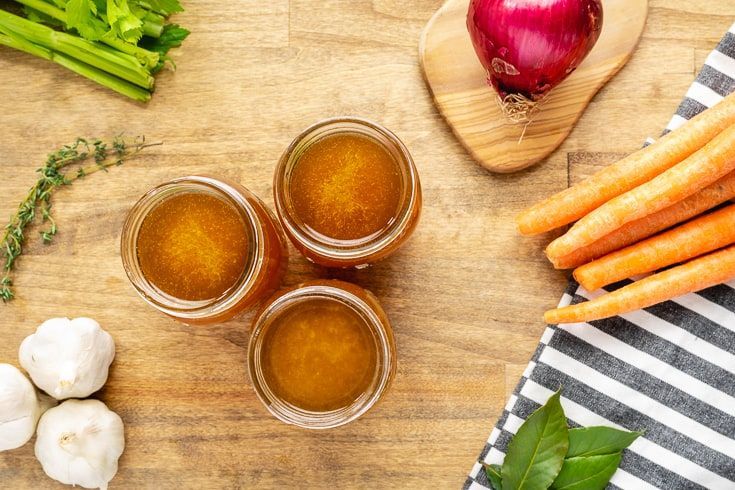
Beef bone broth is good for your gut lining and your joints, because it brings gelatin, collagen and amino acids like glycine and proline, the materials both are built from.13 It's easy to digest, and in Chinese medicine, bone broth nourishes the kidneys and adrenals.610
Bone broth has been used for thousands of years for health, for immunity and for longevity, and it naturally contains collagen along with minerals and other beneficial compounds.12 A mug of beef bone broth brings them to your gut lining, your joints and skin, and, in Chinese medicine, your kidneys and adrenals.
Your gut lining. It's one of the easiest foods to digest, which is why it's the number one food I recommend for most people while they're repairing the gut,6 and it feeds that lining the glycine, glutamine and collagen it rebuilds from.5
Your joints and skin. The long cooking releases collagen from the bones and connective tissue, along with its amino acids proline, hydroxyproline, glycine and glutamine, which help preserve youthful skin and joints.2 The joint research on collagen is encouraging: in a 2024 review of 35 randomized trials with 3,165 people with osteoarthritis, collagen products eased pain and improved joint function compared with control groups, without raising side effects, and the reviewers rated the evidence for better function as high certainty.13 Those trials used collagen products rather than broth, and in your pot, that collagen comes from the knucklebones, oxtail and short ribs and ends up in the broth as gelatin.
Warmth and nourishment in Chinese medicine. In Chinese medicine, bone broth is very nourishing to the adrenals and the kidneys. When someone with a low thyroid tends to run cold, I recommend warming the body with soups and cooked meats, and the first food on that list is bone broth, chicken and beef alike.10
In Chinese medicine for women, it's a lot of blood-building foods. It's beets, it's dates, it's beef bone broth.Dr. Josh Axe, DC, DNM, CNSFrom Why Men and Women Shouldn't Eat the Same Way, The Dr. Josh Axe Show (2025)
For more on what bone broth can do for you, from sleep and skin to hydration, see our guide to bone broth benefits.
Beef bone broth supports gut health by feeding your gut lining the glycine, proline and gelatin it's built from, in a warm, soft food your gut handles easily.35
There's a principle in Chinese medicine that like supports like, so a food made of the same materials as an organ is the food that supports it, much as eating muscle meat gives you the right amino acids to build muscle.3 When you drink bone broth, you're getting the amino acids your gut is made of, and that's why it's the number one food I recommend for healing a leaky gut.3 My protocol adds a second principle from Chinese medicine: a healing gut prefers warm, cooked, soft foods over raw, cold or fibrous ones, and a mug of broth fits that description well.5
Modern research is starting to explain what traditional medicine saw. A 2025 review by Mayo Clinic researchers, drawing on animal and human studies of broth's nutrients, found that its glutamine, glycine, proline, histidine, arginine and minerals support the gut barrier, the lining that decides what passes from your gut into your body, especially in inflammatory bowel disease.14 In a study in mice, researchers simmered beef femur bones for 8 hours and let the mice drink the broth freely for 10 days before triggering colitis. Among the mice given colitis, six in each group, those that had the broth showed less damage to the colon: gene activity fell by 94.70% for IL-6 and 68.88% for TNF-alpha, two proteins that drive inflammation, while activity for IL-10, a protein that calms inflammation, rose by 531.97%.15
Collagen in the knuckles, oxtail and bone breaks down into gelatin, and glycine, alanine and proline lead the amino acids in a beef bone broth.21
Glycine, glutamine and collagen are the building blocks of new gut lining in the Healing Leaky Gut Protocol, and a Mayo Clinic review ties broth's amino acids to a stronger gut barrier.514
In mice with induced colitis, a beef femur broth given beforehand meant less colon damage and 94.70% lower IL-6 gene activity.15
Collagen products eased osteoarthritis pain and improved joint function in a review of 35 randomized trials.13
If you're not sure how your gut is doing, the Gut Health Quiz is a quick place to start, and a daily mug of this broth is one of the simplest first steps you can take.
Blanch 5 pounds of beef bones for 20 minutes, roast them with the vegetables and garlic at 450 °F for about 50 minutes, then cover everything with cold water, add the herbs, peppercorns, salt and apple cider vinegar, and simmer on low for 24 to 36 hours before you strain and chill it. It makes about 20 cups.
Marrow bones bring richness, while the collagen comes mainly from the dense bone and the joints and connective tissue of knucklebones, oxtail and short ribs, so a pot with some of each gives you both.95 Oxtail and short ribs are the collagen-rich cuts my Healing Leaky Gut Protocol tells you to eat freely,5 and they matter because most people eat almost nothing but muscle meat, even though nearly a third of your body's protein is collagen.16 Ask your butcher to cut the bones into smaller pieces too, since in the lab, beef bone pieces 4 centimeters (about 1½ inches) or smaller released more protein and collagen into the broth than bigger chunks.1
The meat that falls off the oxtail and short ribs is good eating, in a soup, in a sandwich or on its own, so this is a red-meat recipe as well as a broth. The World Health Organization's cancer agency classifies processed meat of every kind, processed beef included, as a Group 1 carcinogen and red meat itself as Group 2A, probably carcinogenic.17 As I've said on my show, the studies that link red meat to poor health mostly reflect grain-fed and processed meat, not the fresh, grass-fed red meat I recommend.18 So choose fresh bones and cuts from pasture-raised cattle, the same grass-fed beef I recommend for your table.
The ¼ cup of apple cider vinegar has a job to do, because acid helps pull minerals out of bone. In a lab test on leg bones (from pigs, in that study), simmering them in water with 20 milliliters of table vinegar per liter drew out 17.4 times as much calcium and 15.3 times as much magnesium as plain water.9 This recipe uses a little less vinegar per liter than that, and while the minerals in a serving of broth stay modest even with vinegar, the vinegar helps you get more out of every bone in the pot.9
Both work well. A slow cooker is the easiest, since it can run on low through the night, and if yours shuts off after 12 hours, you simply restart the cycle as soon as it ends, two or three times in all, so the broth stays hot. On the stovetop, keep the pot at a gentle simmer with the lid slightly ajar, and never leave the burner on overnight. Take the pot off the heat in the evening, chill it and refrigerate it, then bring it back to a boil the next morning and lower it to a gentle simmer again.
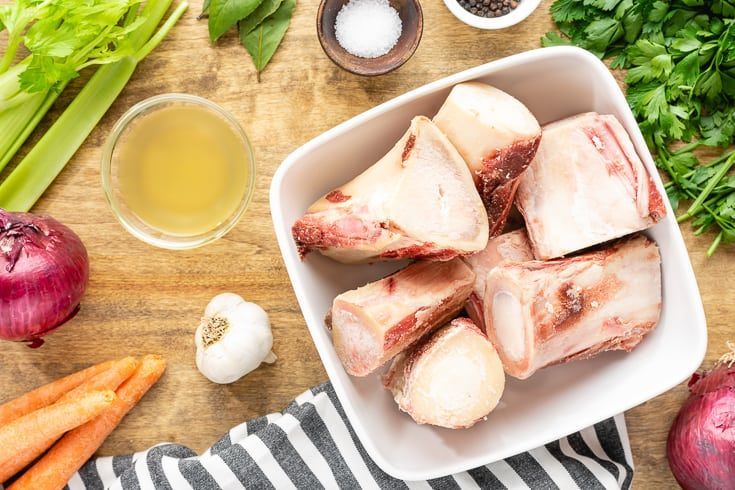
Begin by heating the oven to 450 °F. While it heats, blanch the bones: put them in a large stockpot, cover them with cold water, bring it to a boil and simmer for 20 minutes, then drain the bones and rinse them with cold water. Blanching clears away blood and surface impurities, which gives you a cleaner, clearer broth.1
Spread the bones, vegetables and garlic in a roasting pan without piling them on top of each other, using two pans if you need to. Roast them for 30 minutes, turn everything over and roast for 20 minutes more. Then put the roasted bones and vegetables in a 10-quart slow cooker or a large stockpot with the herbs, peppercorns, sea salt and vinegar.
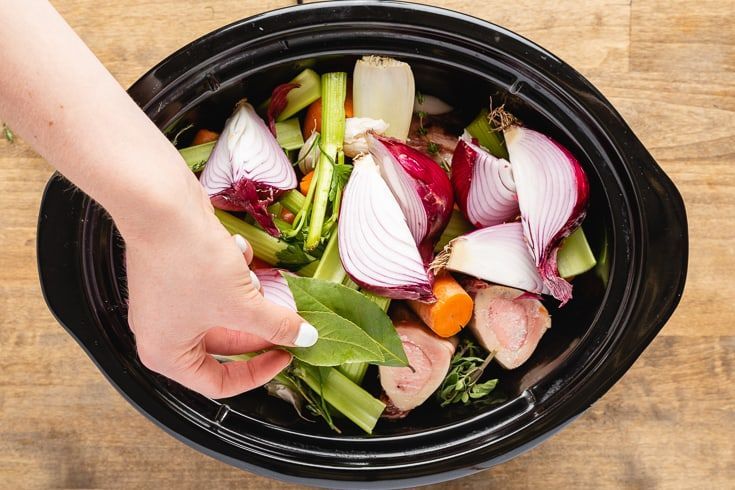
Add cold water until everything is submerged by about an inch. Set the slow cooker on low, or bring the covered stockpot to a boil over high heat and then turn it down to a gentle simmer with the lid slightly ajar. Skim off the fat that rises to the surface now and then, and let the broth cook for 24 to 36 hours.
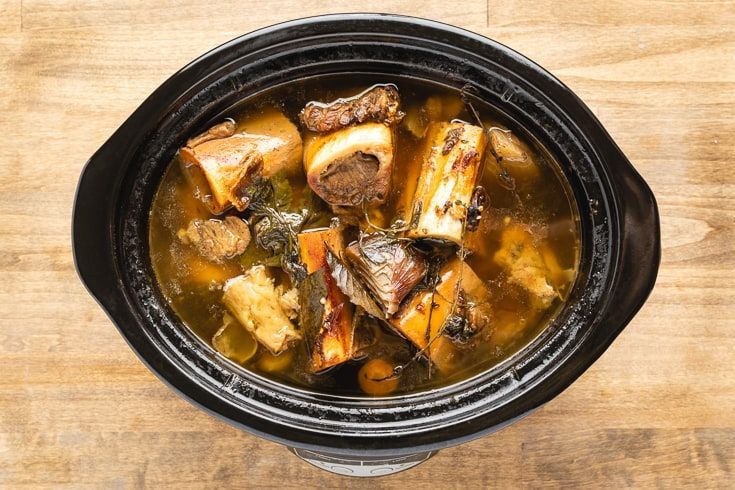
When it's done, take the pot off the heat and let it cool slightly. Pull out any meat to use in soups or sandwiches, or to eat on its own, then discard the bones and vegetables and strain the broth through a colander into a large bowl.
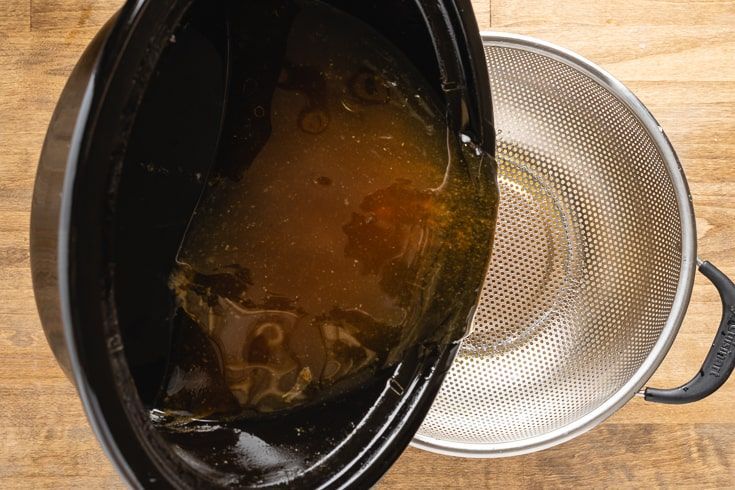
Cool the strained broth quickly and refrigerate it, as the recipe card describes. After a few hours in the refrigerator, the fat hardens into a layer on top, and you can lift it off with a spoon or fork. Underneath, a well-made beef bone broth often sets like a soft jelly, and it turns back into a rich liquid as soon as you warm it.
If you'd like broth the same day, a pressure cooker works too. The short version I recommend is just an hour or two under pressure, with the vinegar left out, and it's also the version I suggest if long-simmered broth bothers you, as the safety section explains.6 Pressure speeds the extraction a great deal. In a lab study of beef bones cooked under pressure at 115 °C, the broth already held nearly two-thirds of its peak protein after just 1 hour: 1,344 milligrams of total nitrogen, a measure of protein, per liter, against 2,095 at the 4-hour peak.1
A cup (8 ounces) most days is a good everyday amount, and while you're healing your gut, my Healing Leaky Gut Protocol calls for 8 to 16 ounces a day, ideally 16.745 One 1.5-cup serving of this recipe is 12 ounces, right in that range.
Bone broth does the most for you as a daily food rather than an occasional one. In my Anti-Inflammatory Reset, it's a cup a day for the gut lining and joints, and in the Mitochondrial Longevity Protocol, it's 8 ounces most days.47 My gut protocol goes further while you're healing, with 8 to 16 ounces every day and ideally 16 in the repair step, which works out to one or two mugs.5
The time of day is up to you, and the evening is a good choice. Glycine is an amino acid I recommend for calming the body, and since broth is a good food source of it, a warm mug in the evening can help you improve your sleep.191
A good option is to do bone broth in the evening. Chicken broth or beef broth are great as well.Dr. Josh Axe, DC, DNM, CNSFrom The Truth About Cortisol Face and The Exact Steps To Fix It, The Dr. Josh Axe Show (2026)
Some people take it further with a bone broth fast. When I started writing about bone broth, I had patients start doing one, drinking only bone broth and herbal tea along with a form of intermittent fasting.8 Our guide to the bone broth fast explains how to do one. On busy weeks, a good store-bought bone broth or a protein powder made from bone broth can fill in for a homemade batch.
You can drink beef bone broth straight from a mug, and it's just as useful in the kitchen. Soups are the ideal meal while you heal a leaky gut,3 my gut protocol's meal plan builds several meals around broth,5 and here are some of the best ways to use a batch:
For chicken dishes like gumbo or a chile verde, reach for this chicken bone broth recipe, and you'll find more ideas in our roundup of bone broth recipes.
The nutrition in bone broth changes from batch to batch with the bones you use, how long you simmer them, how much fat you skim and how much salt you add. USDA has no record for bone broth itself, so the numbers below come from its record for home-prepared beef stock, the closest match, for one 1.5-cup serving (360 grams):20
| Nutrient | Per 1.5 cups (360 g) |
|---|---|
| Calories | 47 |
| Protein | 7.1 g |
| Fat | 0.3 g |
| Carbohydrates | 4.3 g |
| Total sugars | 1.9 g |
| Fiber | 0 g |
| Sodium | 713 mg (31% DV) |
| Potassium | 666 mg (14% DV) |
| Magnesium | 25 mg (6% DV) |
| Calcium | 29 mg (2% DV) |
| Iron | 0.97 mg (5% DV) |
It's a light, savory food, with a little carbohydrate and sugar from the vegetables, very little fat and a good amount of potassium. The sodium in the table reflects USDA's sample, and your own pot's sodium depends mostly on how much salt you add, as the safety section explains.
USDA doesn't measure amino acids in its stock record, but a lab study did for a beef bone broth made from fresh beef bones pressure-simmered for 4 hours and then concentrated to one-fifth of its volume, and glycine led the list, followed by alanine and proline:1
| Amino acid (total) | mg per 100 mL of concentrated broth |
|---|---|
| Glycine | 638.31 |
| Alanine | 558.26 |
| Proline | 483.24 |
| Glutamic acid | 208.28 |
| Aspartic acid | 208.12 |
| All 17 amino acids measured | 3,010.31 |
Glycine, alanine and proline lead the amino acids in a beef bone broth
Those are figures for the concentrate, so they show which amino acids lead in a beef bone broth, not how much a mug holds.1 In an Australian lab analysis, bone broths made at home to a standard recipe came out higher in all six amino acids measured than store-bought ones.21
For most people, beef bone broth is simply food. People who react to histamine or to free glutamate, and anyone with a red-meat allergy, need a different approach, and a big pot needs to be cooled and stored with care.
Histamine. Some people with histamine intolerance don't do well with bone broth, because broth cooked a long time or with a lot of vinegar carries more histamine.6 If that's you, make the short pressure-cooker version with no vinegar, which most everyone tolerates, even people with histamine problems or SIBO, or use a chicken stock or a protein powder made from bone broth.6
Glutamate. Broth also contains glutamate, the compound that gives MSG its savory taste, and some people react to it in its free form. In a placebo-controlled trial of 61 adults who believed they were sensitive to MSG, run so that neither the people nor the researchers knew who got what, symptoms after 5 grams of MSG were more severe than after a placebo, and on retesting, reactions began at about 2.5 grams.22 In a lab-made beef broth, even after it was concentrated to one-fifth of its volume, only about 9 milligrams per 100 milliliters was free glutamic acid, because most of it stayed bound in protein, though that broth simmered for 4 hours and a day-long pot may differ.1 If you're sensitive, start with a small mug, and when you buy broth, check the label for flavor enhancers such as yeast extract and hydrolyzed protein.11
Red-meat allergy. If you're allergic to red meat, make chicken or fish broth instead. In an Australian allergy clinic, 30 of 40 people with a red-meat allergy also tested positive to gelatin, and alpha-gal, a sugar tied to red-meat allergy, was found in bovine gelatin itself.23
Sodium. USDA's sample of home-prepared beef stock carries 713 milligrams of sodium per 1.5 cups, while the ½ teaspoon of sea salt in this recipe adds about 87 milligrams a serving.2024 Season each mug to taste with unrefined sea salt, and if you're watching your sodium, check the label on store-bought broth.
Cooling and storage. A big pot of broth takes a long time to cool, so chill it quickly in a sink of ice water or in shallow containers, and get it into the refrigerator within 2 hours.25 Use it within 3 to 4 days, freeze it for up to 3 months, and bring it to a rolling boil when you reheat it.2526
Lead. If you've wondered about lead, the numbers for beef are reassuring: UK government testing found little evidence that lead moved from bone into beef stock, and six commercial beef noodle broths averaged about 1.6 micrograms of lead per serving.279
Yes. Beef bone broth is one of the most nourishing foods you can make at home, and it's the first food I recommend when you're healing your gut. A day-long simmer turns knuckles, marrow bones, oxtail and short ribs into a broth rich in gelatin, glycine and proline, the materials your gut lining is built from, and the collagen research on joints points the same way.
Blanch and roast the bones, simmer them for 24 to 36 hours, then strain, chill and skim. Drink a cup most days, or 8 to 16 ounces a day while you're healing your gut, and use the rest for stews, pho and soups. Your body was designed to heal, and a warm mug of broth gives it the building blocks to do it.
The 6R roadmap, the foods that heal with bone broth first, and a 7-day meal plan built around broth, soups and gentle, cooked foods.
Free with your Dr. Axe account (email or Google). You'll also get the protocol's short email series and the Dr. Axe newsletter; unsubscribe anytime.
Open the free protocol →A 1.5-cup serving has about 47 calories, with 7.1 grams of protein, 0.3 grams of fat and 4.3 grams of carbohydrate, based on USDA's record for home-prepared beef stock.20 The exact numbers vary with your bones, how long you simmer them and how much fat you skim.
Yes. It's the first of the foods that heal in my Healing Leaky Gut Protocol, because it brings glycine, glutamine and collagen, the building blocks of new gut lining, in a warm food that's easy to digest.56 In a study in mice, a beef bone broth given for 10 days before colitis was triggered meant less colon damage and 94.70% lower IL-6 gene activity than in mice given colitis without the broth.15
Simmer it for 24 to 36 hours, on low in a slow cooker or at a gentle simmer on the stovetop, so the dense beef bones have time to give up their collagen and minerals. In a lab study of animal leg and rib bones simmered for up to 12 hours, cooking longer than 8 hours drew out significantly more calcium and magnesium.9 In a pressure cooker, an hour or two is enough for the short version I recommend.6
Yes. Cook the bones under pressure for an hour or two, and leave out the vinegar if long-simmered broth bothers you; that short version is one most everyone tolerates, even people with histamine problems or SIBO.6 In a lab study of beef bones cooked under pressure at 115 °C, the broth reached its peak of protein and collagen at about 4 hours.1
A broth that stays liquid in the refrigerator has less gelatin, which usually means fewer knucklebones, oxtail and other collagen-rich pieces in the pot, or a lot of water for the bones. Very long cooking can soften a gel too: in a lab study of a concentrated commercial beef stock held at 90 °C for up to 168 hours, gel strength fell steadily the longer it was heated.29 Next time, add more knuckles and joints, keep the water just covering the bones and stop at 36 hours.
Yes. Skim the fat that rises while it cooks, then lift off the hardened layer after the broth has chilled for a few hours. That leaves a lean broth, about 0.3 grams of fat per 1.5 cups in USDA's beef stock record.20
Yes. In USDA's beef stock record, a 1.5-cup serving has about 4.3 grams of carbohydrate and 0.3 grams of fat, so it fits a keto or paleo way of eating.20
Yes. You can use beef bone broth anywhere a recipe calls for beef stock or beef broth, and it brings a richer flavor and more body to dishes like a slow cooker beef stew or pho.
A 1.5-cup serving has about 47 calories, with 7.1 grams of protein, 0.3 grams of fat and 4.3 grams of carbohydrate, based on USDA's record for home-prepared beef stock.20 The exact numbers vary with your bones, how long you simmer them and how much fat you skim.
Yes. It's the first of the foods that heal in my Healing Leaky Gut Protocol, because it brings glycine, glutamine and collagen, the building blocks of new gut lining, in a warm food that's easy to digest.56 In a study in mice, a beef bone broth given for 10 days before colitis was triggered meant less colon damage and 94.70% lower IL-6 gene activity than in mice given colitis without the broth.15
Simmer it for 24 to 36 hours, on low in a slow cooker or at a gentle simmer on the stovetop, so the dense beef bones have time to give up their collagen and minerals. In a lab study of animal leg and rib bones simmered for up to 12 hours, cooking longer than 8 hours drew out significantly more calcium and magnesium.9 In a pressure cooker, an hour or two is enough for the short version I recommend.6
Yes. Cook the bones under pressure for an hour or two, and leave out the vinegar if long-simmered broth bothers you; that short version is one most everyone tolerates, even people with histamine problems or SIBO.6 In a lab study of beef bones cooked under pressure at 115 °C, the broth reached its peak of protein and collagen at about 4 hours.1
A broth that stays liquid in the refrigerator has less gelatin, which usually means fewer knucklebones, oxtail and other collagen-rich pieces in the pot, or a lot of water for the bones. Very long cooking can soften a gel too: in a lab study of a concentrated commercial beef stock held at 90 °C for up to 168 hours, gel strength fell steadily the longer it was heated.29 Next time, add more knuckles and joints, keep the water just covering the bones and stop at 36 hours.
Yes. Skim the fat that rises while it cooks, then lift off the hardened layer after the broth has chilled for a few hours. That leaves a lean broth, about 0.3 grams of fat per 1.5 cups in USDA's beef stock record.20
Yes. In USDA's beef stock record, a 1.5-cup serving has about 4.3 grams of carbohydrate and 0.3 grams of fat, so it fits a keto or paleo way of eating.20
Yes. You can use beef bone broth anywhere a recipe calls for beef stock or beef broth, and it brings a richer flavor and more body to dishes like a slow cooker beef stew or pho.

This article is for educational purposes. See our medical disclaimer.