




Advertisement
Herbs & Spices · Calming herbs
What lemon balm is, how to brew it, what the human trials show for stress, anxiety, sleep, mood and cold sores, how much to take and who should be careful.
Larger trials of the tea and of standardized extracts would raise it.
Interaction check: Moderate for sedative medicines (benzodiazepines, prescription sleep aids, sedating antihistamines) and alcohol, and for thyroid medicine. Lemon balm may add to drowsiness, and in lab studies it blocked thyroid-stimulating hormone. Interactions are rated separately and don't change the score.
30-day protocol
The complete root-cause framework for resetting your body clock, falling asleep faster and sleeping through the night — and ending the 3am wake-ups, groggy mornings and afternoon crashes most sleep aids never fix.
Free with your Dr. Axe account
View the protocol →
Lemon balm is a lemon-scented herb in the mint family, long brewed as a calming tea, and placebo-controlled trials show it can ease stress, anxiety and poor sleep, while a 1% leaf cream brings faster cold sore relief.1234 A cup of the tea is essentially calorie-free, and the European Medicines Agency recognizes lemon balm as a traditional herbal medicine for mild stress, sleep and mild digestive complaints such as bloating and gas.56
Lemon balm is one of the sleep herbs in my free Deep Sleep Protocol.8
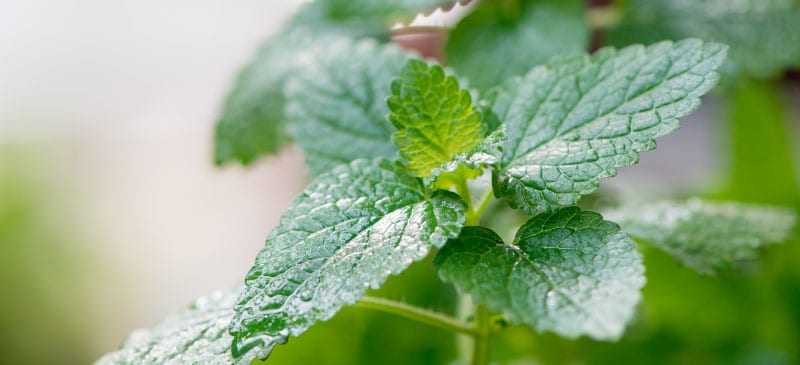
Crush a fresh lemon balm leaf between your fingers and the smell of lemon rises right away, from citral and citronellal in the leaf's essential oil.9 This soft, crinkled member of the mint family has long been part of European and Iranian traditional medicine, steeped as a tea and added to dishes for its flavor.1
It's also one of the easiest healing herbs to grow and use. Jordan Rubin and I grow lemon balm on our farm.10 Modern placebo-controlled trials have tested it for stress, anxiety, sleep, mood and cold sores.
I like lemon balm, I like chamomile, I like magnolia. Those are probably some of my favorite herbals that directly affect sleep.Dr. Josh Axe, DC, DNM, CNS
This free 30-day protocol names lemon balm among its sleep herbs. It lays out:
Free with your Dr. Axe account (email or Google). You'll also get the protocol's short email series and the Dr. Axe newsletter; unsubscribe anytime.
Open the free protocol → →Did you know?
In the U.S., lemon balm is on the FDA's list of spices and natural seasonings generally recognized as safe, and in Europe it's used to add fragrance to wine, tea and beer.119
Lemon balm products have been sold in Europe for more than 30 years, and a 2013 European Medicines Agency review found no case reports of harm in the medical literature or the WHO safety database.9
When Japanese researchers screened 681 hot-water plant extracts for one that blocks pentosidine, a compound tied to stiffening tissue with age, they chose lemon balm leaf; in lab tests it outperformed a reference anti-glycation compound.12
Lemon balm (Melissa officinalis) is a leafy, lemon-scented herb in the mint family whose dried leaves are used as tea, capsules, extracts and tinctures, and whose essential oil is sold as Melissa oil.16 Its main active compounds are rosmarinic acid and other phenolic acids, plus a small amount of fragrant essential oil.9
The leaf is the part you use. Its traditional use is recorded mostly in Europe, the Mediterranean region and the Middle East.1 Only 0.06% to 0.8% of the dried leaf is essential oil, so Melissa oil is a concentrated product of its own, used on the skin.9
Lemon balm is a different plant from lemongrass and lemon verbena, which share its lemony scent. Its closer relatives are the other mint-family herbs you cook with, such as basil, oregano, rosemary and thyme.13
Lemon balm's medical record runs through both Persian and European medicine. Iranian traditional medicine has long regarded it as a remedy for heart palpitations, and in 2015 a placebo-controlled trial of 71 adults put that old use to the test and found fewer palpitation episodes on lemon balm.14 In Europe, herbal handbooks have recorded it for mild stress, sleep and digestive complaints such as bloating since at least 1938.9 Germany's Commission E listed it in 1984 at 1.5 to 4.5 grams of herb per cup of tea, several times a day, the same range the European Medicines Agency recognizes today.96
In Ancient Remedies, I list lemon balm among the additional herbs that help with anxiety.15
Steep 1.5 to 4.5 grams of dried lemon balm leaf, about 1½ to 4½ teaspoons, in 150 mL (about 5 ounces) of boiling water, and drink it one to three times a day, the traditional amount the European Medicines Agency recognizes.69 Brewed herbal tea has about 2 calories a cup, and the fresh leaves work in salads, fruit and water too.51
Tea is the traditional way to take lemon balm and the easiest place to start. With fresh leaves from the garden, use about three times as much as you would dried, the ratio The Biblio Diet gives for leaf teas.16 Lemon balm works in food too: in two studies, a lemon balm extract mixed into an iced-tea-style drink or a yogurt eased stress or sharpened alertness within hours, as the stress section below describes.17
Four trials tested the tea itself:
Lemon balm's best-supported uses in people are easing stress, anxiety and low mood and improving sleep, backed by placebo-controlled trials and a 2021 meta-analysis, plus faster cold sore relief from a 1% leaf cream.2734 Trials also point to benefits for period pain and PMS, heart palpitations and blood pressure.211422
We cite 31 human trials of lemon balm on its own here, with 11 to 323 people and lasting from a single dose to 96 weeks, plus a 2021 meta-analysis of anxiety and depression trials.2 They tested several preparations, from tea and dried leaf to standardized extracts, a phospholipid-bound extract, a 1% cream and the essential oil, and makers ran or funded some of them, so each result below says which product was tested.
| Use | Evidence | What was studied | What the research shows |
|---|---|---|---|
Stress and anxiety | Moderate | Standardized and phospholipid-bound extracts, dried leaf, tea | Anxiety scores fell from 22.2 to 6.7 in 3 weeks, against 21.1 to 15.9 on placebo7 |
Sleep quality | Moderate | Phospholipid-bound extract, dried leaf, tea | Insomnia scores 6.8 after 2 weeks, against 9.7 on placebo3 |
Low mood | Moderate | Extracts, dried leaf | Depression scores fell 3.91 points in 12 weeks, against 0.04 on placebo23 |
Cold sores | Emerging | 1% leaf-extract cream | Lower symptom score on day 2: 4.03, against 4.94 on placebo cream4 |
Period pain and PMS | Emerging | Capsules, about 1 to 1.2 g a day | Period pain fell from 7.63 to 2.00 on a 10-point scale, against 7.09 to 3.03 on placebo21 |
Heart rhythm and blood pressure | Emerging | Tea, water extract, capsules | Fewer extra heartbeats and palpitation episodes; lower systolic pressure181424 |
Memory and focus | Mixed | Dried leaf, extracts | Better memory and attention after single doses; over 96 weeks, no overall difference, though the researchers concluded it may help prevent decline in people without high blood pressure2526 |
Agitation in dementia | Mixed | Essential oil lotion or aromatherapy | Agitation down at least 30% in 60% of residents, against 14% on placebo, in one trial; similar to donepezil and placebo in another2728 |
Researchers trace lemon balm's calming effect to rosmarinic acid and two triterpenes in the leaf, which slow the breakdown of GABA, your brain's main calming messenger, in lab tests.29
Up to 6% of the dried leaf; the main compound behind its calming and antiviral activity in lab studies.92930
Joined rosmarinic acid in slowing the breakdown of GABA in lab tests.29
From leaf to calm
Rosmarinic acid made up about 1.5% of dried lemon balm leaf in one analysis and was the main compound behind its activity in lab testing.29
In rat brain tissue, a water extract of lemon balm slowed GABA transaminase, the enzyme that breaks down GABA, more than any other traditional calming herb tested; rosmarinic, ursolic and oleanolic acids did the work.3229
GABA quiets nerve signaling, so slowing its breakdown is the proposed way lemon balm brings calm. It hasn't been measured in human brains.
In a randomized study of 11 healthy adults, rosmarinic acid from a lemon balm extract peaked in the blood about 1 hour after a dose; taking it with food raised the amount absorbed and slowed the peak.33
In a study where 18 adults each tried two doses and a placebo, 600 mg raised self-rated calm during a stressful task 1 hour later.34
Two other routes show up in lab work. Dried lemon balm leaf bound to acetylcholine receptors, the brain's memory-and-attention switches, in human brain tissue,25 and the leaf extract and oil inactivated herpes viruses before they entered cells, which the cold sore section below covers.3031
Sorted by how much human research backs each one, lemon balm does the most for stress, anxiety, low mood and sleep, with encouraging results for cold sores, period pain, heart rhythm and the aging brain.
Across randomized trials pooled in a 2021 meta-analysis, lemon balm lowered anxiety scores by a large margin compared with placebo, and depression scores by about half as much, with no serious side effects and the clearest results for acute anxiety.2 In single trials, calm showed up within an hour of one dose and built over 3 weeks of daily use; the details are in the stress section below.
Study takeaway: pooled trials found a large drop in anxiety scores compared with placebo.
In 30 adults with poor sleep who each tried lemon balm extract and a placebo for 2 weeks, 87% said they slept better on the extract, against 30% on placebo.3 Sleep scores also improved more than on placebo in stressed adults and in heart patients.735 The details are in the sleep section below.
Study takeaway: nearly 9 in 10 people with poor sleep reported better nights within 2 weeks.
A 1% lemon balm leaf-extract cream applied four times a day lowered cold sore symptoms by day 2 compared with a placebo cream in 66 adults with recurring outbreaks, and it worked best when started at the first sign.436 The cold sore section below has the details.
Study takeaway: symptoms eased by day 2 of using the cream.
In 110 university students with painful periods, 330 mg lemon balm extract capsules three times a day for the first 3 days of each period lowered pain from 7.63 to 2.00 on a 10-point scale over two cycles, against 7.09 to 3.03 on placebo.21 In 100 high school girls with PMS, 1,200 mg a day through the cycle cut PMS scores from 42.56 to 13.90 by the third month, against 39.28 to 28.38 on placebo,37 and in a separate trial of 100 teenage girls with PMS, the same daily amount eased anxiety and sleep problems more than placebo.38 For more natural approaches, see how to get rid of period cramps.
Study takeaway: period pain dropped by about three-quarters over two cycles.
In 55 adults with benign palpitations who finished a 14-day placebo-controlled trial, 500 mg of a water extract twice a day cut weekly palpitation episodes and the number who scored as anxious, though how strong the palpitations felt didn't change.14 In 49 adults with high blood pressure who each tried lemon balm capsules and a placebo for 4 weeks, pressure fell from about 152/96 to 130/80 mmHg in the group that took lemon balm first,22 and a meta-analysis of 7 trials found lower systolic pressure (pooled from 3 of them) and lower total cholesterol (from 6).24 Lemon balm tea also cut extra heartbeats, as the tea trials above show.18 See natural ways to lower blood pressure for the bigger plan.
Study takeaway: palpitation episodes fell within 2 weeks, and daily tea cut extra heartbeats.
Single doses sharpened memory and attention in young adults: 1,600 mg of dried leaf improved memory and calm for 6 hours in 20 adults who each tried several doses, though lower doses slowed some timed memory tasks, and 600 mg of an extract improved accuracy of attention in another 20.2539 In 42 adults with mild to moderate Alzheimer's disease, extract drops for 4 months improved cognitive scores more than placebo,40 and in 23 people with mild Alzheimer's, an extract rich in rosmarinic acid improved behavioral symptom scores by 0.5 points over 24 weeks while placebo worsened by 0.7.41 A 96-week trial in 323 older adults with mild memory complaints found no overall difference, though the researchers concluded the extract may help prevent cognitive decline in those without high blood pressure.26
In a placebo-controlled trial of 72 care-home residents with severe dementia and agitation, a lemon balm oil lotion cut agitation by at least 30% in 60% of residents, against 14% on placebo.27 A Cochrane review of 13 aromatherapy trials, four with lemon balm, found results that vary from trial to trial,42 and in a second trial of 114 people with Alzheimer's, lemon balm aromatherapy gave similar results to the drug donepezil for agitation, with all three groups, placebo included, improving by more than a third on a behavior scale over 12 weeks.28 See how to improve memory.
Study takeaway: single doses sharpened memory and attention within hours, and a rosmarinic-acid-rich extract eased behavioral symptoms in mild Alzheimer's.
Yes. In a 3-week placebo-controlled trial of 100 adults with stress, anxiety or poor sleep, 400 mg a day of a lemon balm extract cut anxiety scores from 22.2 to 6.7, against 21.1 to 15.9 on placebo.7 Single doses have also raised feelings of calm within an hour during stressful tasks.3417
That trial, run at three centers in Pakistan, enrolled 104 adults aged 18 to 65 with moderate stress, anxiety, low mood or poor sleep and gave them 200 mg of a lemon balm leaf extract bound to phospholipids, a form made to improve absorption, twice a day after meals; 100 finished. Depression scores fell from 23.3 to 6.9, against 22.7 to 17.1 on placebo, stress scores fell from 26.3 to 8.2, against 26.1 to 20.0, and well-being and quality of life rose. Mild stomach upset affected 4 people on lemon balm and 5 on placebo, and no one had a serious side effect.7
Lemon balm can work fast. In a study at a UK university, 18 healthy adults each took 300 mg of a standardized extract, 600 mg and a placebo on separate days, then did a 20-minute stress test of four tasks at once an hour later. On 600 mg they rated themselves calmer, and on 300 mg they did math faster with no loss of accuracy.34
In two studies where young adults each tried every version, a lemon balm extract was mixed into an iced-tea-style drink or a yogurt and compared with plain versions. In 25 adults, the drink with 0.3 grams of extract lowered anxiety ratings 1 and 3 hours after a multitasking stress test and improved working memory, and in 21 adults, the yogurt with 0.3 grams improved alertness and word recall. The 0.6-gram servings brought mixed results, including more mental fatigue an hour after the yogurt, so the smaller amount worked best in food.17
In 80 adults with chronic stable angina, chest pain from narrowed heart arteries, 3 grams a day of powdered lemon balm leaf for 8 weeks lowered depression, anxiety, stress and sleep-disturbance scores more than placebo,35 and in hospitalized burn patients, lemon balm tea eased anxiety, depression and sleep problems more than black tea did, as the tea trials above show.19
In a placebo-controlled trial of 106 young adults with moderate stress, one 300 mg dose of a lemon balm extract improved accuracy on the hardest thinking tasks 5 hours later and helped calm return after each round of mental demand, though overall calmness across the day didn't change.43 In an earlier 15-day study in which people knew they were taking lemon balm, 300 mg of an extract twice a day lowered anxiety symptoms by 18% and insomnia by 42% in 20 adults with mild to moderate anxiety and sleep problems; 19 of the 20 responded, and by day 15, 14 were free of their anxiety symptoms and 17 of their insomnia.44
In 60 adults with type 2 diabetes and symptoms of depression, 350 mg of an extract twice a day for 12 weeks lowered depression scores by 3.91 points, against 0.04 on placebo, and anxiety scores by 2.04 points, while they rose 0.23 on placebo; 44 people finished, and sleep quality, blood sugar and blood pressure didn't differ between the groups.23 In 45 adults with mild to moderate depression, 2 grams a day of dried leaf for 8 weeks gave similar results to the antidepressant fluoxetine (20 mg a day), with depression scores falling in all three groups of a trial that also tested lavender; there was no placebo group.45 If you take an antidepressant, keep taking it as prescribed; the side effects section covers using lemon balm alongside medicine.
Pair lemon balm with the stress relievers that address what's driving your stress; natural remedies for anxiety has more options. I use herbs like lemon balm inside a bigger plan, never as a substitute for fixing the cause. For more on cortisol, the hormone at the center of chronic stress, see cortisol levels.
Yes. In a placebo-controlled study of 30 adults with poor sleep who each tried both, 400 mg of a lemon balm extract each evening for 2 weeks lowered insomnia scores to 6.8, against 9.7 on placebo, and 87% said they slept better, against 30%.3 Sleep quality also improved more than on placebo in trials in stressed adults and heart patients.735
The extract in that study was also bound to phospholipids and was taken as two 200 mg tablets 30 minutes before bed, with a week's break between the 2-week lemon balm and placebo periods. A wrist sleep tracker recorded 15% more deep sleep on lemon balm and 10% less REM sleep, while total sleep time and anxiety scores didn't change.3
In the 3-week stress trial, sleep-quality scores improved from 10.9 to 3.5 on lemon balm, against 8.6 to 6.6 on placebo, though the lemon balm group started with worse sleep.7 In 32 adults with poor sleep or emotional distress who knew they were taking it, 400 mg a day improved sleep scores by 30% in 3 weeks, twice the 15% gain at 200 mg.46
On my show I've said to aim for around 8 hours of sleep, 7 at minimum, with the ideal closer to 90 minutes to 2 hours each of deep sleep and REM sleep.47 Herbs work best on top of a steady rhythm. As my Deep Sleep Protocol puts it, "Add a sleep supplement to a day with no morning light, coffee at 4pm and a phone in bed and you're pushing against your own clock. Set the clock. Build the runway."8 Lemon balm is one of the herbs that protocol names, and an evening cup fits right into its wind-down. For the rest of the foundation, see sleep hygiene, natural sleep aids and the ideal amount of sleep.
A few markers can show whether something else, such as your thyroid or iron stores, is part of the stress-and-sleep picture. Go over your results with your practitioner.
See the cellular bloodwork panel
Have results? Analyze them free → →Yes. In a placebo-controlled trial of 66 adults with recurring cold sores, a 1% lemon balm leaf-extract cream applied four times a day for 5 days lowered the combined symptom score on day 2, when cold sores usually hurt most, to 4.03, against 4.94 on a placebo cream.4 Starting at the first tingle gives it the best chance to work.36
The cream in that trial was made from a concentrated dried leaf extract, and the people using it also reported faster relief from itching, tingling, burning and swelling.4 Two earlier studies of the same kind of cream, one in which 115 patients knew they were using it and a placebo-controlled one with 116, found it protective against herpes simplex infections and most effective when started at the earliest stage.36 A 2025 systematic review of herbal creams for cold sores found that lemon balm preparations eased pain and swelling, with some trials also showing smaller sores than with placebo or the antiviral drug acyclovir.48
Lab studies explain the timing. Lemon balm water extract inactivated free herpes simplex virus and kept it from attaching to cells, including strains resistant to acyclovir, but had no effect once the virus was inside cells; rosmarinic acid did most of the work.3049 The essential oil cut herpes plaques by 98.8% for HSV-1 and 97.2% for HSV-2 in lab tests at concentrations that didn't harm the cells, again acting before the virus got in.31 That's why you start at the first tingle, and why lemon balm sits on lists of antiviral herbs.
In Ancient Remedies, I recommend applying Melissa oil, lemon balm's essential oil, to a cold sore three times a day.15 Dilute it first: mix 2 to 3 drops into a teaspoon of coconut oil or another carrier oil, about a 2% to 3% blend, and dab a little on the sore. The human trials used the 1% leaf-extract cream, so the oil's evidence comes from lab studies.31 Use the oil on the skin only.
Choose the form by what you want from it: tea for a daily calming ritual, a standardized extract for the amounts tested in many of the stress and sleep trials, and the 1% cream for cold sores.
An alcohol extract; the traditional amount is 2 to 6 mL of a 1:5 tincture, one to three times a day.6
A cream made with a concentrated dried leaf extract, applied four times a day for cold sores.4
The distilled oil; for the skin only, diluted to about 2% to 3% in a carrier oil.
Products vary a lot. In 19 dried-herb samples from 12 Polish makers, rosmarinic acid ranged from 0.158 to 48.608 mg per gram,50 and Europe's standard for medicinal lemon balm leaf is at least 1% rosmarinic acid.9 Tea holds its own here: in lab tests of commercial lemon balm, a hot-water infusion drew out rosmarinic acid at least as well as a strong lab solvent did, though the solvent pulled out more of most other compounds.51
When you shop, check for:
The plant name on the label: Melissa officinalis, leaf.
A stated rosmarinic acid or hydroxycinnamic acid content on extracts, the measures the trials used.733
A single-herb product if you want lemon balm alone, since many lemon balm products are blends with other herbs.9
Organic, whole-leaf tea from a seller who names the source, stored airtight away from light and heat.
Ask Dr. Axe AI. Answers are grounded in this library, with sources shown.
Drink one to three cups of lemon balm tea a day, each made with 1.5 to 4.5 grams of dried leaf, the traditional amount; in trials, extracts were used at 300 to 600 mg as a single dose for stress and at 400 to 700 mg a day for 2 to 12 weeks for anxiety, mood and sleep.6347233
| Use | Form | Amount | How long |
|---|---|---|---|
Mild stress and sleep, traditional use | Tea, dried leaf | 1.5 to 4.5 g in 150 mL boiling water, one to three times a day | As needed6 |
Stress in the moment | Standardized extract | 300 or 600 mg, one dose | Calm and focus measured 1 hour later34 |
Anxiety, stress and low mood | Phospholipid-bound leaf extract | 400 mg a day, as 200 mg twice | 3 weeks7 |
Sleep | Phospholipid-bound leaf extract | 400 mg, 30 minutes before bed | 2 weeks3 |
Low mood | Leaf extract | 700 mg a day, as 350 mg twice | 12 weeks23 |
Anxiety and sleep in heart patients | Dried leaf capsules | 3 g a day | 8 weeks35 |
Period pain | Leaf-extract capsules | 330 mg three times a day, first 3 days of the period | 2 cycles21 |
Traditional tincture | 1:5 tincture | 2 to 6 mL, one to three times a day | As needed6 |
Cold sores | 1% leaf-extract cream | Four times a day | 5 days4 |
Timing follows the goal. For a stressful day, the single-dose studies measured calm and focus 1 to 6 hours after a dose.3425 For sleep, the trial gave the extract in the evening, 30 minutes before bed, and judged results at 2 weeks.3 Taking lemon balm with food raises how much rosmarinic acid you absorb and slows its peak.33 Start with tea or the lower trial doses; the side effects section covers drowsiness at larger doses.
There's no set limit on how long you can use lemon balm, but if stress or sleep symptoms last longer than 2 weeks of use, see a practitioner.9
Lemon balm is well tolerated: the European Medicines Agency lists no known undesirable effects, and in trials, side effects such as mild stomach upset showed up about as often as on placebo.6741 Take care with drowsiness at higher doses, sedative medicines and alcohol, thyroid conditions, pregnancy and breastfeeding, and children under 12.
In a 24-week trial in 23 people with mild Alzheimer's disease, 41.6% reported a side effect or other health complaint on lemon balm extract and 45.5% on placebo, with no serious events.41 In a randomized study of 11 healthy adults, an extract carrying 500 mg of rosmarinic acid didn't change liver, kidney or blood-cell tests,33 and a 90-day rat study found no harmful effects at the highest doses tested.52
Drowsiness: Single doses of 600 to 900 mg lowered alertness in trials, and the EMA notes lemon balm may impair driving.34396 Save larger doses for the evening, and don't drive until you know how it affects you.
Medicines and alcohol: In mice, lemon balm extract made a sedative drug's sleep come faster and last longer, and the EMA flags added drowsiness with alcohol or sedatives as possible; we found no reported case in people.53549 If you take a benzodiazepine, a prescription sleep aid, a sedating antihistamine, an antidepressant or another medicine that affects mood or sleep, start with a cup of tea in the evening, keep taking your medicine exactly as prescribed, and make any change only with the doctor who prescribes it. Thyroid medicine is covered just below.
Pregnancy and breastfeeding: Safety hasn't been established, so the EMA doesn't recommend lemon balm preparations, including the tea, while you're pregnant or nursing.69 Skip it until you've weaned.
Children: The EMA doesn't recommend lemon balm for children under 12, because there are no data for that age.6
Pollen allergy: In 180 people tested for pollen allergy, those allergic to birch, mugwort or grass pollen were more likely to react on skin-prick tests to common kitchen herbs, including lemon balm.13 Stop if your mouth, lips or skin itch or swell after using it.
Stopping after long use: In one documented case, a 30-year-old had restlessness, tremor and sweating after stopping long-term lemon balm use.55 If you've used it daily for months, tell your practitioner about any restlessness after you stop.
When to see a doctor right away: Palpitations with chest pain, fainting or shortness of breath, or anxiety with thoughts of harming yourself, need medical care now.
In Ancient Remedies, I list lemon balm among the traditional herbs for an overactive thyroid,15 and lab studies line up with that use: lemon balm extract blocked thyroid-stimulating hormone (TSH) from binding to its receptor on thyroid cells and blocked the antibodies that overstimulate the thyroid in Graves' disease.565758 In one documented case, a 27-year-old woman whose overactive thyroid hadn't improved enough on medication had normal thyroid tests within 3 months on a Persian-medicine plan of lemon balm tea, barley water and lifestyle changes.59 No human trial we found has measured thyroid levels during lemon balm use, and the EMA calls the relevance of the lab findings for people unknown.6
If you have an underactive or overactive thyroid or take thyroid medicine, have your doctor check your thyroid levels after you start using lemon balm daily, and keep taking your medicine exactly as prescribed.
Yes, especially if stress or restless nights are part of your life. Lemon balm is a gentle, lemony mint-family herb with a long record in Persian and European medicine, and that history carries real weight with me, because a remedy people have kept reaching for over generations has earned a close look. Placebo-controlled trials now support it for stress, anxiety, low mood and sleep, and a 1% leaf cream for cold sores; the period-pain, heart-rhythm and memory findings are promising.
Start with a cup of tea in the evening, made with 1.5 to 4.5 grams of dried leaf, or use an extract at 300 to 600 mg, the single doses used in the stress studies. Avoid it during pregnancy and breastfeeding and for children under 12, take care with sedative medicines and alcohol, and have your thyroid checked if you have a thyroid condition. Then brew a cup, slow your evening down and let your body do what it was designed to do: rest and heal.
Four phases in 30 days, the top 8 sleep nutrients ranked, the top 10 foods for sleep and a 20-minute evening routine. Free with your Dr. Axe account (email or Google). You'll also get the protocol's short email series and the Dr. Axe newsletter; unsubscribe anytime. Have recent bloodwork? Analyze it free.
Open the free protocol → →Yes. In a placebo-controlled study of 30 adults with poor sleep, 87% said they slept better after 2 weeks of 400 mg of extract each evening, against 30% on placebo.3
Yes, as a traditional remedy: the European Medicines Agency recognizes lemon balm tea, 1.5 to 4.5 grams of dried leaf in 150 mL of boiling water one to three times a day, for mild digestive complaints such as bloating and gas, based on its long use.6 European herbal handbooks have recorded it for digestive complaints since at least 1938.9
Lemon balm may help indirectly: in trials it eased stress and improved sleep,73 and my Deep Sleep Protocol lists steadier energy, mood and appetite among the results of consistent sleep.8 In a 12-week placebo-controlled trial in adults with type 2 diabetes, weight didn't change on the extract, so use it to support a plan built on food and movement; unsweetened, the tea has about 2 calories a cup.235
It can be, especially for period pain and PMS: in 110 university students, lemon balm extract capsules lowered period pain from 7.63 to 2.00 on a 10-point scale over two cycles, against 7.09 to 3.03 on placebo.21 In 100 high school girls, 1,200 mg a day cut PMS scores from 42.56 to 13.90 by the third month.37
It may help steady it: in placebo-controlled trials, 2 weeks of a water extract cut benign palpitation episodes, and 4 weeks of lemon balm capsules lowered blood pressure in 49 adults with high blood pressure; lemon balm tea also left people with about 2,142 extra heartbeats a day, against 3,126 with lifestyle advice alone.142218 If you have palpitations, check the warning signs in the side effects section first.
Lemon balm is a mint-family leaf rich in rosmarinic acid, which slows the breakdown of the calming messenger GABA in lab tests, while chamomile's calming compound is apigenin, which my Deep Sleep Protocol notes binds the same receptors as calming medications, far more gently.1298 I like both for sleep.47
October 2, 2026 — Rewrote the page in full. The previous version listed nine benefits, several of them drawn from animal and lab studies (heart and liver protection, blood sugar in mice, cancer cells) and gave capsule doses up to 600 mg three times a day. This version leads with the tea and food uses; ranks the benefits by human trials on stress, anxiety, low mood, sleep, cold sores, period pain, heart rhythm and memory, each labeled by design and size; adds the Dr. Axe Score (7.7) with an interaction check; gives lemon balm's traditional use for an overactive thyroid alongside guidance for anyone with a thyroid condition; gives the European Medicines Agency's traditional uses for stress, sleep and digestion and its tea and tincture amounts alongside the doses used in trials; and gathers the cautions on drowsiness, sedative medicines, pregnancy, children and pollen allergy into one safety section, with 59 references.
August 22, 2024 — Previous version updated. Originally published July 11, 2023.
This article is for educational purposes. See our medical disclaimer.