
Advertisement
Advertisement
Nutrition
The best soluble fiber foods ranked with USDA grams per serving, what the gel-forming kind does for your cholesterol, blood sugar and gut, how much to eat and how to add more without the bloating.
Soluble fiber is the part of plant fiber that dissolves or swells in water, and its gel-forming kinds, found in beans, lentils, oats, barley, chia, flax, fruit and cooked vegetables, do most of its work in your gut.1
The best soluble fiber foods are beans, lentils and peas, oats and barley, chia and flax, fruits such as peaches, oranges, pears and apples, and cooked vegetables such as broccoli and carrots, and the gel their fiber forms in your gut helps lower LDL cholesterol, steady your blood sugar and feed the good bacteria in your colon.14 My approach is food first, with a variety of these plants every day and a fiber supplement fitted to your gut when you need more help.1011
Cholesterol that creeps up, blood sugar that swings after meals and hunger that's back an hour after you eat can all trace back to the same root cause: a diet short on the gel-forming fiber your gut was designed to work with. Soluble fiber does its work inside your gut, where its gel slows how quickly sugar reaches your blood, carries cholesterol-rich bile out so your liver draws more cholesterol from your bloodstream, and gives your gut bacteria the fuel they turn into compounds that nourish your colon and help you feel full.1126
90-day protocol
The complete root-cause framework for lowering insulin, protecting muscle and losing the weight that won’t move — and reversing the cravings, energy crashes and belly fat most diets never trace back to the source.
Free with your Dr. Axe account
View the protocol →The list below ranks the best soluble fiber foods by food group, with USDA lab values for the soluble and total fiber in a realistic serving where USDA measured both, and total fiber from FoodData Central for the rest.23
Soluble fiber helps balance out your blood chemistry, improving your blood work.Dr. Josh Axe, DC, DNM, CNSFrom 7 Habits That Age You Faster & Cost Nothing to Fix, The Dr. Josh Axe Show (2026)
Soluble fiber is the part of plant fiber that dissolves or swells in water, and many kinds, such as psyllium, oat beta-glucan and pectin, thicken into a gel as they move through your gut.1 Your own enzymes can't digest it, so it travels on to your colon, where your gut bacteria ferment much of it.16
Soluble fiber (spelled fibre in Britain and Canada) comes in several families. Beta-glucan is the soluble fiber in oats, barley and mushrooms; pectin is the one in apples, citrus and other fruit; gums such as guar gum come from seeds; and psyllium husk is the seed coat of Plantago ovata, a plant in the plantain family.11314 Glucomannan comes from the konjac root, and inulin is the soluble fiber stored in onions, garlic and leeks.1513
Nearly every plant food carries some of each kind of fiber, in shares that vary from one food to the next. In a USDA laboratory analysis of 70 commonly eaten foods, 58.1% of the fiber in a navel orange was soluble, 55.4% in prunes, 46.0% in a peach with its skin and about 30% in an apple with its skin, and the researchers concluded that foods have to be judged case by case.2
You can watch soluble fiber work in your own kitchen. Stir chia seeds or ground flaxseed into water, or let a pot of oatmeal sit, and it thickens as the fiber holds on to the water and turns it into a soft gel.1 When a soluble fiber is taken out of its plant and shown to benefit people, as psyllium and wheat dextrin have been, it's called a functional fiber.1
Psyllium or glucomannan before meals, the soluble fiber that thickens in your gut and slows sugar, is one of the first boosters this free 90-day protocol starts. Inside, you'll find:
Free with your Dr. Axe account (email or Google). You'll also get the protocol's short email series and the Dr. Axe newsletter; unsubscribe anytime.
Open the free protocol →Soluble fiber dissolves or swells in water and insoluble fiber doesn't, and viscous fiber is the gel-forming group within soluble fiber: psyllium, beta-glucan from oats and barley, pectin, guar gum and glucomannan.1 The viscous kinds carry most of soluble fiber's effects on cholesterol and blood sugar.15
Insoluble fiber is the tougher fiber that gives plants their structure, such as the bran on whole grains and the skins of fruit, and its main job is to add bulk to your stool.1 Our guide to soluble vs. insoluble fiber puts the two side by side.
Within soluble fiber, the most useful line runs between the fibers that make a gel and the ones that don't. Viscous, or gel-forming, fibers thicken what's moving through your gut, and that thickness is what slows digestion and holds on to bile, which is why "soluble viscous fiber" is the term you'll see in cholesterol and blood-sugar research.1 Other soluble fibers, such as inulin and wheat dextrin, dissolve without forming much of a gel and act mainly as food for your gut bacteria.1 Partially hydrolyzed guar gum (PHGG) and acacia fiber belong with this gentler group, and they're the ones I suggest when you have bloating or leaky gut.11
That's why the cholesterol and blood-sugar results on this page come from the gel-forming fibers, while inulin's strengths, covered in the gut section, are regularity and feeding your bifidobacteria.
Turn your daily calorie, protein and fiber estimates into practical meals and recipe ideas.
Calculate my plan →Among the whole foods in USDA's lab analysis, fruit, cooked vegetables, avocado and beans rank near the top for soluble fiber per serving: a medium peach with its skin has 1.97 grams, ¼ cup of prunes 1.96, a navel orange 1.92 and half a cup of cooked broccoli 1.44.23 Oats and barley add beta-glucan, and beans and chia bring the most total fiber.163
Both columns below come from a USDA Agricultural Research Service analysis that measured soluble and insoluble fiber separately in 70 commonly eaten foods, multiplied by USDA FoodData Central serving weights, so each food's soluble and total fiber come from the same lab sample.23 Most food labels list only total fiber, so a lab analysis like this one is how you see the soluble part.
| Food | Serving | Soluble fiber (g) | Total fiber (g) |
|---|---|---|---|
Peach with skin | 1 medium | 1.97 | 4.3 |
Prunes | ¼ cup | 1.96 | 3.5 |
Navel orange | 1 fruit | 1.92 | 3.3 |
Pear with skin | 1 medium | 1.63 | 5.6 |
Broccoli, cooked | ½ cup | 1.44 | 3.6 |
Nectarine with skin | 1 medium | 1.39 | 2.9 |
Avocado | ½ fruit | 1.38 | 3.8 |
Carrots, cooked | ½ cup | 1.23 | 3.0 |
Apple with skin | 1 medium | 1.22 | 4.0 |
Kidney beans, canned | ½ cup | 1.07 | 5.6 |
Lima beans, cooked | ½ cup | 0.87 | 4.4 |
Green beans, cooked | ½ cup | 0.86 | 2.7 |
Guava | 1 fruit | 0.85 | 7.0 |
Green peas, cooked | ½ cup | 0.75 | 2.8 |
Plum with skin | 1 fruit | 0.74 | 1.9 |
1 medium | 0.68 | 2.1 | |
Onion, raw | ½ cup chopped | 0.57 | 1.5 |
Lentils, cooked | ½ cup | 0.44 | 5.8 |
My order follows the evidence behind each food group and how much fiber a serving brings overall, which is why beans and lentils come first.
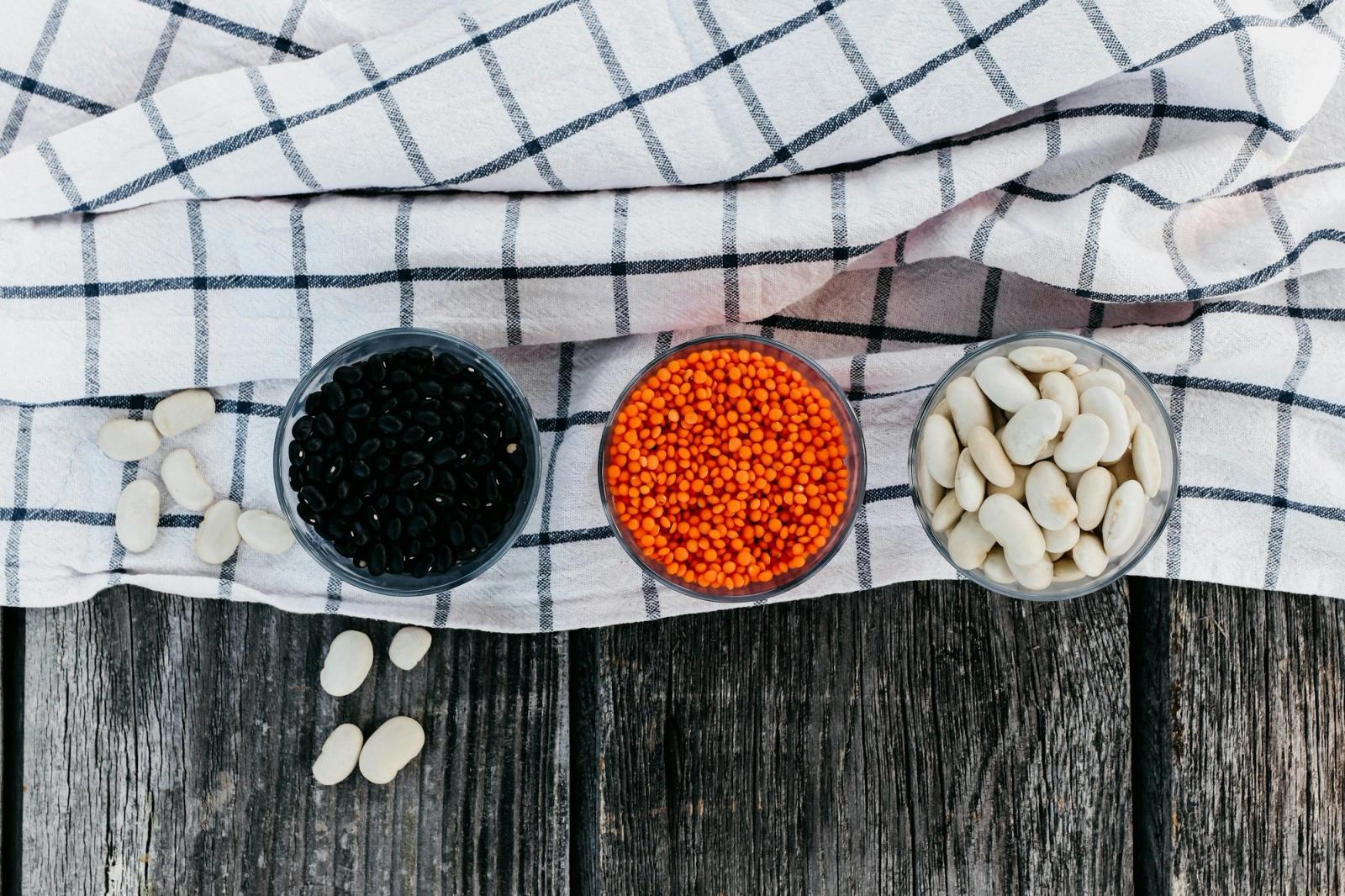
Beans and lentils carry some of the most total fiber on this list, along with plant protein, and beans carry a good share of soluble fiber too. Half a cup of canned kidney beans carries 1.07 grams of soluble fiber and 5.6 grams of total fiber in USDA's lab analysis, canned pinto beans 0.84 grams of soluble fiber, and lima beans and green peas sit close behind in the table above.23 In FoodData Central's figures for beans cooked from dry, half a cup of navy beans carries 9.6 grams of total fiber, pinto beans 7.7 and black beans 7.5.3 Eating more beans and lentils is one of my steps for losing visceral fat, because their soluble fiber turns into a gel in your gut.7
Beans lower cholesterol as an everyday food. In a 2026 review of 38 randomized trials with 2,095 people, eating whole pulses, the family of beans, lentils, chickpeas and peas, at a median of 130 grams a day (about ½ to ⅔ cup) for a median of 6 weeks lowered LDL cholesterol by 0.14 mmol/L (about 5.4 mg/dL), non-HDL cholesterol by 0.22 and ApoB by 0.08 g/L in the 3 trials that measured it. For beans, LDL fell in step with how much people ate, by about 0.25 mmol/L for each half cup a day, up to 1 cup a day.17
I recommend beans soaked or pressure-cooked, the traditional way to prepare them, and soaking and sprouting also lower phytic acid, a compound that holds on to minerals, so more of the iron, zinc and magnesium in them becomes available.1819 For soy, choose organic and lean on fermented forms such as tempeh; half a cup of organic edamame carries 4.0 grams of fiber, and half a cup of firm tofu 2.9.3
Legumes have fed people for a very long time, and when Daniel was offered the king's food and wine in Babylon, he asked for a simpler test: "Prove thy servants, I beseech thee, ten days; and let them give us pulse to eat, and water to drink" (Daniel 1:12).20 Pulse is still the word for dried beans, lentils and peas, and a pot of them is one of the easiest ways to put soluble fiber on your table.
Oats and barley carry beta-glucan, a gel-forming soluble fiber, and it's the reason the FDA lets foods made from them carry a heart-health claim, which rests on 3 grams or more a day of beta-glucan from whole oats or barley. Rolled oats must be at least 4% beta-glucan by dry weight to qualify, and oat bran at least 5.5%.16 Half a cup of dry rolled oats carries 4.1 grams of total fiber and a quarter cup of raw oat bran 3.6.3
In a review of 58 randomized trials with 3,974 people, a median of 3.5 grams of oat beta-glucan a day lowered LDL cholesterol by 0.19 mmol/L (about 7.3 mg/dL), non-HDL cholesterol by 0.20 and ApoB by 0.03 g/L.21 Beta-glucan is found in large amounts in oats, barley and mushrooms such as shiitake and maitake, and it helps your gut make butyrate.13
I recommend organic, slow-cooked oats rather than instant oatmeal, and barley in its sprouted form.18 Amaranth, a seed that cooks up like a grain, carries 5.2 grams of total fiber per cooked cup.3
Soaked in water, chia and flax swell into a soft gel, the same gel that sets a chia pudding. An ounce of chia seeds carries 9.8 grams of total fiber, a tablespoon of ground flaxseed 1.9 and an ounce of macadamia nuts 2.4.3
Flaxseed has been tested for regularity, too. In a randomized trial of 90 adults with functional constipation in Shanghai, 50 grams of flaxseed flour a day with meals for 4 weeks raised median bowel movements from 2 to 7 a week in the 60 people on flax, against 2 to 6 in the 30 on lactulose, a common laxative, so flaxseed did somewhat better than the drug at raising how often people went.22
I suggest adding flax or chia to the fruit you eat at breakfast, along with about a handful of nuts a day.718 Our comparison of chia seeds vs. flax seeds covers how the two differ.
Fruit fills the top of the table above. A medium peach with its skin carries 1.97 grams of soluble fiber, and prunes, navel oranges, pears, nectarines, avocado and apples follow close behind, with a guava at 0.85 grams and a plum at 0.74.23 For other fruits, USDA reports total fiber, and a quarter cup of dried figs carries 3.7 grams, dried apricots 2.4, one passion fruit 1.9 and one Medjool date 1.6. In USDA's newer Foundation Foods analysis, dried figs measured 1.5 grams of soluble fiber per 100 grams and green kiwifruit 0.7.3
Much of fruit's soluble fiber is pectin.1 Pectin lowers cholesterol about as well as oat bran and psyllium, gram for gram: in a review of 67 controlled trials that used 2 to 10 grams of soluble fiber a day, the effects of pectin, oats and psyllium didn't differ significantly, and each gram lowered LDL by about 0.057 mmol/L (about 2.2 mg/dL).23 You get pectin from apples and citrus fruits such as grapefruit, and it's a really great type of fiber; apples and pears in particular bring pectin-rich, prebiotic fiber to your plate.2419
Eat your fruit whole and with the skin on, since the peach, pear, apple and nectarine values above are for fruit with its skin.2
Cooking moves vegetables such as broccoli and carrots toward the soluble kind. In USDA's analysis, the soluble share of broccoli's fiber was 12.6% raw and 39.7% cooked, and half a cup of cooked broccoli carries 1.44 grams of soluble fiber and cooked carrots 1.23, with cooked green beans close behind.23 For total fiber, a medium cooked artichoke carries 6.8 grams, a cup of baked butternut squash 6.6, a medium baked sweet potato 3.8 and a cup of cooked turnips 3.1. Half a cup of cooked Brussels sprouts or okra carries 2.0 grams, and half a cup of cooked asparagus 1.8.3 Raw cabbage measured 0.46 grams of soluble fiber per 100 grams in USDA's lab analysis, about a fifth of its fiber.2 Cooked vegetables are gentler on your gut, too.19
Traditional Chinese medicine has long turned to cooked, moist, fiber-rich plants when the bowel runs slow. In that tradition, the root causes of constipation are liver stagnation and heat and dryness in the large intestine, and the healing foods include cooked vegetables, okra, carrots, pumpkin, sweet potatoes, apples, prunes, figs and beans.25 Pumpkin, sweet potatoes and squash also bring fiber that helps stabilize blood sugar.19
Onions, garlic and leeks bring inulin, a fermentable soluble fiber, and half a cup of chopped raw onion carries 0.57 grams of soluble fiber.1323 When you add corn to your plate, choose organic.18
Soluble fiber per serving, from USDA's lab analysis
Soluble fiber does nearly all of its work inside your gut, and the changes you can measure in your blood start there. It becomes a gel in your gut that slows digestion, feeds the good bacteria and keeps your blood sugar steady.7 Step by step, it looks like this:
Gel-forming soluble fibers such as psyllium, oat beta-glucan and pectin thicken in water as they travel through your stomach and small intestine.1
A thicker meal moves through more slowly, so the sugar from it reaches your blood more gradually.15
The gel holds on to bile acids, which your liver makes from cholesterol, so more leave in your stool and your liver pulls cholesterol from your blood to make new bile, the mechanism researchers have proposed for its cholesterol-lowering effect.12
In your colon, bacteria ferment soluble fiber into short-chain fatty acids such as butyrate, acetate and propionate.6
Those fatty acids prompt gut cells to release GLP-1, a gut hormone that helps control appetite and insulin release, as cell and mouse studies show.26
Put together, that's why a meal built on beans or oats tends to keep you full longer, why your blood sugar rises more gently after it, and why your cholesterol numbers move over a few weeks of eating this way.2754 A fiber supplement works the same way, helping lower LDL cholesterol by increasing how much bile and cholesterol your body clears out.28
Soluble fiber lowers LDL cholesterol and ApoB, and in a review of 181 randomized trials with 14,505 adults, soluble fiber supplements lowered LDL cholesterol by 8.28 mg/dL, total cholesterol by 10.82 and ApoB by 44.99 mg/L (about 4.5 mg/dL) on average, and each 5 grams a day lowered LDL by 5.57 mg/dL.4
Psyllium and glucomannan, two gel-forming fibers sold on their own, each lower LDL. Psyllium, at a median of about 10.2 grams a day, lowered LDL by 0.33 mmol/L (about 12.8 mg/dL) across 28 randomized trials with 1,924 people, and it lowered non-HDL cholesterol by 0.39 and ApoB by 0.05 g/L as well.14 Glucomannan from konjac root, about 3 grams a day, lowered LDL by 0.35 mmol/L (about 13.5 mg/dL), roughly 10%, in a review of 12 randomized trials with 370 adults and children, though ApoB didn't change in the 6 trials that measured it.15 Most of these trials used fiber supplements, and the oat and bean trials in the list above show the same effect from food.2117
In my bloodwork guide, I call ApoB the cleanest single number for cardiovascular risk, because it counts the particles that carry cholesterol, and in the pooled trials above, soluble fiber overall and psyllium both lowered it.29414
Soluble fiber also adds to what a statin does. In a pooled analysis of 3 randomized trials lasting 4 to 12 weeks, adding psyllium to a statin lowered LDL further than the statin alone, by about as much as doubling the statin dose; the analysis came from researchers at a company that makes a psyllium supplement.30 For the rest of a cholesterol plan built on food, see cholesterol-lowering foods and how to lower cholesterol naturally.
LDL cholesterol drop in pooled randomized trials, by soluble fiber
Gel-forming fiber steadies blood sugar, and in a review of 28 trial comparisons with 1,394 adults with type 2 diabetes, gel-forming fiber supplements, about 13 grams a day added to usual care, lowered HbA1c by 0.58 points and fasting blood sugar by 0.82 mmol/L (about 15 mg/dL).5 A standard score for insulin resistance fell by 1.89 in the same review.5
The gel slows how fast a meal's sugar reaches your blood, and over weeks that gentler rise shows up in your HbA1c, the marker of your average blood sugar over about three months.15
Gel-forming fiber and HbA1c
Psyllium taken before meals steadies blood sugar too, and it helps most in the people whose blood sugar runs highest. In a review of 35 randomized trials, it lowered fasting blood sugar by 37.0 mg/dL and HbA1c by 0.97 points in people being treated for type 2 diabetes, had a smaller effect in prediabetes and didn't lower blood sugar in people whose levels were already normal; several of the authors came from a company that makes a psyllium supplement.31 That's why my protocols put psyllium before meals for people working on their blood sugar: 5 grams before meals in my Insulin Resistance & Prediabetes Protocol, and 5 to 10 grams before large meals in my Type 2 Diabetes Protocol, which notes that soluble fiber blunts the rise in blood sugar after a meal and supports the gut.3233
Our guide to normal blood sugar has the numbers to aim for.
Soluble fiber's effect on blood sugar shows up in these two markers, so test them before you add more and again a few months later.
See the cellular bloodwork panel
Have results? Analyze them free →Yes: in a review of 12 randomized trials with 609 adults with overweight or obesity, isolated soluble fiber supplements lowered body weight by 2.52 kilograms (about 5.6 pounds) and BMI by 0.84 compared with placebo, with no calorie restriction.34
Body fat came down with the weight, by 0.41%, along with fasting blood sugar (0.17 mmol/L) and fasting insulin (15.88 pmol/L), in trials lasting 2 to 17 weeks.34 The filling effect belongs mostly to the gel-forming fibers. In a systematic review of randomized trials, where fiber's overall effects on how much people ate and weighed were relatively small, more viscous fibers such as pectins, beta-glucans and guar gum reduced appetite in 59% of comparisons, against 14% for less viscous fibers, and cut how much people ate in the short term in 69%, against 30%.27
Soluble fiber also goes with less of the deep belly fat that wraps around your organs. In an observational study that followed 1,114 African American and Hispanic American adults for 5 years with CT scans, each extra 10 grams of soluble fiber a day went with a 3.7% slower build-up of visceral fat, independent of changes in BMI.35
If you want to support GLP-1 naturally, the food to reach for is more fiber, along with more probiotic-rich foods like kefir.7 A fiber engineered to deliver propionate to the colon shows that pathway in people: in a 24-week randomized trial of 60 overweight adults, 10 grams a day of it limited weight gain and the build-up of fat inside the abdomen and liver, compared with plain inulin, and in shorter tests it raised the fullness hormones PYY and GLP-1 after a meal and people ate less.36 In my Healthy Weight & Metabolic Reset protocol, psyllium or glucomannan, 3 to 5 grams before meals, is one of the first boosters, started in Phase 1 alongside magnesium, because it thickens in the gut, slows sugar absorption and helps you feel full on less.9 For the bigger picture, see how to lose belly fat.
Soluble fiber holds water in your stool as a gel, which is why it can help with both a hard, slow stool and a loose one.13738 It's also the fiber to reach for with IBS. In a review of 14 randomized trials with 906 adults with IBS, fiber eased symptoms overall, and in the trials that used soluble fiber, people were 17% less likely to still have symptoms than those on a comparison; for every 7 people who took it, one more improved.39 For the rest of the eating plan, see the IBS diet.
Partially hydrolyzed guar gum is one of the gentlest options. In a 12-week trial of 121 adults with IBS, 108 of whom were analyzed, in which neither the people nor the researchers knew who got what, 6 grams of PHGG a day lowered bloating scores by 4.1 points, against 1.2 on placebo, and the improvement in bloating and gas lasted 4 weeks after people stopped; their other IBS symptoms didn't differ from placebo.40 That fits what I recommend: with leaky gut or bloating, start with gentler prebiotic fibers such as PHGG, at about 5 to 7 grams a day, or acacia fiber, both of them low FODMAP (low in the fermentable carbohydrates that tend to bother a sensitive gut), with PHGG the slowest to ferment.11
For loose stools, soluble fiber helps firm things up. In a 3-month trial of 44 healthy adults who tended toward loose stools, in which neither the people nor the researchers knew who got what, PHGG brought stool form toward normal and raised their Bifidobacterium; three of the authors worked for the company that makes it.38 In hospital patients on tube feeding, a review of 16 randomized trials found that formulas with added fiber cut diarrhea by 36%, and PHGG and a mix of soluble and insoluble fiber each lowered it on their own.41 This is where I fine-tune the fiber to the person: if you need to build up your good bacteria or you tend toward loose stools, a fiber other than psyllium can work better.11 See how to stop diarrhea for the other steps.
For constipation, psyllium is my number one fiber, though if you're sensitive to bloating, it isn't the best place to start.11 In a review of 16 randomized trials with 1,251 adults with chronic constipation, 311 of 473 people taking a fiber supplement (66%) improved, against 134 of 329 (41%) on a comparison, in the trials that reported how many people got better, and psyllium and pectin both raised how often people went, with doses above 10 grams a day for at least 4 weeks working best.37 For more steps, see natural constipation relief.
Soluble fiber is one of the main foods for the bacteria in your colon, which is why so many soluble fibers count as prebiotics.1 When those bacteria ferment it, they make short-chain fatty acids such as butyrate, acetate and propionate, which your body uses as fuel and as chemical messengers, and butyrate is the preferred fuel of the cells lining your colon.6 This kind of fiber is great for clearing out LDL cholesterol, improving your blood sugar and making more short-chain fatty acids such as butyric acid in your gut, which is really important for healing leaky gut.24
Different soluble fibers ferment at different speeds. Inulin, the fiber in onions, garlic and leeks, ferments readily, and it's very good for Bifidobacterium and Akkermansia.13 In a smaller review of 5 randomized trials in people with chronic constipation, most of them using inulin-enriched dairy or a fiber blend, inulin raised how often people went (all 5 trials, 252 people) and improved stool consistency (3 trials) and transit (2 trials), though pain and bloating didn't change (2 trials).42 PHGG ferments slowly, so it grows good bacteria without the overfermentation that can bother a sensitive gut, and for most people inulin, acacia and psyllium are all fine prebiotic fibers.13
Variety feeds the widest range of them. The average person eats about 10 different types of plants a week, and you want to be shooting for 20 to 30, because the more plant variety you have, the more diverse your gut bacteria tend to be.13 Beans one day and lentils the next, oats one morning and chia another, and a different cooked vegetable at each dinner will get you there, and our list of prebiotic foods has more ideas for your microbiome.
I recommend about 10 grams of soluble fiber a day as part of 30 to 40 grams of total fiber, since there's no official daily target for soluble fiber on its own.7 The FDA's heart-health claims rest on 3 grams a day of beta-glucan from oats or barley, or 7 grams a day of soluble fiber from psyllium husk.16
Most people fall well short of that total, and I've put the average at about 15 grams of fiber a day, which is far too low when you want to be closer to 30 to 40.43 In a series of reviews in The Lancet covering 185 prospective studies and 58 clinical trials, people who ate the most total fiber had 15% to 30% less death from all causes and from cardiovascular disease, and less type 2 diabetes, stroke, coronary heart disease and colorectal cancer, with the biggest drop at 25 to 29 grams a day and signs that more could help further.44
The pattern I suggest is fruit at breakfast with flax or chia, vegetables and beans at lunch, and a double serving of vegetables at dinner, which gets you to the 30 to 40 grams of fiber a day you need.7 Here's one way to reach about 10 grams of soluble fiber from food, adding up USDA's values:23
| Meal | Foods | Soluble fiber (g) | Total fiber (g) |
|---|---|---|---|
| Breakfast | 1 medium pear and 1 navel orange | 3.55 | 8.9 |
| Lunch | ½ cup kidney beans with ½ avocado | 2.45 | 9.4 |
| Dinner | ½ cup cooked broccoli and ½ cup cooked carrots | 2.67 | 6.7 |
| Snack | ¼ cup prunes | 1.96 | 3.5 |
| Total | 10.63 | 28.5 |
Add an ounce of chia seeds to breakfast and the day's total fiber climbs to about 38 grams.23 Our guides to how much fiber per day and high-fiber foods have more ways to build your day.
The best soluble fiber supplement depends on your gut: psyllium husk is my number one fiber for constipation and lowered both LDL cholesterol and blood sugar in pooled trials, while PHGG and acacia fiber are gentler if you bloat easily.111431
When food alone isn't enough, these are the soluble fibers sold on their own and the jobs I match them to:10
| Fiber | What it is | Where it fits best |
|---|---|---|
Psyllium husk | The seed husk of Plantago ovata, a gel-forming fiber14 | Constipation, cholesterol and blood sugar, taken before meals112832 |
Glucomannan | The gel-forming fiber of the konjac root15 | Fullness and weight, as the alternative to psyllium before meals9 |
PHGG | A partly broken-down form of guar gum that ferments slowly4011 | |
Acacia fiber (gum arabic) | A gentle, low-FODMAP tree gum11 | A sensitive gut11 |
Modified citrus pectin | A gentle binder made from citrus pectin10 | Liver and heart health10 |
Inulin | The fermentable fiber in onions, garlic and leeks13 |
I recommend modified citrus pectin, about 5 grams a day, for people with liver issues and for a lot of my patients who have heart health issues.10 Wheat dextrin is another soluble, fermentable fiber that doesn't form a gel.1
Our guide to the best fiber supplement compares the forms in more detail.
If your gut is already sensitive, with bloating, IBS or food intolerances, my advice is to start low and slow, because your microbiome needs time to adapt and a sudden jump in fiber can overwhelm a gut that's out of balance.19
Add one new food at a time, a little more each week. Even the psyllium label starts new users on one serving a day while the body adjusts.8
Mix every fiber powder into a full glass of water. That means at least 8 ounces of water or another fluid for each dose.45
Soak or pressure-cook your beans. It's the traditional way to prepare them, and it makes their minerals easier to absorb.1819
Cook your vegetables. Cooked broccoli and carrots carry more of their fiber in the soluble form than raw ones.2
Give chia and flax time to gel. Stir them into oats or coconut milk and let them sit for a few minutes before you eat.
Build each meal around a fiber food. Fruit with chia or flax at breakfast, beans and vegetables at lunch and extra vegetables at dinner.7
A lot of mornings I have a pumpkin smoothie for its fiber, and in the fall, when pumpkin, sweet potatoes and winter squash are easy to find, they're an easy way to add more of it to your plate.24
Ask Dr. Axe AI. Its answers draw on this library and show their sources.
Interaction check: Moderate. Fiber, especially from supplements, can change how well some medicines are absorbed, so the timing matters.846 If you take any prescription by mouth, such as levothyroxine, take fiber powders and capsules at least 2 hours before or 2 hours after it, the spacing the psyllium label gives; in a small case series, people on levothyroxine needed less of it once they stopped a fiber supplement.846 If you take a blood-sugar medicine such as metformin or insulin, soluble fiber lowered blood sugar in trials where it was added to usual care, so if your readings start coming down, ask your prescriber whether your dose needs adjusting.5
Expect some gas and bloating while you raise your fiber, because your gut bacteria are adjusting to the extra food. That can be normal and even healthy when you're improving your diet, though gas and bloating that become a constant, long-term thing aren't.43 In the constipation trials, people taking fiber supplements had more flatulence than people on a comparison, so raise it slowly, one food at a time.37
Trouble swallowing: Skip fiber powders and capsules. Taken without enough fluid, dry psyllium and gum products can swell and block the throat or esophagus, so take them with a full glass of water, and get immediate care for chest pain, vomiting, or trouble swallowing or breathing after a dose.45
Psyllium allergy: People sensitive to inhaled or swallowed psyllium can react to it, so choose a different fiber.8
SIBO: My SIBO Protocol holds off on onion and garlic, beans and lentils, and apples and pears early on, because they feed fermentation, then reintroduces them one at a time.47
Histamine reactions: If fermentable foods such as onions and garlic set off histamine symptoms, PHGG is the fiber I suggest.13
Major gut issues: A temporary low-fiber approach may be necessary, under supervision.19
When to stop and get checked: Constipation that lasts more than 7 days on a fiber supplement, or any bleeding from your rectum.8
Soluble fiber turns the food on your plate into a gel that slows sugar, carries cholesterol-rich bile out of your body and feeds the bacteria that nourish your colon, and in the trials that meant lower LDL and ApoB, a lower HbA1c and a calmer gut.14539 Cooking, which Chinese medicine has long favored for a slow bowel, also raised the soluble share of broccoli and carrots in USDA's lab work.252
Build your day around beans and lentils, slow-cooked oats, chia and flax, whole fruit and cooked vegetables. Aim for about 10 grams of soluble fiber inside 30 to 40 grams of total fiber, and raise it slowly with plenty of water. The free Healthy Weight & Metabolic Reset protocol shows where psyllium or glucomannan fits before meals.
Give your gut that gel-forming fiber at every meal, and over the following weeks and months it shows up in your LDL, ApoB and HbA1c.45
Fruit, cooked vegetables, avocado and beans rank near the top among the whole foods in USDA's lab analysis: a medium peach with its skin carries 1.97 grams, a quarter cup of prunes 1.96, a navel orange 1.92, a medium pear 1.63, half a cup of cooked broccoli 1.44 and half a cup of canned kidney beans 1.07.23 Oats and barley add beta-glucan, a gel-forming soluble fiber.16
It lowers LDL cholesterol, steadies blood sugar, helps you feel full and feeds your gut bacteria. In a review of 181 randomized trials with 14,505 adults, soluble fiber supplements lowered LDL by 8.28 mg/dL on average, and in a review of 28 trial comparisons with 1,394 adults with type 2 diabetes, gel-forming fiber lowered HbA1c by 0.58 points.45
Both: in a USDA laboratory analysis of 70 foods, about a quarter of the fiber in cooked regular oatmeal was soluble, and that soluble part is beta-glucan, a gel-forming fiber.216 In a review of 58 randomized trials with 3,974 people, a median of 3.5 grams of oat beta-glucan a day lowered LDL by 0.19 mmol/L.21
Moderately: in a USDA laboratory analysis of 70 foods, a baked white potato eaten with its skin carried 0.61 grams of soluble fiber per 100 grams, about a quarter of its fiber.2
The gel-forming ones: beans and lentils, oats and barley, chia and flax, and pectin-rich fruit such as apples, pears and citrus.277 In a review of 12 randomized trials with 609 adults with overweight or obesity, isolated soluble fiber supplements lowered weight by 2.52 kilograms compared with placebo, without calorie restriction.34
Soluble fiber, especially gentle kinds such as PHGG: in a 3-month trial of 44 healthy adults who tended toward loose stools, in which neither the people nor the researchers knew who got what, PHGG brought stool form toward normal.38 I fine-tune the fiber to the person, and for loose stools a fiber other than psyllium can work better.11
Yes, while your gut adjusts: in a review of 16 randomized trials with 1,251 adults with chronic constipation, people taking fiber supplements had more flatulence than people on a comparison.37 Raise it a little each week, mix powders into a full glass of water, and if you bloat easily, start with PHGG or acacia fiber.84511
November 9, 2026 — Corrected the inulin constipation review to show how many trials measured each result and that most used enriched dairy or a fiber blend.
November 7, 2026 — Rewrote the page in Dr. Axe's voice, replacing the 2024 version by Jillian Levy ("Top 20 Soluble Fiber Foods + Their Benefits"). Kept every food on the old Top 20 list, now grouped into five ranked food groups with USDA laboratory values for soluble and total fiber per serving and FoodData Central total-fiber values for the other foods. Corrected the earlier definition (not every soluble fiber is viscous or gel-forming), the cholesterol mechanism (soluble fiber holds on to bile acids, which the liver makes from cholesterol) and the supplement list (powdered cellulose is an insoluble fiber, so it's removed). Replaced a commercial fiber table with USDA data, removed brand names, and replaced an unsourced list of interacting drugs with one sourced medication-timing statement. Added the research on cholesterol and ApoB, blood sugar, weight, digestion and gut bacteria, three charts, a diagram of how soluble fiber works, a sample day, six recipe ideas, a supplements table, one safety section and an FAQ, with 47 numbered references.

This article is for educational purposes. See our medical disclaimer.